Most hotel engineering teams are managing hundreds of assets, dozens of work orders per week, and ongoing preventive maintenance schedules — all through clipboards, radios, and spreadsheets patched together over years. It works until it doesn't.
Hotel maintenance digitization isn't just about technology for its own sake. When a guest's AC fails at 11pm and your team has no centralized log of when it was last serviced, no history of prior complaints, and no automated escalation — that's a preventable problem. Paper systems create invisible gaps that turn into negative reviews. According to industry data, the average hotel property spends 8–12% of operating revenue on maintenance activities, yet facilities lacking strategic digital approaches experience 30–40% higher costs through emergency repairs, guest complaints, and revenue loss from negative reviews.
This 90-day hotel CMMS implementation guide is built for real engineering teams — not IT departments. It respects that you're running a live operation while making a major systems change, and it sequences every step so your team builds confidence before adding complexity. By Day 90, hotel maintenance modernization is complete and measurable results are visible in your KPIs. Hotels that implement comprehensive CMMS solutions typically achieve 50–65% reduction in guest-reported maintenance issues within the first 90 days while identifying significant annual cost optimization opportunities across labor, parts, and vendor management.
6 Ways Paper-Based Hotel Maintenance Fails Your Operation
Hotels relying on paper-based maintenance tracking face 40–60% longer resolution times and 3–5x higher emergency repair costs compared to properties using modern CMMS platforms. Here are the six most damaging consequences of manual maintenance management in hospitality operations.
No Audit Trail for Compliance
Health inspections, fire safety audits, and brand standard reviews require documented maintenance history. Paper logs are incomplete, illegible, or simply lost — leaving your hotel exposed during any formal audit or insurance claim. Properties without digital records spend days preparing for audits that should take minutes.
Reactive Maintenance Dominates
Without hotel maintenance digitization, preventive maintenance schedules slip. Teams spend 70–80% of their time on breakdowns rather than prevention, driving up part costs, contractor callouts, and guest-facing failures. Emergency HVAC service calls alone can cost 2–3x standard rates during peak occupancy periods.
Work Orders Fall Through Gaps
Verbal requests and sticky notes disappear. Housekeeping reports a broken shower fixture to the front desk who tells engineering verbally — and it never gets assigned, tracked, or closed. Guests check in to the same problem next week. A typical 200-room hotel can generate up to 50 maintenance requests per day, and without digital tracking, a significant percentage are lost.
No Performance Visibility
Without hotel maintenance technology, you can't measure mean time to repair, technician productivity, or recurring asset failures. Management decisions are based on gut feel rather than data — a significant risk for ownership-level reporting and capital expenditure planning across your property portfolio.
Staff Training Is Slow and Fragile
New maintenance technicians inherit institutional knowledge verbally. When experienced staff leave, that knowledge leaves with them. Paper systems have no structured onboarding path, no standard operating procedures, and no searchable history — creating a cycle of lost expertise that compounds with every turnover event.
Cost Tracking Is Impossible
How much did you spend maintaining the rooftop HVAC unit last year? Without a digital hotel maintenance system, the answer requires manually cross-referencing purchase orders, invoices, and work logs spread across multiple filing systems. Hotels that can't track maintenance cost per room miss critical budgeting insights that drive profitability.
Your 90-Day Hotel CMMS Implementation Plan
Three structured phases that build on each other — no disruption to daily operations, full team adoption by Day 90. Most mid-scale hotels achieve basic functionality within 3–4 weeks, with full feature deployment by week 8–10 when following this phased approach.
Foundation & Asset Inventory
Phase 1 is about creating the data foundation that makes the entire hotel CMMS rollout possible. Before any workflows are digitized, your team needs a complete, accurate asset register — every piece of equipment with its location, model number, install date, warranty status, and maintenance history. This is the single most important step in hotel maintenance digitization because every workflow, report, and PM schedule in Phases 2 and 3 depends on the quality of your asset data.
This phase is intentionally narrow in scope. The goal is not to change how work is done yet — it's to build the inventory and configure the platform so that Phases 2 and 3 can move quickly. Staff are introduced to the mobile app in a low-stakes environment: photo capture and asset tagging, not work order management. This reduces resistance to change and builds team confidence before adding operational complexity.
Work Order Workflows & PM Scheduling
Phase 2 is where hotel maintenance modernization becomes visible to the entire operation. Work orders move off verbal communication and into Oxmaint — every request, assignment, status update, and closure is logged digitally. Paper logs are officially retired for work order management. This single change eliminates the verbal handoff failures that cause the majority of recurring guest complaints in hotels still running manual systems.
Simultaneously, preventive maintenance schedules are built out in the platform. Every asset gets its PM calendar configured: HVAC filter changes, elevator inspections, pool chemical logs, fire suppression tests, and brand-standard room rounds. Automated PM triggers replace the whiteboard and memory-based scheduling that fails under pressure — particularly during high-occupancy periods when maintenance demand peaks and preventive tasks are most likely to be skipped.
Optimization, Reporting & Full Digital Hotel Maintenance
Phase 3 shifts focus from adoption to optimization. With a full month of real work order data, your team can identify failure patterns, adjust PM intervals based on actual asset behavior, and build the reporting cadence that ownership and management need. This is where your hotel CMMS implementation transitions from a technology project into a permanent operational advantage — data-driven maintenance decisions replace guesswork across every department.
This phase also extends hotel maintenance technology to vendor and contractor management — uploading service agreements, configuring SLA alerts, and linking contractor invoices to completed work orders. By Day 90, your hotel's engineering operation has a complete digital backbone: asset history, work order audit trail, PM compliance data, and contractor performance visibility — all in one platform. Properties that reach this stage typically see maintenance cost per room tracked and trending downward month-over-month.
Hotel CMMS Rollout Checklist by Phase
A complete, actionable checklist for every phase of your hotel maintenance digitization journey. Print this list, assign owners to each item, and track completion weekly to stay on schedule through your 90-day CMMS implementation.
Foundation
Work Orders & PM
Optimization
Paper-Based vs. Digital Hotel Maintenance: Side-by-Side
The operational difference between paper and CMMS adoption hotel-wide becomes visible within the first 30 days of implementation. Hotels using digital maintenance management systems report 25–35% lower maintenance expenses and 40–50% fewer maintenance-related guest complaints compared to properties running on paper-based processes.
| Operational Area | Paper-Based System | Oxmaint Digital System |
|---|---|---|
| Work Order Dispatch | Verbal, walkie-talkie, or sticky note — no record | Digital dispatch with priority, assignee, SLA clock, and status tracking |
| Preventive Maintenance | Whiteboard or spreadsheet — easily missed under pressure | Automated PM triggers with mobile notifications and compliance tracking |
| Asset History | Paper binders — incomplete, unsearchable, lost with staff turnover | Full digital history per asset — searchable, photo-supported, always accessible |
| Guest Request Workflow | Passes through multiple verbal handoffs — requests lost regularly | Direct digital submission from any department — tracked from open to close |
| Maintenance Reporting | Manual compilation from logs — takes hours, often inaccurate | Automated KPI dashboards — available to management in real time |
| Vendor Management | Contracts in filing cabinets — expiry dates missed, SLAs untracked | Centralized vendor profiles with expiry alerts, SLA tracking, and scorecard data |
| Compliance Readiness | Audit prep takes days — records incomplete or missing entirely | One-click compliance reports — full audit trail always available |
| Staff Onboarding | Dependent on verbal knowledge transfer — slow and fragile | New technicians access full asset history and task library from Day 1 |
Results Hotels See After 90-Day CMMS Adoption
Hotel maintenance technology delivers measurable impact within the first 3 months of full platform rollout. These metrics are based on aggregate performance data from hotels that followed a structured, phased CMMS implementation approach.
Oxmaint Features That Power Your Hotel Digital Transformation
Every capability your hotel needs for paperless hotel maintenance — deployed in a single, mobile-first platform designed specifically for hospitality engineering teams.
Asset Management & QR Tagging
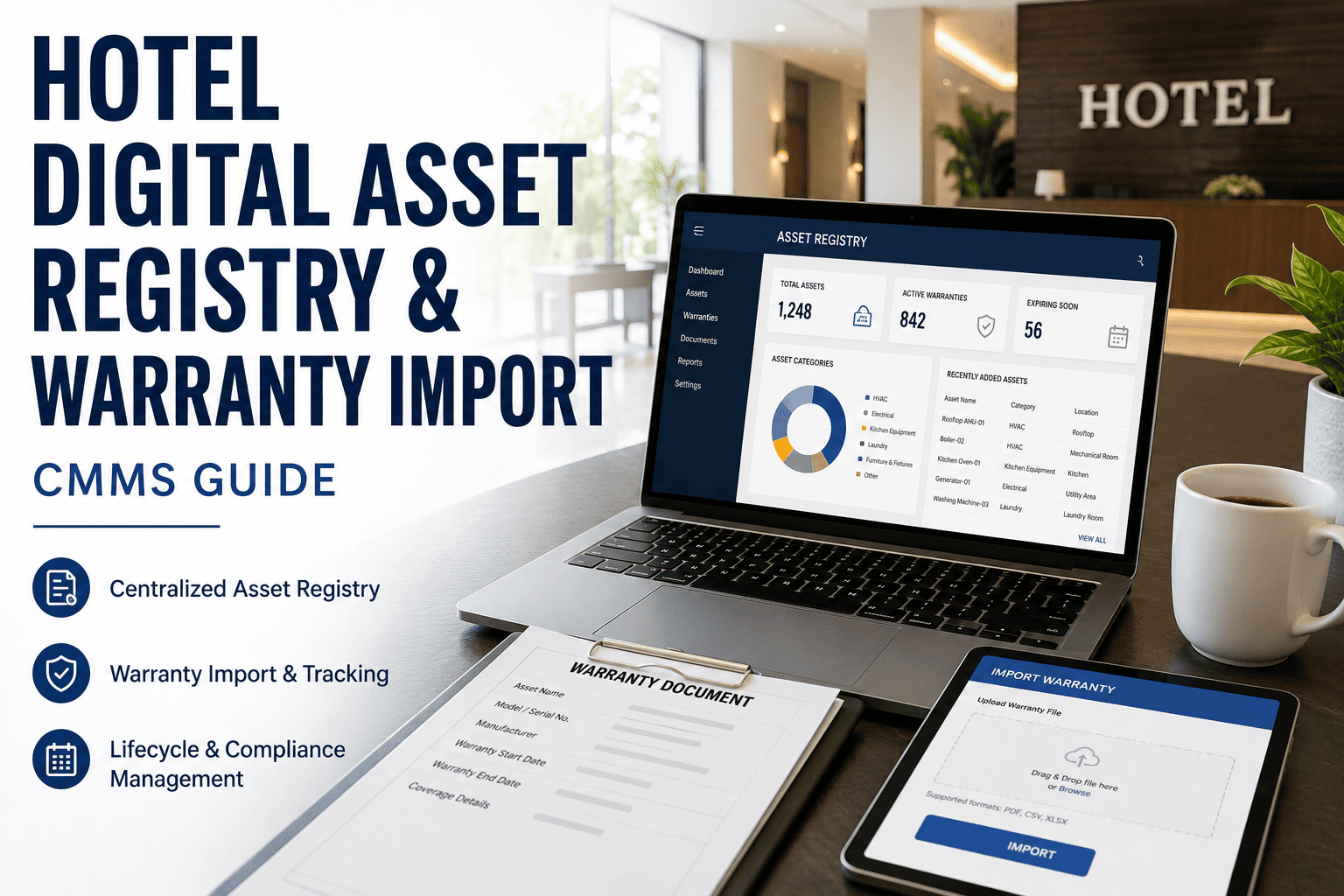
Build a complete hotel asset register with photos, maintenance history, warranty data, and QR codes. Technicians scan any piece of equipment on-site to access full service history and submit work orders instantly — eliminating the paper binder searches that waste 15–30 minutes per lookup in manual systems.
Automated PM Scheduling
Configure preventive maintenance schedules for every asset in your hotel — daily, weekly, monthly, or seasonal. Automated triggers replace whiteboard scheduling and ensure no PM task is missed during high-occupancy periods. Hotels running automated PM programs typically reduce emergency repairs by 70–80% and extend equipment lifespan by 20–30%.
Multi-Department Work Order Submission
Enable front desk, housekeeping, F&B, and security to submit maintenance requests digitally. Every request is tracked, assigned, prioritized, and closed with a full digital audit trail from any device. Cross-department digital submission eliminates the verbal handoff failures that account for the majority of lost work orders in hotel operations.
Real-Time KPI Dashboards
Track PM compliance rate, mean time to repair, work order aging, technician productivity, and maintenance cost per room in real time. Generate ownership-ready maintenance reports in one click — replacing the hours of manual data compilation that paper-based reporting requires every week.
Inspection Checklists & Photo Verification
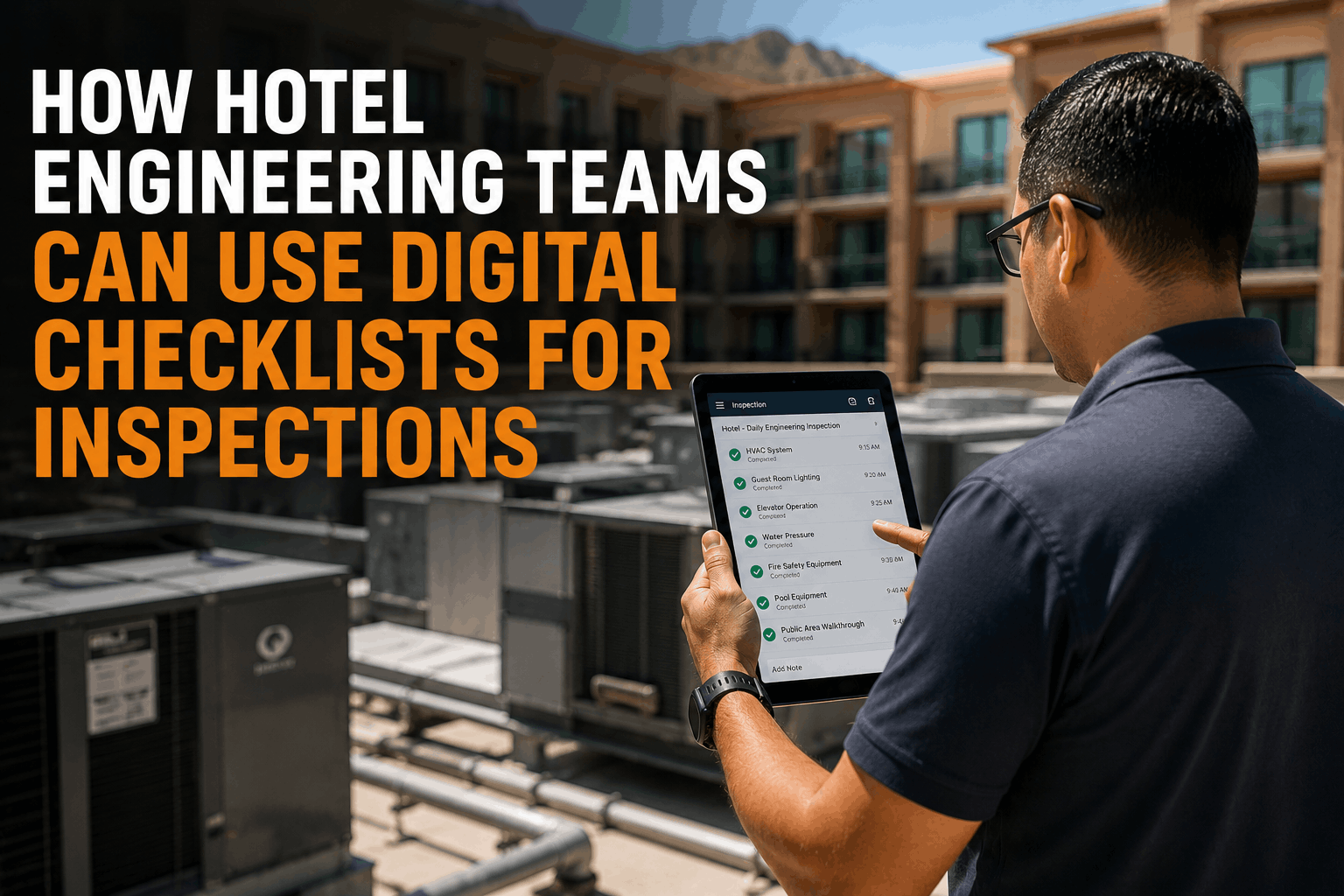
Assign structured inspection checklists to any work order or PM task. Require photo evidence before task closure — creating a visual, timestamped audit trail for every service event across your hotel. Photo verification ensures compliance accountability and provides documentation for insurance claims and brand standard reviews.
Vendor & Contractor Integration
Manage all hotel third-party maintenance providers in one platform — from compliance documents and SLA tracking to work order assignment and performance scorecards. Properties that centralize vendor management through CMMS typically reduce outsourced maintenance costs by 15–25% through consolidated service contracts and SLA enforcement.
Frequently Asked Questions About Hotel CMMS Implementation
Answers to the questions hotel engineering teams ask most before starting their hotel CMMS implementation and maintenance digitization journey.
How long does it realistically take to fully transition from paper to digital hotel maintenance?
For most hotels, a structured 90-day timeline is realistic and achievable without disrupting daily operations. The key is sequencing: Phase 1 (Days 1–30) focuses exclusively on asset inventory and system configuration. Phase 2 (Days 31–60) introduces digital work orders and PM scheduling. Phase 3 (Days 61–90) shifts to optimization and reporting. Smaller properties with 100–250 rooms often achieve basic functionality within 3–4 weeks, with full feature deployment by week 8–10.
Hotels that try to implement everything at once — asset management, work orders, PM, vendor tracking, and reporting simultaneously — typically see poor adoption rates and team frustration. The phased approach ensures your team builds confidence at each step before adding new workflows, which is why industry best practices consistently recommend this sequenced implementation methodology.
Do maintenance technicians need to be tech-savvy to use a hotel CMMS?
No. Oxmaint is designed specifically for hotel engineering teams — not IT departments. The mobile app is built around simple, task-focused workflows: scan a QR code, update a work order status, take a photo, mark complete. Most technicians are fully comfortable with core functions within their first week of use.
The learning curve is low because the app mirrors how technicians already think about their work — by room, by asset, by task. Training for basic work order and asset functions typically takes less than two hours. If your team can use a smartphone to take photos and send messages, they can use Oxmaint effectively from day one.
What happens to our existing paper maintenance records? Do we need to digitize everything?
You do not need to digitize your entire paper history before going live. The recommended approach is to upload the last 12 months of service records for critical assets — HVAC units, elevators, pool/spa equipment, and fire safety systems — and move forward digitally from there. This gives you enough historical context for PM scheduling without delaying your rollout.
For older records, scan and attach them as PDF documents to the relevant asset profiles in Oxmaint. Historical records become accessible and searchable without a full manual transcription project that can delay your CMMS rollout by weeks or even months. The most important step is establishing a clean digital baseline going forward.
How does hotel maintenance digitization affect our front desk and housekeeping teams?
For front desk and housekeeping, digital hotel maintenance simplifies their role in the workflow significantly. Instead of calling engineering verbally or using a paper log, they submit a digital request through a simple form — specifying the room, issue type, and urgency level. The entire process takes under 60 seconds.
They receive automatic status updates when the work order is accepted and closed. No follow-up calls, no risk of requests being lost in verbal handoffs, and no ambiguity about whether an issue was addressed before the next guest checks in. Training for non-engineering staff on the request submission workflow typically takes under 30 minutes, and most teams report immediate improvement in cross-department communication.
We're a smaller property (under 100 rooms). Is a hotel CMMS worth the investment?
Yes — particularly for smaller properties where one or two technicians manage the entire building. At this scale, paper systems create disproportionate risk: if your one experienced technician leaves, virtually all institutional knowledge walks out with them. A CMMS preserves that knowledge digitally and makes it available to any new hire from day one.
Digital hotel maintenance at smaller properties delivers outsized returns in three areas: preventing recurring issues from going untracked, making audit preparation fast rather than stressful, and enabling the property to scale maintenance without proportional headcount growth. Oxmaint's pricing scales with property size, making CMMS adoption accessible for independent and boutique hotels that need professional-grade maintenance management on a realistic budget.
How do we measure ROI from hotel maintenance technology after 90 days?
The most meaningful ROI metrics at the 90-day mark are PM compliance rate (target: 95%+), mean time to repair versus your pre-CMMS baseline, the reactive-to-preventive maintenance ratio, guest complaint volume related to maintenance issues, and maintenance cost per available room tracked month-over-month. These five metrics together give you a comprehensive picture of operational improvement.
Oxmaint's reporting dashboard surfaces all of these metrics automatically. Hotels that run a 90-day before/after comparison typically see measurable improvement in each area, with reactive maintenance cost reduction being the most immediately visible financial benefit. Industry benchmarks suggest that hotels implementing comprehensive CMMS solutions can reduce overall maintenance expenses by 25–35% within the first 12 months of full adoption.
Can the CMMS handle multiple properties or a hotel group?
Yes. Oxmaint supports multi-property management from a single account, allowing regional engineering managers or ownership groups to view performance data across all properties from a consolidated dashboard. This is essential for hotel management companies that need standardized maintenance practices and cross-property performance benchmarking.
Each property maintains its own independent asset register, work order queue, PM schedule, and vendor roster — while group-level reporting rolls up KPIs across the entire portfolio. This makes it straightforward to benchmark maintenance performance property-to-property, identify where additional resources or process improvements are needed, and report aggregated metrics to ownership groups or brand partners.
What if our team resists the change from paper to digital maintenance?
Resistance to hotel maintenance modernization is normal and usually stems from concern about added complexity and unfamiliarity with new technology. Both concerns are addressed directly through the phased implementation approach, which is specifically designed to build comfort incrementally rather than overwhelming the team with change.
The most effective strategy is to start with asset tagging in Phase 1 — a low-stakes activity that gets every technician using the mobile app before any workflow changes. Once the team is comfortable with the app, the transition to digital work orders feels like a natural next step rather than a disruptive overhaul. Involving the Chief Engineer and at least one experienced technician as internal champions during Phase 1 significantly accelerates team-wide CMMS adoption and reduces resistance from the broader maintenance crew.
Start Your 90-Day Hotel Digital Maintenance Journey Today
Oxmaint is designed for hotel engineering teams — not IT departments. Get your asset register started in under an hour and have your first digital work orders running within a week. Join the growing number of hospitality properties that are eliminating paper-based maintenance and driving measurable operational improvement.