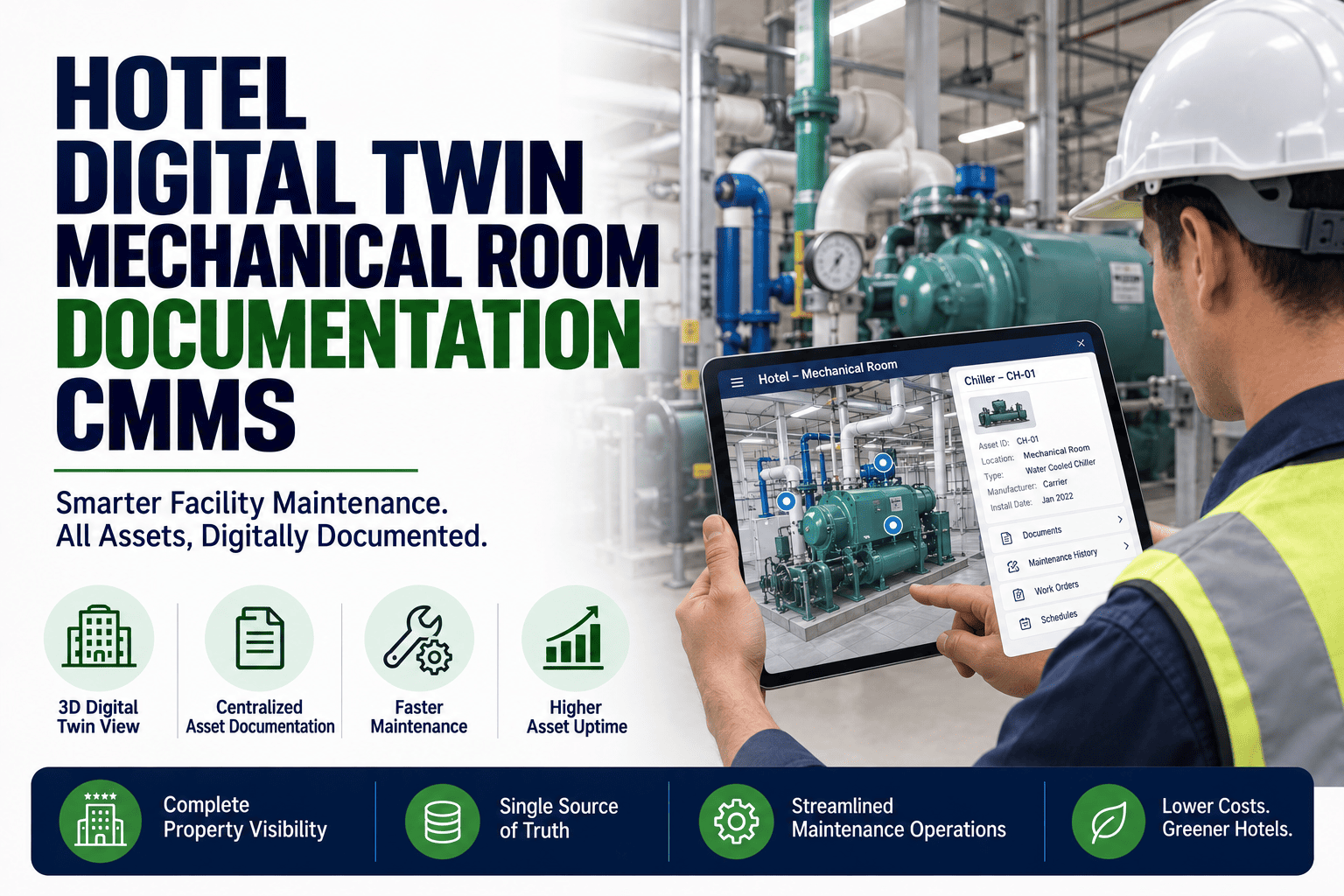
A 2 a.m. leak in a hotel's main mechanical room is not the time to learn that the isolation valve was re-piped three years ago and never re-labeled on the as-builts. Hotel digital twin mechanical room documentation closes that gap by pairing periodic 3D capture with asset location mapping, valve and panel labeling, and direct CMMS attachments — so every shift change inherits the same spatial truth. Properties that operationalize this workflow routinely cut mean-time-to-isolate by 40-60% and onboarding for new engineers from weeks to days. This guide walks through the capture cadence, labeling standards, and CMMS integration points that make mechanical room knowledge portable. Ready to digitize your first room? Start Free Trial and publish your first twin inside 14 days.
Can a new engineer find the isolation valve at 2 a.m. — without paging a senior tech?
A photo-accurate digital twin of your hotel mechanical room turns institutional knowledge into a portable, time-stamped asset. Every valve, panel, and pipe run is captured, labeled, and pinned directly to the work order it belongs to — so staff turnover never erodes what your building actually looks like behind the doors.
Four documentation layers that make a mechanical room twin actionable
A digital twin is only useful if a night-shift engineer can act on it without a phone call. These four layers — capture, mapping, labeling, and CMMS attachment — convert a 3D walkthrough into a maintenance-grade record aligned with ISO 55000 asset-information standards.
Photo-based 3D capture
Periodic 360° walkthroughs of the mechanical room, boiler plant, and riser shafts — captured quarterly or after any major retrofit. Each scan is time-stamped and stored as a comparable layer, so you can visually diff the room before and after a chiller swap.
Asset location mapping
Every pump, VFD, backflow preventer, and isolation valve is geotagged inside the twin and linked to its CMMS asset record. A new engineer clicks the asset tag in the 3D model and lands directly on the correct PM schedule, spec sheet, and work-order history.
Valve and panel labeling
Physical QR-coded tags are matched to digital callouts inside the twin. Scan the tag on the domestic-water isolation valve and the twin highlights its location, downstream zones affected, and the correct shut-order — critical for leak response and life-safety isolation.
CMMS attachments
The twin file, asset map, and labeled panorama are attached directly to the CMMS asset and work-order records — not stored on a shared drive. When a work order opens, the technician sees the room exactly as it was last captured, with the problem asset already highlighted.
A 12-month timeline for keeping the twin honest
A digital twin decays the day a contractor re-pipes a return line and nobody updates the model. This cadence — modeled on a 220-key full-service property with a central plant and three remote fan-coil closets — keeps the twin within 5% of reality at any given inspection.
Baseline full capture
Complete 3D scan of the main mechanical room, boiler room, chiller plant, and all riser shafts. Tag every asset, label every isolation valve, and attach the baseline twin to all CMMS asset records. Target: 100% of mechanical assets mapped within 30 days.
Quarterly verification sweep
A 2-hour walkthrough comparing the twin to current conditions. Focus on anything that changed since Month 1 — replaced actuators, re-routed condensate lines, added BMS sensors. Update asset tags and re-attach revised views to affected CMMS records.
Mid-year full re-capture
Second full 3D scan, stored as a comparable time layer. Run a visual diff against Month 1 to catch undocumented modifications — a common finding after summer HVAC retrofits. Attach the new layer to the asset history timeline in the CMMS.
Pre-winter isolation audit
Verify every heating-system isolation valve, PRV, and expansion tank is labeled, accessible, and matches the twin. Confirm shut-order documentation for freeze-response scenarios. This is the layer your night-shift engineer will rely on when a domestic-hot-water leak hits in January.
Annual archival + re-baseline
Archive the year's four capture layers as a time-sequenced condition record — valuable for insurance, capital planning, and ISO 55000 compliance. Re-baseline the twin for the next year, carrying forward any permanent modifications. The archived layers become a defensible asset-history timeline.
What a 180-room hotel loses without a documented twin
The math on institutional knowledge loss is unforgiving. Below is a worked scenario for a 180-key property with a central plant, two remote mechanical closets, and a 55% engineer turnover rate over three years — a profile common to upscale urban hotels.
Based on 6 field engineers averaging 2 hours/week searching for undocumented valves, panels, and shut-offs — at a $61.50 loaded rate including benefits. Excludes guest-room downtime and after-hours call-in premiums.
A documented twin pays for itself the first time a new engineer isolates a domestic water leak in 18 minutes instead of 90 — at 2 a.m., with no phone call to the director of engineering.
— Scenario modeled on a 180-key urban upscale property, central plant configurationWhy static as-builts fail the 2 a.m. test
Paper as-builts and PDF riser diagrams are the industry default — and they are almost always wrong by the time a property is five years old. Here is how a CMMS-attached digital twin compares across the dimensions that matter during a fault response.
| Capability | Static as-builts / PDFs | CMMS-attached digital twin |
|---|---|---|
| Time to locate an isolation valve at night | 30–90 minutes, often requires a call | Under 5 minutes, no call needed |
| Accuracy after a retrofit | Drifts immediately; rarely updated | Re-captured quarterly; stays within 5% |
| Linked to CMMS work orders | Stored on a shared drive, detached | Attached directly to asset + work order |
| Time-sequenced condition history | Single snapshot, no diff capability | Layered captures; visual diff between dates |
| Onboarding time for a new engineer | 3–6 weeks of shadowing | 2–5 days to reach independent response |
| Insurance / ISO 55000 defensibility | Weak; undated, unverified | Strong; time-stamped, auditable layers |
Publish your first mechanical room twin in 14 days
Capture, label, and attach a CMMS-ready digital twin of your hotel's main mechanical room — before the next night-shift emergency makes you wish you had.
Hotel mechanical room digital twin — what teams actually ask
How often should a hotel re-capture the mechanical room twin?
Quarterly verification sweeps with a full re-capture every six months is the defensible standard for a full-service property. Any time a contractor modifies piping, controls, or equipment, the affected area should be re-scanned within 14 days and the revised view re-attached to the CMMS asset record. Properties in active capex cycles may need monthly spot-captures of the modified zones.
What equipment is needed for the initial 3D capture?
A commercial 360° camera or a structured-light scanner is sufficient for most hotel mechanical rooms — you do not need survey-grade LiDAR. The deliverable is a navigable, photo-accurate walkthrough with embedded asset tags, not a millimeter-precise BIM model. Most properties complete a baseline capture in 4–8 hours of field time depending on room count and complexity. You can Book a Demo to see a sample capture workflow.
How does the twin attach to our existing CMMS?
The twin file, labeled panoramas, and asset-location map are attached directly to the corresponding asset and work-order records inside the CMMS — not stored on a separate shared drive. When a technician opens a work order, the most recent capture of the relevant mechanical space loads alongside the PM checklist, spec sheet, and fault history. This is what makes the documentation portable across shift changes.
What does a labeled valve look like inside the twin?
Each isolation valve, PRV, and panel carries a physical QR tag on-site and a matching digital callout inside the 3D model. The callout shows the asset ID, the system it serves (e.g., domestic hot water return), the downstream zones affected if closed, and the correct shut-order for emergency isolation. Scanning the on-site tag pulls up the same record on a phone — so field and office stay synchronized.
Is this defensible for insurance and ISO 55000 compliance?
Yes — the time-stamped, layered capture history is exactly what asset-information standards under ISO 55000 look for. Each capture is dated, attributable, and stored as part of the asset's condition record. Insurers increasingly ask for documented evidence of mechanical-room condition and maintenance access; a time-sequenced twin with CMMS-linked asset tags is a stronger evidentiary artifact than a static as-built PDF. Start building yours with a Start Free Trial.
Stop losing mechanical room knowledge to staff turnover
Capture your hotel's mechanical room as a CMMS-attached digital twin — label every valve, map every asset, and give your night-shift engineer the answer before they need to ask.
Free 14-day trial · No credit card