Commercial HVAC service contracts operate in a different universe than residential agreements. A single office building may have 15-50 rooftop units, multiple air handling systems, a chiller plant, a boiler room, and a building management system — all requiring coordinated maintenance across different schedules, skill requirements, and compliance standards. A hospital or data center adds even more complexity: 24/7 uptime requirements, strict temperature and humidity tolerances, regulatory inspections, and penalties for non-compliance. The commercial HVAC sector makes up roughly 30% of the overall HVAC market (Grand View Research), and in 2024, preventive maintenance dominated commercial service demand with 38% market share as facility managers prioritize reducing unplanned outages and extending equipment life. More than 60% of U.S. commercial buildings have now adopted IoT-enabled predictive maintenance systems. Commercial contracts deliver the highest margins in the HVAC business — approximately 40% gross margin compared to 24% for installation work — but only if they're managed with the sophistication these accounts demand.
Managing commercial contracts means juggling multi-site portfolios, SLA compliance tracking, equipment asset registries spanning hundreds of units, complex billing structures with annual escalation clauses, and coordinated scheduling across specialized technician teams. A spreadsheet can't do this. A residential-focused tool can't do this. You need purpose-built contract management software. Oxmaint CMMS gives commercial HVAC contractors the infrastructure to manage complex service agreements — from multi-site asset tracking and SLA monitoring to automated PPM scheduling, contract profitability analysis, and compliance documentation. Schedule a demo.
One Platform to Manage Them All.
What Makes Commercial Contracts Different
Residential agreements are simple: one home, one or two units, two visits per year, flat annual price. Commercial contracts have an entirely different complexity profile that demands purpose-built management tools:
Asset Scale
1-2 units per customer → 15-500+ units per site, multiple sites per customer. Each unit has different make/model, age, refrigerant type, and service requirements. The asset registry alone can run hundreds of lines.
SLA Requirements
Best-effort response → Contractual response time guarantees (2-4 hour emergency, 24-hour standard). Financial penalties for SLA breaches. Uptime guarantees (99%+ for critical facilities). Documented escalation procedures.
Service Complexity
Seasonal tune-ups → Monthly/quarterly PPM with detailed checklists per equipment type. Chiller maintenance, cooling tower treatment, BMS calibration, economizer testing, exhaust system balancing, refrigerant management, and filter programs across dozens of unit types.
Billing Structure
Flat annual/monthly fee → Per-unit pricing, per-ton pricing, tiered service levels per building, annual escalation clauses (CPI-linked), separate emergency call rates, parts markup schedules, and multi-year contract terms with renegotiation windows.
Compliance & Reporting
Minimal documentation → Refrigerant tracking (EPA Section 608), leak rate reporting, energy efficiency documentation, indoor air quality records, ASHRAE compliance, fire/life safety system inspection records, and formal quarterly/annual performance reports to facility managers.
Stakeholder Management
Single homeowner decision → Facility managers, property managers, building engineers, procurement departments, tenant coordinators, and C-suite approvers. Different contacts for scheduling, billing, escalation, and renewal decisions.
Built for Commercial Complexity, Not Residential Simplicity
Oxmaint handles multi-site portfolios, per-unit asset tracking, SLA monitoring, complex billing structures, and compliance documentation — everything commercial HVAC contracts demand.
Commercial Contract Tiers: Structuring Service Levels
The most successful commercial HVAC contractors offer three-tier service structures that let customers choose their level of coverage and commitment. Each tier must be precisely defined in the contract and trackable in your software:
Inspection & PM
Full Service
Comprehensive
The Commercial Asset Management Challenge
A single commercial customer can have more equipment than 50 residential customers combined. Your software must maintain a complete asset registry for every contracted site:
Track Every Unit, Every Site, Every Service Visit
Oxmaint's asset registry links every piece of equipment to its contract, maintenance schedule, service history, and compliance records — across unlimited sites and hundreds of units per customer.
SLA Compliance: The Make-or-Break for Commercial Contracts
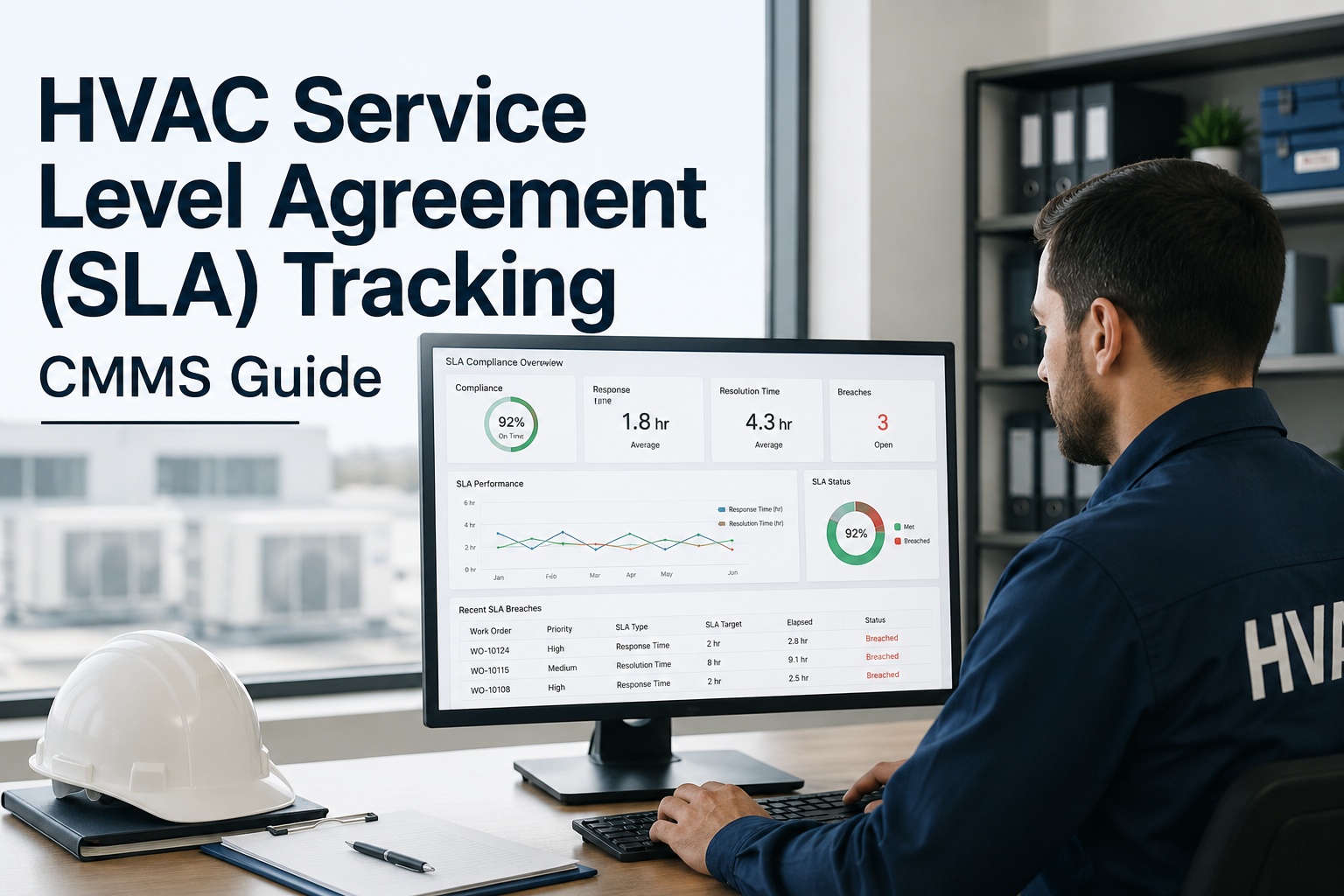
Commercial clients pay premium rates because they expect guaranteed service levels. Missing an SLA doesn't just risk a penalty — it risks losing the entire contract. Your software must track and enforce these commitments:
Response Time SLA
Guaranteed time from customer call to technician on-site. Tier 1: 8 hours. Tier 2: 4 hours. Tier 3: 2 hours. Software must timestamp the service request, dispatch, arrival, and completion. Track SLA compliance rate per contract — target 95%+ achievement. Automated escalation when approaching SLA deadline.
Uptime Guarantee
For critical facilities (data centers, hospitals, labs), contracts guarantee system uptime — typically 99%+ for the overall HVAC system. Track actual uptime vs. guaranteed uptime. Document all downtime events with root cause analysis. Calculate financial exposure for SLA breaches.
PPM Completion
Every contracted preventive maintenance visit must be completed within the scheduled window. Track completion rates per site, per equipment type, per technician. Overdue PPM visits should trigger automatic alerts and escalation. Commercial clients expect 100% PPM completion — anything less is a contract breach.
Reporting & Documentation
Facility managers require formal performance reports — monthly, quarterly, or annually depending on the contract. Reports must include: visits completed vs. scheduled, SLA compliance metrics, equipment condition summaries, energy efficiency trends, compliance certifications, and capital planning recommendations.
Contract Profitability: Know Your Numbers
Commercial contracts are only valuable if they're profitable. Higher revenue per contract also means higher risk if costs aren't tracked. Your software must calculate true profitability per contract:
Frequently Asked Questions
What should a commercial HVAC service contract include?
A comprehensive commercial HVAC service contract must define: Scope of services — specific maintenance tasks per equipment type (RTU, AHU, chiller, boiler, cooling tower, VAV, BMS), with detailed checklists for each; Equipment inventory — complete asset list with make, model, serial number, tonnage/capacity, refrigerant type, and installation date for every covered unit; Service frequency — PPM visit schedule per equipment type (monthly, quarterly, semi-annual, annual) with specific seasonal requirements; SLA terms — guaranteed response times for emergency calls (2-8 hours depending on tier), uptime guarantees for critical facilities, and financial penalties for SLA breaches; Pricing structure — per-unit rates, what's included vs. billable, parts markup schedule, emergency call rates, and annual price escalation clauses; Reporting requirements — format, frequency, and content of performance reports to the facility manager; Compliance obligations — EPA refrigerant tracking, ASHRAE compliance, fire/life safety inspections, and indoor air quality documentation; Contract term — duration (typically 1-3 years for commercial), renewal and termination procedures, and renegotiation windows.
How do you price commercial HVAC maintenance contracts?
Commercial HVAC contract pricing should be built from fully burdened costs, not guesswork: Calculate labor cost per visit — number of technician hours required × fully burdened labor rate (including benefits, insurance, vehicle, tools) for each equipment type and each visit type; Estimate parts and materials — filters, belts, lubricants, refrigerant, and consumables per visit based on equipment type and historical usage; Factor equipment age and condition — older equipment (10+ years) requires more service time and generates more emergency calls; Add overhead allocation — scheduling, administration, account management, and compliance documentation time; Apply target margin — 40%+ gross margin for standard contracts, potentially lower (30-35%) for large multi-site portfolio contracts where volume compensates; Structure the pricing — per unit per year is most common for commercial, though per-ton pricing is used for chiller plants. Typical ranges: $500-$800/unit/year for inspection-only, $800-$1,500 for full service, $1,500-$2,500+ for comprehensive all-inclusive. Always include annual price escalation (3-5% or CPI-linked) in multi-year contracts. Factor in rooftop access complexity and hours of operation when quoting.
How is commercial HVAC contract management different from residential?
Commercial contracts differ from residential in virtually every dimension: Asset scale — a single commercial site may have 15-500+ individual units versus 1-2 for residential, requiring a comprehensive asset registry with equipment-specific maintenance protocols; SLA requirements — commercial contracts include legally binding response time guarantees, uptime commitments, and financial penalties that don't exist in residential; Service complexity — commercial maintenance includes chillers, cooling towers, BMS systems, economizers, and VAV systems that residential technicians never encounter, requiring specialized skills and certifications; Billing — commercial uses per-unit or per-ton pricing with annual escalation clauses, multi-year terms, and complex discount structures versus simple flat-fee residential plans; Compliance — commercial contracts require EPA refrigerant tracking, ASHRAE compliance documentation, energy reporting, and formal performance reports that are minimal or absent in residential; Stakeholders — commercial involves facility managers, property managers, procurement departments, and building engineers versus a single homeowner decision-maker. Your CMMS must handle all of these differences natively.
What software features are essential for commercial HVAC contract management?
Essential commercial HVAC contract management features include: Multi-site asset management — track hundreds of units across multiple locations per customer, each with unique specifications, service history, and maintenance schedules; SLA tracking and enforcement — automated timestamping of service requests, dispatch, arrival, and completion, with real-time SLA compliance dashboards and escalation triggers when approaching deadlines; Automated PPM scheduling — generate recurring work orders per equipment type at the correct frequency, assigned to technicians with the right certifications; Contract profitability analysis — track actual labor hours, parts consumption, and costs against contract revenue to measure margin per agreement; Compliance documentation — refrigerant tracking logs, inspection checklists per equipment type, and compliance report generation; Client reporting — automated generation of quarterly/annual performance reports showing visits completed, SLA metrics, equipment condition, and recommendations; Mobile field execution — equipment-specific digital checklists, barcode/QR scanning for unit identification, photo documentation, and real-time work order updates; Renewal and billing management — automated renewal workflows, complex billing structures, escalation clause calculations, and integration with accounting software.
How do you ensure SLA compliance on commercial HVAC contracts?
SLA compliance requires systematic tracking and proactive management: Automated timestamping — every service request, dispatch decision, technician arrival, and job completion must be automatically time-stamped by the software to create an indisputable compliance record; Real-time dashboard — dispatchers need a live view of all open service requests with SLA countdown timers showing time remaining before breach; Escalation rules — when a service request reaches 50% of its SLA window without dispatch, automatically escalate to a supervisor; at 75%, escalate to the operations manager; at 90%, trigger emergency dispatch procedures; Technician availability — maintain visibility into which technicians are available, where they are, and what certifications they hold for the specific equipment type; Preventive scheduling — most SLA breaches occur because emergency calls overwhelm the team during peak periods, so robust PPM programs that prevent breakdowns are the best SLA protection; Monthly SLA reporting — track compliance rate per contract (target 95%+), analyze breach patterns (time of day, equipment type, season), and implement corrective actions. Regular maintenance can reduce downtime by 35-45% and minimize unexpected breakdowns by up to 75% (Trane), which directly improves SLA achievement.
Manage Commercial Contracts Like the Professionals You Are
Join commercial HVAC contractors using Oxmaint to manage multi-site portfolios, track SLA compliance, monitor contract profitability, and deliver the documentation your facility manager clients demand.