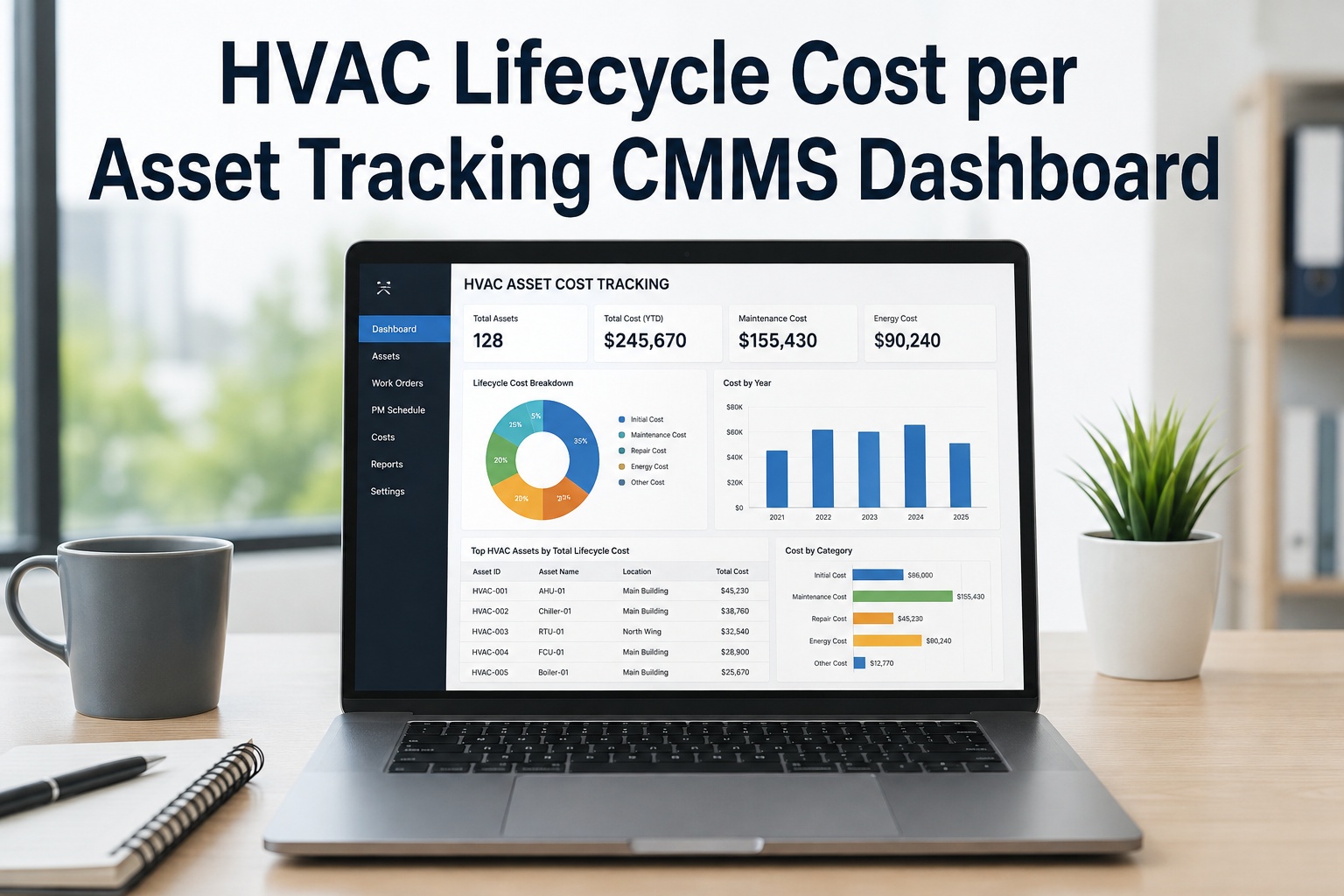
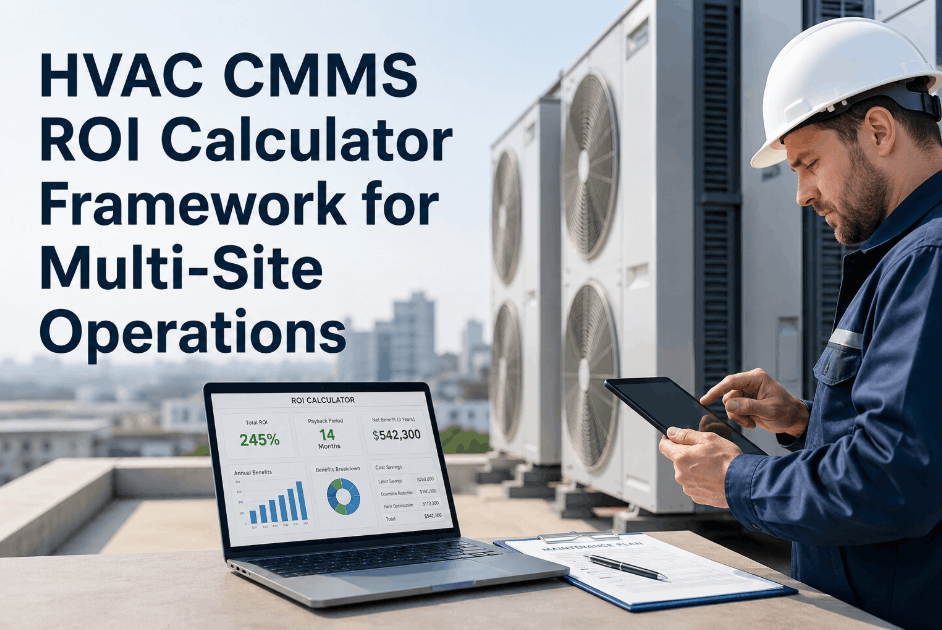
Most HVAC maintenance teams already know that a CMMS would reduce their costs — the challenge is proving it to the people who control the capital budget. Finance directors and operations VPs do not approve software investments based on operational intuition. They approve them based on numbers: payback period, year-one return, and the specific cost lines being reduced. This guide gives HVAC maintenance managers and facilities directors the complete framework for calculating HVAC CMMS ROI — the metrics that matter, the formula that works, the benchmarks to compare against, and the business case structure that gets budget approved.
See Your Facility's CMMS ROI in 30 Minutes
OxMaint's Analytics Dashboard gives HVAC teams real-time visibility into downtime costs, maintenance labour spend, energy variance, and asset performance — the exact data inputs your ROI calculation needs.
The HVAC CMMS ROI Formula — Visualised
Every credible CMMS business case starts with the same fundamental equation. The formula below is the structure your finance team will recognise and accept — populate each input with your facility's actual numbers and the output is a defensible ROI figure ready for budget presentation.
The Five Saving Streams That Drive HVAC CMMS ROI
HVAC CMMS return on investment does not come from a single source — it accumulates across five distinct cost categories, each of which compounds the others. Understanding all five is essential for building a complete business case. Sign up free to see OxMaint's Analytics Dashboard quantify each saving stream for your facility from day one.
CMMS ROI Benchmarks: What HVAC Teams Are Actually Achieving
The benchmarks below are drawn from commercial and industrial HVAC maintenance programmes that have transitioned from reactive-only maintenance to structured CMMS-driven reliability. The ROI ranges reflect variation in facility size, equipment age, baseline maintenance maturity, and the depth of CMMS programme implementation. Book a demo to see how these benchmarks apply to your specific portfolio.
| ROI Metric | Reactive Baseline | CMMS-Driven Result | Typical Saving (Year 1) |
|---|---|---|---|
| Unplanned Downtime Events | 12–20 events per quarter | 4–8 events per quarter | 35–50% reduction — £18,000–£95,000 saved |
| Energy Cost per Conditioned m² | Baseline 100% (index) | 75–85% of baseline | 15–25% reduction — £8,000–£40,000 saved |
| Maintenance Labour Hours per Asset | 48–72 hrs/asset/year | 32–50 hrs/asset/year | 20–35% reduction — £12,000–£55,000 saved |
| Emergency Call-Out Events | 8–14 per month | 2–5 per month | 60–75% reduction — £15,000–£60,000 saved |
| PM Compliance Rate | 52–68% | 88–96% | Compliance uplift drives all other savings |
| Mean Time to Repair (MTTR) | 4.2–7.8 hours | 1.6–3.2 hours | 55–65% faster — reduces occupant disruption cost |
| Parts Emergency Procurement | 8–14 events/month at 2.8× cost | 2–4 events/month at standard cost | 60–75% premium eliminated — £6,000–£28,000 saved |
| CMMS ROI Payback Period | Not applicable | 6–14 months (median: 9 months) | Full investment recovered within year one |
Payback Period by Facility Type and Portfolio Size
Payback period varies significantly based on three factors: the size of the maintenance budget being optimised, the current baseline maturity of the maintenance programme, and the depth of CMMS features deployed. The visualisation below shows typical payback ranges for the most common HVAC-intensive building categories.
Step-by-Step: How to Build Your HVAC CMMS ROI Calculation
The calculation below is structured to produce a number your finance team will find credible — because it starts from your actual cost data, not from vendor-supplied assumptions. Work through each step in order. Sign up free to access OxMaint's Analytics Dashboard, which pre-populates most of these inputs from your live maintenance data.
Establish Total Current Maintenance Spend — All Categories
Pull your last 12 months of maintenance cost data across five categories: (1) planned maintenance labour — technician time on scheduled PMs; (2) reactive maintenance labour — call-out, overtime, emergency response; (3) parts and materials — both planned procurement and emergency spot orders; (4) energy cost — your HVAC systems' share of the total utility bill; (5) compliance and audit cost — time and resource spent preparing and responding to regulatory and landlord inspections. This total is your baseline. Most facilities find this number 20–40% higher than their line-item maintenance budget once hidden costs are fully accounted.
Multiply Each Cost Category by Its CMMS Improvement Rate
Apply the following conservative improvement rates to each cost category from Step 1: reactive labour × 45% reduction; emergency parts premium spend × 60% reduction; energy cost × 18% reduction; planned labour × 25% reduction (productivity gain); compliance cost × 65% reduction. Use the lower end of each range for a conservative projection — conservative estimates survive scrutiny better than optimistic ones and still typically produce compelling ROI figures. Sum the five savings figures to produce your projected annual saving.
Build the Full Cost of Ownership — Not Just the Licence Fee
The total CMMS investment has four components: (1) annual software licence — typically £3–£15 per asset per month depending on platform and feature tier; (2) implementation cost — data migration, system configuration, and asset record setup, typically a one-time cost equivalent to 2–4 months of the annual licence; (3) training cost — technician and manager onboarding, typically 8–16 hours total; (4) integration cost — connecting to your BMS, energy monitoring, or FM system if required. Year-one cost is higher than subsequent years due to the one-time implementation element. Present year-one cost separately from year-two-and-beyond cost to show the payback trajectory clearly.
Divide Total Year-One Investment by Monthly Saving Rate
Payback period in months = (Total year-one CMMS investment) ÷ (Annual projected saving ÷ 12). Example: £42,000 investment ÷ (£180,000 annual saving ÷ 12) = £42,000 ÷ £15,000 = 2.8 months. Note that this calculation assumes savings accrue linearly from month one — a conservative assumption that is acceptable for presentation purposes, but you should disclose that full savings are typically realised from month 3–4 onward as PM compliance builds and technician adoption reaches full velocity.
Show Year 1, 2, and 3 Net Benefit — Finance Teams Think in Cycles
Present the ROI calculation as a 3-year cumulative model: Year 1 net benefit = Annual saving minus full implementation + licence cost. Year 2 net benefit = Annual saving minus licence-only cost (no implementation). Year 3 = same as Year 2. Cumulative 3-year net benefit is the number most finance directors use for software investment decisions. For a typical 100-asset HVAC portfolio, the 3-year cumulative net benefit after all CMMS costs is £320,000–£480,000. This framing converts the conversation from "cost of the software" to "cost of not having the software."
What OxMaint's Analytics Dashboard Measures — The ROI Evidence Engine
The most common reason HVAC CMMS ROI calculations fail to get approved is not the numbers — it is the credibility of the data behind the numbers. OxMaint's Analytics Dashboard provides the live, auditable data that makes your ROI calculation defensible rather than estimated. Book a demo to see the dashboard configured for your portfolio's asset types and cost structure.
Real-Time Downtime Cost Tracking
Every unplanned failure is logged with asset ID, failure mode, time to respond, time to repair, and estimated production or occupancy impact. The dashboard aggregates this data into a monthly downtime cost figure using your facility's cost-per-hour input — the most compelling single number in any HVAC CMMS ROI presentation.
PM Compliance Rate vs Failure Correlation
The dashboard plots PM completion rate against failure frequency by asset — showing directly whether PM compliance changes failure rates. This correlation is the most powerful evidence that your maintenance activity is producing measurable reliability outcomes, not just generating paperwork.
Labour Cost by Work Order Type
Maintenance labour hours are split automatically between planned PM, reactive response, and corrective maintenance — enabling before/after comparison of the reactive-to-planned ratio over time. This ratio is the single most intuitive indicator of CMMS programme maturity for non-technical stakeholders.
Energy Variance Monitoring per Asset
HVAC energy consumption per asset is tracked against its baseline — assets consuming above baseline trigger alerts and are flagged in the dashboard. This converts energy efficiency from an estimated saving to a measured one: you know which units are degraded, how much extra energy they are using, and how much the repair saved.
Parts Cost and Emergency Procurement Tracking
Every parts transaction is recorded at work order level — enabling split of standard procurement from emergency spot orders. The premium cost of emergency procurement is calculated and surfaced monthly, giving you a running total of the parts-premium cost that structured inventory management is eliminating.
Asset Health Score and Lifecycle Projection
Each HVAC asset receives a health score based on maintenance history, failure frequency, age, and PM compliance. The dashboard projects expected remaining useful life per asset — enabling capital expenditure planning that distinguishes between assets that need replacement now and assets that can be maintained for another 5–8 years with targeted PM.
Build Your HVAC CMMS Business Case with Real Data
OxMaint's Analytics Dashboard gives maintenance managers the downtime costs, labour split, energy variance, and parts premium data needed to construct a CMMS ROI calculation that finance directors will approve — not estimate from vendor benchmarks, but calculate from your own live facility data.
Frequently Asked Questions: HVAC CMMS ROI
QWhat is a realistic ROI expectation for an HVAC CMMS in year one?
For most commercial HVAC operations transitioning from reactive-only to CMMS-managed maintenance, a realistic year-one ROI is 150–300%. This means for every £1 spent on the CMMS, you recover £1.50–£3.00 in year one from reduced downtime, lower energy costs, labour efficiency gains, and eliminated emergency parts premiums. The variance in this range is driven primarily by two factors: the size of the reactive maintenance spend in your baseline (higher baseline reactive spend = higher CMMS saving), and how quickly PM compliance builds during the first 6 months. Programmes that reach 85%+ PM compliance within the first quarter consistently achieve the upper end of this range.
QHow long before we see measurable results from HVAC CMMS implementation?
The first measurable results typically appear within 30–60 days: parts availability improves immediately as minimum stock levels are set, and emergency call-out volume begins falling as PM schedules are activated. Labour efficiency gains from mobile work order dispatch are visible within the first month. Energy savings and MTBF improvements develop more gradually — typically 3–6 months for energy variance improvements to be statistically measurable, and 4–8 months for MTBF improvements to be clearly attributable to the new PM programme rather than random variation. Full programme ROI, combining all five saving streams, is typically measurable at the 6–9 month mark.
QIs energy saving really measurable as part of HVAC CMMS ROI?
Yes — and it is one of the most consistently demonstrable saving streams once the methodology is correct. The key is measuring energy consumption per individual HVAC asset before and after its PM programme is brought into compliance, rather than looking at site-level energy totals which are influenced by occupancy, weather, and other variables. HVAC units with degraded coils, low refrigerant, or blocked filters typically consume 20–40% more energy than the same unit in properly maintained condition. OxMaint's energy variance monitoring tracks individual asset energy draw against its baseline — so the saving from each PM event is directly measurable rather than estimated. For a 200-room hotel, this typically amounts to £8,000–£22,000 per year in measurable energy saving attributable directly to HVAC maintenance improvement.
QHow does CMMS ROI differ for a portfolio of buildings versus a single facility?
Portfolio deployments typically produce higher ROI percentages than single-facility deployments for three reasons. First, the platform cost per asset decreases as portfolio size grows — the licence cost does not scale linearly with asset count. Second, cross-portfolio benchmarking enables you to identify the highest-cost and lowest-performing assets across buildings and concentrate improvement effort on the facilities where the saving opportunity is greatest. Third, portfolio-level reporting consolidates the compliance and audit documentation burden that currently requires per-building effort into a single reporting layer. The most common ROI amplifier in portfolio deployments is contractor management: a CMMS gives the facilities team the data to verify contractor invoices against work orders and challenge rate variances that would previously go undetected — which typically saves 8–14% of total contractor spend.
QWhat is the biggest reason HVAC CMMS ROI calculations fail to get approved?
The most common reason is not the ROI number itself — it is the quality of the baseline data used to derive it. A CMMS ROI calculation built on estimated or assumed cost inputs will be challenged successfully in any competent financial review. The calculation that gets approved is built from your own historical cost data — actual reactive labour invoices, actual emergency parts receipts, actual energy bills, actual downtime records — with conservative improvement rates applied. The second most common reason for rejection is presenting only the licence cost as the investment, without including implementation and training. Finance teams expect total cost of ownership, and if your calculation omits it, they will ask and your projection will look less rigorous. Use OxMaint's Analytics Dashboard to build the calculation from live data from day one — the credibility difference between "we estimate our reactive cost is X" and "our CMMS shows our reactive cost was X last quarter" is the difference between approval and deferral.