HVAC Maintenance Guide 2026: Complete System Maintenance for Commercial & Residential HVAC
By Liam Neeson on March 25, 2026
Your HVAC system accounts for 40% of your building's total energy bill — the single largest operating expense under your roof. A neglected system consumes 20% more energy, fails 3 to 5 times more expensively, and dies 8 to 10 years earlier than a maintained one. Preventive maintenance delivers a documented 545% return on every dollar invested, reduces unplanned downtime by 73%, and extends equipment life from 12 years to over 20. This guide covers monthly checklists, seasonal schedules, commercial vs residential cost differences, and the top failure points to prevent — everything you need to run a complete HVAC maintenance program in 2026. Sign up free on OxMaint to automate every schedule in this guide, or book a demo to see how preventive maintenance tracking works on your system type today.
Stop reacting to HVAC failures. Start preventing them with automated PM schedules.
OxMaint's Preventive Maintenance platform auto-schedules every task in this guide, assigns them to the right technician, and tracks completion — so nothing is missed and every service is documented.
Reactive vs Preventive: The Numbers That Settle the Debate
Most facility managers discover their true HVAC spend only after an emergency breakdown. By then, the bill is 3 to 5 times what a scheduled visit would have cost — plus expedited parts, emergency labor premiums, and tenant disruption on top.
The True Cost Gap: Reactive vs Preventive HVAC Maintenance
Same system, same building — two completely different 5-year cost outcomes
Reactive Maintenance
Equipment Lifespan
10–12 years
Emergency Repair Premium
1.5× – 3× rates
Energy Waste vs Maintained
+20% annual
Unplanned Downtime
Unpredictable
5-Year Total Cost
3–5× higher
Single rooftop unit failure during summer: $8,000–$18,000+ all-in
How Neglected HVAC Components Silently Drain Your Energy Budget
Dirty Condenser Coil
+30%
Energy consumption increase
Duct Leakage
15–30%
Conditioned air lost before delivery
Clogged Filters
+15–20%
Fan energy increase per cycle
Uncalibrated Controls
12–18%
Excess energy from bad scheduling
Section 02
Complete HVAC Maintenance Checklist by Frequency
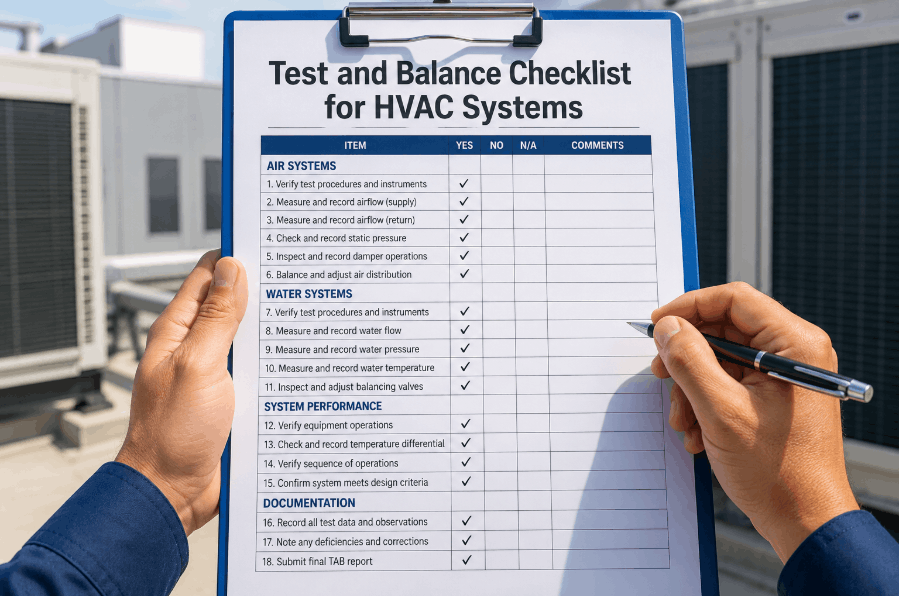
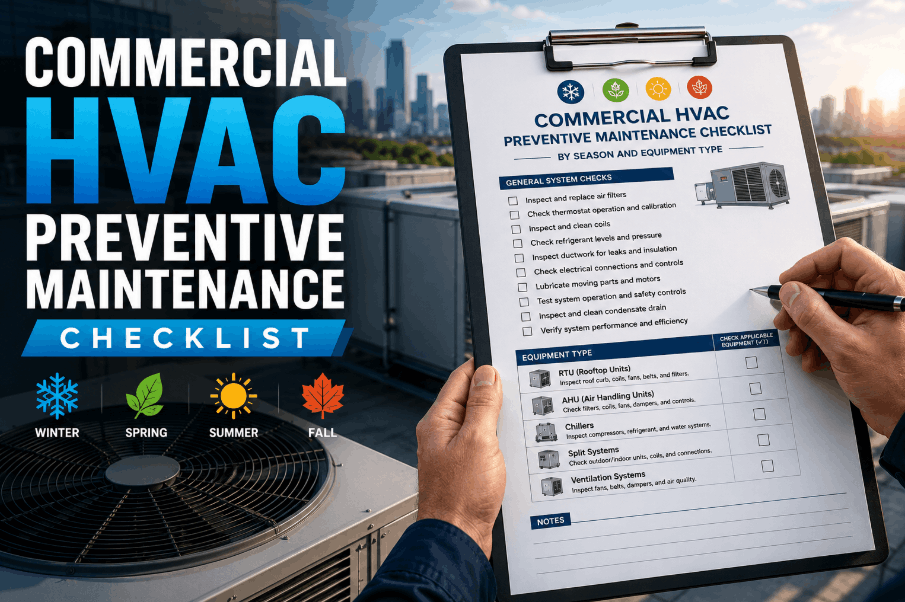
Effective HVAC maintenance is not one annual visit. It is a layered program of tasks performed monthly, quarterly, and annually — each addressing different degradation timelines and failure modes. Use this checklist as your standard template for both commercial and residential systems.
Monthly
Quick checks — prevent gradual performance loss
Inspect and replace air filters (1–3 inch filters: monthly; 4–5 inch: quarterly)
Check thermostat operation and calibration against actual room temperature
Inspect condensate drain pan for standing water or blockage
Listen for unusual vibration, noise, or cycling irregularities
Verify supply and return vents are unobstructed
Check outdoor unit clearance — minimum 2 feet of clear space
Quarterly
System-level inspection — catch wear before it fails
Clean evaporator and condenser coils — dirty coils add 30% to energy use
Inspect all electrical connections and tighten loose terminals
Check refrigerant levels and inspect for leaks (certified technician required)
Lubricate blower motor bearings and fan shaft
Inspect and tension drive belts — replace if cracked or glazed
Flush and treat condensate drain line to prevent biological growth
Test all safety controls and emergency shutoffs
Measure supply and return air temperature differential (target 15–20°F)
Annual
Full system assessment — extend lifespan, meet compliance
Full ductwork inspection for leaks, damage, and insulation integrity
Professional coil cleaning — chemical treatment for fouled evaporator coils
Full refrigerant system check — pressure test, leak detection, charge verification
Heat exchanger inspection for cracks or carbon monoxide risk (heating systems)
Controls calibration — BAS sensors, damper actuators, zone controls
Combustion analysis for gas furnaces and boilers (efficiency and safety)
Full airflow balance and measurement — verify design CFM per zone
Document all findings in asset maintenance record with photos
This checklist should never live on paper or in a spreadsheet.
OxMaint turns every item on this checklist into an auto-scheduled work order — assigned to the right technician, tracked to completion, and documented with timestamps and photos. Start free and have your first HVAC PM schedule running in 72 hours.
HVAC systems face different stresses in each season. A structured seasonal program ensures your system is prepared before peak demand — not scrambling for repairs during the hottest week of summer or the coldest night of winter.
Spring
Pre-Cooling Season Prep
Clean condenser coils and outdoor unit
Test AC operation before first hot day
Check refrigerant charge and inspect for leaks
Replace filters with clean media
Inspect and clean condensate drain system
Verify thermostat cooling mode operation
Critical: Find AC problems in April, not July
Summer
Peak Load Monitoring
Monthly filter inspection during high-use period
Monitor system runtime and energy consumption
Inspect condensate lines weekly in humid climates
Check for ice formation on evaporator coil
Verify airflow across all zones is balanced
Log and investigate unusual cycle frequency
Watch: Short cycling signals refrigerant or airflow issues
Fall
Pre-Heating Season Prep
Inspect heat exchanger for cracks before first run
Test furnace or boiler ignition and controls
Flush and fill hydronic heating systems
Replace filters before heating season begins
Test carbon monoxide detectors and safety shutoffs
Inspect flue venting for obstructions or deterioration
Critical: Heat exchanger cracks = CO risk — inspect every fall
Winter
Cold Weather Protection
Monitor outdoor heat pump performance in sub-freezing temps
Check pipe insulation in unconditioned mechanical spaces
Inspect condensate line freeze protection
Verify emergency heat operation on heat pump systems
Keep outdoor unit clear of ice and snow buildup
Log heating output vs setpoint for efficiency tracking
Commercial vs Residential: Key Differences in Scope and Cost
Commercial HVAC
System Types
RTUs, chillers, VAV, VRF, AHUs, cooling towers
Visit Frequency
Quarterly to monthly — critical facilities monthly
Annual Cost Range
$1,500 – $6,000 per system
Cost per Sq Ft
$0.12 – $0.65 / sq ft annually
Compliance Requirements
ASHRAE, local codes, energy benchmarking mandates
Technician Certification
EPA 608 certified — refrigerant handling required
Emergency Repair Cost
$8,000 – $18,000+ per single unit failure
Residential HVAC
System Types
Split systems, heat pumps, mini-splits, furnaces
Visit Frequency
Minimum once per year — twice recommended (spring + fall)
Annual Cost Range
$150 – $500 per year (maintenance plan)
Average Repair Cost
$415 – $1,200 in 2026
Compliance Requirements
Manufacturer warranty terms, local permit requirements
System Lifespan (Maintained)
15–20 years with structured annual PM
Replacement Cost
$9,000 – $16,500 full system in 2026
Section 05
Top HVAC Failure Points and What They Cost to Ignore
Most HVAC failures are not sudden — they are the predictable result of deferred maintenance on specific components. Knowing which parts fail earliest, and what the repair costs look like, makes the case for preventive maintenance in concrete dollar terms.
HVAC Failure Points: Prevention Cost vs Emergency Repair Cost
What it costs to prevent vs what it costs to fix after failure
Every item in this table is preventable with a structured PM schedule and the right tracking system.
OxMaint tracks component age, last-service date, and failure history for every asset — alerting your team before repair costs spike. Book a demo to see how asset-linked PM works in practice.
Paper checklists and spreadsheets document HVAC maintenance after the fact. They do not prevent failures. OxMaint's Preventive Maintenance platform replaces manual tracking with an automated system that schedules tasks, dispatches technicians, captures completion evidence, and builds a full asset history — for every HVAC unit across your portfolio.
Auto-Scheduled PM Tasks
Monthly, quarterly, and annual HVAC tasks auto-generate on the right date and assign to the qualified technician — no manual scheduling, no missed intervals.
Zero missed PM visits
Mobile Digital Checklists
Technicians complete structured checklists on mobile — with photo capture for each item. Every task is timestamped, attributed, and stored permanently against the asset record.
Photo-verified completion
Asset Performance Tracking
Every HVAC unit has a complete maintenance history — filter changes, coil cleans, refrigerant checks, repair history, and energy readings — all searchable by asset, date, or technician.
Full asset audit trail
Failure Pattern Alerts
When the same component generates repeat work orders, OxMaint flags the pattern automatically — surfacing chronic problems before they escalate into compressor failure or full system replacement.
Catch failures early
Compliance Documentation
Warranty audits, ASHRAE compliance reviews, and energy benchmarking reports — generated in minutes from the OxMaint platform rather than assembled from paper logs and binders.
Audit-ready always
PM Compliance Analytics
Weekly reports show PM completion rates by system, building, and technician. Overdue tasks escalated automatically — so no maintenance interval ever slips through without accountability.
Completion rate tracking
The OxMaint PM Outcome at a Glance
Facilities using structured preventive maintenance programs with CMMS tracking reduce unplanned HVAC downtime by 73% and extend average equipment lifespan from 12 years to 22 years — a direct reduction in capital replacement spend across the asset portfolio.
73%
Less unplanned downtime
+10 yr
Equipment life extension
545%
ROI per PM dollar spent
FAQ
Frequently Asked Questions
How often should HVAC systems be serviced — commercial vs residential?
Residential systems require a minimum of one professional service visit per year, though twice per year is strongly recommended — once in spring before cooling season and once in fall before heating season. Commercial systems demand more frequent attention: most building codes and manufacturer warranties require quarterly inspections for rooftop units and central air handlers, with monthly visits for critical facilities such as hospitals, data centers, and food service operations. Systems running year-round in high-occupancy buildings benefit from monthly filter checks regardless of professional visit frequency.
What are the most common signs that an HVAC system needs immediate maintenance?
The most critical warning signs are: unusual noises during operation (grinding, squealing, or banging — indicating bearing failure or loose components), short cycling where the system turns on and off repeatedly without reaching setpoint (suggesting refrigerant issues or airflow restriction), ice formation on the evaporator coil (low refrigerant or blocked filters), and a 15–20% increase in energy bills without changes in usage patterns. Any of these signals should trigger an inspection within 48 hours — not at the next scheduled visit. For commercial systems, a sudden spike in runtime hours logged by a BAS is the earliest digital indicator of declining efficiency.
What is the difference between preventive and predictive HVAC maintenance?
Preventive maintenance follows a fixed schedule — filters changed monthly, coils cleaned quarterly, full system inspections annually — regardless of actual component condition. It is the baseline standard for all HVAC programs. Predictive maintenance uses sensor data, runtime hours, and performance readings to determine when a specific component is likely to fail — scheduling service based on condition rather than calendar. In practice, most commercial HVAC programs combine both: a preventive schedule for consumables and routine tasks, with predictive monitoring (via IoT sensors or BAS integration) for critical components like compressors and chillers. OxMaint supports both approaches — fixed-schedule PM automation and condition-based work order triggers.
How does a CMMS help manage HVAC preventive maintenance across multiple buildings?
A CMMS such as OxMaint centralizes every HVAC asset across your portfolio into one system — with maintenance schedules, service history, part replacement records, and technician assignments all linked to each individual unit. When a quarterly inspection is due, the work order generates automatically and routes to the correct technician with the pre-built checklist. Completed tasks are recorded with timestamps and photos, building a compliance-ready audit trail without manual paperwork. For multi-building operators, the dashboard surfaces which sites have overdue PM, which assets are trending toward failure, and where emergency repair costs are spiking — making capital planning and vendor management data-driven rather than reactive.
How much can proper HVAC maintenance reduce energy costs?
The documented range is substantial: well-maintained HVAC systems use 20–40% less energy than neglected equivalents running the same building. The largest gains come from coil cleaning (restoring heat transfer efficiency), filter replacement (reducing fan motor strain by 15–20%), refrigerant charge verification (preventing inefficient cycling), and controls calibration (eliminating simultaneous heating and cooling waste that can consume 12–18% excess energy undetected). For a commercial building spending $15,000 annually on HVAC energy, a structured maintenance program typically saves $3,000–$6,000 per year — often exceeding the cost of the maintenance plan itself in energy savings alone.
Live in 72 Hours — No IT Project Required
Every failure in this guide is preventable. The only question is whether your PM program is running or not.
OxMaint's Preventive Maintenance platform automates every schedule in this guide — monthly filter reminders, quarterly coil cleanings, annual full-system checks — for commercial and residential HVAC systems of any size or complexity. Deploy in 72 hours. See your first auto-scheduled work order in your first shift. Stop paying emergency rates for problems a $150 PM visit would have prevented.