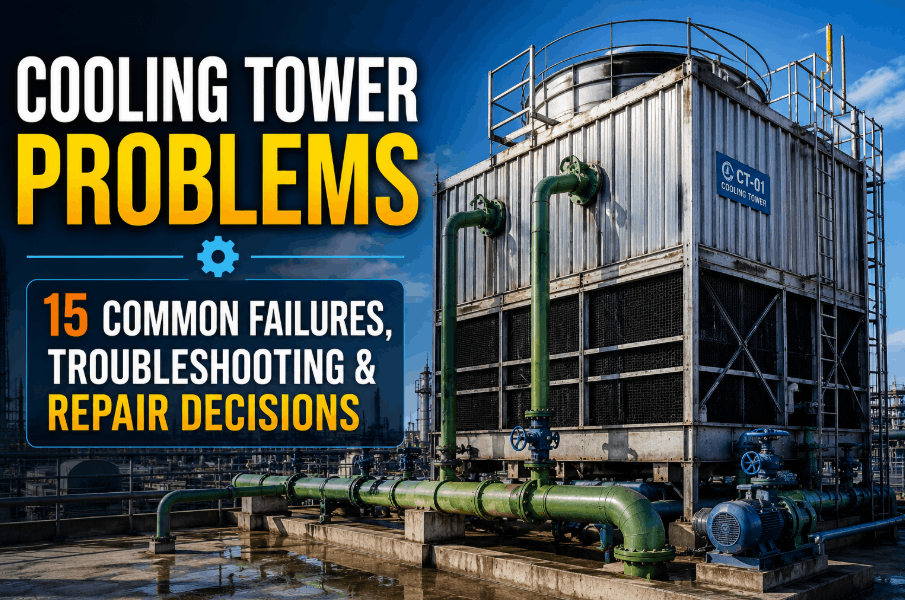
Cooling tower problems are among the most disruptive and costly failures in commercial HVAC and industrial process cooling. When a cooling tower underperforms — whether from fan failure, fill fouling, drift eliminator damage, or water treatment breakdown — the ripple effects hit chiller efficiency, process uptime, and operating budgets simultaneously. This guide covers 15 common cooling tower failures, step-by-step troubleshooting logic, and the repair-versus-replace decisions that facility managers and HVAC engineers need to minimize downtime and control lifecycle costs.
Why Cooling Tower Troubleshooting Demands a Systematic Approach
Cooling tower failures rarely announce themselves with a single, obvious cause. In most industrial and commercial HVAC systems, a degraded cooling tower cascades through the condenser water loop — raising chiller head pressure, reducing coefficient of performance, and ultimately triggering thermal shutdowns or process interruptions. Sign Up Free to start tracking cooling tower asset health from day one.
The stakes are measurable: a fouled cooling tower fill pack can reduce heat transfer efficiency by 20 to 40 percent, forcing chillers to work harder, consume more energy, and wear faster. A failed cooling tower fan motor during peak summer load can cost $50,000 or more per day in unplanned downtime for a data center or manufacturing facility. Systematic troubleshooting — anchored in documented baseline data and structured maintenance records — is the only reliable path to early detection and controlled repair costs.
15 Common Cooling Tower Problems, Symptoms, and Troubleshooting Steps
The failures below represent the most frequently encountered cooling tower problems across counterflow and crossflow tower designs, ranging from mechanical and structural issues to water quality and controls failures. Each entry includes diagnostic indicators and the PM interventions that prevent recurrence. Book a Demo to see how OxMaint structures cooling tower failure tracking across multi-site portfolios.
No airflow, rising water temperature, motor trips, abnormal current draw, vibration at fan deck.
Reset overload relay if tripped. Check motor amperage vs. nameplate. Inspect fan blades and pitch. Verify gearbox oil level. Test motor winding resistance for faults.
Under 10 years with bearing damage: repair. Over 15 years or failed windings: replace. Always swap fan belts when replacing motors on belt-drive units.
High approach temperature, reduced water flow, visible algae or biofilm on fill, elevated Legionella risk from water samples.
Inspect fill for plugging or collapse. Check water distribution uniformity. Review biocide dosing logs. Collect water samples for microbiological testing.
Light fouling: chemical clean with approved biocide. Collapsed or heavily fouled fill: replace. Fill replacement delivers the biggest single improvement in thermal performance.
Water carryover from discharge, wet surfaces downwind of tower, mineral deposits on nearby structures, high makeup water use.
Inspect eliminator blades for cracks or missing sections. Check frame mounting. Verify fan speed is within spec — overspeeding worsens drift. Review makeup water trends.
Partial damage: replace affected modules. Full replacement needed when more than 30% of blades are cracked or missing — critical for Legionella compliance.
Chiller high-pressure alarms, reduced capacity, elevated kW/ton, leaving water temperature above setpoint, early chiller staging.
Calculate approach temp (LWT minus wet bulb). Verify fan operation and airflow. Inspect fill for fouling. Check condenser water flow rate. Confirm basin level and makeup valve function.
Approach more than 3°F above design: investigate fill, fan, and flow before blaming weather. Persistent high approach on a clean tower may mean the tower is undersized for the actual load.
Visible basin overflow, high makeup water use, float valve stuck open, water pooling around the tower base.
Check float valve for failure or wrong setpoint. Inspect overflow drain for blockage. Verify blowdown valve isn't stuck open. Look for basin cracks causing seepage.
Bad float valve: replace. Minor basin cracks: epoxy injection. Major cracks: fiberglass restoration. If overflow continues with a working valve, adjust blowdown setpoints in the water treatment system.
Grinding or whining noise, oil leaks at seals, high gearbox temperature, metallic debris in oil sample, shaft vibration.
Check oil level and condition — milky or metallic oil means imminent failure. Measure gearbox temp vs. OEM limit. Run vibration analysis at fan shaft. Pull oil sample for lab analysis if possible.
Contaminated but quiet gearbox: drain, flush, refill. Noisy gearbox with metal debris: rebuild or replace. On towers over 15 years, compare gearbox replacement cost against full tower replacement before committing.
Dry fill sections visible during inspection, higher leaving water temperature, uneven cell performance, scaling in low-flow zones.
Observe nozzle spray pattern with tower running. Remove clogged nozzles and inspect for scale or debris. Check inlet header strainer. Verify basin debris screen is clean.
Clean or replace clogged nozzles — the cost is low compared to fill damage from chronic dry spots. If scale is the cause, address the water treatment program, not just the nozzles.
Low airflow without motor fault, motor amperage below expected, excessive vibration, fan hub noise, air recirculation at tower discharge.
Check motor amps — low amps with poor cooling indicates insufficient airflow. Verify blade pitch angle against OEM spec. Inspect hub bolts for looseness that lets blades rotate during operation.
Reset all blades to correct pitch and torque hub bolts per spec. Replace cracked or eroded blades before re-pitching. After correction, confirm motor amps are within nameplate FLA.
White or gray hard deposits on fill, basin, heat exchangers, and nozzles. Reduced heat transfer, rising water temperatures, increased chemical consumption.
Run a Langelier Saturation Index (LSI) calculation on a water sample. Review blowdown rate and cycles of concentration. Check conductivity controller setpoint and blowdown valve operation.
Light scale: acid descaling. Heavy scale blocking fill: replace fill and fix the water treatment program. Heat exchanger scale: mechanical or chemical descaling. Scaling always requires a program fix — not just a one-time clean.
Rust or delamination on steel components, basin leaks, warped casing panels, sagging louvers, structural movement at fan deck.
Inspect all steel components annually. Check coating condition and note failure areas. Measure basin wall thickness in corroded zones with an ultrasonic gauge. Review corrosion inhibitor compliance in water treatment logs.
Localized coating failure: sandblast and recoat. Basin corrosion over 50% wall thickness: install fiberglass liner or replace basin. Structural column damage: engineering assessment required before operating. Widespread deterioration usually favors full tower replacement.
VFD fault codes on BAS, fan stuck at fixed speed, motor overtemperature trips, unstable speed, loss of remote control signal.
Read VFD fault log. Check control signal wiring from BAS for continuity. Verify input voltage and phase balance. Confirm VFD parameters match motor nameplate. Check VFD internal cooling fan and filter.
Overtemperature faults: clean filters and improve ventilation. Wiring faults: repair. Drive board failure under 8 years: repair. Older VFDs where repair exceeds 60% of replacement cost: replace.
High bacteria counts in water samples, biofilm on basin or fill surfaces, damaged drift eliminators, missed biocide treatments, water temps in the 77–113°F Legionella growth range.
Collect water sample for Legionella culture testing. Review biocide dosing records. Inspect all drift eliminators. Check water temp history for periods in growth range. Confirm ASHRAE 188 WMP compliance.
Positive Legionella test: immediate remediation per ASHRAE 188 — hyperchlorination, system isolation, and notifications. Replace damaged drift eliminators right away. Update the Water Management Plan.
High vibration at fan deck, noise from shaft or coupling, accelerated bearing wear, visible lateral shaft movement, gearbox vibration.
Measure vibration at motor, shaft midpoint, and gearbox input bearing. Compare to baseline. Inspect coupling for wear. Check hanger bearing condition and lubrication. Verify motor-to-gearbox alignment.
Misalignment: realign to OEM tolerance. Worn couplings: replace flexible elements. Failed hanger bearing: replace and re-lubricate. Vibration above 0.2 in/sec peak needs immediate diagnosis to prevent gearbox and motor damage.
Ice in basin or on fill during cold weather, collapsed fill from ice loading, cracked basin sections, frozen distribution headers, restricted flow on startup.
Verify basin heater and thermostat before winter. Confirm bypass valve recirculates properly during low-load cold operation. Check BAS freeze protection sequence. Look for stagnant low-flow zones most vulnerable to freezing.
Failed basin heater: replace before temps drop below 35°F. Ice-collapsed fill: replace and fix the freeze protection logic. Cracked basin: fiberglass or epoxy repair. Prevention wins — a heater costs under $1,000; one freeze event can cause $20,000+ in damage.
Year-over-year rise in LWT minus wet-bulb differential at similar loads, chillers staging earlier each season, rising kW/ton without any load growth.
Plot approach vs. wet bulb over multiple seasons from BAS data. Normalize for the same wet-bulb band to rule out weather. Inspect fill, fan performance, and nozzle distribution. Compare to any available tower thermal performance report.
Gradual approach rise over 3–5 years usually means fill aging or fouling — fill replacement typically restores near-original performance. If approach stays high after fill replacement, commission a thermal performance test to check whether the tower can still meet design conditions.
Cooling Tower PM Schedule: Recommended Frequency by Component
An effective cooling tower maintenance schedule aligns task frequency with actual component degradation rates. The table below provides baseline PM frequencies drawn from leading OEM recommendations and ASHRAE 188 Water Management Plan guidance. Sign Up Free to import your tower asset list and automate PM scheduling instantly.
| Tower Component | Primary Failure Mode | Critical PM Tasks | Recommended Frequency | Consequence of Deferral |
|---|---|---|---|---|
| Fan Motor and Drive | Bearing wear, winding degradation | Amperage check, vibration, lubrication | Quarterly | In-season motor failure, capacity loss |
| Fill Pack | Fouling, collapse, biological growth | Visual inspection, flow distribution check | Semi-annually | 20–40% heat transfer efficiency loss |
| Drift Eliminators | Physical damage, warping | Visual inspection, replace damaged sections | Annually | Legionella risk, excessive water loss |
| Water Distribution Nozzles | Clogging from scale or debris | Spray pattern inspection, nozzle cleaning | Semi-annually | Uneven fill wetting, localized scaling |
| Gearbox | Oil contamination, bearing failure | Oil level/condition, oil sample analysis | Semi-annually | Gearbox seizure, fan failure |
| Basin and Structure | Corrosion, coating failure, cracking | Structural inspection, coating assessment | Annually | Basin leaks, structural safety risk |
| Water Treatment System | Biocide dosing failure, scale formation | Chemical analysis, LSI, bacteria counts | Monthly minimum | Legionella risk, scaling, corrosion |
| Fan Blade and Pitch | Erosion, pitch drift, hub loosening | Pitch verification, blade condition, hub torque | Annually | Reduced airflow, motor overload |
| Basin Heater and Thermostat | Element failure, thermostat drift | Element resistance, setpoint verification | Annually (fall) | Freeze damage to basin and fill |
Cooling Tower Water Treatment: The Root Cause Behind Half of All Tower Failures
Water treatment failure is the most underdiagnosed root cause in cooling tower troubleshooting. Corrosion, scaling, microbiological growth, and Legionella risk are all water chemistry problems — and each one degrades thermal performance, accelerates mechanical component wear, and creates health and regulatory liability simultaneously. Book a Demo to see how OxMaint links water treatment compliance records directly to cooling tower asset maintenance history.
- Monitor conductivity and set automated blowdown to maintain 3–6 cycles of concentration
- Measure makeup and blowdown water conductivity to calculate actual cycles
- Adjust cycles downward with aggressive source water (high TDS, hardness, or silica)
- Document cycles monthly and compare to water treatment program targets
- Maintain oxidizing biocide residual (chlorine or bromine) at program-specified concentration
- Alternate oxidizing and non-oxidizing biocides to prevent resistance development
- Perform dip-slide or ATP bacteria count tests between formal water sampling
- Document all biocide additions with date, product, dosage, and post-treatment residual reading
- Maintain inhibitor residual at program-specified level for all metallurgies in the system
- Test corrosion coupon program results quarterly — target less than 5 mpy for steel
- Review pH and LSI monthly — maintain pH 7.0–8.5 for combined scale and corrosion control
- Inspect basin anode protection system where installed
- Maintain current Water Management Plan (WMP) per ASHRAE 188 for all cooling towers
- Document control limits, monitoring frequency, and corrective action triggers
- Conduct Legionella culture testing at minimum quarterly frequency
- Perform annual system inspection and WMP review with certified water treatment specialist
Cooling Tower Troubleshooting: Systematic Diagnostic Framework
Experienced HVAC engineers approach cooling tower troubleshooting through a structured diagnostic hierarchy — eliminating the most common and most impactful failure modes first before moving to controls, structural, or water chemistry root causes. The framework below applies to counterflow and crossflow towers across commercial and industrial HVAC applications.
Establish the Baseline: Leaving Water Temperature vs. Wet-Bulb Temperature
The most important diagnostic parameter for cooling tower performance is approach temperature: leaving water temperature (LWT) minus the outdoor wet-bulb temperature. A tower performing within 5°F of wet bulb at design flow and heat load is functioning well. Approach above 7–8°F under design conditions indicates a mechanical, fill, or water distribution problem that warrants immediate investigation — not ambient weather conditions. Always record wet-bulb at the time of the performance measurement using a sling psychrometer or calibrated sensor.
Verify Airflow: Fan Operation, Blade Pitch, and Motor Amperage
Confirm that all fans are operating, verify motor amperage against nameplate FLA, and check that fan blades are at the correct pitch angle for the current ambient conditions. A fan running at 60 percent of design airflow — from pitch drift, belt slippage, or gearbox inefficiency — reduces cooling capacity by a roughly proportional amount. Vibration measurement at the motor, shaft, and gearbox should be part of every airflow diagnostic sequence on gear-driven towers.
Inspect Fill, Nozzles, and Water Distribution
With the tower operating, inspect fill sections visually for dry zones, collapsed packing, biological mat growth, or heavy mineral scaling. Walk the perimeter and observe water distribution from nozzle headers — uniform spray coverage across the full fill face is the objective. Document percentage of fill area that appears effectively wetted and note any structural damage to fill frame or support members. Maldistribution in even a 20 percent section of fill has a measurable impact on overall thermal performance.
Evaluate Water Flow Rate Against Design GPM
Cooling tower thermal performance is rated at a specific design flow rate — typically measured in GPM per ton of cooling. Operating a tower at flows significantly above or below design specification degrades performance in opposite ways: low flow reduces fill wetting and heat transfer surface contact time; high flow reduces residence time in the fill and can cause flooding. Verify condenser water pump operation and measure flow through the tower against design documentation using flow meter or pump curve correlation with measured head.
Review Water Treatment Records and Sample Results
Pull the last 12 months of water treatment service reports and review conductivity, pH, corrosion inhibitor residual, biocide residual, bacteria count, and LSI trend data. A pattern of biocide residual failures, conductivity exceedances, or rising bacteria counts explains fill fouling, scaling, and drift eliminator biological accumulation — and points directly to a water treatment program compliance problem rather than a mechanical failure mode. Document findings against ASHRAE 188 WMP control limits.
Cooling Tower Repair vs. Replace: Decision Framework for Facility Managers
Cooling tower replacement decisions require a structured financial analysis that compares remaining service life, cumulative repair history, energy performance degradation, and refrigerant or water compliance constraints against the capital cost and operational benefit of a new tower. Facility managers who defer replacement beyond the economic inflection point consistently accumulate higher total costs through reactive repairs, energy waste, and emergency rental tower expenses. Book a Demo to see how OxMaint's repair history tracking makes these decisions objective and defensible.
Apply the 50 Percent Rule to Single-Event Repair Decisions
The most widely applied cooling tower replacement trigger is the 50 percent rule: when a single repair — fill replacement, gearbox replacement, basin structural restoration — exceeds 50 percent of the cost of a new equivalent tower, replacement is typically the superior financial decision. Apply this rule in combination with tower age: a gearbox replacement representing 35 percent of replacement cost on a 6-year-old tower is defensible; the same repair on a 20-year-old tower with a corroded basin and aging fill is not.
Quantify the Chiller Energy Penalty of Tower Degradation
Every 1°F increase in condenser water temperature increases chiller energy consumption by approximately 1.5 to 2 percent. For a 500-ton chiller system operating 3,000 hours annually, a degraded cooling tower raising condenser water temperature by 5°F generates $15,000 to $25,000 in additional chiller energy costs per year — before any equipment repair costs are added. This energy penalty is a quantifiable component of the total cost of continued operation that should be included in every tower replacement business case.
Evaluate Structural Condition Against Repair Feasibility
Cooling towers with widespread basin corrosion, deteriorated structural steel, or failed casing panels present repair economics that typically favor replacement. Unlike fill replacement or mechanical component repair — which restore specific performance parameters — structural restoration of a steel tower with pervasive corrosion requires continuous reinvestment and rarely eliminates the root cause (inadequate corrosion protection and water treatment program compliance history). An engineering condition assessment is required before committing to structural restoration of towers over 20 years old.
Use CMMS Repair History to Build the Replacement Business Case
The most compelling tower replacement business case is built from documented CMMS repair history showing cumulative reactive maintenance costs over three to five years. When facility managers can demonstrate that a specific tower cost $40,000 in repairs over five years while a replacement tower costs $80,000 and carries comprehensive OEM warranties, the financial case for replacement becomes objective rather than subjective — and capital approval follows far more quickly. Sign Up Free with OxMaint to begin building that repair cost history today.
Schedule Replacement During Spring or Fall Shoulder Seasons
Cooling tower replacement projects planned for spring or fall avoid the contractor availability constraints and premium pricing that accompany emergency summer replacements. Scheduling crane access, rigging, and structural work during mild weather also reduces operational disruption and allows commissioning and startup to be completed under controlled conditions before peak cooling season demand begins. A properly planned shoulder-season replacement typically costs 15 to 25 percent less than an emergency replacement executed during the peak summer service window.
-not-cooling-18-common-causes,-diagnostics-&-troubleshooting-guide.png)