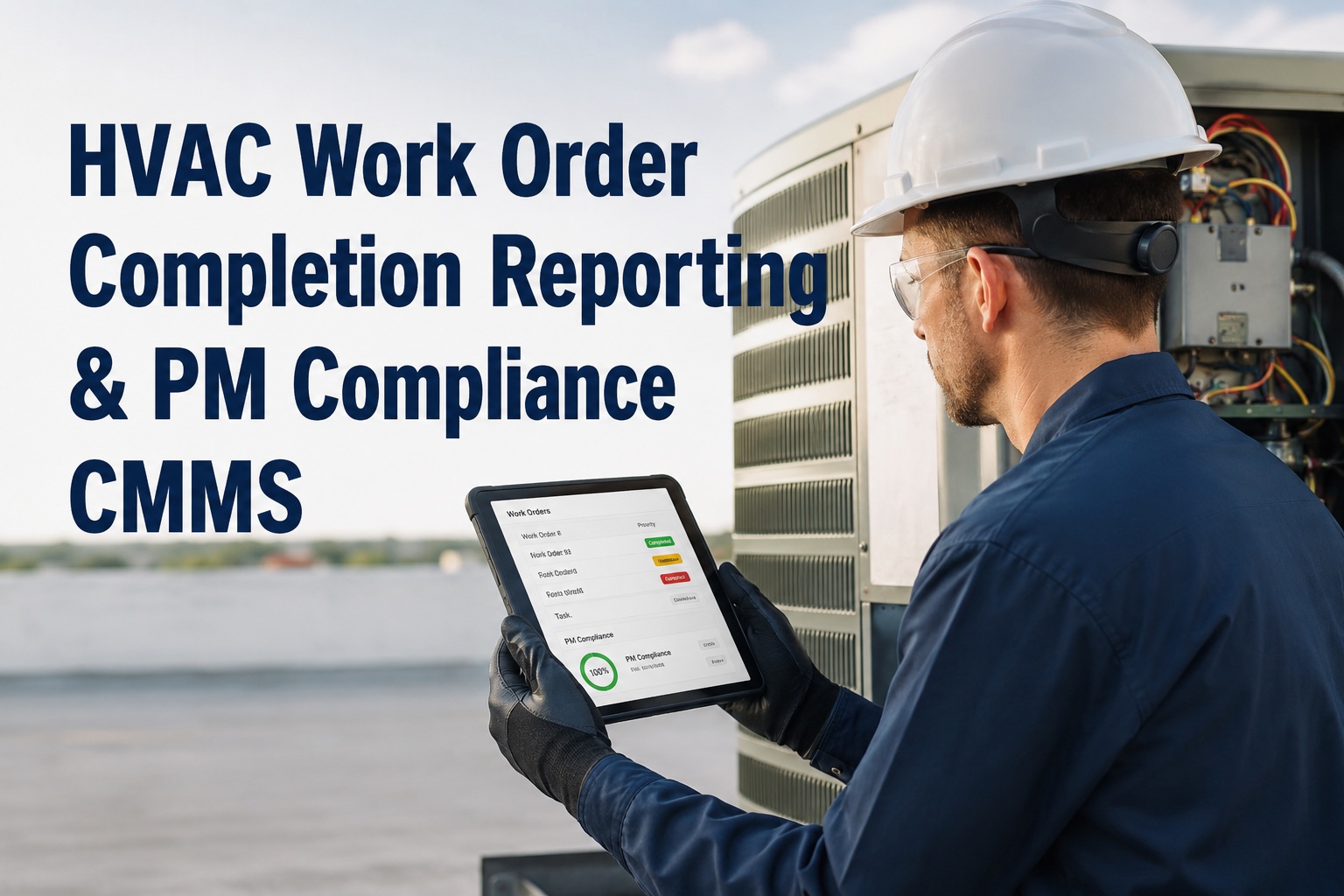
HVAC work order completion reporting and PM compliance tracking are the backbone of any reliable preventive maintenance program — yet most facilities teams still rely on manual spreadsheets that leave overdue tasks invisible until equipment fails. A CMMS with automated HVAC weekly reports transforms this by giving you real-time visibility into completion rates by system, building, and technician, so nothing slips through the cracks. Whether you manage a single commercial building or a multi-site campus, PM compliance reporting for HVAC ensures filter changes, belt inspections, and coil cleanings happen on schedule, extending asset life and cutting energy waste. This guide breaks down how to calculate, track, and improve your HVAC compliance rate using modern CMMS completion reporting — and shows how OxMaint makes the entire process automatic. Ready to eliminate paper work orders and automate your PM reporting? Start Free Trial and see the difference in your first week.
Is Your HVAC PM Compliance Rate Above 90% — or Just Looking That Way?
Most facilities teams believe their preventive maintenance completion rate is near-perfect. The reality: when you track HVAC work order reporting by building, system, and technician, the true compliance rate often sits between 55–70%. Overdue filter changes, skipped belt inspections, and missed coil cleanings quietly drain energy budgets and shorten equipment life. A CMMS changes that — automatically.
How to Calculate HVAC PM Compliance Rate — The Right Way
Your PM compliance rate is the single most important KPI in HVAC maintenance reporting. Get the formula wrong — or apply it inconsistently — and every downstream report is misleading. Here is the industry-standard calculation used by reliability engineers and auditors.
A PM work order is on-time if it is completed on or before the scheduled due date. Tasks completed 1–7 days late are "overdue"; tasks missed entirely by 8+ days are "non-compliant" and typically trigger an escalation in audited environments.
A single building-wide compliance number hides problems. Track compliance by system type (chillers vs RTUs vs AHUs), by building/floor, and by technician — each dimension reveals a different failure pattern.
Best-in-class HVAC maintenance teams sustain a PM compliance rate of 90–95%. Below 80%, unplanned downtime typically rises 2–3x and energy costs climb 10–18% due to fouled coils, clogged filters, and degrading belts.
Building Automated HVAC Weekly Reports in 5 Steps
Moving from manual spreadsheet reporting to automated CMMS-driven weekly reports takes less than a single sprint. Here is the proven 5-week rollout timeline that facilities teams follow to go from paper chaos to 90%+ PM compliance.
Audit Your HVAC Asset Register
Inventory every piece of HVAC equipment — RTUs, chillers, boilers, AHUs, pumps, VAV boxes — and tag each asset with location, manufacturer, model, install date, and criticality rating. A complete asset register is non-negotiable; you cannot schedule PMs for equipment you have not logged. Most teams find 10–15% of assets are missing from their current spreadsheet in this step.
Build PM Schedules by System Type
Create preventive maintenance templates for each HVAC system type. A rooftop unit typically needs quarterly filter changes, semi-annual belt inspections, and annual coil cleaning. In OxMaint, you define these once as recurring work order templates — the system auto-generates work orders on the correct cadence and assigns them to the right technician based on skill and location.
Configure Compliance Dashboards
Set up your HVAC work order reporting dashboard with three views: compliance rate by building, compliance rate by system type, and completion rate by technician. Configure thresholds — green at 90%+, yellow at 75–89%, red below 75% — so problem areas are instantly visible without digging through rows.
Automate Weekly Report Distribution
Schedule OxMaint to email a PDF or interactive HVAC weekly report every Monday at 7 AM to your facilities director, operations manager, and technician leads. The report includes: total PMs scheduled, completed, overdue, compliance rate by building, top 5 at-risk assets, and upcoming PMs for the next 7 days. No more manual spreadsheet assembly on Friday afternoons.
Review & Course-Correct
Hold a 30-minute weekly compliance review using the automated report. Identify buildings or system types below 85% compliance, investigate root causes (staffing gaps, parts shortages, access issues), and adjust schedules or assignments. Teams that run this cadence consistently reach 90%+ PM compliance within 60–90 days.
What a High-Quality HVAC Work Order Completion Report Must Include
A weekly HVAC report that only shows a single compliance percentage is a wasted opportunity. The report below represents the minimum dataset that maintenance and reliability decision-makers need to act — not just observe.
| Report Section | What It Shows | Why It Matters |
|---|---|---|
| Overall PM Compliance Rate | Percentage of scheduled PMs completed on time this week | The headline KPI — trended week-over-week, it reveals whether your maintenance program is improving or degrading. |
| Compliance by Building | On-time completion rate broken down by site or facility | Surfaces underperforming locations — often a sign of staffing gaps, access issues, or unclear ownership. |
| Compliance by System Type | Rate by RTUs, chillers, AHUs, boilers, pumps, cooling towers | Reveals system-specific problems — e.g., 60% compliance on cooling tower PMs may indicate a technician skill gap. |
| Compliance by Technician | On-time completion rate per assigned technician | Identifies training needs and workload imbalances — not to penalize, but to rebalance and coach. |
| Overdue Task Register | Every PM past due, with asset, age, and assigned tech | The action list — each overdue item is a failure waiting to happen. This section drives the weekly review meeting. |
| Reactive vs. Preventive Ratio | Breakdown of work orders this week: PM vs. reactive/corrective | A healthy HVAC program runs 70–80% preventive. If reactive exceeds 40%, your PM strategy has gaps. |
| Upcoming PMs (7-Day Look-Ahead) | PM tasks scheduled for the next week, by building and tech | Enables proactive staffing, parts pre-staging, and contractor scheduling — eliminates same-day scrambles. |
| Mean Time to Complete (MTTC) | Average hours from work order assignment to completion | Rising MTTC signals parts availability issues, access delays, or scope creep in PM checklists. |
See OxMaint Build Your HVAC Compliance Report in 30 Minutes
Book a live demo and we will connect your HVAC asset list, build PM schedules, and generate a sample weekly compliance report — using your buildings, your equipment, your numbers. No slideware.
How OxMaint Automates HVAC Work Order Reporting & PM Compliance
OxMaint replaces spreadsheets, paper work orders, and manual report assembly with an AI-powered CMMS that generates, tracks, and reports every HVAC PM automatically. Here is exactly what changes when you switch.
Automated PM Work Order Generation
OxMaint auto-generates recurring HVAC PM work orders on the exact cadence you define — daily, weekly, monthly, quarterly, seasonal. Each work order includes checklists, required parts, estimated time, and assigned technician. No one has to remember to create the work order; the system never forgets.
Real-Time Compliance Dashboards
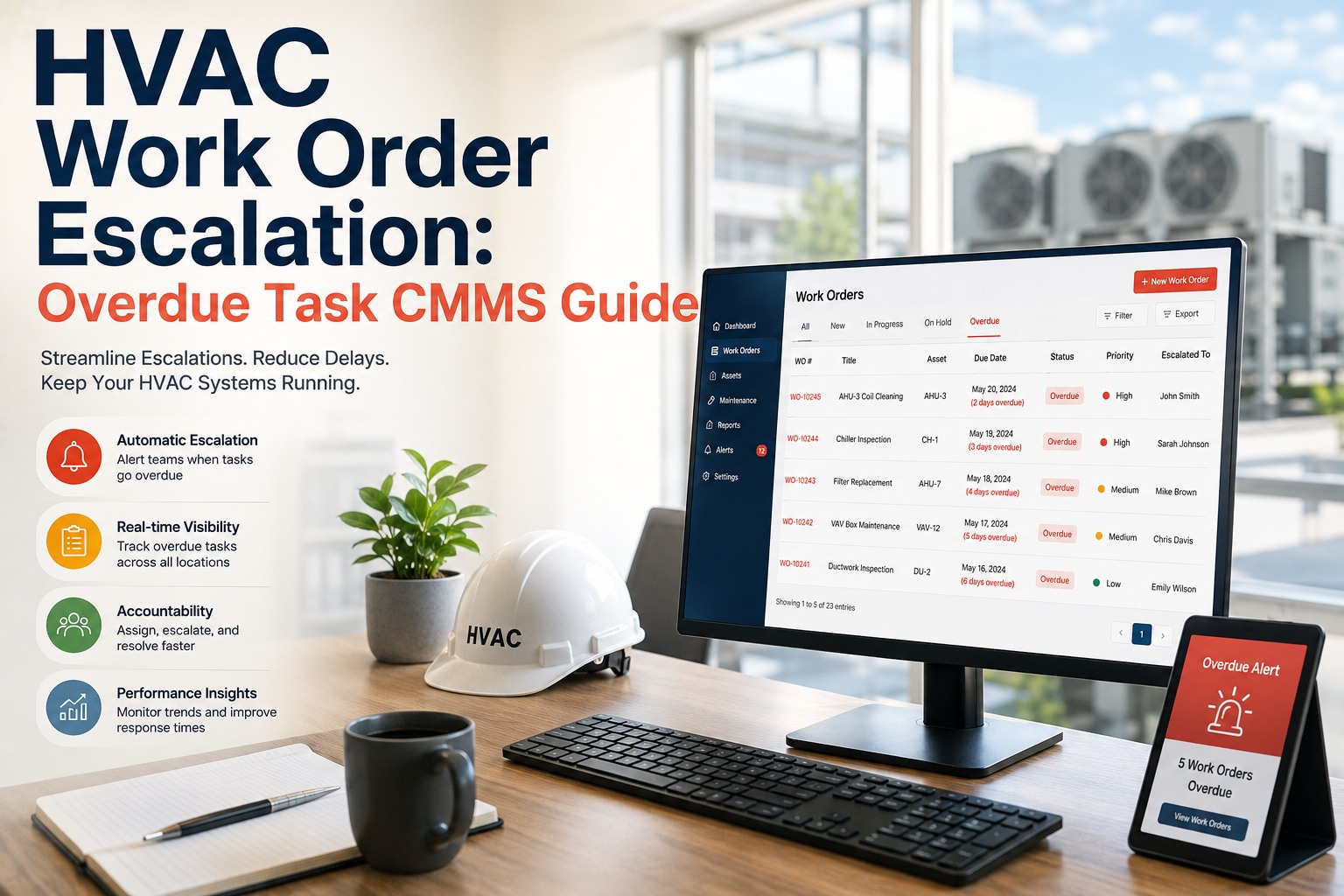
Live dashboards show PM compliance by building, system type, and technician — updated the instant a work order is closed in the mobile app. Color-coded thresholds (green/yellow/red) make problem areas obvious in seconds, not after a week of spreadsheet work.
Automated Weekly Report Delivery
Schedule OxMaint to email a complete HVAC weekly report — compliance rates, overdue register, technician breakdown, 7-day look-ahead — to stakeholders every Monday at 7 AM. The report assembles itself. Your team spends Friday afternoons on maintenance, not on Excel.
Predictive Maintenance Alerts
OxMaint's AI analyzes vibration, temperature, and runtime data from HVAC sensors to predict failures 7–21 days before they happen. The system auto-generates corrective work orders and flags the asset in your compliance report — so you fix it before it fails, not after.
The Cost of Poor HVAC PM Compliance — and the Payback of Fixing It
Consider a typical scenario: a commercial property portfolio with 8 buildings, 180 HVAC assets, and a reactive maintenance program spending $42,000/year on emergency HVAC repairs and energy waste from poorly maintained equipment.
Before OxMaint: PM compliance tracked in spreadsheets, actual on-time completion ~62%, $42K/year in reactive repairs + energy waste, 5 hours/week spent on manual reports. After implementing OxMaint: PM compliance rose to 94% within 90 days, reactive repair costs dropped to $14K/year, energy waste fell to $6K/year, and weekly reporting became fully automated. Net annual savings: $38,000+, plus 260 hours of staff time reclaimed. The OxMaint subscription paid for itself in under 4 months.
"We went from not knowing which buildings were behind on PMs to a 94% compliance rate in one quarter. The automated Monday morning report replaced five hours of spreadsheet work — and our emergency HVAC callouts dropped by more than half. OxMaint paid for itself in the first cooling season."
HVAC Work Order Completion Reporting & PM Compliance — FAQ
What is a good HVAC PM compliance rate?
A good HVAC PM compliance rate is 90–95%, meaning 90–95% of scheduled preventive maintenance tasks are completed on or before their due date. World-class facilities teams sustain 95%+; below 80%, unplanned downtime typically rises 2–3x and energy costs increase 10–18%. Tracking compliance by building, system type, and technician — not just as a single number — is essential to finding and fixing the gaps.
How does a CMMS improve HVAC work order completion reporting?
A CMMS like OxMaint improves HVAC work order reporting by automatically generating recurring PM work orders, tracking completion in real time via mobile apps, and assembling weekly compliance reports without manual spreadsheet work. This eliminates the two biggest reporting failures: missed PM schedules (the system never forgets) and stale data (dashboards update the instant a tech closes a work order). You can see it in action — book a 30-minute demo and we will build a sample report using your assets.
What should be included in an HVAC weekly maintenance report?
An HVAC weekly maintenance report should include: overall PM compliance rate, compliance broken down by building and system type, completion rate by technician, an overdue task register with asset and age, reactive-to-preventive work order ratio, mean time to complete, and a 7-day look-ahead of upcoming PMs. Each section should be color-coded against thresholds so problem areas are instantly visible without data digging.
How do I track overdue HVAC PM tasks?
In a CMMS, overdue HVAC PM tasks are tracked automatically — every work order past its due date is flagged, surfaced in a dedicated overdue register, and included in the weekly compliance report with the asset name, days overdue, and assigned technician. In OxMaint, overdue tasks also trigger escalation notifications to supervisors and can be configured to auto-reassign if a technician has not started within a set window.
Can I switch from spreadsheets to CMMS without losing my PM history?
Yes — OxMaint supports bulk import of existing PM schedules, asset lists, and work order history from spreadsheets, and most teams complete the migration in 1–2 weeks. The system maps your current PM frequencies, asset locations, and technician assignments directly into recurring work order templates, so there is no gap in your compliance tracking. You can start a free 14-day trial and import your first building's asset list on day one.
Stop Guessing. Start Reporting HVAC PM Compliance with Confidence.
Join the facilities teams who replaced spreadsheets and paper work orders with automated HVAC weekly reports, real-time compliance dashboards, and predictive maintenance alerts — all in one AI-powered CMMS.
Free 14-day trial · No credit card

.png)