Commercial facilities lose an average of 17% of HVAC system uptime each year to reactive maintenance — breakdowns that a connected BMS could have predicted weeks earlier. When a Building Management System detects a fault but has no direct path to a maintenance work order, the alert sits in a dashboard while the asset degrades. OxMaint's Work Order Automation closes that gap by converting BMS alarms directly into assigned, prioritized maintenance tasks — with full asset history, escalation rules, and technician routing built in. This case study documents what happens when BMS integration replaces reactive maintenance as the operating model for a multi-site commercial facility.
Reducing HVAC Downtime with BMS-CMMS Automation
How automated alarm-to-work-order workflows cut unplanned HVAC downtime by 71% — and eliminated the 6-hour gap between fault detection and technician dispatch.
The Problem: Alarms That Go Nowhere
A 14-building commercial campus in the Midwest was running a Siemens Desigo BMS with 3,200 monitored points across AHUs, chillers, cooling towers, VAV boxes, and building pressurization systems. The BMS was generating fault alerts — but those alerts landed in a read-only dashboard, reviewed once per shift by the facilities supervisor on duty. By the time a work order was manually created and a technician dispatched, 4–8 hours had typically elapsed from fault detection to first physical response.
BMS fault queue reviewed once per 8-hour shift. Low-priority alarms routinely aged 24–48 hours before any work order was created, compounding into major failures.
Technicians arrived at assets without maintenance history, previous fault patterns, or OEM repair guidance — increasing mean time to repair by 40–65 minutes per incident.
Preventive maintenance ran on a fixed calendar — not triggered by actual equipment condition. Condition-based triggers from the BMS were ignored because there was no automated pathway to PM scheduling.
ASHRAE 180 and local energy code compliance required documented maintenance records per AHU and chiller. Paper-based records were incomplete, missing technician signatures, and scattered across shift binders.
Before vs. After: BMS-CMMS Integration
Downtime Reduction — Visual Comparison
Monthly unplanned HVAC downtime tracked across all 14 buildings over 12 months pre- and post-integration. Data sourced from OxMaint work order records and BMS fault log exports.
How OxMaint BMS-CMMS Integration Works
OxMaint connects to existing BMS platforms — Siemens Desigo, Honeywell EBI, Johnson Controls Metasys, Schneider EcoStruxure — via BACnet/IP, Modbus, or REST API. No BMS replacement is required. The integration layer maps fault codes to asset records and applies configurable routing rules to auto-generate work orders.
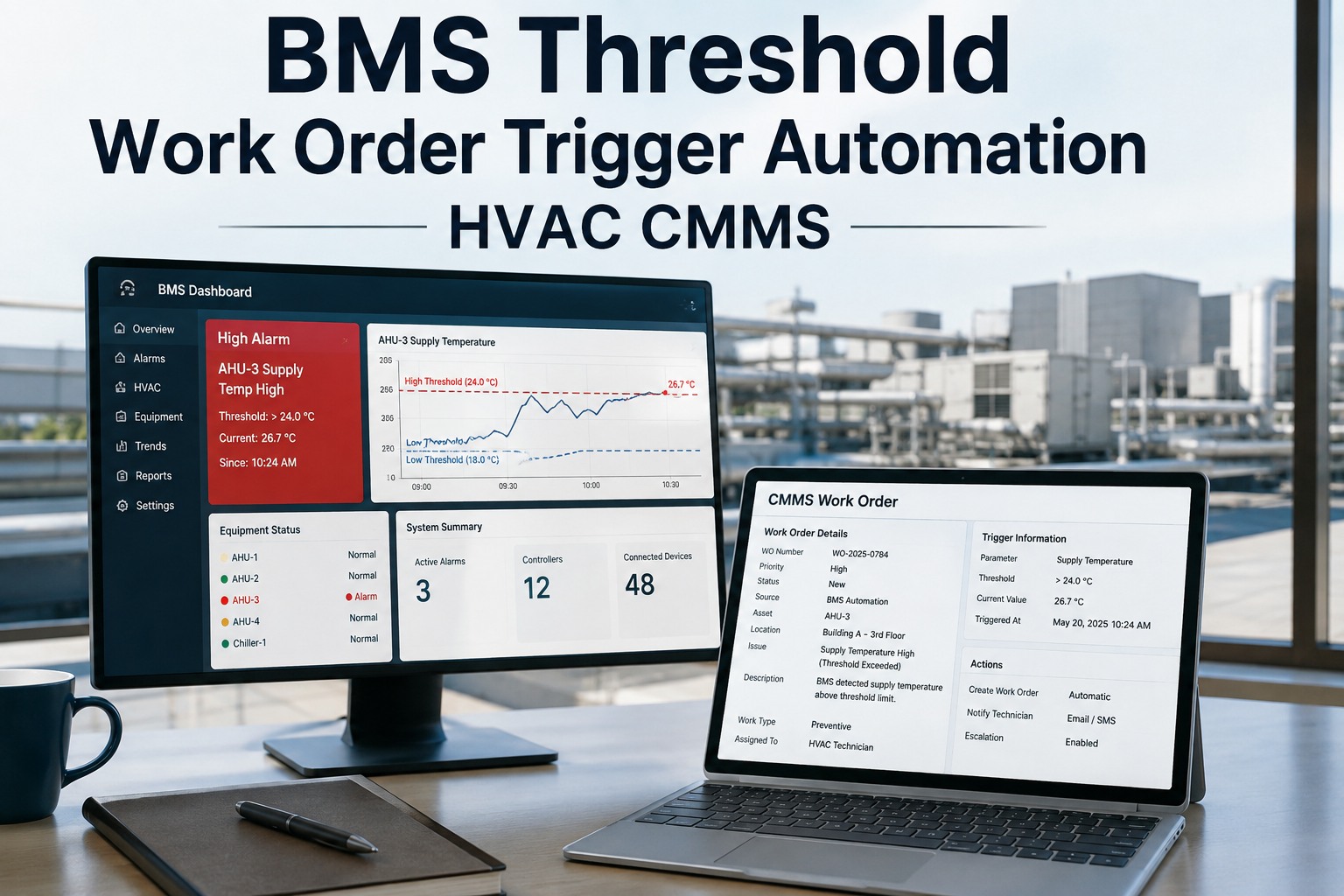
BMS generates a fault on an asset — AHU supply fan failure, chiller high-pressure cutout, cooling tower fan overload, VAV actuator fault. The fault code and asset tag are transmitted to OxMaint via the integration layer within seconds.
OxMaint applies configurable priority rules — critical faults (chiller trip, fire damper failure) are P1 with immediate push notification; comfort faults (VAV out of range, filter DP high) are P2 dispatched within 4 hours. Routing assigns to the correct technician skill and shift.
A fully populated work order is created in under 6 minutes — with asset name, location, fault description, maintenance history for the last 24 months, OEM troubleshooting guide, and required parts checklist pre-attached. The technician receives mobile notification with full context.
Technician completes the work order on mobile with digital signature, resolution notes, and parts used. OxMaint closes the BMS fault loop and stores the maintenance record against the asset — building an audit-ready compliance trail per ASHRAE 180 and local energy codes.
Live BMS Alert Feed — Simulated Dashboard
This is a representative view of OxMaint's real-time BMS integration dashboard as it appears during active facility operations. Each alert auto-generates a work order within minutes of detection.
See Your BMS Alarms Become Work Orders — Live
OxMaint connects to Siemens, Honeywell, JCI, Schneider, and 20+ BMS platforms. Most facilities are live within 5 business days — no hardware changes, no BMS replacement required.
Measured Results — 12-Month Summary
Results tracked across 14 buildings, 3,200 BMS points, covering AHUs, chillers, cooling towers, VAV systems, and BMS-linked fan coil units. Baseline: 12 months prior to integration.
| Metric | Baseline (Manual) | Post-OxMaint | Improvement |
|---|---|---|---|
| Alarm-to-work-order time | 4–8 hours | Under 6 minutes | 97% faster |
| Unplanned HVAC downtime (hrs/month) | 52 hrs | 15 hrs | -71% |
| PM compliance rate | 38% | 93% | +55 pts |
| Mean time to repair (MTTR) | 3.8 hrs | 1.6 hrs | -58% |
| Emergency work orders / month | 31 | 7 | -77% |
| Annual maintenance cost avoided | Baseline | $386,000 | 2.4x ROI / 11 months |
| ASHRAE 180 compliance documentation | Partial (38% complete) | 100% asset records complete | Fully compliant |
Expert Review
The integration of BMS fault data with automated CMMS work order generation is one of the highest-leverage changes a facilities team can make. In my experience across large commercial portfolios, the single most expensive failure mode is not the mechanical failure itself — it is the 4 to 8 hours between a BMS fault alert and a technician physically responding. Every hour in that gap is additional wear on the affected asset, potential for cascade failures in connected systems, and occupant comfort impact that erodes tenant satisfaction scores. When OxMaint closes that gap to under 10 minutes automatically, with a work order that includes full asset history and repair guidance, the technician arrives faster and resolves the fault in significantly less time. I have seen MTTR drop by 50–60% in connected implementations — not because the technician is more skilled, but because they arrive informed rather than cold. The compliance documentation benefit is equally important as ASHRAE 180 audits become standard across commercial leases. Platforms like OxMaint make this achievable without a $500K BAS upgrade project.
Frequently Asked Questions
Your BMS Is Already Detecting Problems. OxMaint Makes Sure They Get Fixed.
Stop letting BMS fault alerts expire in a dashboard. OxMaint converts every alarm into a routed, documented maintenance work order — automatically, within minutes, with full asset context attached. See a live walkthrough with your building type and BMS platform.