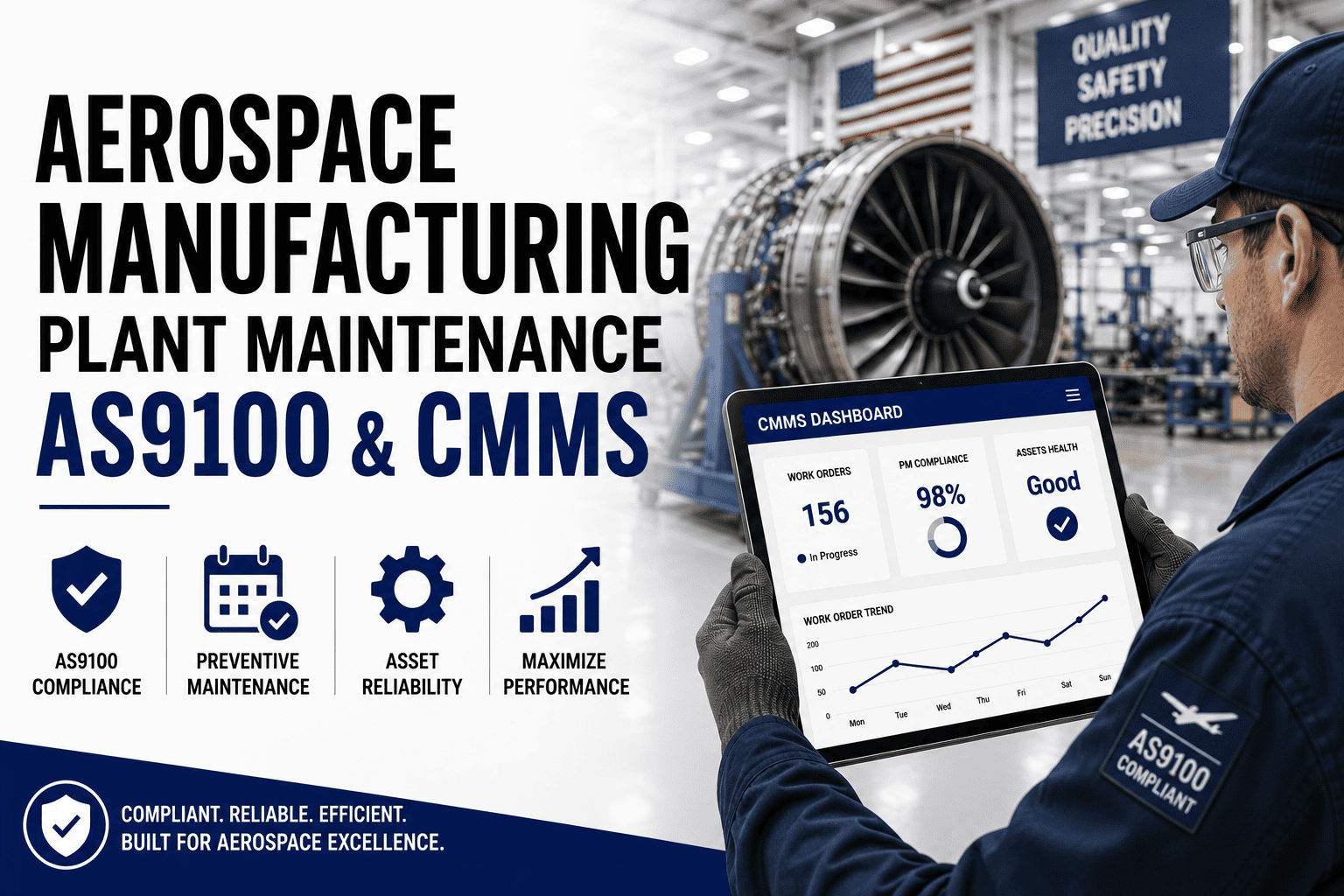
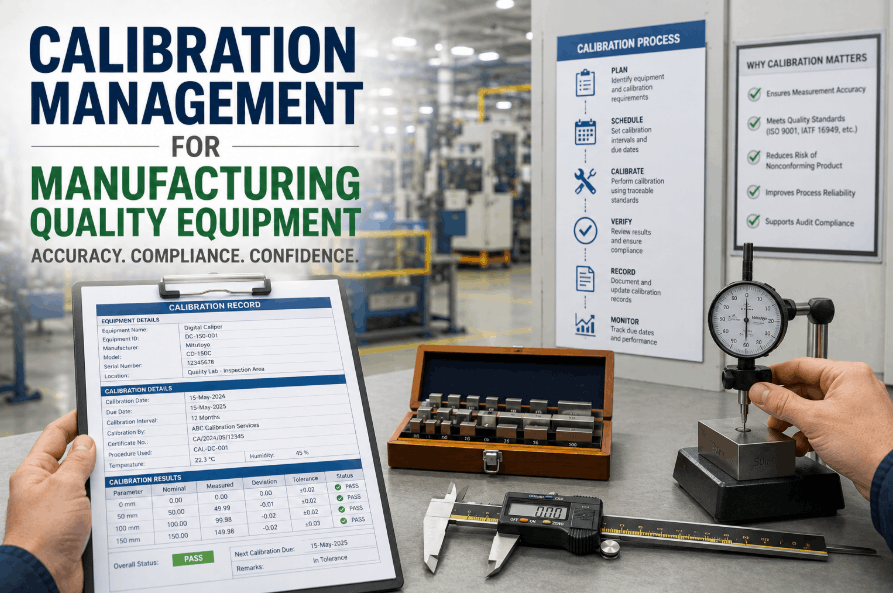
A Boeing 737 costs between $51.5M and $87M. A B-52 runs roughly $53M. A single RQ-4 Global Hawk can cross $130M. Every aerospace component in those airframes traces back to a gauge, a furnace, a welder, or an NDT technician — and to the maintenance, calibration, and traceability records that prove each one performed to spec on the day that part was made. AS9100 Rev D is the quality management system behind that proof, and calibration non-conformance is consistently one of the leading audit findings that trip suppliers up. When a torque wrench drifts out of tolerance, it is not a maintenance problem — it is a potential product recall, a customer notification, and a risk assessment that reaches back through every measurement that tool ever made. Managing calibration, preventive maintenance, and audit-ready records across your entire equipment register is how aerospace manufacturers stay flight-worthy — start with a free OxMaint workspace or book a working session with our aerospace team.
Why Aerospace Maintenance Is Different
Precision Measured in Thousandths of an Inch
General manufacturing accepts tolerances a commercial aerospace auditor would reject instantly. A ±0.002" digital caliper is acceptable in most shops — on a turbine blade root, a wing component, or a fastener torque verification it is out of spec before it leaves the tool crib. The scale below is what AS9100 enforces.
±0.01"
General metal fabrication tolerance — acceptable for non-critical brackets, enclosures, and visual fit parts
±0.002"
Standard precision machining — often the upper bound for AS9100 secondary structure components
±0.0005"
Aerospace component tolerance — turbine discs, structural fasteners, airframe critical features
±0.0001"
Flight-critical features — turbine blade airfoils, rocket engine injector geometry, CMM master artifacts
The Four Audit Hotspots Every AS9100 Assessor Opens With
AS9100 auditors arrive with aerospace-specific expectations that far exceed generic ISO 9001 assessments. These four areas generate the largest share of findings — and the largest share of supplier certification risk.
Clause 7.1.5
Calibration & Measurement Traceability
Every micrometer, torque wrench, CMM, and gauge must have unique identification, documented calibration intervals, and unbroken traceability to NIST or equivalent national standards. Uncontrolled personal tools are a top finding.
Uncontrolled or unmarked equipment on the floor
Missing out-of-tolerance impact analysis
Calibration certificates without NIST traceability chain
Clause 8.5.2
Identification & Traceability
Every output must carry forward its serial number, batch, or other identification through manufacturing, assembly, test, and inspection — for the life of the product. Component lineage must be reconstructable on demand.
Broken chain between raw material lot and finished part
Acceptance stamps or e-signatures not controlled
Configuration management gaps across revisions
Clause 8.1.4
Counterfeit Parts Prevention
Added as a dedicated clause in Rev D. Requires source control for externally provided product, obsolescence monitoring, verification methods to detect counterfeits, and quarantine procedures for suspect parts.
Purchases outside authorized distributor chains
Missing counterfeit awareness training records
No documented verification and test methodology
Clause 6.1
Risk-Based Thinking
Risk management is woven throughout the standard, not a standalone clause. Maintenance frequency, calibration interval, and process controls must all be justified on risk — with documented evidence of effectiveness, not just activity.
Calibration intervals extended without justification
Risk registers that never update
Corrective actions missing human factors analysis
Nadcap Special Processes — Where Maintenance Meets Accreditation
A special process is any process whose output cannot be fully verified by inspection after the fact — heat treatment, welding, NDT, chemical processing. If the equipment drifts, the part looks fine but fails in service. Nadcap accredits 24 such process categories with prescriptive equipment, pyrometry, and maintenance requirements. Top six shown below.
| Special Process | Critical Equipment | Key Maintenance Control | What Drifts |
| Heat Treating |
Vacuum and atmosphere furnaces, quench systems |
Pyrometry per AMS 2750, TUS & SAT surveys |
Temperature uniformity, quench oil viscosity |
| Nondestructive Testing |
UT, radiography, dye penetrant, MPI stations |
System performance verification, reference blocks |
Transducer response, film density, magnetic field |
| Welding & Brazing |
TIG, EB, laser weld cells, brazing furnaces |
Calibrated power supplies, atmosphere integrity |
Voltage/amperage drift, shielding gas purity |
| Chemical Processing |
Anodize, passivation, plating lines |
Solution analysis frequency, temperature control |
Bath concentration, rinse water conductivity |
| Coatings |
Thermal spray, PVD, CVD chambers |
Deposition rate calibration, thickness standards |
Spray parameters, target wear, substrate temp |
| Measurement & Inspection |
CMM, optical comparators, surface plates |
Artifact verification, environmental controls |
Probe wear, granite stability, lab temperature |
For Nadcap-accredited operations, the equipment register, maintenance intervals, calibration records, and pyrometry surveys are not supporting documentation — they are the audit. Gaps here mean accreditation suspension, which means lost contracts with Boeing, Airbus, Rolls-Royce, Lockheed Martin, and every prime in the supply chain.
Built For Aerospace & Defense Manufacturers
Every Gauge. Every Furnace. Every Certificate. One System.
OxMaint keeps your entire equipment register, calibration schedule, out-of-tolerance workflow, and special process maintenance records audit-ready. When your AS9100 auditor asks for the calibration history of asset T-0487 going back three years, you pull it in seconds — not days.
The Calibration Lifecycle — Five Stages That Must Never Break
Every measurement device in an aerospace shop moves through the same five-stage lifecycle. Miss one stage and your traceability chain snaps — which means every measurement that device made since the last verified calibration becomes suspect.
01
Register & Identify
Unique ID, equipment type, location, owner, calibration method, frequency, and acceptance criteria — recorded before first production use.
02
Calibrate to Standard
Against reference standards traceable to NIST or equivalent. Internal or external accredited lab with certificate showing full traceability chain.
03
Control & Use
Label shows calibration status, due date, and unique ID. Protected from handling damage and environmental drift between calibrations.
04
Verify & Recalibrate
At documented intervals or prior to use per risk. Interval adjustments require documented justification — not just convenience.
05
Handle Out-of-Tolerance
Impact analysis on all measurements taken since last valid calibration. Corrective action, potential product notification or recall, root cause analysis.
Traceability Chain — From NIST to Your Shop Floor
An auditor picking up a micrometer on your production floor must be able to follow the measurement chain back through your working standards, through your reference standards, to the national metrology institute. No gap. No mystery step.
Level 01
NIST / National Standard
The national metrology institute maintaining primary standards. Everything traces up to here.
→
Level 02
Accredited Cal Lab
ISO/IEC 17025 lab with reference standards calibrated directly against NIST.
→
Level 03
Your Reference Standard
In-house gauge block set, master micrometer, or ring gauge used only to check working tools.
→
Level 04
Working Instrument
The caliper, torque wrench, or CMM probe actually used to verify the aerospace part.
→
Level 05
The Part Itself
Serialized, batch-traced, with measurement records tying back through every level above.
Frequently Asked Questions
What is AS9100 and who must comply with it?
AS9100 Rev D is the quality management system standard for aviation, space, and defense. It incorporates the full text of ISO 9001:2015 plus aerospace-specific additions for product safety, counterfeit parts, risk, and traceability. Major aerospace primes — Boeing, Airbus, Lockheed Martin, Rolls-Royce — require AS9100 certification as a condition of doing business with their supply chain.
How does AS9100 differ from Nadcap, and do I need both?
AS9100 governs your overall quality management system; Nadcap accredits specific special processes — heat treatment, NDT, welding, chemical processing, coatings, and others. Most aerospace suppliers need AS9100 for the organization and Nadcap for any special process they perform in-house.
Book a session to discuss how OxMaint supports both.
What happens when a calibrated instrument is found out of tolerance?
AS9100 Clause 7.1.5 requires impact analysis on every measurement made with that instrument since its last valid calibration. If nonconforming product may have been accepted, corrective action follows — potentially including customer notification, product recall, or rework. This is why every out-of-tolerance event must trigger a documented investigation.
How does OxMaint help with AS9100 calibration and maintenance compliance?
OxMaint holds your complete equipment register, tracks calibration due dates with advance notifications, stores certificates and NIST traceability documentation, routes out-of-tolerance events through impact analysis, and produces audit-ready reports on demand.
Start a free account to see the calibration workflow in action.
What counts as a special process under Nadcap?
A special process is any process whose output cannot be fully verified by subsequent inspection — the part looks fine but material properties may be wrong. Heat treatment, welding, brazing, NDT, chemical processing, coatings, and nonconventional machining are classic examples. Nadcap accredits 24 such categories with prescriptive equipment, pyrometry, and training requirements.
Your Next AS9100 Audit Is Already Scheduled. Your Records Should Already Be Ready.
OxMaint is built for the aerospace manufacturing reality — thousands of calibrated gauges, dozens of special process furnaces, prescriptive Nadcap requirements, and auditors who expect proof in seconds. Stop maintaining compliance with spreadsheets. Start maintaining it with a system built for the standard.