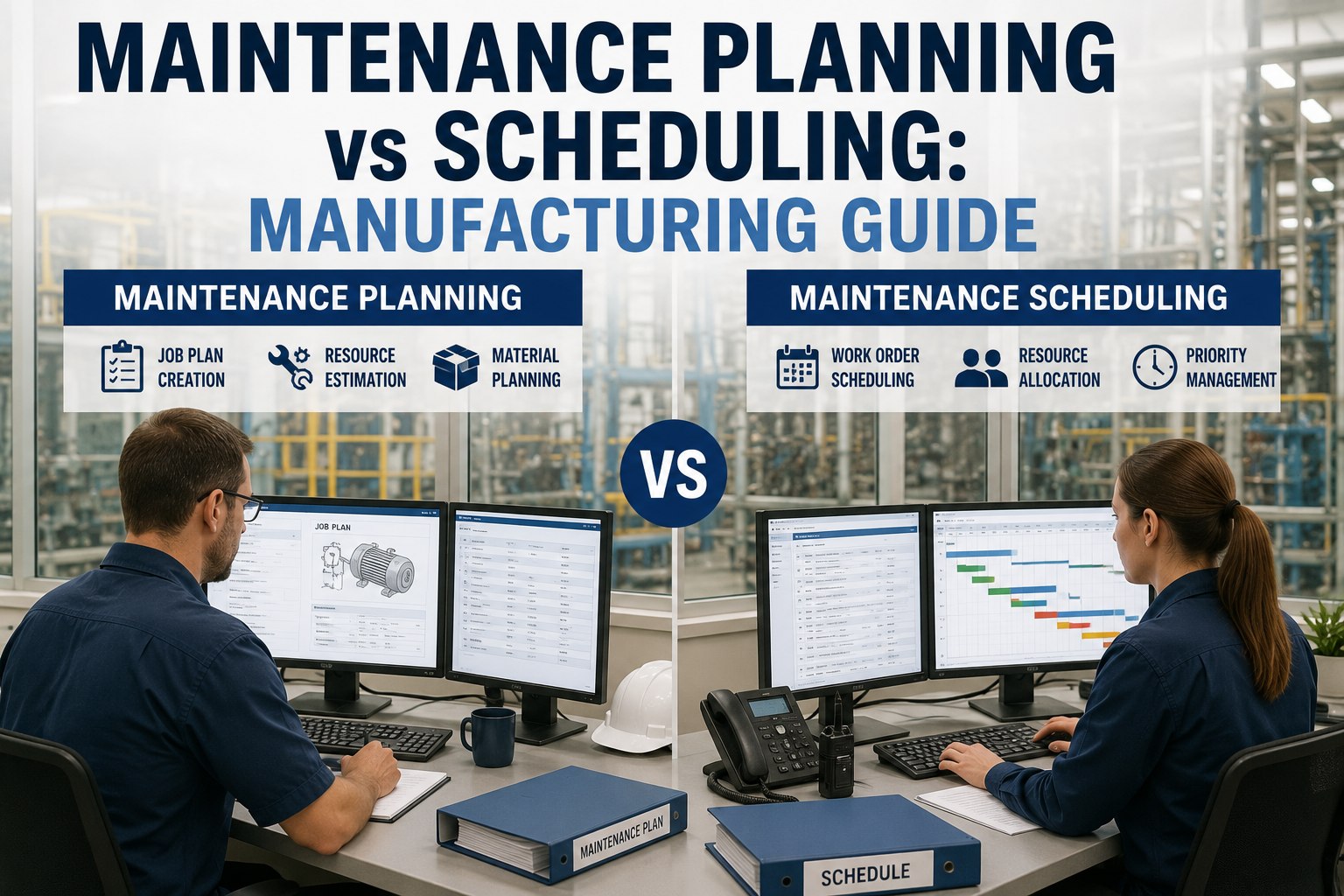
Maintenance planning and maintenance scheduling are two of the most misused terms in manufacturing operations — often treated as synonyms when they represent distinct, sequential functions that each require dedicated expertise. Whether you manage a single production floor or a multi-site plant portfolio, understanding the difference between maintenance planning and scheduling is the foundation of a high-performance maintenance program. Facilities that confuse the two roles consistently suffer from reactive backlogs, missed PMs, and technician idle time that drains maintenance budgets. Sign Up Free to bring structured planning and scheduling workflows to your plant maintenance operations today.
Unify Maintenance Planning and Scheduling with OxMaint CMMS
OxMaint gives maintenance planners and schedulers a shared platform — work orders, resource allocation, PM calendars, and compliance documentation in one place built for manufacturing plants.
Maintenance Planning vs Scheduling: The Core Distinction
The fundamental distinction is this: maintenance planning answers the question "what needs to be done and how?" while maintenance scheduling answers "when will it be done and by whom?" Planning is a technical function — a maintenance planner defines the scope, parts, tools, labor hours, and safety procedures for every work order before it enters the execution queue. Scheduling is a logistics function — a maintenance scheduler assigns that planned work to specific technicians based on availability, skill level, equipment access windows, and production priorities. The two functions are sequential and interdependent. Book a Demo to see how OxMaint structures both roles in a single connected workflow.
What the Planner Owns
- Defines job scope and step-by-step task procedures
- Identifies required parts, materials, and tools
- Estimates labor hours per craft trade
- Specifies permits — LOTO, confined space, hot work
- Builds equipment-specific work order templates
- Maintains technical asset history and documentation
- Reviews completed work for lessons learned capture
What the Scheduler Owns
- Assigns planned work orders to available technicians
- Coordinates equipment access windows with production
- Publishes weekly and daily maintenance schedules
- Balances labor capacity against planned work backlog
- Manages PM due-date compliance across the asset register
- Tracks schedule compliance KPIs week over week
- Re-prioritizes work during breakdowns and emergencies
The Maintenance Planner Role: Responsibilities and Skills
Job Plan Development
The planner converts a work request into a complete, executable job plan — identifying every task, part, and safety requirement before the work order reaches a technician. Well-crafted job plans are the single greatest driver of wrench-time improvement in maintenance organizations.
Parts and Materials Coordination
Planners work ahead of the schedule — typically 1–2 weeks — to identify, kit, and stage all parts required for upcoming planned work orders. Parts availability at job start is the leading cause of delay in unplanned maintenance; pre-staging eliminates this entirely.
Asset History and Documentation
Planners maintain equipment-specific libraries of job plans, technical manuals, failure history, and as-found/as-left records. This institutional knowledge base — ideally stored in a CMMS — prevents repeat failures and accelerates future work planning on the same asset.
Backlog Management
The planner owns the ready-to-schedule backlog — the queue of fully planned work orders that are parts-ready and permit-cleared, waiting only for a scheduled execution window. A healthy backlog of 4–6 weeks of planned work is the foundation of effective scheduling.
The Maintenance Scheduler Role: Responsibilities and Skills
Weekly Schedule Publication
The scheduler builds and publishes the weekly maintenance schedule — typically by Friday for the following week — matching available technician hours against the planner's ready-to-schedule backlog and production's equipment release windows. Weekly schedules are the primary coordination tool between maintenance and operations.
Capacity Planning and Labor Balancing
Schedulers calculate available craft hours — accounting for shifts, vacation, training, and emergency response reserves — and load planned work to approximately 80–90% of capacity to maintain schedule compliance while preserving flexibility for urgent corrective work.
Production Coordination
Schedulers negotiate equipment downtime windows with production supervisors, align PM schedules with planned outages and changeovers, and ensure maintenance access requirements are incorporated into the production calendar — minimizing both unplanned production interruptions and PM deferrals.
Schedule Compliance Tracking
The scheduler measures schedule compliance — the percentage of scheduled work completed as planned — and reviews compliance deviations weekly with the maintenance supervisor. World-class maintenance organizations target 90%+ weekly schedule compliance as a leading indicator of maintenance program health.
Key Differences: Maintenance Planning vs Scheduling at a Glance
| Dimension | Maintenance Planning | Maintenance Scheduling |
|---|---|---|
| Primary Question | What needs to be done and how? | When and by whom will it be done? |
| Time Horizon | 1–4 weeks ahead of execution | Daily and weekly execution windows |
| Key Output | Completed, parts-ready job plan | Published weekly technician schedule |
| Primary Interaction | Storeroom, vendors, engineering | Production supervisors, technicians |
| Core KPI | % of work orders fully planned before execution | Weekly schedule compliance rate |
| CMMS Function | Work order templates, BOM, job plans | Schedule boards, capacity views, PM calendars |
| Role Background | Experienced craft technician or engineer | Operations logistics or senior maintenance |
Why Separating Planning and Scheduling Increases Wrench Time
In maintenance organizations without dedicated planners, technicians perform their own planning — arriving at a job without correct parts, spending time locating tools, or waiting for permits. Studies from the Maintenance Excellence Institute consistently show that unplanned technicians spend only 25–35% of their shift on actual hands-on work; planned technicians achieve 55–65%. The economic return on a dedicated maintenance planner — typically one planner per 20–25 field technicians — is one of the highest ROI investments available to maintenance managers. Pair effective planning with a Sign Up Free CMMS that structures the entire workflow from request to completion.
How CMMS Bridges Maintenance Planning and Scheduling
Work Order Template Library
CMMS platforms store planner-created job plan templates linked to specific equipment assets — enabling one-click generation of fully planned work orders with pre-populated task lists, parts requirements, and estimated labor hours whenever a PM trigger fires or a corrective work request is approved.
Parts and Storeroom Integration
Integrated CMMS storeroom modules allow planners to reserve parts against planned work orders weeks in advance — generating automatic replenishment purchase orders when reserved quantities drop below reorder points and staging kits for technicians before job start.
Scheduling and Dispatch Boards
Visual schedule boards in CMMS give schedulers drag-and-drop tools to assign planned work orders to technicians across shifts and days — with real-time visibility into craft capacity, skill certifications, and current job status. Book a Demo to see OxMaint's scheduling board in action for your plant.
PM Calendar and Compliance Tracking
Preventive maintenance scheduling in CMMS automates PM due-date generation based on calendar intervals, meter readings, or runtime triggers — surfacing overdue PMs in the scheduler's queue and generating regulatory compliance documentation without manual log compilation.
Reporting and KPI Dashboards
Shared CMMS reporting gives both planners and schedulers visibility into backlog health, schedule compliance, PM completion rates, and mean time to repair — enabling data-driven continuous improvement reviews that progressively increase planning maturity and scheduling efficiency across the maintenance program. Sign Up Free to access OxMaint's maintenance KPI dashboards today.
Give Your Planners and Schedulers the CMMS They Need
OxMaint's work order planning, PM scheduling, storeroom integration, and schedule compliance dashboards are purpose-built for manufacturing maintenance teams ready to move beyond reactive firefighting.
Frequently Asked Questions: Maintenance Planning vs Scheduling
What is the main difference between a maintenance planner and a maintenance scheduler?
A maintenance planner prepares work orders with full job scope, parts, and procedures before execution. A maintenance scheduler assigns those planned work orders to technicians based on availability, skill, and production access windows. Planning is technical; scheduling is logistical.
Can one person handle both maintenance planning and scheduling?
In smaller facilities with under 10 technicians, a single planner-scheduler role is common. As the maintenance team grows, separating the roles produces significantly better results — each function requires different skills and time horizons that compete when combined.
How does a CMMS support maintenance planning and scheduling?
A CMMS stores job plan templates, manages the ready-to-schedule backlog, provides scheduling boards for work assignment, automates PM due dates, and tracks schedule compliance — giving planners and schedulers a shared operational system that replaces spreadsheets and manual coordination.
What is schedule compliance and why does it matter?
Schedule compliance is the percentage of scheduled work orders completed as planned within the scheduled week. It measures both planning quality and scheduling effectiveness. World-class targets are 90%+; most reactive plants start below 50% and improve as planning maturity grows.
What ratio of planners to technicians is recommended in manufacturing?
Industry best practice recommends one dedicated planner for every 20–25 field technicians. This ratio ensures planners work 1–2 weeks ahead of execution — maintaining a healthy planned backlog without becoming a bottleneck in the work order pipeline.
How does maintenance scheduling differ from preventive maintenance scheduling?
Maintenance scheduling covers all work order types — corrective, preventive, predictive, and project work. Preventive maintenance scheduling specifically refers to scheduling time-based or condition-based PM tasks from a recurring PM program. Both fall under the scheduler's coordination responsibilities.
Start Building a World-Class Planning and Scheduling Program
OxMaint CMMS gives manufacturing maintenance teams the work order planning tools, PM scheduling automation, and compliance tracking needed to achieve 90%+ schedule compliance — starting day one.