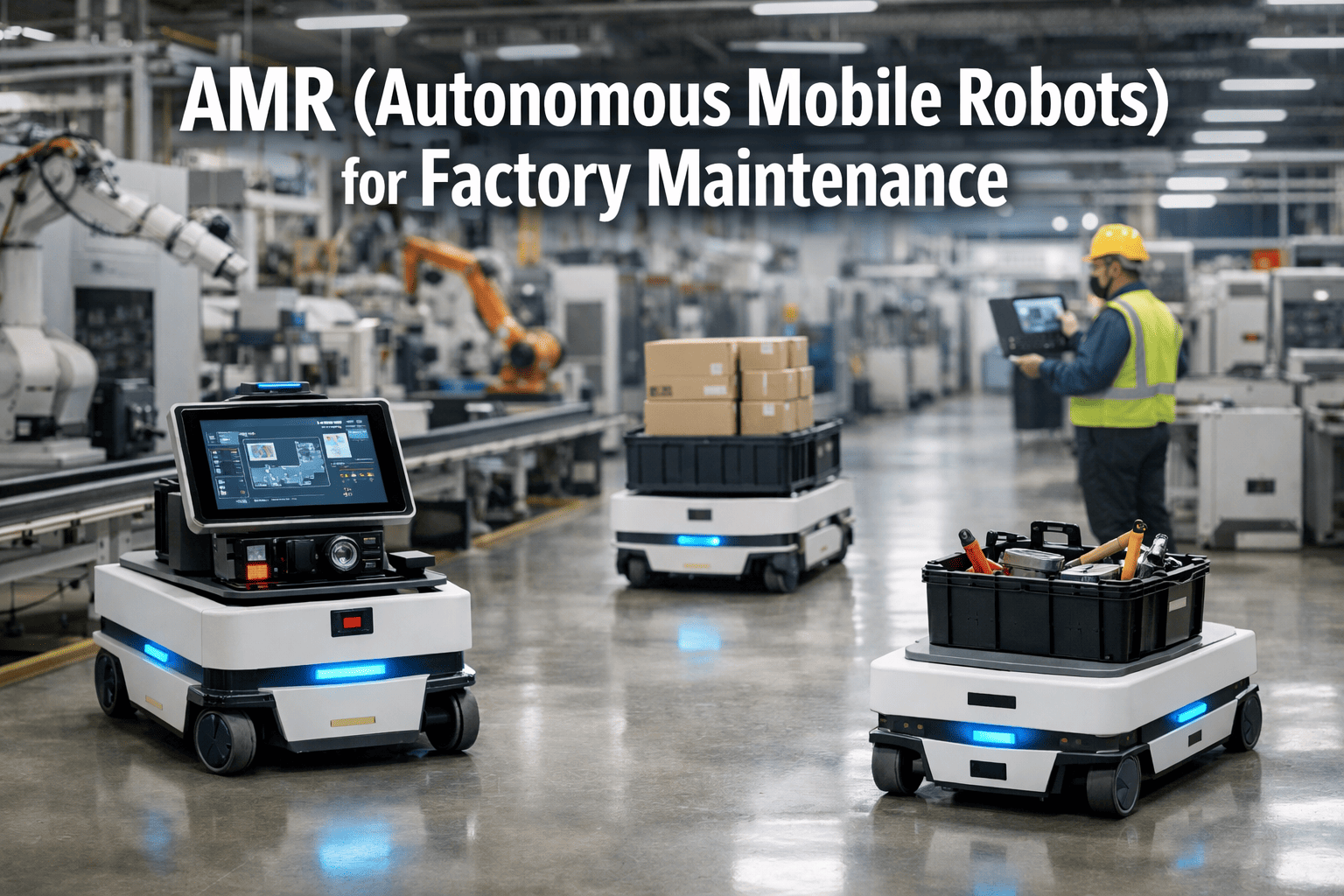
Best Autonomous Mobile Robots (AMRs) for Factory Maintenance in 2026
By oxmaint on February 12, 2026
Autonomous Mobile Robots are reshaping how factories handle inspections, asset monitoring, and predictive maintenance in 2026. Instead of relying on technicians to walk repetitive routes with clipboards, facilities now deploy AMRs equipped with AI vision cameras and thermal sensors that patrol production floors around the clock, capturing equipment health data that human eyes simply cannot match. Schedule a consultation to discover how AMR-integrated inspection management can transform uptime at your plant.
The Inspection Gap That AMRs Close
Manufacturing plants lose an estimated 800 hours per year to unplanned downtime, with a significant portion traceable to missed or delayed inspections. Manual rounds are inherently limited by shift schedules, technician availability, and human variability. AMRs armed with AI vision cameras eliminate these blind spots by delivering consistent, data-rich inspections at a frequency no human team can sustain.
73%
Of equipment failures show visible early warning signs that manual inspections miss
5x
More inspection data points captured per shift with AMR patrols vs. technician walkthroughs
24/7
Continuous coverage including nights, weekends, and holidays without fatigue or inconsistency
Stop losing uptime to missed inspections. Oxmaint connects AMR inspection data directly to maintenance workflows so every anomaly becomes an actionable task.
Not every mobile robot qualifies for factory maintenance work. Logistics AMRs that move pallets are built for payload capacity and route efficiency. Maintenance-grade AMRs are purpose-engineered for sensory intelligence, environmental resilience, and seamless integration with inspection management platforms like a CMMS.
Navigation Intelligence
LiDAR-based SLAM mapping navigates dynamic factory floors with forklifts, carts, and personnel moving unpredictably
Sub-centimeter positioning accuracy ensures the AI vision camera captures the same angle at every checkpoint across every patrol
Multi-terrain mobility handles oil-slick floors, metal grating, cable trays, and elevation changes common in manufacturing
Sensor Payload Architecture
AI vision cameras with 4K resolution and computational photography detect corrosion, leaks, gauge misreadings, and component wear
Radiometric thermal imaging identifies hot spots on motors, bearings, switchgear, and steam traps before failure escalation
Acoustic and ultrasonic microphones capture bearing degradation signatures and compressed air leak frequencies
CMMS Integration Layer
Open APIs push structured inspection reports with timestamped images, thermal maps, and severity scores into platforms like Oxmaint
Auto-generated work orders include asset ID, location coordinates, anomaly type, and AI-recommended corrective action
Historical trend data from repeated patrols feeds predictive maintenance models that forecast failure windows
2026 AMR Platforms Ranked for Inspection Performance
The market has matured rapidly, with distinct categories emerging for different factory environments and inspection requirements. Here is how the leading platforms compare specifically for maintenance inspection use cases.
Modular sensor mounts for thermal and optical payloads
Flat-floor warehouses and light manufacturing
Cloud API, work order triggers
AI Vision Camera: The Core Inspection Engine
The AI vision camera payload is what separates a maintenance AMR from a simple mobile platform. These are not standard surveillance cameras. They are computational imaging systems trained on millions of industrial failure mode images, capable of detecting subtle visual anomalies that experienced technicians might overlook.
What AI Vision Cameras Detect on Patrol
Thermal Anomalies
Overheating bearings, loose electrical connections, blocked heat exchangers, and failing steam traps produce thermal signatures detectable 2-6 weeks before mechanical failure occurs.
Surface Degradation
AI models trained on corrosion, paint blistering, rust propagation, and coating delamination patterns measure degradation rates and predict when structural integrity thresholds will be breached.
Leak Detection
Visual detection of fluid weeping, pooling, staining patterns, and drip traces on pipes, valves, flanges, and hydraulic fittings. AI differentiates condensation from actual process fluid leaks.
Gauge and Dial Reading
Optical character recognition reads analog gauges, pressure dials, level indicators, and digital displays. Out-of-range values trigger immediate alerts with photographic evidence.
Component Displacement
Baseline comparison imaging detects shifted equipment, loosened bolts, missing guards, open access panels, and displaced safety covers across patrol checkpoints.
Environmental Hazards
Floor-level obstruction detection, spill identification, blocked emergency exits, and fire hazard recognition protect both personnel safety and regulatory compliance.
See AI vision inspection in action. Book a personalized demo and we will show you how AMR-captured anomalies flow into prioritized Oxmaint work orders.
From Robot Patrol to Completed Repair: The Integrated Workflow
An AMR that captures data but cannot trigger action is an expensive data logger. The real value emerges when inspection findings flow directly into your maintenance management system, creating a closed loop from detection to resolution. Sign up for Oxmaint to build this integrated pipeline for your facility.
AMR-to-CMMS Inspection PipelineAutomated from detection to work order completion
A
Scheduled Patrol Execution
AMR follows programmed route, stopping at each inspection checkpoint. AI vision camera captures multi-angle images and thermal scans of every monitored asset.
B
Edge AI Analysis
Onboard processors run trained models against captured data in real time. Anomalies are classified by type, severity, and confidence score before leaving the robot.
C
CMMS Data Injection
Structured findings push to Oxmaint via API: asset ID, anomaly classification, thermal delta, visual evidence, GPS coordinates, and historical trend comparison.
D
Automated Work Order Generation
Critical findings auto-generate prioritized work orders assigned to the right technician with full context. Moderate findings queue for supervisor review during planning sessions.
E
Repair Verification Loop
After repair completion, the next AMR patrol automatically re-inspects the asset. AI confirms the anomaly is resolved or flags persistent issues for escalation.
Selecting the Right AMR for Your Factory Layout
Factory environments vary enormously. A pharmaceutical cleanroom demands a different robot than a steel mill floor. Matching the AMR platform to your specific conditions determines whether the investment delivers results or creates an expensive obstacle.
Environment-to-AMR Matching Guide
Factory Condition
Challenge
Recommended AMR Type
Key Consideration
Multi-level with stairs
Ground robots cannot access upper floors
Quadruped (Spot, ANYmal)
Stair climbing ability, elevator integration
Hazardous atmosphere
Explosion risk from electronics
ATEX-certified (ANYmal, ExR-2)
Zone 1/2 certification, intrinsic safety
Flat warehouse floor
Large area, repetitive layout
Wheeled AMR (Fetch, custom)
Battery range, charging infrastructure
Overhead structures
Ceiling cranes, pipe racks, HVAC
Indoor drone (Flyability Elios)
Flight time, confined space access
High-traffic zones
Dense forklift and personnel movement
Advanced obstacle avoidance AMR
Safety certification, dynamic replanning
Extreme temperature
Foundries, cold storage, furnace areas
Thermally rated quadruped or wheeled
Operating temperature range, lens protection
Build Your Inspection Management Foundation First
Before deploying AMRs, you need a CMMS that can receive, organize, and act on robotic inspection data. Oxmaint provides the digital backbone that turns AMR intelligence into completed maintenance tasks, tracked assets, and measurable uptime improvements across your entire operation.
Facilities that have operated AMR inspection fleets for 12 months or more report consistent, quantifiable improvements across maintenance efficiency, safety, and asset availability. These numbers reflect aggregated data from automotive, pharmaceutical, energy, and heavy manufacturing deployments.
Verified Factory Outcomes
65%
Reduction in unplanned downtime through early anomaly detection by AI vision cameras
70%
Faster anomaly-to-work-order cycle time with automated CMMS integration
55%
Decrease in manual inspection labor hours reallocated to skilled repair work
45%
Improvement in safety incident prevention by removing humans from hazardous inspection zones
Ready to quantify the impact for your facility? Create a free Oxmaint account and our team will help model the ROI of AMR-integrated inspection management for your specific asset portfolio.
AMR inspection programs fail not because of robot limitations but because of integration gaps, unrealistic expectations, or poor change management. Learning from early adopters prevents repeating their mistakes.
Critical Success Factors
PitfallDeploying without CMMS integration
AMR captures thousands of images but data sits in a separate portal. Technicians ignore it because findings are not part of their daily workflow.
Solution: Integrate AMR output into Oxmaint from day one. Every anomaly should appear as a work order or flagged inspection item within the system technicians already use. Sign up for Oxmaint to establish your integration-ready CMMS foundation.
PitfallSkipping the pilot phase
Full-site deployment before validating detection accuracy and workflow integration leads to alert fatigue, false positives, and technician distrust.
Solution: Start with one production zone and 15-20 critical assets. Calibrate AI models, tune alert thresholds, and validate work order quality before expanding.
PitfallTreating AMRs as technician replacements
Framing AMRs as job eliminators creates organizational resistance. Technicians sabotage adoption or ignore robot-generated findings.
Solution: Position AMRs as inspection force multipliers. Robots handle repetitive data collection; technicians focus on diagnosis, repair, and improvement. Schedule a consultation to discuss change management strategies.
Frequently Asked Questions
How accurate are AI vision cameras compared to trained inspectors?
Current AI vision models achieve 92-97% detection accuracy for trained anomaly categories like corrosion, leaks, and thermal hotspots. They excel at consistency since they never have a bad day, skip a checkpoint, or rush through a route. However, they complement rather than replace human judgment for complex diagnostic decisions. The AI finds the anomaly; the technician determines the root cause and repair strategy.
What does an AMR inspection program cost to implement?
Entry-level wheeled AMRs with basic camera payloads start around $50,000-$80,000. Advanced quadrupeds like Spot or ANYmal with full inspection sensor suites range from $150,000-$300,000 including software licensing. Most factories achieve payback within 12-18 months through reduced downtime and labor reallocation. Book a demo to model specific ROI projections for your operation.
Can AMRs operate safely alongside factory workers?
Yes. Maintenance AMRs are designed for human-occupied environments with multi-layered safety systems including 360-degree LiDAR, 3D depth cameras, and contact-sensitive bumpers. They comply with ISO 3691-4 for autonomous industrial vehicles and automatically stop, reroute, or slow down when people or vehicles enter their path.
How do AMR inspection findings integrate with our existing CMMS?
Leading AMR platforms provide REST APIs that push structured data into CMMS platforms. When paired with Oxmaint, each anomaly detection creates a work order containing the asset identifier, anomaly classification, severity score, thermal reading, photographic evidence, and recommended action. No manual data entry is required. Sign up for Oxmaint and start building this closed-loop workflow.
What factory conditions are currently too challenging for AMRs?
Current limitations include heavily flooded floors, aisles narrower than 60cm, environments with extreme electromagnetic interference, and areas above 50 degrees Celsius ambient temperature for extended periods. Quadruped robots handle stairs and rough terrain well, and indoor drones cover overhead areas. Approximately 85% of typical factory floor space is well within current AMR capabilities.
Your AMR Strategy Starts with the Right CMMS
The factories leading in 2026 are not just buying robots. They are building intelligent maintenance ecosystems where AMR inspection data flows seamlessly into work order management, asset tracking, and predictive analytics. Oxmaint provides that digital foundation, ready to receive robotic intelligence and convert it into measurable uptime gains across every asset on your floor.


.png)
.png)