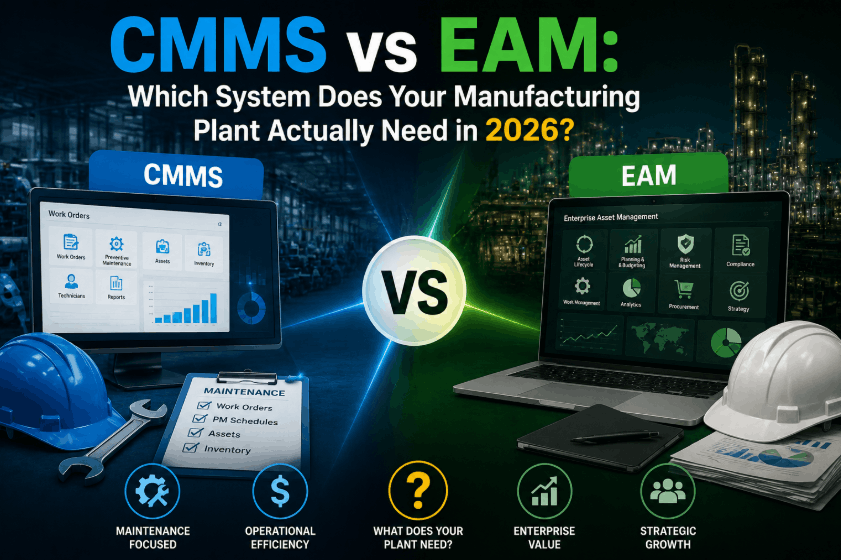
Choosing between a CMMS vs EAM is one of the most consequential software decisions a manufacturing plant can make in 2026. Both systems manage assets and maintenance — but they operate at fundamentally different scopes, depths, and costs. This guide cuts through the confusion with a clear breakdown of CMMS vs enterprise asset management, real-world use cases, cost implications, and a decision framework built for plant managers and operations leaders.
What Is a CMMS? Core Features and Use Cases
A Computerized Maintenance Management System (CMMS) is software designed to streamline maintenance operations — work orders, preventive maintenance schedules, parts inventory, and technician assignments. CMMS software for manufacturing plants is the operational backbone that keeps equipment running and unplanned downtime low. Most mid-size plants can be fully operational on a modern CMMS within 30 to 60 days — you can Sign Up Free on OxMaint and have your first work orders running the same day, a major differentiator over EAM platforms that typically require 6 to 18 months of implementation before delivering ROI.
Create, assign, track, and close corrective and preventive work orders. Full technician history and labor time logging on every asset.
Time-based and meter-based PM triggers that auto-generate work orders. Reduce reactive maintenance from 70%+ to under 30% within 12 months.
Real-time spare parts inventory, minimum stock alerts, and consumption tracking tied directly to work orders and asset records.
Complete maintenance history per asset, MTTR, MTBF, downtime trends, and maintenance cost reports that drive smarter capital decisions.
Field technicians access work orders, asset manuals, and checklists from mobile devices — eliminating paper-based maintenance workflows.
Manage third-party maintenance contractors, service history, and warranty records alongside internal maintenance activity.
What Is an EAM? How Enterprise Asset Management Goes Further
Enterprise Asset Management (EAM) software extends beyond maintenance operations to manage the full lifecycle of physical assets — from capital procurement and commissioning through depreciation, compliance, and decommissioning. The key distinction in the CMMS vs EAM comparison is scope: a CMMS asks "Is this asset maintained correctly?" while an EAM asks "Is this asset delivering the expected return on capital, and when should it be replaced?" If your plant manages tens of millions in fixed assets, operates under heavy regulatory requirements, or runs multi-site operations with consolidated financial reporting, EAM functionality becomes genuinely necessary — not just a nice-to-have. Curious how this maps to your operation? Book a Demo with OxMaint to walk through your specific asset portfolio.
| Capability | CMMS | EAM |
|---|---|---|
| Work Order Management | Full | Full |
| Preventive Maintenance Scheduling | Full | Full |
| Parts Inventory Control | Full | Full |
| Asset Lifecycle Management | Basic | Full |
| Capital Planning & Budgeting | Not included | Full |
| Depreciation & Financial Tracking | Not included | Full |
| Regulatory Compliance Modules | Limited | Full |
| Multi-Site Asset Consolidation | Basic | Full |
| ERP Integration Depth | Moderate | Deep |
| Implementation Time | 30–90 days | 6–18 months |
| Total Cost of Ownership | Low–Medium | High–Very High |
CMMS vs EAM: The 5 Decisive Differences for Manufacturing Plants
The difference between CMMS and EAM is not simply a matter of features — it is a difference in organizational scope, user base, and strategic purpose. Here are the five dimensions that matter most when evaluating which system your manufacturing plant actually needs in 2026.
A CMMS focuses on keeping assets running efficiently. An EAM manages the financial and operational lifecycle from acquisition to disposal — including capital spend justification, depreciation schedules, and decommissioning workflows. For most plants under $50M in annual revenue, the lifecycle management layer of EAM adds cost without proportional value.
CMMS users are primarily maintenance managers, planners, and technicians. EAM systems serve a broader audience — adding finance controllers, procurement managers, compliance officers, and executive leadership. If your CFO or auditors need direct system access for asset reporting, EAM is warranted; otherwise, a CMMS delivers everything needed.
CMMS systems track maintenance labor and parts costs per asset. EAM systems integrate with general ledger systems to track total asset cost of ownership, depreciation, insurance, and capital replacement forecasting — necessary only when maintenance costs must flow automatically into financial statements.
Industries with strict requirements — pharmaceutical, food processing, aerospace — often need EAM-level compliance documentation: 21 CFR Part 11 support, ISO 55000 alignment, and full audit trail depth. For standard manufacturing without heavy regulatory burden, CMMS compliance tracking is typically sufficient.
EAM implementations routinely cost $250,000 to $2M+ with go-live timelines of 12 to 24 months. CMMS platforms deploy in weeks at a fraction of the cost. For plants where maintenance efficiency is the primary ROI driver, a modern CMMS delivers 80 to 90% of EAM value at 10 to 20% of the cost.
When to Use a CMMS vs EAM: A Decision Framework for 2026
The most important question is not "which system has more features?" — it is "which system matches where our operation actually is today, and where it will be in three years?" Use the framework below to identify the right choice. If you want to map this to your specific situation, Book a Demo and work through it with an OxMaint implementation specialist.
CMMS Upgrade to EAM: When and How to Make the Transition
The key upgrade triggers are: your CFO needs asset depreciation data flowing automatically into the general ledger; you are managing $50M+ in fixed assets across 5+ locations; or regulatory requirements demand audit trail depth beyond CMMS capability. If none of these apply today, a well-implemented CMMS is the right answer — and you can Sign Up Free on OxMaint to build the maintenance data foundation that makes any future EAM migration significantly smoother.
Best CMMS and EAM Software for Manufacturing Plants in 2026
The best CMMS EAM 2026 landscape has shifted significantly — cloud-native platforms have closed the gap between CMMS and EAM functionality, while traditional EAM vendors face pressure from leaner competitors. OxMaint is purpose-built for manufacturing maintenance teams that need real CMMS power without the implementation overhead of legacy platforms, and plants that need to demonstrate maintenance ROI within 90 days consistently choose it as their platform. If that matches your timeline and objectives, Book a Demo to see a live plant workflow walkthrough.
| Platform Type | Best For | Implementation Time | Typical Cost | EAM Depth |
|---|---|---|---|---|
| Cloud CMMS (OxMaint) | SMB–Mid-size manufacturing, fast deployment | 2–8 weeks | $–$$ | CMMS + growing EAM features |
| Legacy CMMS | Mid-size plants with IT resources | 3–6 months | $$–$$$ | Moderate |
| Full EAM Suite (IBM Maximo, SAP PM) | Large enterprise, multi-site, heavy compliance | 12–24 months | $$$$ | Full |
| ERP-Embedded EAM (SAP S/4, Oracle) | Already on SAP/Oracle ERP | 18–36 months | $$$$+ | Full + Financial |
How OxMaint Bridges CMMS and EAM for Manufacturing Plants
OxMaint was designed with a clear thesis: most manufacturing plants need more than a basic work order tracker, but far less than a $1M EAM implementation. The platform delivers the full CMMS core — preventive maintenance scheduling, parts inventory with real-time consumption tracking, mobile work orders, and comprehensive asset history — while adding the asset visibility and reporting depth that operations and plant managers actually use for capital and sourcing decisions. Plants weighing the CMMS or EAM for manufacturing decision can Sign Up Free and explore the full feature set on a live account with their own asset data.
The Right System Depends on Where You Are — Not Where You Want to Be
The CMMS vs EAM decision for manufacturing plants comes down to an honest assessment of operational scale, user base, financial integration requirements, and implementation capacity. For the vast majority of manufacturing plants in 2026 — operating 1 to 5 locations, focused on uptime and maintenance cost reduction, without heavy ERP financial dependencies — a modern cloud-native CMMS is the correct tool that delivers fast ROI, low total cost of ownership, and the operational visibility needed to make better maintenance and procurement decisions every day. EAM investment is justified only when asset portfolios reach enterprise scale, finance teams require system-level integration with asset accounting, and regulatory complexity demands audit trail depth beyond maintenance records.
.png)

.png)