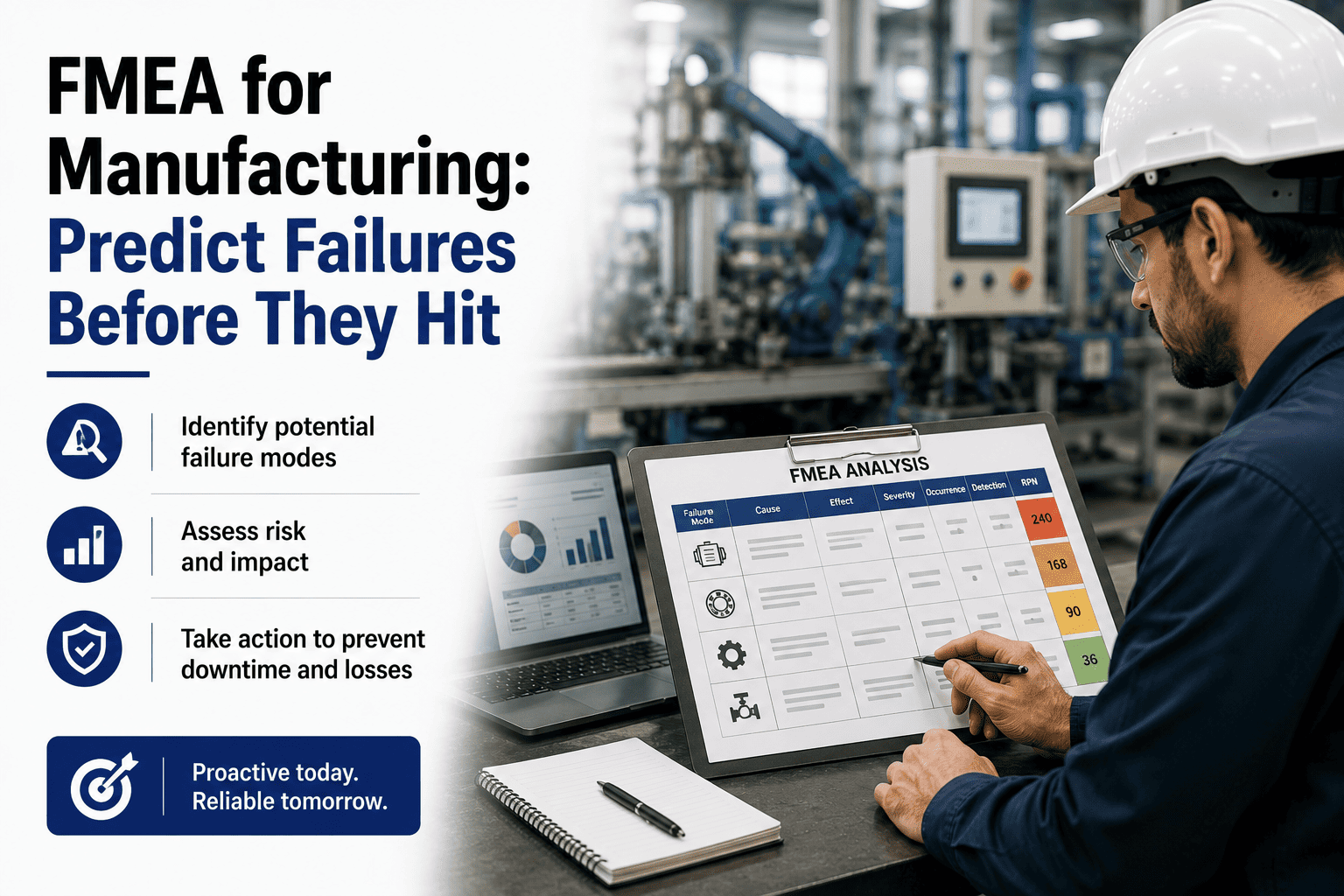
Failure Mode and Effects Analysis (FMEA) is a structured, systematic reliability engineering method used in manufacturing to identify every potential way a process, product, or asset can fail — and assess the impact of each failure before it occurs. Originally developed by the U.S. military in the 1940s and adopted across aerospace, automotive, and process manufacturing, FMEA has become the foundational risk assessment tool that connects asset knowledge to preventive and predictive maintenance planning. When integrated with a digital CMMS like OxMaint, FMEA analysis moves from a static document exercise into a live, asset-linked risk management workflow — where failure modes drive PM task generation, spare parts planning, and inspection frequency. Sign Up Free to connect your FMEA findings directly to asset records, work orders, and maintenance schedules in OxMaint.
Connect FMEA Findings to Live Maintenance Planning
OxMaint links your failure mode analysis directly to asset records, PM schedules, and inspection workflows — turning FMEA from a document into a living maintenance strategy.
What is Failure Mode and Effects Analysis (FMEA)?
FMEA is a proactive risk assessment methodology that systematically asks three questions for every component or process step: What can fail? What happens when it fails? How do we detect it before or when it does? The output is a structured register of failure modes, each scored on Severity (S), Occurrence (O), and Detectability (D) — multiplied into a Risk Priority Number (RPN) that ranks which failure modes demand the most urgent preventive attention. In manufacturing, FMEA analysis is applied at the design stage (DFMEA), the process stage (PFMEA), and increasingly at the asset reliability level — where it directly informs CMMS maintenance strategies, inspection routes, and spare parts stocking decisions. Book a Demo to see how OxMaint connects each RPN score to a triggered PM task or condition-monitoring check.
The 5 Core Elements of Every FMEA Analysis
Failure Mode
The specific way a component, process, or system can fail — bearing seizure, seal leak, voltage spike, misalignment, contamination ingress. Each failure mode is listed and analysed independently.
Failure Effect
The consequence of the failure mode on the process, product quality, safety, or downstream operations — production stoppage, scrap generation, equipment damage, safety incident.
Severity (S) Score
Rated 1–10. How serious is the consequence if this failure mode occurs? Safety and regulatory failures score highest; cosmetic or negligible effects score lowest.
Occurrence (O) Score
Rated 1–10. How frequently is this failure mode likely to occur based on historical data, design knowledge, and operational experience?
Detection (D) Score
Rated 1–10. How difficult is it to detect this failure mode before it causes the effect? High scores indicate failures that are hard to catch before damage occurs.
Risk Priority Number (RPN)
RPN = S × O × D. The composite risk score that prioritises which failure modes need immediate preventive action, design change, or enhanced monitoring.
How to Conduct an FMEA: Step-by-Step Process
Step 01
Define the Scope
Select the asset, process, or system to analyse. Define boundaries — which sub-systems, components, or process steps are in scope.
Step 02
Identify Failure Modes
For each component or process step, list every possible failure mode. Use maintenance history, OEM manuals, and reliability databases as inputs.
Step 03
Assess S, O, D Scores
Score each failure mode on Severity, Occurrence, and Detection using your defined rating scale. Involve operations, maintenance, and engineering.
Step 04
Calculate RPN and Prioritise
Compute RPN = S × O × D for each failure mode. Rank by RPN. Focus resources on high-RPN items with the greatest combined risk exposure.
Step 05
Define and Assign Actions
For high-RPN failures, assign preventive actions — PM tasks, inspection intervals, design changes, spare parts pre-positioning, or condition monitoring triggers.
FMEA Example: Manufacturing Equipment Failure Modes
Scroll →
| Component |
Failure Mode |
Failure Effect |
Severity (S) |
Occurrence (O) |
Detection (D) |
RPN |
Recommended Action |
| Spindle Bearing |
Bearing seizure due to lubrication loss |
CNC machine stoppage, spindle damage |
9 |
4 |
6 |
216 |
Add vibration monitoring; reduce lube interval |
| Hydraulic Pump Seal |
Seal degradation — fluid leak |
Pressure loss, cycle abort, fluid contamination |
8 |
5 |
5 |
200 |
Scheduled seal replacement at 3,000 hrs; pressure trend monitoring |
| Conveyor Drive Belt |
Belt wear and slippage |
Tracking fault, production interruption |
6 |
6 |
4 |
144 |
Visual inspection monthly; replace at 18-month interval |
| Air Compressor Filter |
Filter blockage — reduced airflow |
Thermal trip, compressor shutdown |
7 |
5 |
3 |
105 |
Quarterly filter replacement; pressure differential alarm |
| Process Pump Impeller |
Impeller wear — reduced flow rate |
Under-spec output, product quality impact |
7 |
3 |
5 |
105 |
Flow rate trending; impeller inspection at annual shutdown |
| MCC Overload Relay |
Incorrect trip set-point after motor change |
Nuisance trips, production loss |
5 |
3 |
4 |
60 |
Post-maintenance parameter verification checklist |
FMEA vs FMECA: Understanding the Difference
FMEA
Identifies failure modes and assesses their effects
Scores Severity, Occurrence, and Detection (S × O × D = RPN)
Prioritises maintenance actions by RPN ranking
Standard across automotive, process, and discrete manufacturing
Focuses on failure prevention and detection improvement
Foundation for PM task and inspection planning
FMECA
Extends FMEA by adding Criticality Analysis (CA)
Quantifies failure probability and mission-loss consequence
Produces a criticality matrix ranking failure modes by impact
Common in aerospace, defence, and high-consequence industries
Supports asset criticality classification and maintenance strategy selection
More rigorous — used when quantitative reliability data is available
How FMEA Connects to Preventive and Predictive Maintenance
FMEA analysis is only as valuable as the maintenance actions it generates. High-RPN failure modes should directly translate into scheduled PM tasks, condition monitoring triggers, or spare parts stocking decisions — not sit in a static spreadsheet. OxMaint bridges this gap: failure modes identified in your FMEA register link directly to asset records in the CMMS, with PM tasks generated at the frequencies your FMEA recommends. Book a Demo to see how OxMaint translates FMEA outputs into scheduled work orders, inspection checklists, and real-time condition alerts — or Sign Up Free and connect your first FMEA findings to live maintenance workflows today.
1
High-RPN Failure Modes
FMEA Output
Critical failure modes ranked by RPN become the input list for maintenance strategy decisions — not generic OEM recommendations.
2
PM Task Generation
CMMS Integration
Each high-RPN failure mode maps to a scheduled PM task in OxMaint — with the right interval, trade, checklist, and spare parts pre-assigned.
3
Condition Monitoring
Predictive Layer
High-severity, low-detection failure modes trigger condition monitoring requirements — vibration, temperature, pressure trend alerts configured in OxMaint.
4
RPN Reduction Tracking
Continuous Improvement
As PM compliance improves and failures reduce, FMEA is updated with new occurrence data — OxMaint failure history feeds directly back into the analysis cycle.
What FMEA-Driven Maintenance Delivers in Manufacturing
60%
Of unplanned breakdowns are caused by failure modes that FMEA would have identified and prevented
RPN
Risk Priority Number scoring ensures maintenance resources focus on failures with the highest real-world impact
Live
OxMaint connects FMEA outputs to live PM schedules, inspection routes, and spare parts plans — not static spreadsheets
34%
Reduction in repeat failures when FMEA findings drive structured root cause and corrective maintenance workflows
Turn Your FMEA Register Into a Live Maintenance Strategy
OxMaint maps failure mode risk priority numbers directly to PM tasks, inspection checklists, and condition monitoring alerts — so your FMEA analysis drives real maintenance decisions, not just documentation.
Book a Demo to see FMEA-driven maintenance planning in action, or
Sign Up Free and connect your first failure mode register to OxMaint today.
Frequently Asked Questions
What is FMEA in manufacturing?
FMEA (Failure Mode and Effects Analysis) is a structured method for identifying every way a manufacturing process or asset can fail, assessing the severity and likelihood of each failure, and prioritising preventive actions by Risk Priority Number (RPN = Severity × Occurrence × Detection).
What is a Risk Priority Number (RPN) in FMEA?
RPN is calculated as Severity × Occurrence × Detection, each scored 1–10. The higher the RPN, the greater the combined risk of that failure mode — and the higher its priority for preventive maintenance action or design improvement.
What is the difference between DFMEA and PFMEA?
DFMEA (Design FMEA) analyses failure modes during product design. PFMEA (Process FMEA) analyses failure modes in manufacturing processes and operations. Both feed into reliability planning and maintenance strategy development.
How does FMEA connect to preventive maintenance planning?
High-RPN failure modes from FMEA directly define what PM tasks are needed, at what frequency, and with what spare parts. OxMaint links FMEA findings to asset-level PM schedules and inspection checklists automatically.
Can OxMaint support FMEA-driven maintenance workflows?
Yes. OxMaint allows maintenance teams to build failure mode registers against assets, assign RPN-based PM tasks, configure condition monitoring alerts, and track failure history — creating a closed-loop FMEA-to-maintenance workflow in one platform.
How often should FMEA be reviewed in manufacturing?
FMEA should be reviewed whenever a significant failure occurs, after a design or process change, and at regular intervals (typically annually). OxMaint failure data provides the historical evidence needed to update occurrence scores and reprioritise the RPN register.
Free to Start — No Credit Card Required
From FMEA Analysis to Live Maintenance Action — In One Platform
OxMaint connects failure mode and effects analysis outputs to digital PM schedules, inspection workflows, and real-time condition monitoring — so every RPN score drives a maintenance decision, not just a spreadsheet row.
-in-manufacturing.png)