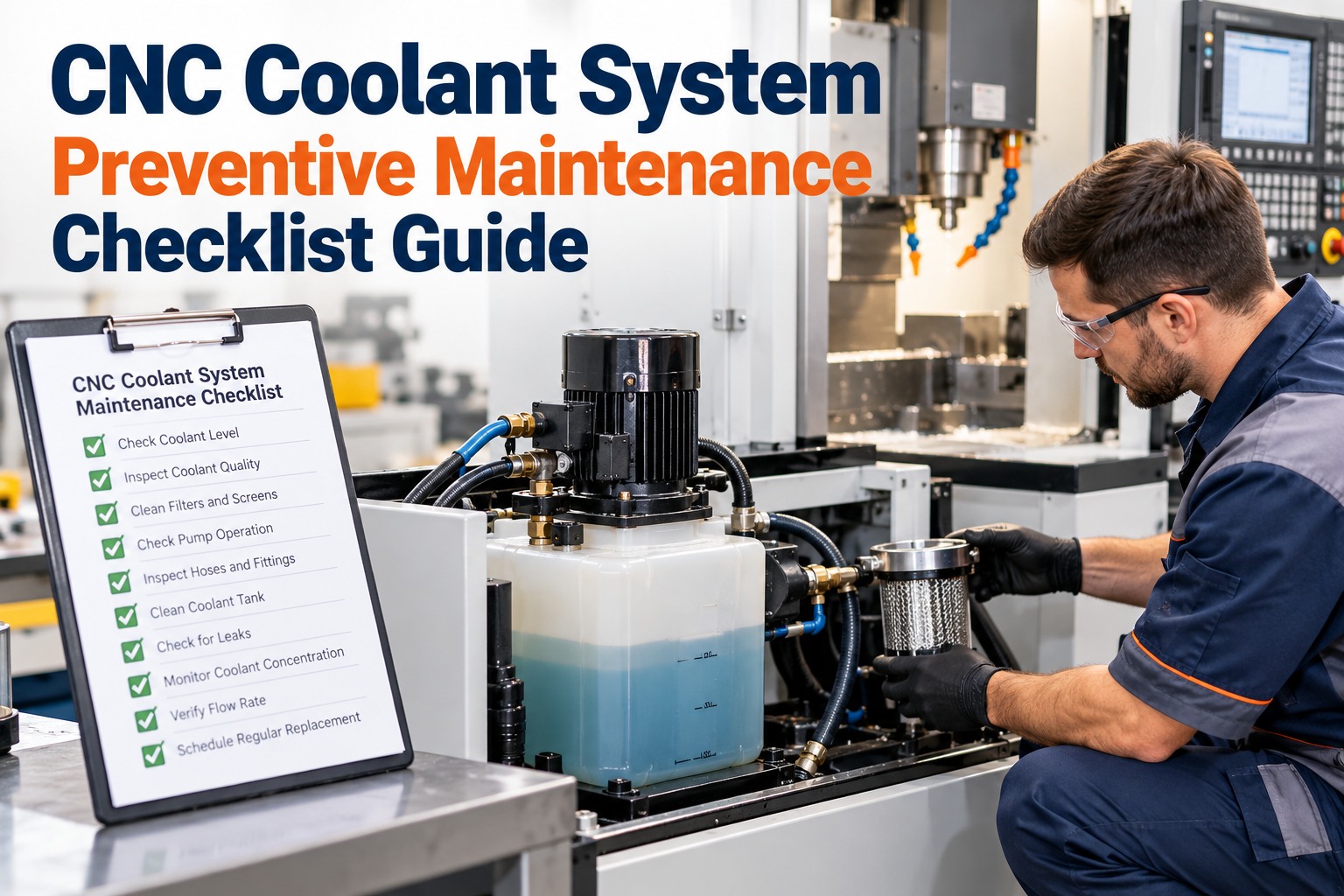
A CNC machine that skips its preventive maintenance schedule does not fail dramatically — it drifts. Tolerances slip by microns, spindle temperatures creep upward, coolant concentration drops silently, and by the time a breakdown arrives, weeks of compounding damage have already eaten into part quality and production output. With unplanned downtime costing manufacturing operations an average of $260,000 per hour and the typical shop facing over 800 hours of equipment downtime annually, a structured PM programme is not optional — it is the difference between predictable production and crisis management. This daily, weekly and monthly CNC preventive maintenance checklist gives your maintenance team and machine operators a structured, shop-floor-ready inspection programme covering every critical subsystem — spindle, axis drives, coolant, tooling, electrical cabinet, and controller — so nothing gets missed and every check is documented.
Smart Factory & Industry 4.0 · CNC Maintenance · Preventive Checklist
CNC Machine Preventive Maintenance Checklist
Daily, weekly and monthly PM tasks for spindle health, axis calibration, coolant systems, tooling integrity, electrical cabinets and controller backups — structured by interval for shop-floor execution.
$260K
Average cost per hour of unplanned manufacturing downtime
5x
Reactive repair cost vs. structured preventive maintenance
0.0001"
Precision tolerance CNC machines maintain with proper PM
30%
Downtime reduction with consistent preventive maintenance
Why PM Matters
What Happens When CNC Maintenance Gets Skipped
CNC machines are built to hold tolerances within ten-thousandths of an inch — but that precision is not self-sustaining. When preventive maintenance is inconsistent, failure modes follow a predictable and expensive pattern. Understanding where breakdowns originate helps maintenance teams prioritise the right checks at the right intervals.
Week 1-2
Silent Drift Begins
Lubrication levels drop, coolant concentration shifts, chip buildup traps heat around guide rails. No alarms fire. No parts fail inspection — yet.
Week 3-4
Quality Starts Slipping
Spindle runout increases. Ball screw backlash accumulates. Surface finishes degrade on precision cuts. Scrap rate ticks upward but root cause is unclear.
Week 5-8
Unplanned Breakdown
Spindle bearing fails catastrophically. Hydraulic seals blow. The machine is down for days — emergency parts, overtime labour, missed delivery deadlines.
Subsystem Map
Six Critical CNC Subsystems Your PM Programme Must Cover
Every item in a CNC maintenance checklist connects to one of six core subsystems. When technicians understand which subsystem each task protects, they make better decisions about when to escalate versus when to continue production.
Spindle System
Highest-value, highest-risk component. Bearing failure is catastrophic and expensive — daily temperature checks and monthly runout measurement are non-negotiable.
Axis & Drive
Ball screws, linear guides and servo motors determine positional accuracy. Backlash accumulates gradually — trending measurements matter more than any single reading.
Coolant & Hydraulics
Coolant neglect leads to bacterial growth, incorrect concentration and accelerated tool wear. Hydraulic fluid contamination causes failures that take machines offline for days.
Tooling & Holders
Tool holder taper contamination causes runout problems instantly. Drawbar retention force must be verified — even a small chip affects precision.
Electrical Cabinet
Overheating is the leading cause of electronic failures in CNC controls. Clogged cabinet filters restrict airflow and accelerate component aging.
Controller & Software
Parameter backups protect against data loss from power failures or software updates. Alarm log review catches developing issues before they become breakdowns.
Daily Checklist
Daily CNC Maintenance Tasks (10-15 Minutes Per Machine)
Daily checks should be completed before production begins each shift. These are the highest-frequency, lowest-effort tasks that prevent the most common and costly failures. Every item takes seconds to verify but has outsized consequences when skipped.
Spindle & Tooling
Warm up spindle using manufacturer-specified RPM ramp-up routine before running production cuts
Operator · Log: Warm-up time and any abnormal noise
Listen for abnormal spindle noise during warm-up — whining, grinding or vibration is an immediate stop-and-inspect trigger
Operator · Log: Pass/Fail with description
Clean tool holder tapers and spindle taper with lint-free cloth — even a small chip causes runout problems
Operator · Log: Completion sign-off
Verify chuck pressure is at correct operating level and grease chuck per manufacturer recommendation
Operator · Log: Pressure reading
Lubrication & Fluids
Verify auto-lube system is operational and oil level is adequate — inadequate lubrication is a leading cause of CNC mechanical failure
Operator · Log: Lube level and system status
Check hydraulic fluid level and verify pressure gauge reads within operating range (typically 4.5 MPa)
Operator · Log: Fluid level and pressure reading
Inspect coolant level and concentration — top up and adjust if below specification
Operator · Log: Refractometer reading
Cleaning & Visual Inspection
Remove chips, dust and debris from machine bed, table, enclosure and way covers — buildup traps heat and accelerates wear
Operator · Log: Completion sign-off
Verify chip conveyor is running freely and removing chips from coolant tank effectively
Operator · Log: Pass/Fail
Check for oil or coolant leaks around spindle housing, hydraulic lines, and way covers
Operator · Log: Leak location if found
Weekly Checklist
Weekly CNC Maintenance Tasks (Every 40 Operating Hours)
Weekly maintenance digs deeper to catch gradual issues before they affect production accuracy. These tasks require slightly more time but catch developing problems that daily checks cannot detect — axis drift, filter degradation and bearing wear patterns.
Axis & Motion Systems
Inspect ball screws and linear guides for visible wear, scoring or contamination — listen for abnormal noise during rapid movement
Maintenance Tech · Log: Visual inspection report
Check for backlash or unusual play during axis movement — trend readings over time to detect gradual deterioration
Maintenance Tech · Log: Backlash measurement per axis
Inspect and lubricate way covers — wipe down stainless steel covers with hydraulic oil for smooth retraction and extension
Maintenance Tech · Log: Way cover condition
Electrical & Cabinet
Remove CNC control cabinet filter and clean thoroughly — clogged filters restrict airflow and cause electronic overheating
Maintenance Tech · Log: Filter condition and cleaning record
Inspect electrical connections and cable runs for signs of wear, chafing or loose terminals
Maintenance Tech · Log: Inspection sign-off
Safety & Accuracy
Test emergency stop, interlocks and limit switches — worn or corroded safety devices go undetected without documented testing cycles
Operator / Safety · Log: E-stop and interlock test record
Measure spindle runout using a dial indicator and compare to baseline — any drift from spec warrants investigation
Maintenance Tech · Log: Runout reading vs baseline
Inspect tool holders for damage, excessive wear or taper contamination — verify drawbar retention force with a pull-force gauge
Maintenance Tech · Log: Retention force reading
Stop tracking CNC maintenance on paper. OxMaint turns every checklist item into a digital task with photo evidence, auto-reminders and inspection-ready reports.
Monthly Checklist
Monthly CNC Maintenance Tasks (Deep Inspection Cycle)
Monthly tasks catch issues that daily and weekly checks cannot surface — fluid contamination, filter degradation, bearing wear progression and machine-level accuracy drift. These inspections are the backbone of long-term machine health and should be scheduled during planned downtime windows.
Coolant & Hydraulic Systems
Drain coolant tank completely, remove accumulated chips and sludge not caught by conveyor, inspect for bacterial growth, clean and refill with fresh coolant at correct concentration
Maintenance Tech · Log: Tank condition photos + new coolant concentration
Test hydraulic oil for contamination, check for unusual fluid consumption trends, and replace hydraulic filters
Maintenance Tech · Log: Oil sample results + filter replacement record
Precision & Calibration
Check machine levelling — thermal cycling over weeks shifts levelling, affecting positional accuracy in ways calibration alone cannot correct
Maintenance Tech · Log: Level readings per axis
Calibrate machine axes using manufacturer-specified procedure and record deviations from last calibration
Maintenance Engineer · Log: Calibration certificate with deviation trend
Measure spindle bearing temperature after extended operation and compare to manufacturer specifications — rising baseline indicates bearing wear
Maintenance Tech · Log: Temperature readings vs spec
Mechanical & Electrical
Inspect and replace gearbox filters, check belt tension and condition, and re-torque motor mounting bolts
Maintenance Tech · Log: Filter, belt and torque records
Inspect way covers for dents, misalignment or corrosion and replace any damaged covers immediately
Maintenance Tech · Log: Way cover condition report
Back up all CNC programmes, tooling offsets and machine parameters to secure external storage — verify backup integrity
CNC Programmer / IT · Log: Backup verification record
Review controller alarm logs for recurring fault codes and investigate any patterns indicating developing mechanical or electrical issues
Maintenance Engineer · Log: Alarm trend analysis
Quick Reference
CNC PM Frequency Summary
Use this table as a quick-reference guide for assigning tasks to operators and maintenance technicians across all three intervals.
| Subsystem |
Daily (Pre-Shift) |
Weekly (40 Hrs) |
Monthly (Deep PM) |
| Spindle |
Warm-up routine, noise check |
Runout measurement, temp check |
Bearing temp trend, vibration analysis |
| Axis / Drive |
Visual inspection |
Backlash check, guide lubrication |
Full axis calibration, levelling |
| Coolant |
Level and concentration check |
Filter condition, flow verification |
Full tank drain, clean and refill |
| Hydraulics |
Fluid level, pressure reading |
Leak inspection, line check |
Oil sample, filter replacement |
| Tooling |
Taper cleaning, chuck grease |
Holder inspection, drawbar force |
Full tooling audit, collet check |
| Electrical |
Visual check for leaks/damage |
Cabinet filter clean, connection check |
Motor torque, belt check, alarm review |
| Safety |
Guard check, area clean |
E-stop test, interlock verification |
Full safety device audit |
| Controller |
Alarm review |
Error log check |
Full backup, parameter verification |
Why OxMaint
From Clipboard Checklists to Digital PM Records
Paper-based CNC maintenance tracking is unreliable — technicians forget to document tasks, paperwork gets lost, and there is no way to analyse trends or predict when problems will occur. OxMaint replaces the clipboard with a system that makes every PM task trackable, accountable, and audit-ready.
01
Auto-Triggered PM Work Orders
Configure daily, weekly and monthly CNC PM schedules once. OxMaint auto-generates work orders at each interval, assigns them to the right technician and tracks completion — no manual scheduling required.
02
Photo-Verified Completions
Every checklist item requires a timestamped photo and technician sign-off before it can be marked complete. When a maintenance audit asks for proof, you have it instantly — not buried in a filing cabinet.
03
Trend Tracking Per Machine
Spindle runout readings, backlash measurements and coolant concentration logs are recorded digitally and trended over time — making it easy to spot degradation patterns before they cause breakdowns.
04
Spare Parts Inventory Integration
OxMaint links PM tasks directly to your parts inventory — so technicians know part availability before they open a job, eliminating the delays that turn a 2-hour fix into a multi-day outage.
FAQs
Frequently Asked Questions
How long does daily CNC preventive maintenance take per machine?
Daily PM takes 10 to 15 minutes per machine when completed before the production shift begins. The tasks — spindle warm-up, fluid checks, cleaning and visual inspection — are designed for operator execution without maintenance technician involvement.
Start tracking daily PM digitally with OxMaint.
What is the single most important CNC maintenance task to never skip?
Auto-lube system verification ranks as the highest-impact single item. Inadequate lubrication is a leading cause of mechanical failure in CNC equipment — and the check takes under a minute. Monthly coolant tank cleaning is the second-highest priority due to bacterial growth and tool wear consequences.
Book a demo to see how OxMaint ensures no critical task gets skipped.
How does preventive maintenance affect CNC machine lifespan?
CNC machines with consistent preventive maintenance routinely produce parts at near-factory specifications for 15 to 20 years. Machines without structured PM programmes degrade faster, require more expensive reactive repairs, and lose positional accuracy years earlier.
Sign up for OxMaint to build your PM programme today.
Can operators perform CNC maintenance or does it require technicians?
Operators can handle all daily tasks — cleaning, fluid checks, spindle warm-up and visual inspections. Weekly and monthly tasks like backlash measurement, axis calibration and hydraulic oil sampling require trained maintenance technicians.
Book a demo to see role-based task assignment in OxMaint.
How much does unplanned CNC downtime actually cost?
Unplanned manufacturing downtime averages $260,000 per hour across industries, and reactive repairs cost roughly five times more than a structured preventive maintenance programme. Even a few hours of unexpected downtime translates to thousands in lost revenue plus overtime and expedited shipping costs.
Start your free OxMaint account and build your PM schedule in minutes.
Your CNC Machines Deserve Better Than a Clipboard
OxMaint turns this entire checklist into a digital PM programme — auto-scheduled work orders, photo-verified completions, trend tracking and one-click audit reports. Set it up once and your shop floor runs it every shift.