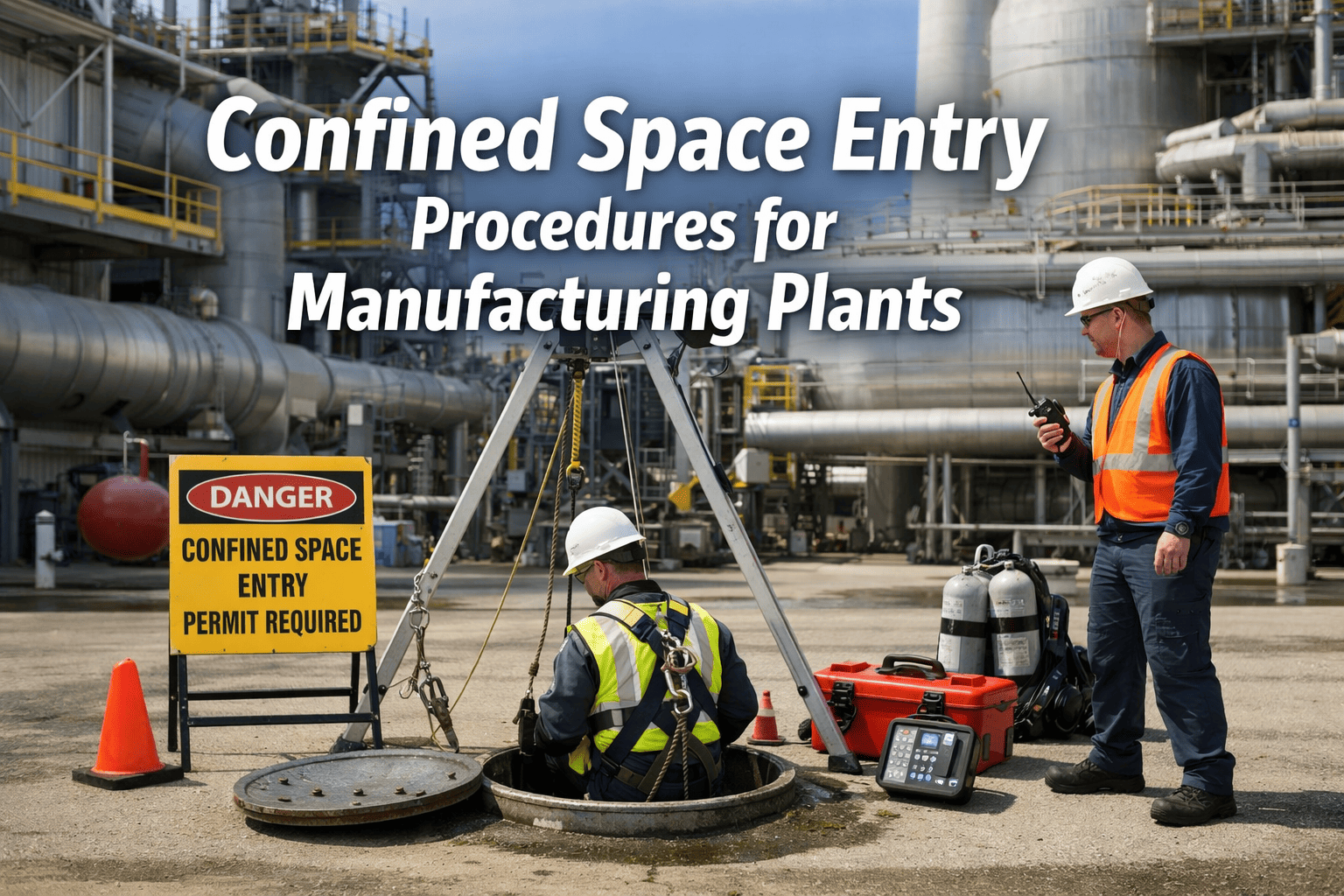
In 2017, a maintenance technician at a Minnesota tanker cleaning facility climbed into a trailer to inspect cleaning quality. His partner had called in sick, so he entered alone. Witnesses later described a gasoline-like smell near the opening that he apparently did not notice. No atmospheric test had been performed. No attendant was stationed outside. When he collapsed, no one was there to see it, and by the time anyone realized something was wrong, rescue was no longer possible. The resulting OSHA citation totaled $621,600 — but the real cost was a life that could have been saved by a $300 gas meter and a written permit. This guide walks through the exact procedures that prevent cases like this one: how to identify permit-required confined spaces, what atmospheric testing actually proves, who plays which role during entry, and how to build a rescue plan that does not kill the rescuers. If your plant runs vessels, silos, tanks, pits, or ductwork, a rigorous permit program is not optional — and digital permit tracking through a CMMS removes most of the paperwork errors that lead to catastrophic entries.
The Human Cost Of Getting This Wrong
What OSHA and BLS data say about confined space incidents in US industry
1,030
Workers killed in confined space incidents between 2011 and 2018, averaging over 90 deaths per year
60%
Of confined space fatalities are would-be rescuers who entered without proper equipment or planning
58%
Of confined space deaths involve atmospheric hazards — oxygen deficiency, toxic gas, or flammable vapor
22%
Of all US confined space fatalities occur in manufacturing facilities, the second-highest sector
Q1
Is the space large enough for a worker to enter and perform assigned tasks?
Think tanks, silos, vessels, pits, manholes, ductwork, hoppers, sumps
↓
Q2
Does it have limited or restricted means of entry or exit?
Manways, narrow hatches, vertical ladders, access openings smaller than a standard door
↓
Q3
Is it designed for continuous human occupancy?
A control room qualifies as designed for occupancy. A process vessel does not.
↓
Q4
Does it contain any of these hazards?
Hazardous atmosphere
Engulfment material
Inwardly sloping walls
Other serious hazard
If YES to Q1, Q2, NO to Q3, and YES to any Q4 hazard:
This is a PERMIT-REQUIRED CONFINED SPACE under OSHA 29 CFR 1910.146. Post danger signs. Write permits before every entry. No exceptions.
Oxygen (O₂)
Oxygen deficiency causes over 40% of atmospheric fatalities. Enrichment makes everything combustible.
Lower Flammable Limit (LFL)
Flammable vapors, dusts, and gases become explosion risks long before they would ignite in open air.
Hydrogen Sulfide (H₂S)
H2S is the leading toxic-gas killer in confined spaces. Smell fatigue makes it undetectable at lethal levels.
Carbon Monoxide (CO)
Invisible, odorless, and deadly. Common around combustion engines, welding, and fuel-burning equipment.
Mandatory Testing Sequence
OSHA requires this exact order because combustible gas sensors fail without adequate oxygen
1
Oxygen First
Confirm 19.5-23.5% before any other test
→
2
Flammability Second
LFL must read below 10% of lower flammable limit
→
3
Toxics Third
H2S, CO, and any other suspected contaminants
Role 1
Entry Supervisor
Authorizes entry by signing the permit, verifies pre-entry conditions meet acceptable limits, terminates entry when hazards change, and cancels the permit when work is complete. The buck stops here for every entry decision.
Role 2
Authorized Entrant
The worker who actually enters the space. Must know the hazards, recognize exposure symptoms, use assigned equipment correctly, communicate with the attendant, and evacuate immediately when ordered or when warning signs appear.
Role 3
Attendant
Stationed outside the space for the entire entry. Maintains continuous communication, tracks everyone inside, monitors conditions, summons rescue, and — most critically — never enters the space to attempt rescue themselves.
Role 4
Rescue Service
Trained and equipped team (internal or external) capable of non-entry retrieval or trained entry rescue. Must practice simulated rescues at least annually on each type of permit space the facility operates.
Role 5
Atmospheric Tester
Operates calibrated direct-reading instruments, performs the mandatory oxygen-flammability-toxic testing sequence, documents every reading on the permit, and retests any time conditions inside the space could have changed.
Stop Chasing Paper Permits Through A Plant
OxMaint digitizes confined space permits, atmospheric readings, attendant logs, and rescue drills — so your next OSHA audit pulls up complete records in 30 seconds, not 30 hours.
Hazard Identification
Space identified and posted. Specific atmospheric, engulfment, mechanical, and energy hazards documented on the permit. Adjacent processes reviewed for migration risk.
Isolation & Lockout
Lines blinded or disconnected. Electrical sources locked and tagged. Agitators, conveyors, and moving parts de-energized and verified zero energy.
Atmospheric Testing
Oxygen, LFL, and toxic gases tested in correct sequence. All readings within acceptable limits. Instruments calibrated and logged on the permit with timestamps.
Ventilation
Forced-air ventilation running continuously when required. Air intake located away from contamination sources. Airflow direction verified.
Equipment Ready
Retrieval harnesses, tripods, lifelines, gas monitors, communications, lighting, and PPE staged and inspected. Extraction path clear.
Rescue In Place
Rescue service notified and on standby. Attendant posted. Emergency contacts confirmed. Simulated drill completed within the last 12 months.
Process Vessels & Reactors
Residual chemicals, inert gas purges, heat
Storage Silos & Bins
Engulfment, combustible dust, bridging
Boilers & Steam Drums
Heat, oxygen deficiency from scale removal
Tanks & Sumps
H2S, solvent vapors, oxygen displacement
Ductwork & HVAC Plenums
Restricted movement, dust, mold, heat
Pits & Underground Vaults
Heavier-than-air gases, flooding, fall
Dust Collectors & Baghouses
Combustible dust, deflagration risk
Pipe Galleries & Tunnels
Leaks from overhead lines, limited egress
The Three-Tier Rescue Priority
Tier 1
Non-Entry Retrieval
Entrant wears a full-body harness connected to a retrieval line anchored outside. The attendant pulls the entrant to safety without entering. This is the preferred method whenever the space geometry allows.
Tier 2
Trained Entry Rescue
Dedicated rescue team with SCBA, trained in space-specific extraction. Only used when non-entry retrieval is not feasible. Must demonstrate proficiency on representative spaces at least once every 12 months.
Tier 3
Emergency Services Backup
Local fire or HAZMAT as a secondary response only. Confirm they have toured the facility, know the permit spaces, and can meet response time targets. Never rely on 911 as your primary rescue plan.
The 60% rescuer fatality rate exists because untrained coworkers enter spaces to help collapsed colleagues — and succumb to the same atmosphere within minutes. Rescue plans documented in a CMMS make the right response reflexive instead of instinctive.
How long is a confined space entry permit valid?
A permit covers only the specific entry it was written for and expires when that task is complete, the shift ends, or conditions inside the space change meaningfully. Repetitive routine entries can use an area permit valid for up to 30 days under certain controlled conditions.
Can we reclassify a permit space to non-permit status?
Yes, but only if every hazard is permanently eliminated — not just controlled. If ventilation alone keeps the atmosphere safe, the space stays permit-required because removing the ventilation restores the hazard. Permanent reclassification requires written certification.
Does the attendant need to physically see the entrant at all times?
Continuous communication is required, not continuous line of sight. Voice, radio, rope signals, or video can satisfy this — but the attendant must be able to confirm entrant status at any moment and detect incapacitation immediately.
How often should gas monitors be calibrated and bump-tested?
Bump-test every monitor before each day of use to confirm sensor response. Full calibration follows the manufacturer's schedule (typically every 6 months) or whenever a bump test fails. Document every test — a CMMS with calibration tracking prevents the "forgot to test" gap that OSHA cites repeatedly.
Do contractors need their own confined space program?
Yes. The host employer must share known hazards and coordinate entry operations, but contractors are responsible for their own written permit program, trained personnel, and rescue arrangements. A pre-job meeting documents the coordination and is itself a compliance record.
What is the most cited confined space violation during OSHA inspections?
Missing or incomplete written permit programs top the list, followed by inadequate atmospheric testing and rescue planning failures. Penalties can exceed $15,000 per violation per day, and willful violations climb much higher — making program rigor the single best investment in both safety and compliance.
From Paper Permits To Predictable Safety
Make Every Confined Space Entry Auditable, Trackable, And Safer
OxMaint keeps permit templates, gas monitor calibrations, attendant training records, and rescue drill documentation in one place — so nothing critical falls through the cracks when a technician is standing at a manhole ready to enter.
![monthly-manufacturing-plant-safety-audit-checklist-[osha---iso-45001]](./manage-post-2k26/uploads/monthly-manufacturing-plant-safety-audit-checklist-[osha---iso-45001].png)


