Every defective part that makes it to the end of a production line represents wasted material, wasted machine time, wasted labor, and in many cases a customer relationship at risk. The hard truth is that most production waste is not random — it is patterned, predictable, and detectable well before it becomes a reject. Real-time monitoring changes the equation by moving quality control from inspection after the fact to intervention before the defect is made. This guide covers how manufacturing plants are using sensors, statistical process control, and integrated monitoring platforms like OxMaint to drive measurable reductions in scrap, rework, and process variation.
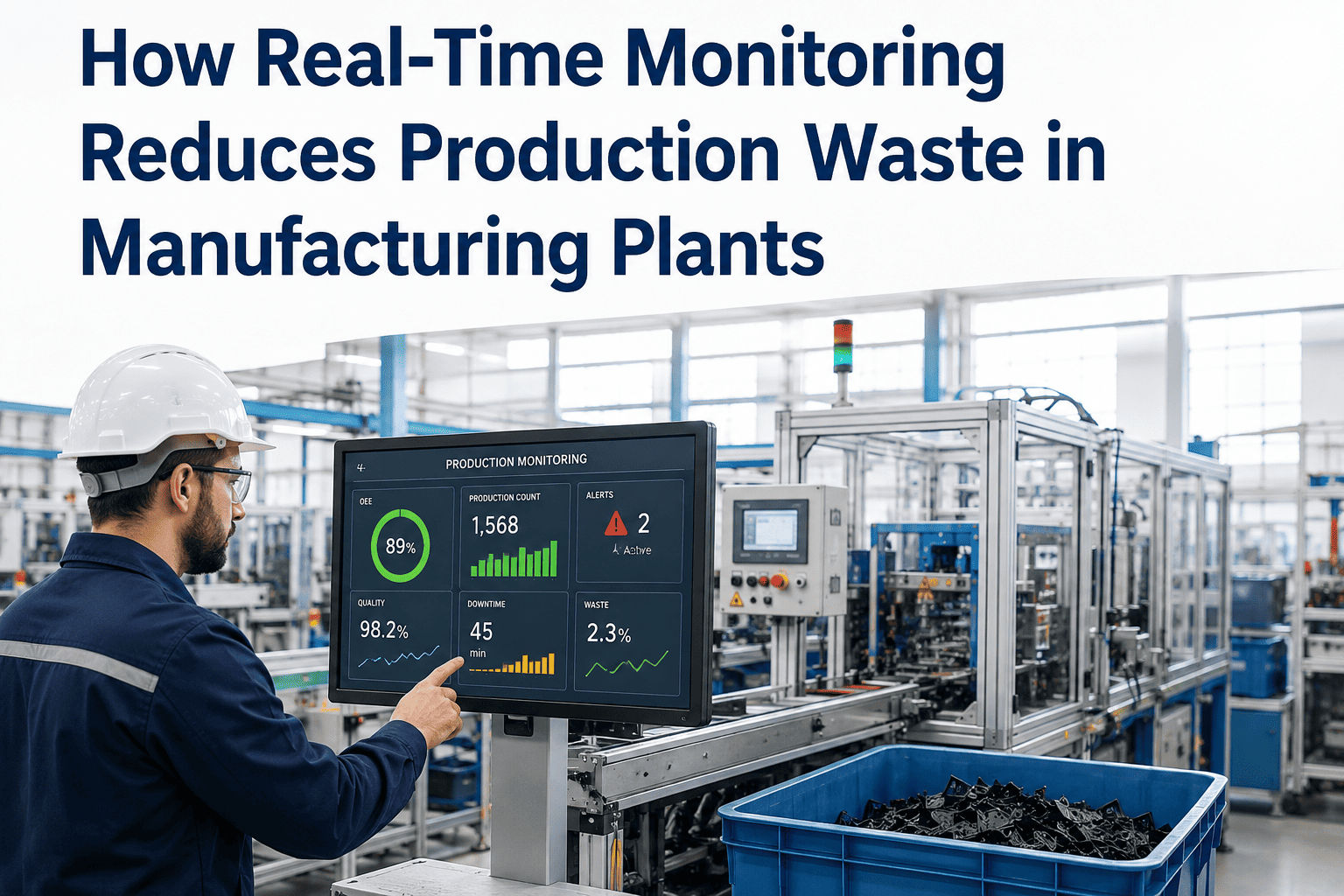
How Real-Time Monitoring Reduces Production Waste in Manufacturing Plants
Sensors, SPC tools, and process monitoring detect defects before they escalate — here is how leading plants are cutting scrap and rework with real-time data.
Where Production Waste Really Comes From
Manufacturing waste is typically categorized into scrap (parts that cannot be salvaged), rework (parts that require additional processing to meet spec), and process waste (energy, materials, and time consumed producing defective output). The distribution of causes is consistent across industries — and most of it is addressable with better monitoring.
Percentage of production waste events attributable to each cause. Total exceeds 100% as events may have multiple contributing factors.
What Real-Time Monitoring Actually Detects
Monitoring systems are only as useful as the signals they are designed to capture. The most impactful monitoring implementations focus on four process dimensions that have the highest correlation with output quality.
Statistical Process Control: The Intelligence Layer
Sensors generate data. SPC transforms that data into decisions. Without a statistical layer interpreting sensor signals against control limits and trend patterns, operators are drowning in numbers rather than acting on insights. The key SPC concepts every manufacturing team should understand are covered below.
| SPC Concept | What It Measures | When to Act | Application in Plant Monitoring |
|---|---|---|---|
| Control Chart (X-bar / R) | Mean and range of a measured characteristic over time | Point outside control limits or 7 consecutive points trending | Temperature, dimension, pressure monitoring |
| Cp / Cpk Index | Process capability relative to spec limits | Cpk falls below 1.33 | Monthly capability review for critical processes |
| CUSUM Chart | Cumulative drift from target value | Cumulative sum exceeds threshold (h) | Slow drift detection in continuous processes |
| EWMA Chart | Exponentially weighted moving average | EWMA crosses control limit | Small, sustained process shifts in batch processes |
OxMaint's PM platform integrates with monitoring data to auto-generate corrective maintenance work orders when process signals indicate equipment condition is driving quality drift — closing the loop between monitoring and action.
From Alert to Action: Closing the Loop
The most common failure point in real-time monitoring programs is not the sensors — it is the workflow gap between an alert firing and a corrective action being taken. Alerts that go unacknowledged for hours, or that trigger paper-based responses, defeat the purpose of real-time data. The plants that achieve the largest waste reductions are the ones that connect monitoring alerts directly to maintenance work order systems.
Sensor reading crosses SPC control limit or alert threshold. Timestamp and machine ID recorded automatically.
Monitoring platform creates a corrective maintenance work order routed to the relevant technician with machine context attached.
Technician receives mobile notification, reviews alert history, and executes the corrective action — logging findings in the CMMS.
Monitoring confirms return to normal signal range. Event is logged for trend analysis and root cause review.
Implementation Path: Starting Without Overcomplicating It
Many plants delay real-time monitoring implementation because they imagine a large, expensive IoT project. In practice, a focused start on 3 to 5 high-waste machines with basic process sensors and a connected CMMS delivers measurable results within 90 days.
| Phase | Activities | Timeframe | Expected Outcome |
|---|---|---|---|
| Phase 1 — Baseline | Identify top 3 waste-generating machines, map current defect types and causes | Weeks 1–3 | Prioritized monitoring target list |
| Phase 2 — Instrument | Install sensors on priority machines, connect to CMMS alert workflow | Weeks 4–8 | Real-time data feed established |
| Phase 3 — Control | Establish SPC limits, tune alert thresholds, train technicians on response workflow | Weeks 9–12 | Alert-to-action loop operational |
| Phase 4 — Expand | Apply learning to next tier of machines, refine SPC parameters with 90-day data | Month 4 onwards | Scrap rate trending down plant-wide |
Frequently Asked Questions
Stop Discovering Defects at the End of the Line
OxMaint connects equipment condition monitoring to preventive maintenance work orders — so when a machine starts drifting out of control, your team gets a work order before it produces a defective part. Most plants are live within one week.