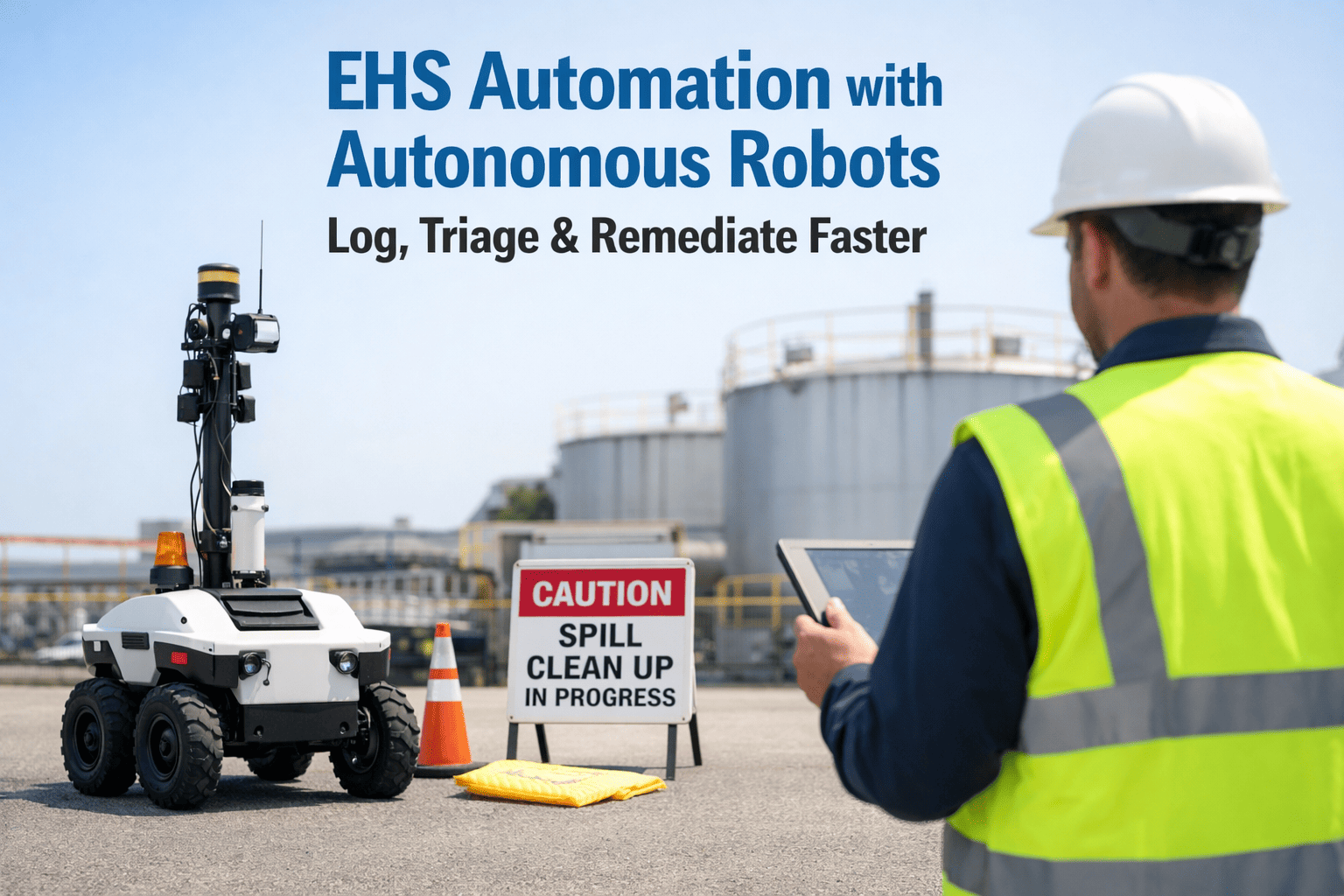
Safety teams in manufacturing, energy, and facility operations share one painful reality — hazards happen between inspections. A chemical spill at 3 AM, an unguarded machine during a shift change, a blocked fire exit that no one notices until the auditor arrives. Autonomous inspection robots now eliminate these blind spots by patrolling around the clock, detecting hazards with thermal cameras, gas sensors, and computer vision, then pushing structured findings directly into your CMMS for instant triage and corrective action. Schedule a free demo to see robotic findings become instant work orders — no manual data entry required.
How Robotic Hazard Detection Connects to CMMS Work Orders
The value of an autonomous robot is not in the detection alone — it is in what happens next. Without a direct pipeline from robot to CMMS, findings still get stuck in email chains and spreadsheets. Oxmaint closes that gap by receiving robot detection events via API, classifying them against your facility's EHS categories, and generating corrective work orders before your EHS officer finishes their morning coffee.
Step 1
Robot Patrols & Detects
Autonomous robots equipped with LiDAR, infrared, and gas sensors follow scheduled or on-demand patrol routes across your facility. They identify spills, thermal anomalies, PPE violations, obstructed exits, and equipment guard failures — day and night, including weekends and holidays.
Step 2
Findings Auto-Log into Oxmaint
Each detection is transmitted as a structured event — hazard type, GPS coordinates, severity score, and visual evidence — directly into Oxmaint's incident management module. No manual transcription. No paper forms. Every finding is timestamped and audit-ready from the moment it is logged.
Step 3
AI Triage Assigns Priority
Oxmaint's triage engine scores each finding by severity, regulatory impact, proximity to personnel, and historical incident frequency in the affected zone. Critical hazards (gas leaks, fire risks) trigger P1 alerts instantly. Lower-severity items queue for the next shift or weekly review cycle.
Step 4
Corrective Work Orders Generate
Prioritized incidents automatically create work orders in Oxmaint — assigned to the right technician or team, with deadline, safety procedures, required materials, and the robot's photographic evidence attached.
Start your free Oxmaint account to automate corrective work orders and eliminate manual assignment delays.
Step 5
Verified & Closed Automatically
After remediation, the robot re-inspects the flagged location on its next patrol. Oxmaint receives the verification result, updates the incident record, closes the work order, and archives the complete audit trail — from first detection through confirmed resolution.
Stop chasing corrective actions through email
Oxmaint connects your robot fleet to automated EHS workflows — so hazards become work orders, not forgotten findings.
What Do Autonomous Inspection Robots Actually Detect?
Modern inspection robots combine multiple sensor types — thermal imaging, gas detection, computer vision, LiDAR mapping, and acoustic monitoring — to identify hazards that manual walkthroughs consistently miss. Each detection type maps to a specific corrective workflow inside Oxmaint, ensuring the right team responds with the right urgency every time.
Thermal
Overheating Equipment & Fire Risks
Infrared cameras flag motors, bearings, electrical panels, and steam traps running above normal temperature thresholds. Oxmaint creates preventive maintenance work orders before thermal events escalate to equipment failure or fire.
Gas
Chemical Leaks & Toxic Exposure
Onboard gas sensors detect combustible gases, VOCs, hydrogen sulfide, and oxygen deficiency. Critical readings trigger P1 alerts in Oxmaint with automatic area lockout notifications and hazmat response procedures attached.
Vision
PPE Non-Compliance & Guard Failures
Computer vision algorithms identify missing hard hats, safety vests, machine guards, and lockout/tagout violations. Findings log to EHS records for trend analysis and corrective training scheduling through Oxmaint.
LiDAR
Blocked Exits & Pathway Obstructions
3D mapping detects obstructed emergency exits, blocked fire extinguishers, and aisle violations. Corrective work orders route to housekeeping or facilities teams with exact location data and photographic evidence.
Liquid
Spills, Puddles & Floor Hazards
Visual and infrared detection identifies liquid spills, pooling fluids, and wet floor hazards. Oxmaint generates containment work orders with the appropriate cleanup protocol based on the spill location and material classification.
Audio
Abnormal Equipment Noise & Vibration
Acoustic sensors detect unusual equipment sounds — grinding, rattling, cavitation — that indicate bearing failure, misalignment, or mechanical wear. Predictive maintenance work orders are created before breakdown occurs.
See the full hazard-to-work-order pipeline in action. Walk through a live demo of robotic findings flowing into prioritized Oxmaint corrective workflows.
Book a Demo
Incident Priority Levels: How Oxmaint Triages Robotic Findings
Not every hazard demands the same response speed. A gas leak and a missing safety sign require fundamentally different urgency levels, team assignments, and escalation paths. Oxmaint's configurable triage engine categorizes every robotic finding into four priority tiers, each triggering a distinct corrective workflow.
Gas leak, active fire risk, structural failure, chemical exposure, confined space oxygen deficiency
Immediate multi-channel alert to EHS lead and facility manager. Emergency work order auto-generated. Area lockout initiated through connected access control. Escalation to site director if unacknowledged within 5 minutes.
Blocked emergency exit, missing machine guard, thermal anomaly on critical equipment, large spill in traffic area
Alert pushed to assigned EHS officer. Corrective work order created with 4-hour completion target, safety procedures, and robot evidence attached. Auto-escalation if unresolved within the defined window.
PPE violation in restricted zone, minor housekeeping issue, damaged safety signage, small non-hazardous spill
Work order queued for next shift. Area supervisor notified. Finding tracked in weekly EHS dashboard review. Trend data aggregated for monthly safety analysis and training recommendations.
Cosmetic damage to equipment, minor lighting issue, non-critical signage wear, small paint peeling on floor markings
Logged for routine preventive maintenance cycle. Bundled with upcoming scheduled work orders to minimize disruption. Monthly trend analysis identifies recurring low-priority patterns that may indicate systemic issues.
Scheduled Walkthroughs vs. Autonomous Robotic EHS Inspections
The gap between traditional manual EHS inspections and robot-integrated CMMS automation is not a matter of marginal improvement. It is a structural shift in how quickly facilities move from hazard awareness to hazard elimination — and how complete the documentation trail is when auditors arrive.
Factor
Manual Process
Robot + Oxmaint
Inspection Coverage
1-2 walkthroughs per shift, limited zones
24/7 autonomous patrol across all zones
Hazard Documentation
Paper forms transcribed into spreadsheets days later
Auto-logged with sensor data, GPS, and images instantly
Detection to Work Order
4-7 days through email chains and approvals
Under 60 seconds via automated triage pipeline
Corrective Verification
Self-reported, no independent check
Robot re-inspects and confirms fix on next patrol
Audit Readiness
Weeks of record assembly before audit
Audit-ready reports generated on demand
Off-Hours Monitoring
None — hazards wait until next shift
Continuous monitoring including nights and weekends
Move from weekly walkthroughs to continuous monitoring. Create your free Oxmaint account and configure robotic EHS workflows in minutes.
Sign Up
Integrating Robot Fleets with Your Existing CMMS
Deploying robotic EHS automation does not require ripping out your current safety infrastructure. Oxmaint connects to leading autonomous robot platforms — including Boston Dynamics Spot, ANYmal, ExRobotics, and drone inspection systems — through standard APIs, layering robotic intelligence on top of your existing work order, asset management, and compliance workflows.
Robot API Gateway
Receives detection events, sensor payloads, location data, and evidence files from your robot fleet. Supports webhooks and REST API for real-time or batch ingestion from any robot platform with an open API.
Incident Classifier
Maps raw robot detections to your facility's EHS categories. Auto-tags incidents with OSHA codes, facility zones, equipment associations, and compliance regulation references.
Triage & Routing Engine
Scores each finding by configurable priority rules. Routes alerts to the correct EHS officer, maintenance team, or facility manager based on hazard type, location, and shift schedule.
Work Order Automation
Converts triaged incidents into fully populated corrective work orders — assigned team, deadline, safety procedures, required materials, and robot evidence. Integrates with existing PM schedules.
Verification Loop
Receives re-inspection results from robot follow-up patrols. Updates incident status, closes work orders, and archives complete audit documentation for regulatory review.
Measurable Safety Outcomes from Robotic EHS Automation
Facilities that connect autonomous robots to Oxmaint's CMMS report measurable improvements across every EHS metric that matters — faster response times, higher corrective completion rates, fewer repeat incidents, and dramatically less time spent preparing for compliance audits.
Faster incident documentation vs. manual logging
85%
Reduction in repeat safety incidents within 90 days
70%
Corrective work order completion rate on schedule
96%
Less time spent preparing for compliance audits
55%
More inspection coverage per shift vs. manual walkthroughs
3x
We used to discover hazards during weekly walkthroughs and spend days chasing corrective actions through email. Now the robot flags issues at 2 AM, Oxmaint creates the work order before sunrise, and the fix is verified on the next patrol. Our OSHA recordable rate dropped by half in the first year.
— EHS Director, Industrial Manufacturing Facility
Deployment Roadmap: From Setup to 24/7 Autonomous EHS
Most facilities reach full autonomous EHS operation within 6 to 8 weeks. The deployment follows a phased approach — starting with CMMS configuration and progressing through robot integration, triage calibration, and team training before activating continuous autonomous patrols.
Week 1 – 2
CMMS Configuration
Define EHS incident categories and priority scoring rules. Configure corrective work order templates. Set up notification routing and escalation paths for EHS officers and facility managers.
Week 3 – 4
Robot API Integration
Connect your robot fleet's API to Oxmaint's incident pipeline. Map detection types to EHS categories. Test end-to-end data flow from robotic detection through work order generation.
Week 5 – 6
Triage Calibration & Training
Tune priority scoring for your facility's specific risk profile. Validate alert routing and escalation behavior. Train EHS team on Oxmaint dashboard, mobile app, and work order workflows.
Week 7+
Full Autonomous Operation
Automate EHS From Detection to Verified Resolution
Your paper checklists cannot patrol at 2 AM or verify that last Tuesday's corrective action actually held. Oxmaint connects autonomous robots to your EHS workflows — automatically logging findings, assigning priority-based corrective work orders, and tracking every incident from first detection through closed-loop verification.
Frequently Asked Questions
Which autonomous robot platforms integrate with Oxmaint for EHS?
Oxmaint integrates with ground-based patrol robots (including Boston Dynamics Spot, ANYmal, ExRobotics), drone inspection systems, and stationary robotic sensor arrays. Any robot platform that exposes a REST API or webhook for detection events can connect to Oxmaint's incident pipeline.
Schedule a demo to explore integration options for your robot fleet.
How does the automated priority triage work for robotic findings?
Oxmaint's triage engine scores each detection based on configurable rules — hazard type, severity from sensor data, proximity to personnel or critical equipment, regulatory classification, and historical incident frequency in the affected zone. EHS officers can adjust scoring weights and manually override any priority assignment through the dashboard at any time.
Can Oxmaint manage both robot-detected and manually reported EHS incidents?
What compliance standards does the automated documentation support?
Oxmaint generates audit-ready documentation aligned with OSHA recordkeeping requirements, ISO 45001 incident management processes, and EPA environmental compliance reporting. Every incident record includes timestamped detection data, corrective action history, and verification evidence — ready for regulatory review without manual assembly.
How long does it take to deploy robotic EHS integration with Oxmaint?
Most facilities complete the full integration in 6 to 8 weeks, covering CMMS configuration, robot API connection, triage calibration, and team training. Facilities with existing Oxmaint deployments can add robotic EHS integration in as few as 2 to 3 weeks since the work order and incident management infrastructure is already in place.