How to Improve Manufacturing Plant Productivity by 45% in 2026
By oxmaint on February 10, 2026
Most manufacturing plants are running at barely 60% of their actual capacity — and the worst part is, most plant managers do not even realize it. Between unplanned equipment failures eating up 20% of production time, changeovers dragging on twice as long as they should, and workflow bottlenecks that nobody has formally mapped, there is a massive reservoir of untapped output sitting inside your existing facility. The manufacturers winning in 2026 are not building new plants — they are squeezing 45% more productivity from the ones they already have. Schedule a free consultation to find out exactly where your plant is leaving output on the table.
Where Is Your Plant Losing 45% of Its Potential Output?
Before you can improve productivity, you need to understand where it disappears. Manufacturing productivity loss rarely comes from a single source. It accumulates across six distinct categories — what lean practitioners call the Six Big Losses — and the compound effect is staggering.
The Six Big Losses Draining Your Plant's ProductivityEach percentage represents typical capacity lost in an average manufacturing facility
Equipment Breakdowns
10–15%
Setup and Changeovers
5–8%
Minor Stoppages and Idling
4–7%
Reduced Speed Operations
3–6%
Startup Rejects
2–4%
Production Defects and Rework
2–5%
$11M
Average annual loss for mid-sized manufacturers from inefficiencies, downtime, and compliance retrofits hidden inside daily operations
The Productivity Multiplier: Why Small Fixes Create Big Results
A 45% productivity gain does not require a 45% improvement in any single area. It works through multiplication. When you improve equipment availability by 10%, and simultaneously improve production speed by 10%, and reduce defects by 10%, the compound result on OEE is far greater than 30%. This is the multiplier effect that makes a 45% total improvement not just achievable but predictable when you take a structured approach.
How Productivity Gains Compound Across Your Operation
Speed optimization, minor stop elimination, bottleneck removal
x
+10%
Quality
Defect reduction, process standardization, first-pass yield
=
45%+
Total OEE Improvement
Compound effect across all three dimensions of manufacturing effectiveness
Seven Proven Strategies to Unlock the Full 45%
Every strategy below has been validated across real manufacturing environments. They are listed in order of implementation priority — start with the ones that deliver the fastest payback, then layer in the rest for compounding returns.
01
Shift from Reactive to Preventive Maintenance
Downtime reduced 26%Equipment life extended 20%
This single shift is the highest-ROI move you can make. Plants running reactive maintenance spend 3–5x more on emergency repairs and lose 15–20% of production capacity to unplanned stops. A CMMS platform like Oxmaint automates your entire preventive maintenance schedule — generating work orders based on time, usage, or condition triggers so equipment gets serviced before it fails. Sign up for Oxmaint and build your first PM schedule in under an hour.
Your production line moves only as fast as its slowest point. Value Stream Mapping reveals exactly where work-in-progress piles up, where operators wait, and where material handling adds zero value. Apply Theory of Constraints thinking — maximize output at the bottleneck, then subordinate everything else to its pace. Plants that formally identify and address their top three bottlenecks routinely see throughput jump by 15–25%.
03
Cut Changeover Times with SMED
Changeover time cut 50–60%Production flexibility doubled
Single-Minute Exchange of Die methodology converts internal changeover steps (machine stopped) to external steps (done while running). One food processing plant combined SMED with operator cross-training and reduced changeover times by nearly 60%. Every minute saved in changeover is a minute added to production. Track changeover performance over time using Oxmaint's reporting dashboards to ensure gains stick.
04
Implement 5S for Workplace Organization
Motion waste reduced 35%Defects decreased 20%
Sort, Set in Order, Shine, Standardize, Sustain. It sounds basic, but the reality is that most plants have never formally implemented 5S across every workstation. When tools, parts, and materials have designated locations, operators spend less time searching and more time producing. A clean, organized workspace also makes it far easier to spot early signs of equipment problems — fluid leaks, unusual vibrations, loose components — before they become breakdowns.
05
Train Operators for Autonomous Maintenance
Labor efficiency up 10–12%Early defect detection improved 40%
When operators own routine inspections, lubrication, cleaning, and basic adjustments, two things happen: maintenance technicians are freed for complex repairs, and equipment issues get caught at the earliest possible stage. This is a core pillar of Total Productive Maintenance. Use Oxmaint to assign autonomous maintenance checklists directly to operators on their mobile devices — no paper, no missed steps. Book a demo to see how mobile checklists work on the shop floor.
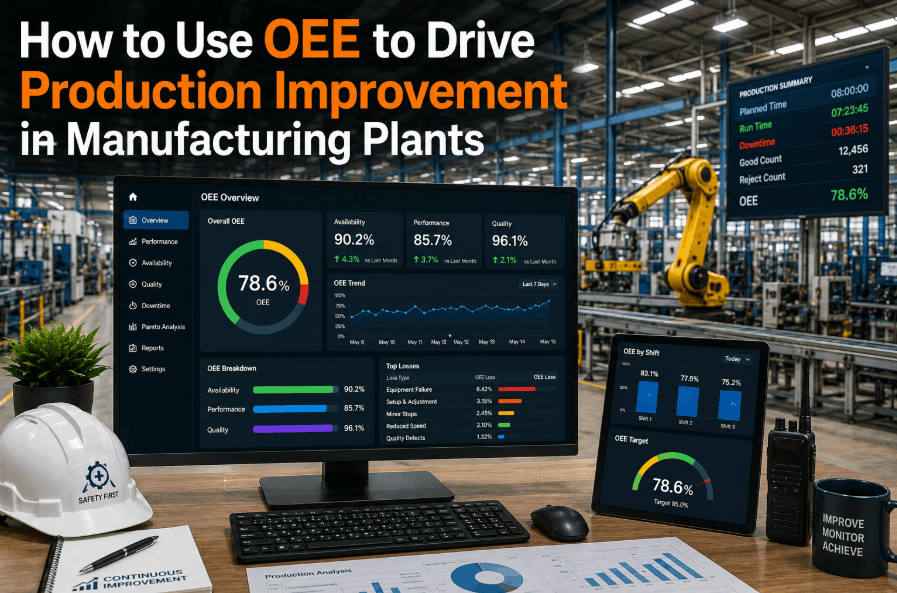
You cannot manage what you cannot see. Manual OEE tracking is slow, incomplete, and usually wrong. Real-time digital dashboards show availability, performance, and quality metrics as they happen — giving supervisors the ability to intervene during a shift rather than discovering problems in last week's report. World-class manufacturers target 85%+ OEE and track it continuously.
07
Centralize Everything with CMMS Software
Maintenance productivity up 25–30%Downtime reduced up to 30%
A CMMS ties every strategy together into a single system of record. Work orders, asset history, PM schedules, spare parts inventory, operator checklists, KPI dashboards — all in one place, accessible from any device. Without this digital backbone, improvements happen in silos and gains erode over time. Oxmaint was built specifically for maintenance and operations teams that need to move fast without months of deployment overhead. Sign up today and have your team productive within days, not months.
Your Competitors Are Already Implementing These Strategies
80% of manufacturing executives plan to invest 20% or more of their improvement budgets in smart manufacturing and automation in 2026. The question is not whether to act — it is how quickly you can start. Oxmaint gives you the CMMS foundation to execute every strategy on this page.
The pressure to improve is not optional anymore. Here is what leading industry research reveals about the manufacturing environment plants must navigate this year — and why productivity optimization is the highest-leverage response to every one of these challenges.
95%
of manufacturing leaders have invested or plan to invest in AI, machine learning, or generative AI within the next five years
67%
of manufacturers report unplanned equipment downtime as their top barrier to achieving lean production goals
4.4%
projected revenue increase for manufacturing in 2026, with over half of manufacturers expecting higher revenues than 2025
33%
of manufacturing executives cite equipping workers with smart manufacturing skills as their number one talent concern
Your 90-Day Execution Timeline
Strategy without execution is just a wish list. Here is the phased approach that leading plants use to go from baseline measurement to measurable 45% productivity improvement. Each phase builds on the previous one, so gains compound rather than compete.
Days 1–30
Measure and Mobilize
Baseline your current OEE across every production line. Catalog all assets and their maintenance history. Deploy Oxmaint CMMS to your maintenance team and digitize all open work orders. Identify your top three bottlenecks through Value Stream Mapping. This phase alone typically reveals 15–20% of the improvement opportunity.
Days 31–60
Eliminate and Optimize
Activate preventive maintenance schedules for all critical assets. Run 5S events on priority workstations. Apply SMED to your longest changeover. Train operators on autonomous maintenance checklists via Oxmaint mobile. Begin real-time OEE tracking. Plants typically see 10–15% productivity improvement by the end of this phase.
Days 61–90
Scale and Sustain
Expand CMMS coverage to all production areas and auxiliary equipment. Launch Kaizen events targeting remaining bottlenecks. Establish weekly OEE review cadence with shift supervisors. Set continuous improvement KPIs and assign ownership. At this point, the full 45% improvement trajectory is established and self-reinforcing.
Want a customized 90-day plan for your plant? Our team will assess your current operations and build a roadmap around your biggest productivity opportunities.
Track these metrics weekly. If the numbers are moving in the right direction, your 45% improvement is on track. If they stall, they will tell you exactly where to focus next.
OEE Score
Target: 85%+
The single best composite measure of your plant's productivity — combining availability, performance, and quality into one number
MTBF
Target: Increasing trend
Mean Time Between Failures shows whether your preventive maintenance program is actually improving equipment reliability over time
MTTR
Target: Decreasing trend
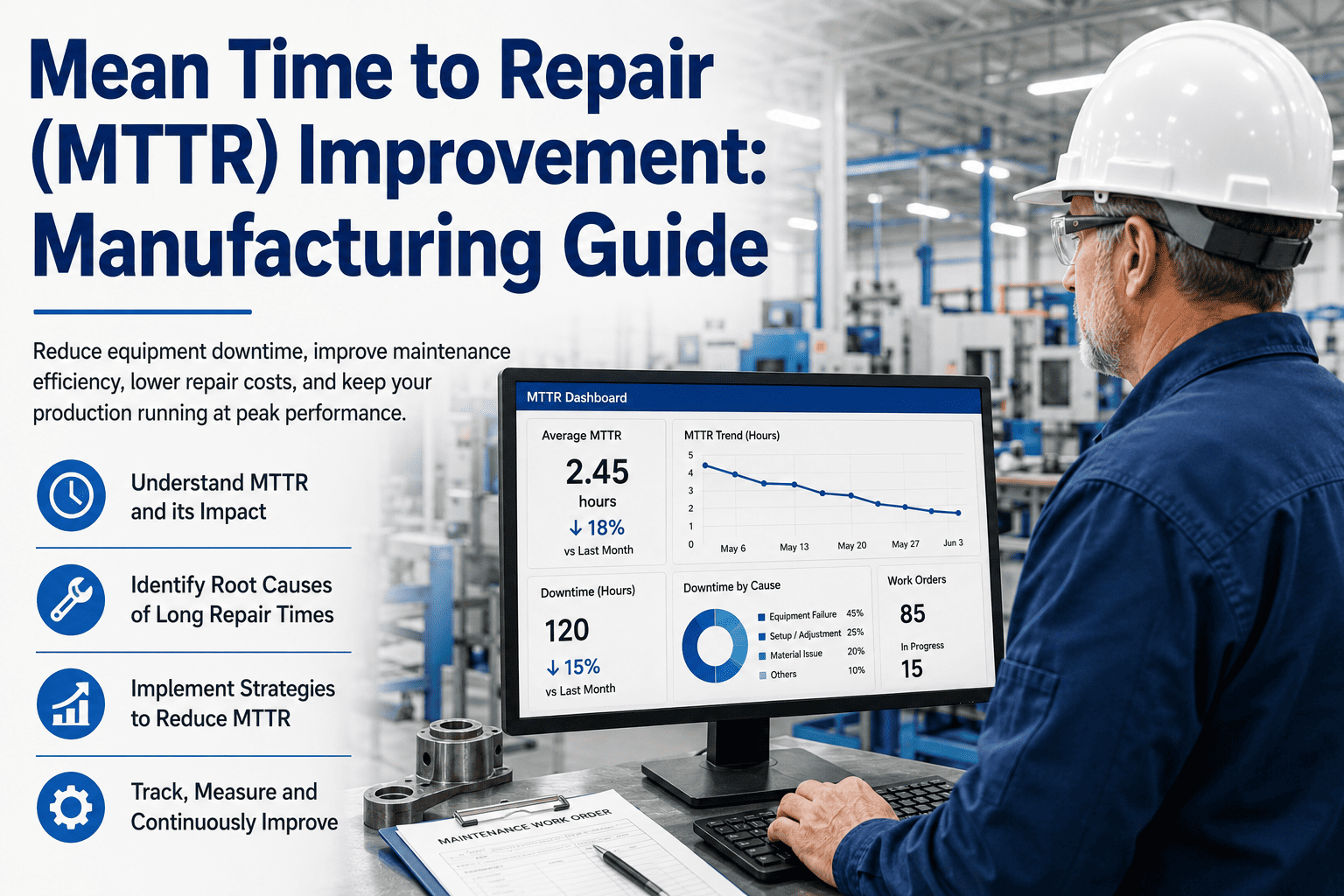
Mean Time to Repair reveals how fast your team responds and resolves issues — shorter is better and indicates mature maintenance processes
Planned Maintenance %
Target: 85%+ of all work
The ratio of planned to unplanned maintenance — the higher this number, the more control you have over your production schedule
First Pass Yield
Target: 95%+
Products made right the first time, without rework. Every percentage point improvement here flows straight to throughput and margin
Throughput per Hour
Target: Increasing trend
Output volume per labor hour — the ultimate measure of whether your improvement efforts are translating into actual production gains
45% More Output from the Plant You Already Have
Every week you wait costs your plant thousands in lost output, wasted labor, and preventable breakdowns. Oxmaint simplifies your maintenance and operations with real-time tracking, workflow automation, and asset management — everything you need to close the productivity gap and start producing more with less. The setup takes days, not months.
Is a 45% productivity improvement realistic for an average manufacturing plant?
Yes. The 45% figure represents the compound effect of addressing multiple efficiency losses simultaneously. Most plants operate at only 55–65% of true capacity. When you reduce unplanned downtime by 26%, improve throughput by 15–25% through lean practices, cut changeover times by 50%, and boost labor efficiency by 10–12%, the cumulative OEE improvement consistently reaches or exceeds 45%. Schedule a consultation to assess your plant's specific improvement potential.
How quickly will we see measurable results?
Most plants see measurable improvement within the first 30 days of CMMS deployment. Downtime reduction and faster work order response times are typically the first wins. By day 60, plants with structured PM programs and lean execution report 10–15% OEE gains. The full 45% trajectory establishes itself by day 90 as continuous improvement systems take hold.
Why is CMMS software essential for productivity improvement?
CMMS serves as the digital backbone connecting all productivity strategies. It automates preventive maintenance, digitizes work orders, tracks asset health, stores SOPs for operator training, and provides the real-time analytics needed to identify and eliminate losses. Without a CMMS, improvements happen in silos and gains erode over time. Plants using CMMS reduce downtime by up to 30% and improve maintenance team productivity by 25–30%. Sign up for a free account to experience the difference.
Do we need to implement all seven strategies at once?
No. The 90-day timeline is designed for phased implementation. Start with CMMS deployment and preventive maintenance — these deliver the fastest ROI with the least organizational disruption. Then layer in 5S, SMED, and autonomous maintenance progressively. Oxmaint supports this phased approach with modular features you activate as your team gains confidence.
What makes Oxmaint different from legacy CMMS platforms?
Oxmaint is built for speed. While legacy CMMS platforms take 3–6 months to deploy and require dedicated IT support, Oxmaint gets your team productive within days through an intuitive, mobile-first interface. Real-time tracking, workflow automation, and asset management are available from day one — no complex configuration required. Book a demo to see how fast deployment actually works.