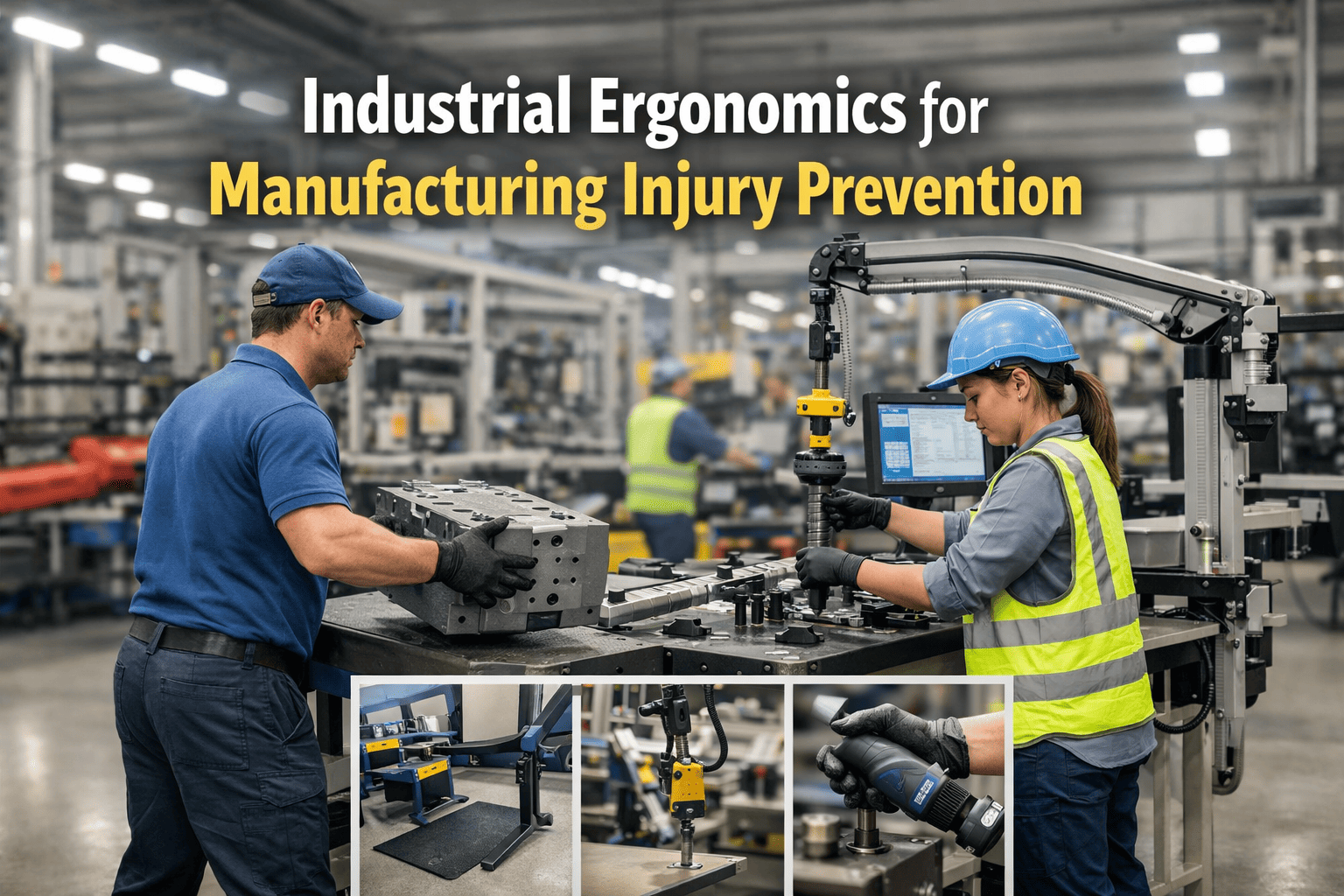
A die-cutting operator on the second shift develops a dull ache in her right shoulder. Eight weeks later, she is filing a workers' compensation claim for a rotator cuff tear, her workstation sits idle, and the plant is down one of its most experienced operators for six months of recovery. The root cause was not a dramatic accident — it was a bench that stood four inches too tall for her frame, forcing a subtle shoulder shrug thousands of times per shift. This is what makes musculoskeletal disorders so expensive and so preventable at the same time: they build silently, cost a fortune, and almost always trace back to a workstation that was designed for "the average worker" who does not exist. Manufacturing takes on nearly a quarter of all work-related MSD cases in private industry, and back injuries alone drain $225 billion annually from US businesses in direct and indirect costs. The playbook to reverse this is well documented — it just needs to be executed. Digital ergonomic tracking through a CMMS turns scattered observations into the data trail that actually reduces incident rates.
Where Manufacturing Work Hurts Workers
Frequency of MSD body-part involvement in manufacturing claims
Neck & Upper Back
14%
Overhead reach, looking down at benches, static postures
Shoulders
18%
Reaching above elbow height, lifting away from body
Lower Back
39%
Manual lifting, twisting, bending, carrying heavy loads
Hands & Wrists
17%
Repetitive gripping, vibration, awkward tool angles
Knees & Hips
8%
Kneeling, squatting, climbing, prolonged standing
Elbows & Forearms
4%
Repetitive torque, hammering, forceful twisting
Lower back injuries alone account for over 38% of all work-related MSDs and drive the largest share of workers' compensation claim costs.
The Five Risk Factors That Drive Every MSD
Risk Factor 1
Awkward Postures
Any time joints deviate from neutral — reaching overhead, twisting the trunk, bending the wrist, kneeling, or working with arms extended away from the body. The further from neutral, the faster tissue damage accumulates.
Risk Factor 2
Excessive Force
Lifting, pushing, pulling, or gripping loads beyond what tissues can safely handle. A 50-pound lift at arm's length creates spinal compression equivalent to 500 pounds at the waist.
Risk Factor 3
High Repetition
Performing the same motion every few seconds without recovery. Assembly lines running 30 cycles per minute generate thousands of identical micro-stresses on the same tissue every shift.
Risk Factor 4
Static Loading
Holding a position without movement — standing still for hours, pinch-gripping a part, or supporting weight in one arm. Blood flow drops, metabolic byproducts build up, and tissue breaks down.
Risk Factor 5
Vibration & Contact Stress
Hand-arm vibration from power tools, whole-body vibration from vehicles and pallet trucks, or sharp pressure points against benches and edges. All three quietly damage nerves and circulation.
The Hierarchy Of Controls (What Actually Works)
Most Effective
Engineering Controls
Redesign the workstation, tool, or process so the hazard physically cannot reach the worker. Height-adjustable benches, powered lift assists, tilt tables, tool balancers, conveyor delivery of parts.
Moderately Effective
Administrative Controls
Change how the work is organized. Job rotation between high-load and low-load tasks, mandatory micro-breaks, work pace adjustment, training on neutral postures, and early symptom reporting.
Last Resort
Personal Protective Equipment
Knee pads, anti-vibration gloves, anti-fatigue insoles. These reduce exposure at the body but never fix the underlying hazard. Always a supplement, never a substitute, for engineering or admin controls.
Engineering fixes cost more upfront and return the most because they eliminate rather than manage risk. PPE is the cheapest and weakest control — if your ergonomic program leads with gloves and back belts, you have a program problem.
What Redesigning A Workstation Actually Looks Like
Before: High-Risk Bench
- Fixed bench height forcing shoulder elevation for shorter workers
- Parts bins 28 inches from body requiring constant reach
- Pneumatic tool hanging from ceiling at awkward angle
- No foot rail, no anti-fatigue mat, standing on concrete
- Poor task lighting causing forward head lean
- Waste bin on floor requiring repeated bending
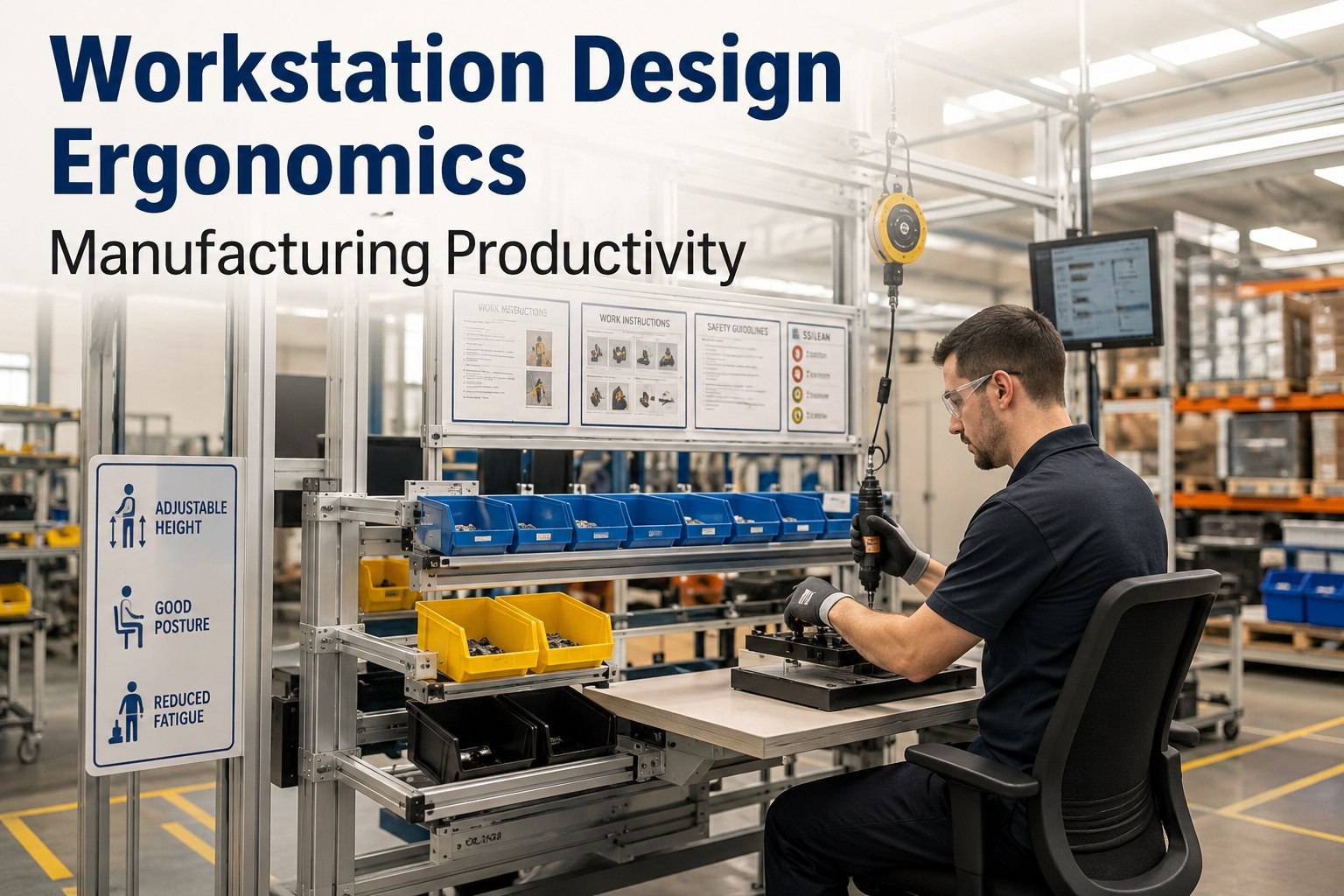
After: Ergonomically Designed
- Height-adjustable bench fitting 5th to 95th percentile operators
- Parts within primary reach zone of 14-18 inches
- Tool balancer positioning grip at elbow height, neutral wrist
- Sit-stand stool plus gel anti-fatigue mat on concrete
- Task lighting at 750 lux, glare-free, adjustable arm
- Waste chute integrated at waist level, no bending
The NIOSH Lifting Equation In Plain English
51 lbs Load constant under ideal lift conditions
HM Horizontal distance of load from body
VM Vertical height where lift starts
DM Distance load travels vertically
AM Asymmetry or twisting angle
FM Frequency of lifts per minute
CM Coupling quality of the grip
Lifting Index (LI) = Actual Load Weight / RWL
LI below 1.0
Safe for most workers
LI 1.0 - 2.0
Elevated risk, redesign
LI above 2.0
High risk, fix immediately
Stop Guessing Which Jobs Are Hurting Your People
OxMaint captures ergonomic assessment scores, near-miss reports, and early symptom data so patterns surface before they become claims. Turn scattered observations into a data trail that actually shifts injury rates.
Six-Step Implementation Roadmap
01
Identify Problem Jobs
Pull OSHA 300 logs, workers' comp records, and symptom surveys. Walk the floor. Talk to operators. Jobs with recurring complaints, high turnover, or visible awkward postures go to the top of the list.
02
Run Structured Assessments
Apply RULA for upper-limb posture, REBA for whole-body, NIOSH equation for lifts, Strain Index for upper-limb repetition. Numbers turn opinions into priorities engineering and leadership can act on.
03
Design Engineering Controls
Match the fix to the risk — adjustable benches, lift assists, tool balancers, turntables, conveyor delivery. Pilot on one line before scaling. Measure posture scores before and after.
04
Layer Administrative Controls
Rotate workers across high-load and low-load tasks. Build micro-breaks into the cycle. Train operators on neutral postures and symptom recognition. Make early reporting culturally safe.
06
Review And Iterate
Quarterly review of incident rates, posture scores, and worker feedback. Retire controls that failed to move the numbers. Scale the ones that did. Ergonomics is a program, not a project.
Solution Categories At A Glance
Workstation
Height-adjustable benches
Tilt tables and turntables
Anti-fatigue matting
Sit-stand stools
Parts bins in primary zone
Adjustable task lighting
Material Handling
Powered lift assists
Vacuum tube hoists
Conveyor delivery of parts
Scissor lifts and levelers
Pallet positioners
Cart and dolly systems
Tools & Assembly
Tool balancers and reels
Anti-vibration grips
Pistol vs inline trigger match
Torque-reaction arms
Exoskeleton assist for overhead
Ergonomic hand tool sets
The ROI Math Leadership Actually Needs
Cost Of Doing Nothing
$40K-$80K
Average MSD claim direct cost
3-5×
Indirect costs (coverage, rework, recruiting)
180 days
Typical lost-time MSD recovery
Return From Ergonomic Program
50-70%
Typical MSD incidence reduction in 24 months
$3-$6
Benefit returned per $1 invested
12-25%
Productivity gain from redesigned stations
Frequently Asked Questions
Does OSHA have a specific ergonomics standard for manufacturing?
Not a dedicated standard, but the General Duty Clause requires employers to address recognized hazards that cause or can cause serious harm. OSHA cites ergonomic hazards under this clause and references NIOSH guidelines, RULA, REBA, and the NIOSH Lifting Equation as accepted assessment methods.
How do I prioritize which jobs to fix first with limited budget?
Rank by MSD claim history, assessment score severity, number of exposed workers, and how feasible the fix is. Jobs with high Lifting Index scores or RULA scores above 5 on many operators give you the biggest injury-reduction per dollar spent.
Are back belts effective at preventing lifting injuries?
No. NIOSH has found no scientific evidence that back belts reduce the risk of injury for healthy workers, and they may create false confidence that leads to heavier lifting. Engineering controls that eliminate or reduce the lift are the evidence-backed solution.
How long before an ergonomic program shows results?
Posture and discomfort scores improve within weeks of a workstation redesign. Incident rate reductions typically take 12-24 months because MSDs that were already developing need time to either resolve or show up in claims data — patience is part of the program.
Do exoskeletons actually work in manufacturing settings?
For overhead assembly and repetitive tool use above shoulder height, passive exoskeletons reduce shoulder muscle activity by 30-60% in controlled studies. They work best as a supplement to workstation redesign, not as a standalone fix. Pilot before committing to a fleet —
consult on a structured pilot to measure actual impact.
Who should own the ergonomics program — safety, operations, or HR?
Safety typically leads, operations implements, HR tracks costs and outcomes, and maintenance executes physical changes. The program fails when any of these four silos try to own it alone. Cross-functional steering committees consistently outperform single-department ownership.
Design Jobs To Fit People, Not The Other Way Around
Every Prevented Injury Is A Person Who Goes Home Whole
OxMaint ties ergonomic assessments, intervention work orders, training records, and incident data together in one system — so your program finally has the continuity and evidence trail it needs to actually work.