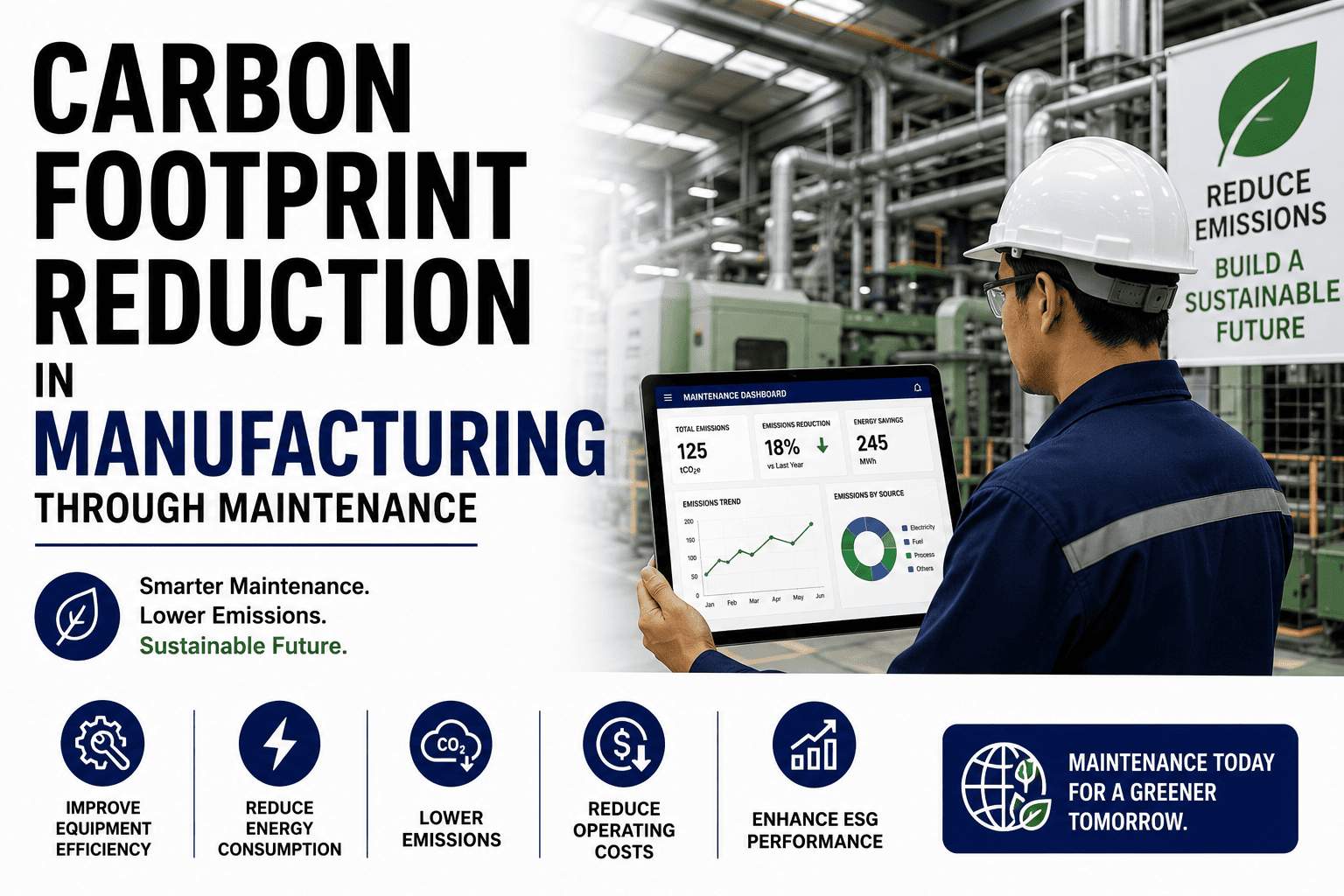
When manufacturing companies publish net-zero roadmaps, the conversation typically centers on energy procurement, renewable power, and supply chain emissions. What gets far less attention is the direct link between maintenance quality and carbon output — and that link is substantial. Poorly maintained equipment runs inefficiently. An HVAC system with clogged filters uses 15 to 25 percent more electricity than a clean one. A compressed air system with undetected leaks loses 20 to 30 percent of its output to waste. A poorly lubricated conveyor motor draws excess current for months before a maintenance team notices. Multiply these inefficiencies across hundreds of assets in a manufacturing plant and the cumulative energy waste directly undermines decarbonisation targets. Maintenance-driven energy reduction is one of the fastest, most controllable paths to reducing Scope 2 emissions in manufacturing — and CMMS platforms like OxMaint are the operational infrastructure that makes it measurable and manageable at scale.
Net Zero · Manufacturing Sustainability · Maintenance Emissions · ESG Operations
The Role of Maintenance in Achieving Manufacturing Net-Zero Goals
Planned maintenance is not just a reliability strategy — it is a carbon reduction strategy. Here is how maintenance operations contribute directly to net-zero targets.
25%
excess energy consumption from poorly maintained HVAC systems alone
30%
of compressed air energy lost to leaks in poorly maintained systems
18%
average Scope 2 reduction achieved by manufacturers with active PM programs
2030
target year for 50%+ Scope 1 and 2 reduction under Science Based Targets initiative
The Carbon-Maintenance Link
How Equipment Condition Directly Affects Carbon Output
Every asset in a manufacturing plant has an energy efficiency curve. Well-maintained equipment operates near its designed efficiency. As maintenance is deferred, efficiency declines and energy consumption rises — increasing Scope 2 emissions from the same operational output.
HVAC Systems
Dirty filters, worn belts, low refrigerant
+15–25% energy draw
One of the largest avoidable Scope 2 sources in manufacturing
Compressed Air
Undetected leaks, dirty filters, over-pressure
+20–30% compressor load
Compressed air is often the single largest energy cost in a plant
Electric Motors
Poor lubrication, bearing wear, alignment drift
+8–12% current draw
Motors account for 70% of industrial electricity; wear compounds quickly
Boilers and Steam
Scale buildup, trap failures, burner drift
+10–20% fuel consumption
Direct Scope 1 emissions increase; hardest to decarbonise quickly
Conveyor Systems
Misalignment, insufficient lubrication, worn components
+5–10% drive motor energy
Low visibility but high cumulative impact across long conveyor runs
Lighting Systems
Degraded fixtures, dirty lenses, failed sensors
+10–15% lighting energy
Quick wins available through regular cleaning and sensor calibration
Scope 1, 2, and 3
Where Maintenance Touches Each Emissions Scope
Scope 1
Direct Emissions
Maintenance directly reduces Scope 1 emissions by keeping combustion equipment (boilers, furnaces, gas turbines) operating at designed efficiency. Scale buildup, burner drift, and heat exchanger fouling increase fuel burn — and therefore direct CO2 output — measurably and continuously.
PM program focus: boiler tune-ups, burner calibration, heat exchanger cleaning schedules
Scope 2
Purchased Energy Emissions
The largest maintenance-addressable emissions category. Every kWh saved through well-maintained motors, HVAC, and compressed air systems reduces purchased electricity and the Scope 2 emissions associated with it. In grid-intensity terms, 1 MWh saved is 0.3–0.8 tonnes of CO2 avoided depending on the local grid mix.
PM program focus: HVAC filters, motor lubrication, compressed air leak audits, VFD calibration
Scope 3
Value Chain Emissions
Asset lifecycle extension through maintenance reduces the frequency of equipment replacement — and the embedded carbon cost of manufacturing new equipment. A machine that lasts 20 years instead of 12 represents 8 fewer years of manufacturing emissions amortised into each production unit.
PM program focus: predictive maintenance to extend asset life, reduce material waste from failures
CMMS as the Tool
How CMMS Platforms Turn Maintenance Into Measurable Carbon Reduction
01
Energy Anomaly Detection
CMMS platforms connected to energy monitoring systems flag equipment consuming above its efficiency baseline. A chiller drawing 20% more power than its rated load is a maintenance signal — and a carbon signal. Early detection turns a sustainability problem into a preventive work order before it compounds.
02
Structured PM Scheduling for Energy-Intensive Assets
HVAC filter changes, motor lubrication, compressed air leak audits, and boiler tune-ups need to happen on schedule — not when someone remembers. CMMS automates these triggers based on calendar intervals or usage hours, ensuring energy efficiency maintenance happens consistently rather than reactively.
03
Maintenance Cost and Carbon Data for ESG Reporting
ESG frameworks require documented evidence of operational efficiency improvements. CMMS generates PM completion records, energy anomaly work order histories, and asset condition trends — all of which provide auditable documentation of maintenance-driven emission reduction actions for sustainability reports and board presentations.
04
Asset Lifecycle Optimization
CMMS tracks cumulative repair costs, failure frequency, and condition ratings per asset — enabling data-backed decisions on repair vs. replace. Replacing an aging motor with a high-efficiency model at the right time avoids the carbon cost of running degraded equipment for years beyond its efficient life.
05
Predictive Maintenance for Pre-Failure Efficiency Recovery
Sensor-connected predictive maintenance catches equipment degradation before it reaches the failure threshold — and before energy consumption rises significantly. Addressing a bearing showing early vibration anomalies costs a fraction of replacing a failed motor, and recovers energy efficiency weeks earlier than reactive response would.
Make Your Maintenance Program Part of Your Net-Zero Strategy
OxMaint gives sustainability and operations teams the shared platform they need — PM scheduling for energy-intensive assets, energy anomaly alerting, and ESG-ready maintenance documentation — all in one CMMS.
Implementation Roadmap
A Practical Maintenance Decarbonisation Roadmap
Now — 6 Months
Audit energy consumption by asset class to identify the highest-impact maintenance gaps
Implement CMMS with PM schedules for HVAC, compressed air, motors, and boilers
Establish energy consumption baselines per asset for anomaly detection thresholds
Begin documenting all maintenance activities for ESG audit trail
6–18 Months
Connect IoT energy sensors to CMMS for real-time anomaly alerts on critical assets
Initiate compressed air leak detection and repair program with tracking in CMMS
Use MTBF and repair cost data to identify assets for efficiency-grade replacement
Produce first maintenance-linked sustainability report from CMMS data
18–36 Months
Predictive maintenance integration for high-energy assets reduces pre-failure waste
Lifecycle replacement program driven by CMMS asset data reduces Scope 3 intensity
PM compliance rates above 90% maintained as verified emission reduction control
CMMS data contributes to Science Based Targets reporting and third-party verification
FAQs
Maintenance, Net Zero, and CMMS — Common Questions
How much of a plant's carbon footprint can maintenance actually influence?
Studies from the Carbon Trust and the US Department of Energy indicate that 10 to 20 percent of a manufacturing facility's energy consumption is attributable to maintenance-related efficiency losses. For a typical mid-size plant, this represents a significant and relatively low-cost decarbonisation opportunity compared to renewable energy procurement.
Start a free trial to begin tracking your asset energy baselines.
Does CMMS data qualify as evidence for ESG and sustainability reporting?
Yes. CMMS records — PM completion timestamps, energy anomaly work orders, and asset condition histories — provide dated, auditable documentation of operational efficiency actions. This type of operational evidence supports Scope 1 and 2 reduction narratives in frameworks including GRI, CDP, and Science Based Targets reporting.
Book a demo to see OxMaint's reporting capabilities.
What is the fastest maintenance action to reduce energy consumption?
HVAC filter changes and compressed air leak audits deliver the fastest energy reductions relative to cost and effort. Both are typically achievable within 30 to 60 days of implementing a CMMS-scheduled PM program and show measurable energy consumption improvement within the same billing cycle.
How does predictive maintenance support net-zero goals differently from planned maintenance?
Planned maintenance improves efficiency by ensuring tasks are done on schedule. Predictive maintenance goes further by catching efficiency degradation between PM intervals — flagging a motor running hot before its next scheduled lubrication, for example. The combination recovers carbon-relevant efficiency losses earlier and more completely than schedule-based PM alone.
Maintenance Is Your Most Controllable Path to Net Zero
Decarbonising manufacturing requires multiple levers. Maintenance-driven energy efficiency is among the fastest, lowest-cost, and most measurable of those levers — and it is entirely within operational control. OxMaint gives manufacturing sustainability teams the data infrastructure to make maintenance a documented part of their net-zero journey, from PM compliance dashboards to ESG-ready asset histories.