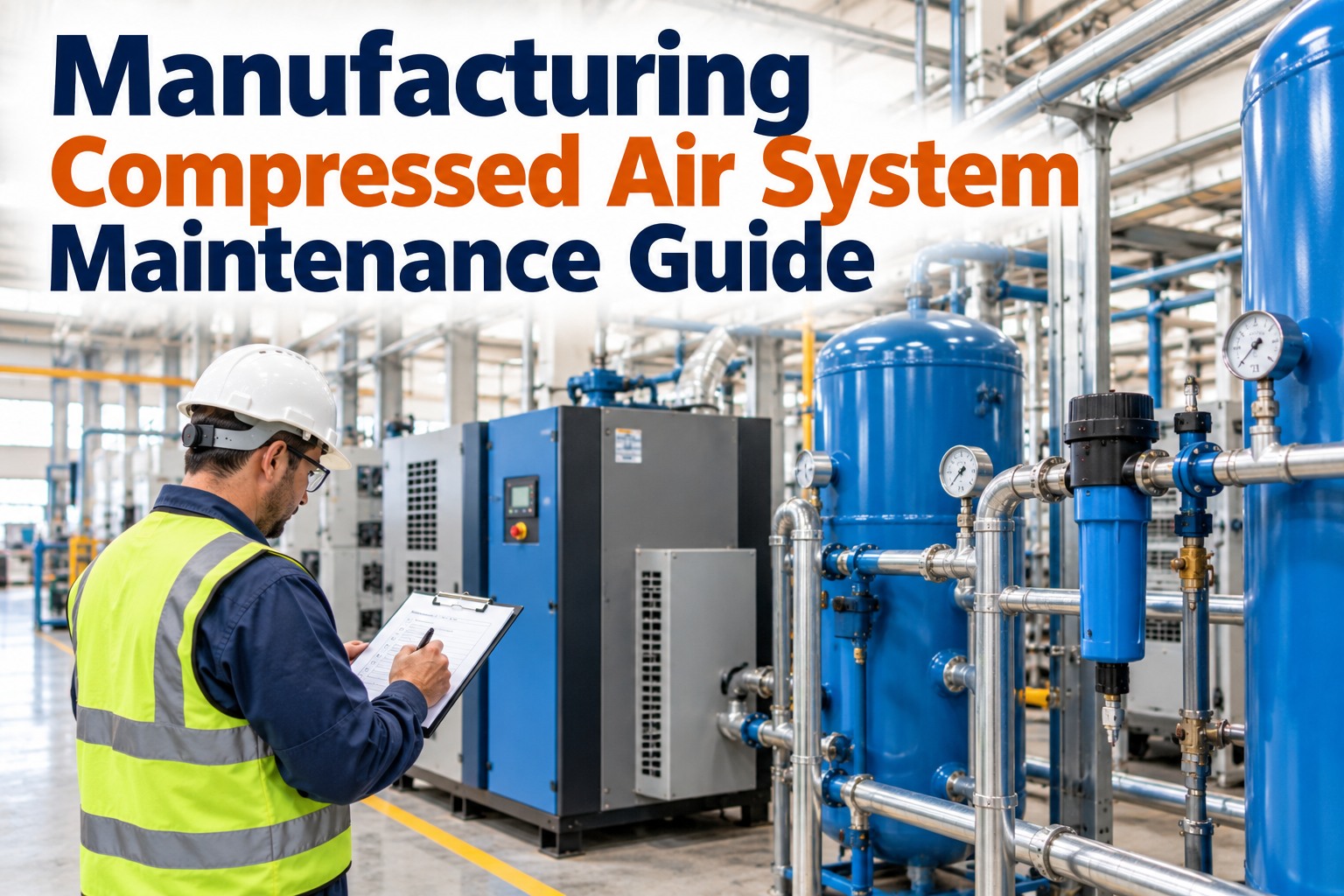
Air compressors power pneumatic tools, control valves, conveyor actuators, and automated machinery across virtually every manufacturing facility — and when one fails unexpectedly, it does not just stop one machine, it stops the entire production line that depends on compressed air. The reality is that most unplanned compressor failures are entirely preventable: industry data consistently shows that structured preventive maintenance on a CMMS like Oxmaint reduces compressor downtime by up to 70%, while reactive maintenance costs three to four times more per incident than planned service. If your maintenance team is still relying on calendar reminders and paper logs, this checklist will show you exactly what a structured, frequency-based compressor maintenance programme looks like — and why it is worth implementing before your next unplanned shutdown.
Checklist · Manufacturing · Compressed Air Systems
Air Compressor Maintenance Checklist for Manufacturing
A complete frequency-based maintenance checklist covering filters, oil, drains, belts, valves, and performance checks — structured for manufacturing teams running rotary screw, reciprocating, and centrifugal compressors.
70%
of compressor failures are preventable with structured PM
3–4x
higher cost of reactive repair vs. planned maintenance
30%
energy waste from dirty filters and leaking air systems
8,000h
typical oil-flooded rotary screw oil change interval
Why It Matters
What Skipped Compressor Maintenance Actually Costs
Maintenance teams under pressure often skip compressor tasks because the machine is "still running." Here is what that decision costs in three measurable ways.
Energy Impact
Dirty Filters Drive Up Power Bills
A clogged intake filter increases differential pressure across the compressor, forcing the motor to work harder for the same output. Even a 2 psi increase in differential pressure can raise energy consumption by 1%.
Up to 30% excess energy draw from neglected filters
Mechanical Impact
Oil Degradation Destroys Bearings
Oil-flooded rotary screw compressors depend on clean, correctly viscous oil to lubricate rotors, bearings, and seals. Degraded oil loses its protective film, causing accelerated bearing wear and rotor contact.
Bearing failures from oil neglect: avg $6,800 repair
System Impact
Water in the System Corrodes Downstream
Compressed air carries moisture that condenses in tanks and distribution lines. Without regular drain service, water accumulates, corrodes the receiver tank, and enters pneumatic tools and process instruments.
Receiver tank corrosion failures: up to $18,000 replacement
Safety Impact
Pressure Relief Valves That Never Get Tested
Safety relief valves that are never tested can seize in the closed position under oxidation and scale buildup. A failed relief valve on an over-pressurised receiver is a catastrophic failure — not a maintenance inconvenience.
OSHA cites inadequate pressure vessel inspection regularly
Quality Impact
Oil Carry-Over Contaminates Products
Failed coalescing filters allow oil aerosol carry-over into process air. In food, pharmaceutical, and precision manufacturing this creates product contamination, customer returns, and regulatory compliance failures.
ISO 8573-1 violations from oil carry-over: serious audit risk
Downtime Impact
High Discharge Temperature Shutdowns
Oil cooler fouling, low oil levels, and failed thermostatic mixing valves all cause elevated discharge temperatures that trigger thermal cutouts. A single shutdown during peak production can cost more than a full year of PM tasks.
Avg unplanned shutdown production loss: $2,400–$9,000/hr
Maintenance Schedule
Frequency-Based Maintenance Task Overview
Compressor maintenance tasks span daily checks to annual overhauls. This overview maps tasks to their correct frequency before the full checklist detail below.
Daily
Weekly
Monthly
Annual
Oil level check
Discharge temperature log
Pressure differential check
Manual drain test
Abnormal noise check
Auto-drain function verify
Belt tension inspect
Air filter visual check
Cooler exterior inspection
Safety valve operation check
Control panel review
Lubrication points grease
Oil sample / analysis
Filter differential pressure record
Leak detection survey
Coalescing filter check
Vibration level baseline
Desiccant dryer check
Full oil change
Air-end service / inspection
Valve overhaul (reciprocating)
Pressure vessel inspection
Safety relief valve test
Complete system performance test
Full Checklist
Complete Air Compressor Maintenance Checklist
Each checklist section below covers specific maintenance tasks, what to check, and what the recorded finding should confirm. Run these on a CMMS to capture timestamped evidence per task.
Check oil level on sight glass — confirm oil is within the operating band marked on the reservoir
Record: Level reading and any top-up volume added. Low oil on a rotary screw without top-up triggers bearing failure within hours.
Log compressor discharge temperature — compare against baseline and flag any reading more than 5°C above normal
Record: Temperature at full load. Rising discharge temperature is the first signal of oil cooler fouling or low oil flow.
Check inlet and outlet pressure differential — confirm system is operating at design pressure drop across filters and separators
Record: Differential pressure reading. Increasing differential indicates filter restriction building up.
Manually test auto-drain function on receiver tank and dryer — verify condensate is discharging and drain is not blocked or leaking past the seat
Failed drains are the most common cause of water in compressed air systems — test daily without exception.
Listen for abnormal mechanical noise — knocking, squealing, or rattling during loaded operation that was not present previously
Record: Pass / flag with description. New noise is a compressor telling you something — always investigate immediately.
Inspect drive belt tension and condition — check for fraying, cracking, glazing, and correct tension per manufacturer specification using a tension gauge
Record: Tension reading and belt condition grade. Slipping belts reduce output and generate heat that degrades belt life exponentially.
Visually inspect air intake filter element — check for visible dirt loading, tears, and correct seating in housing
Record: Filter condition grade (Clean / Dirty / Replace). Replace on condition, not just on schedule — high-dust environments need more frequent changes.
Inspect oil cooler and aftercooler external surfaces for dust and debris accumulation — blow out with compressed air if fouling is visible
Record: Cooler condition and cleaning action taken. A fouled cooler increases discharge temperature by 10–20°C and accelerates oil degradation.
Manually lift safety pressure relief valve to confirm it moves freely and reseats without leaking — do not hold open for more than 2 seconds
A seized relief valve is a pressure vessel safety critical failure. This test must be documented with a date and technician name.
Review control panel — check for active alarms, logged fault codes, and confirm that all operating parameters are within normal range
Record: Any active alarms and action taken. Controllers log fault history — review the last 7 days during this check.
Take an oil sample for laboratory analysis — submit to an oil analysis lab and compare viscosity, oxidation, contamination, and wear metal results against baseline
Record: Lab report filed against compressor ID. Oil analysis extends oil life, catches internal wear early, and justifies condition-based change intervals.
Conduct a compressed air leak detection survey using ultrasonic leak detector — tag and log every leak point found, quantify estimated CFM loss per leak
Record: Leak survey report with GPS-tagged leak locations. A 1/8-inch leak at 100 psi wastes approximately 25 CFM — quantify the cost to prioritise repair.
Check coalescing separator element differential pressure — replace if differential exceeds manufacturer maximum or element has been in service 2,000 hours
Record: Differential pressure reading. A saturated coalescer passes oil aerosol downstream — replacing on time is a product quality, not just maintenance, decision.
Measure and record vibration levels at bearing points — compare against baseline trend to identify developing imbalance or bearing degradation
Record: Vibration readings (mm/s) at each measurement point. Rising vibration trends give 4–8 weeks of advance warning before bearing failure.
Inspect desiccant dryer desiccant condition and pressure dewpoint — replace desiccant if dewpoint has risen above specification
Record: Dewpoint reading. Desiccant saturation from failed moisture pre-separators is the most common desiccant dryer failure mode in manufacturing.
Complete oil and oil filter change — drain fully, flush if oil analysis shows contamination, refill with manufacturer-specified grade and record volume
Record: Oil type, volume, and batch number. For oil-flooded rotary screws: typically every 4,000–8,000 hours depending on oil type and operating temperature.
Inspect air-end rotors, housing, and bearings for wear — replace bearing sets if hour intervals or condition monitoring data indicates replacement is due
Record: Air-end inspection report signed by authorised technician. Air-end overhaul is typically every 20,000–40,000 hours depending on load cycle.
Overhaul suction and discharge valves on reciprocating compressors — replace valve plates, springs, and seats as a set regardless of apparent condition
Worn valves reduce volumetric efficiency silently — a compressor running 15% below capacity wastes energy equal to the cost of annual valve replacement every month.
Commission external pressure vessel inspection by a certified inspector — obtain inspection certificate and retain for regulatory compliance and insurance purposes
Record: Inspection certificate with inspector credentials and next inspection due date. Statutory requirement in most manufacturing jurisdictions.
Perform full-load performance test — measure and record flow rate (CFM), specific power (kW/100 CFM), and discharge pressure under design load conditions
Record: Performance test data vs. nameplate specification. Performance degradation of more than 10% triggers investigation before accepting the compressor back into service.
Run This Checklist Digitally — Never Miss a Task Again
Oxmaint auto-schedules every compressor maintenance task, captures timestamped evidence per check, and sends alerts before service is overdue — so your air system never fails because a task slipped through.
Diagnostic Guide
Compressor Fault Diagnosis: What the Symptoms Tell You
When something is wrong, the compressor signals it before it fails. This table maps common symptoms to root causes and the maintenance action that resolves them.
| Symptom You See |
Most Likely Cause |
Maintenance Action |
Urgency |
| High discharge temperature alarm |
Fouled oil cooler or low oil level |
Clean cooler, check and top up oil, inspect thermostatic valve |
Immediate |
| Increased power consumption, same output |
Clogged air intake filter or air leaks |
Replace intake filter, run leak survey and repair losses |
Within 48 hours |
| Water in air lines and tools |
Failed auto-drain or saturated dryer |
Repair drain, replace desiccant or refrigerant dryer service |
Immediate |
| Oil carry-over in process air |
Saturated coalescing separator |
Replace coalescing element immediately |
Immediate |
| Vibration increase at bearings |
Developing bearing wear or imbalance |
Oil analysis, vibration trend review, plan bearing inspection |
Within 1 week |
| Low output pressure at full load |
Worn valves (reciprocating) or air-end wear |
Valve overhaul or air-end inspection |
Schedule next maintenance window |
| Pressure relief valve weeping |
Valve seat damage or system over-pressure |
Replace relief valve, check pressure controller setpoint |
Immediate — safety critical |
Performance Benchmarks
Key Performance Metrics for a Well-Maintained Compressor
Track these three parameters monthly. Declining trends are early warning signals that maintenance is needed before a failure occurs.
Specific Power
≤ 22 kW
Per 100 CFM output at design pressure. Rising specific power means the compressor is working harder for the same air — filters, leaks, or valve wear are likely causes.
Discharge Temperature
≤ 100°C
For oil-flooded rotary screws at full load in a 40°C ambient. Higher temperatures degrade oil 2x faster for every 10°C above the baseline operating point.
Pressure Dewpoint
≤ -40°C
For desiccant dryer installations supplying instrument air. Rising dewpoint indicates desiccant saturation — replace before moisture enters control valves and instruments.
System Leak Rate
≤ 10%
Of total compressor output lost to system leaks. Industry average is 20–30% — getting below 10% through quarterly leak surveys directly reduces compressor energy cost.
Oil Carry-Over
≤ 3 ppm
Oil concentration in delivered compressed air. ISO 8573-1 Class 2 specifies 1 ppm for most process applications. Monthly coalescer checks maintain this target reliably.
Volumetric Efficiency
≥ 85%
Actual output vs. theoretical capacity at design pressure. Below 80% indicates valve wear in reciprocating units or air-end clearance increase in screw compressors.
70%
reduction in unplanned compressor failures with CMMS-scheduled preventive maintenance
25%
average energy savings from fixing air leaks found in quarterly leak surveys
2.5x
longer average air-end service life with oil analysis and condition-based maintenance
Frequently Asked Questions
How often should compressor oil be changed in a manufacturing plant?
For oil-flooded rotary screw compressors, the standard interval is every 4,000 to 8,000 operating hours depending on oil type — synthetic oils extend to the higher end. The most reliable approach is condition-based change intervals using oil analysis, which
Oxmaint tracks automatically per compressor and can extend service intervals by 20 to 30% without risk.
What causes the most air compressor failures in manufacturing?
Overheating from dirty coolers and low oil levels, bearing failures from degraded lubricant, and failed auto-drains causing water damage are the three leading failure causes. All three are preventable with daily and weekly checks.
Book a demo to see how Oxmaint auto-assigns these checks to your maintenance team every shift.
How do I know if my compressed air system has a leak problem?
The clearest indicator is compressor load factor — if your compressor is running loaded more than 75% of the time but production demand hasn't increased, air leaks are likely consuming the excess capacity. Conduct an ultrasonic leak survey monthly and track CFM loss. Industry average leak rates are 20 to 30% of total output — a well-maintained system should be under 10%.
Can Oxmaint manage compressor maintenance schedules automatically?
Yes —
Oxmaint CMMS auto-generates work orders for every task in this checklist based on operating hours or calendar intervals, assigns them to named technicians, requires photo evidence for completion, and tracks overdue tasks with escalating alerts. Your compressor maintenance history becomes audit-ready and searchable from day one.
Your Compressors Keep Manufacturing Running — Make Sure Maintenance Keeps Pace
Oxmaint gives manufacturing maintenance teams a complete, digital compressor maintenance system — from daily checks to annual overhauls — with automated scheduling, evidence capture, and performance tracking built in. Start free today.