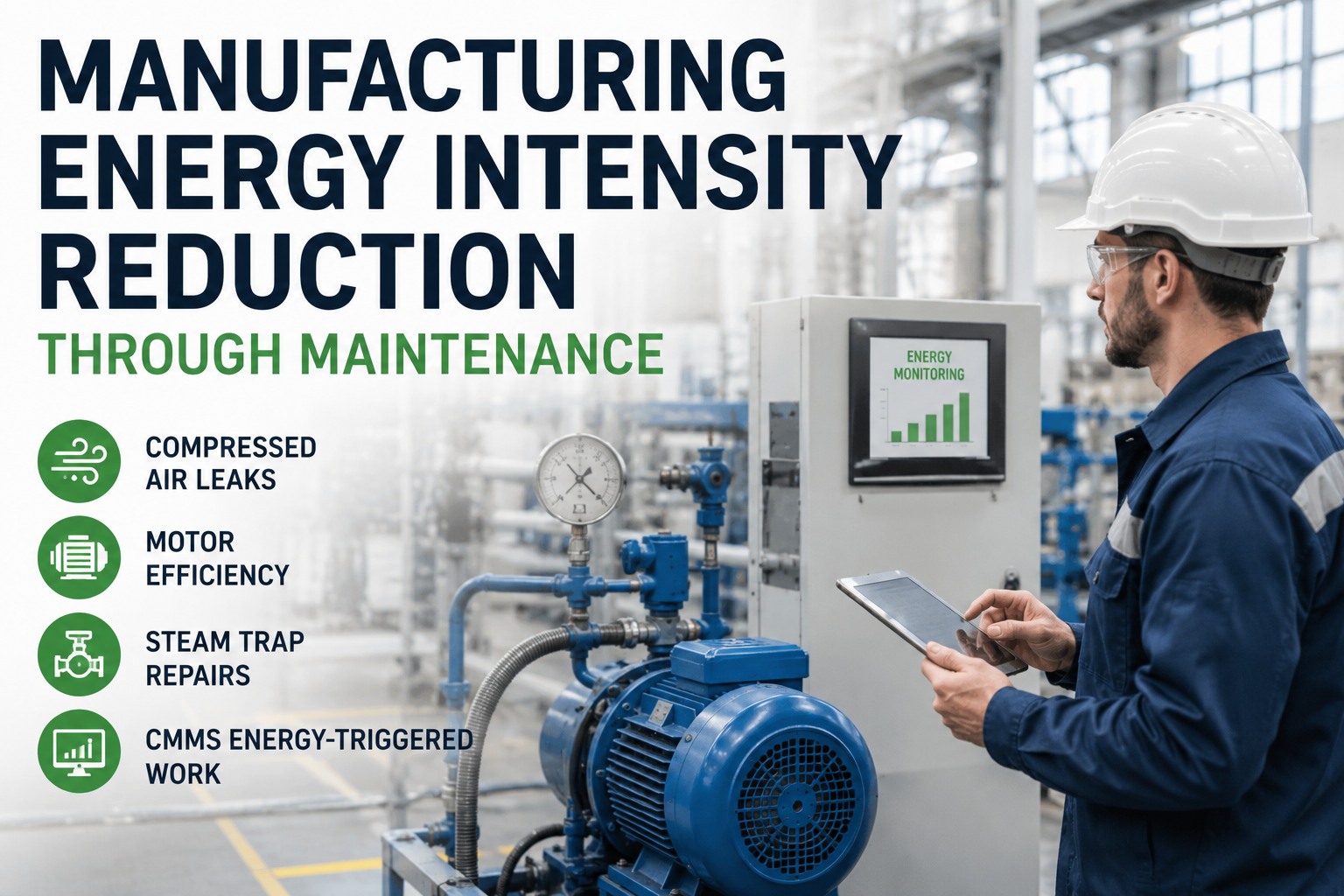
Oxmaint is the manufacturing maintenance software that turns energy intensity from a utility line-item into an operational KPI — linking every compressed air leak, motor bearing degradation, steam trap failure, and HVAC coil cleaning to a work order with an estimated kWh saving attached. Motors alone consume 70% of all industrial electricity, compressed air leaks waste 20-40% of compressor output, and a facility with 500 steam traps typically loses 50-75 of them per year to failure. Every one of these is a maintenance problem with a direct energy cost — and every one is a work order Oxmaint can generate, prioritize, and verify. Plants running structured energy-based maintenance programmes typically cut energy intensity 20-25% within 12 months, most of it in the first 90 days with no capital investment.
Manufacturing Energy Intensity Reduction Through Maintenance
A practical 2026 field guide for plant managers, energy managers, and maintenance leaders — showing how proactive maintenance on compressed air, motors, steam traps, and HVAC cuts kWh per unit of production, powered by Oxmaint's energy-triggered work order engine.
Six maintenance-owned energy leaks in every manufacturing plant
Degraded equipment does not just fail — it wastes energy every hour it runs. A motor with bearing wear draws 8-12% more current than a healthy motor doing the same work. A single quarter-inch compressed air leak wastes $2,220 per year. A failed-open steam trap bleeds continuous heat for months before anyone notices. Oxmaint schedules the PMs that catch every one of these before the waste compounds — and every intervention gets a kWh saving attached to the closed work order. To baseline these losses on your plant, start a free Oxmaint trial.
Compressed air leaks
20-40% of compressor output lost to leaks. Oxmaint schedules quarterly ultrasonic leak surveys, logs every leak against the asset, and closes work orders with the estimated kWh saved.
Motor bearing degradation
Worn bearings and misalignment push motor current draw up 8-12%. Oxmaint tracks vibration and current signatures against baseline, triggering PM before efficiency drops further.
Failed steam traps
15-30% of traps fail open, each bleeding $1,000-5,000/year in continuous steam loss. Oxmaint schedules annual trap surveys and tracks each one by ID, service life, and status.
HVAC filters & coils
Dirty filters and fouled coils force fans to work harder for the same airflow. Oxmaint schedules quarterly filter changes and coil cleaning against the specific HVAC unit.
Pump & fan systems
Fixed-speed pumps and fans running at full load when demand is partial. Oxmaint tracks VFD retrofits and flags impeller wear before efficiency degrades further.
Phantom / after-hours loads
Equipment running during nights, weekends, and holidays with no production. Oxmaint scheduling enforces shutdown protocols and flags any unauthorised runtime.
The maintenance-to-kWh math — cost, savings, and payback
Not every energy loss has the same return. The maintenance interventions below are ranked by savings per dollar invested — the same ranking Oxmaint uses when scoring energy-related work orders in the backlog. Quick wins (leaks, traps, phantom loads) go first because they compound daily; capital projects (VFDs, LED, insulation) follow with structured payback tracking. To baseline these against your plant's actual consumption, book a demo showing the energy-intensity dashboard.
| Intervention | Fix cost | Annual savings | Payback |
|---|---|---|---|
| Compressed air leak repair Per leak, tracked in Oxmaint |
$500-$2,000 | $2,000-$10,000 | <3 months |
| Steam trap replacement Per failed-open trap |
$200-$500 | $1,000-$5,000 | <2 months |
| Motor bearing PM Vibration-triggered work orders |
$300-$1,200 | 8-12% current draw cut | Immediate |
| HVAC filter & coil cleaning Quarterly Oxmaint PM |
$50-$300 per unit | 20-35% HVAC reduction | Same quarter |
| VFD retrofit Pumps, fans, compressors |
$500-$5,000 per motor | 20-50% motor energy | 6-18 months |
| Pipe & steam insulation Bare hot lines & valves |
$150-$800 per section | 25-40% steam system | 6-12 months |
| Off-hours shutdown protocols Oxmaint scheduling enforced |
Zero capital | 5-15% total plant energy | Immediate |
How a manufacturing energy programme actually runs in Oxmaint
Every plant that hits 20-25% energy intensity reduction follows the same five-stage discipline — audit, prioritize, execute, verify, institutionalize. Oxmaint runs this loop as a standard operating rhythm rather than a one-time project, so gains compound month over month instead of eroding after the first quarter. The stages below are how energy managers, plant managers, and maintenance leaders convert one-off audits into a permanent maintenance workflow. To structure this loop for your plant, sign up for a free Oxmaint trial.
Baseline & audit
Walk the plant with an ultrasonic leak detector, thermal camera, and Oxmaint mobile. Log every leak, failed trap, dirty coil, and idle motor against the specific asset — turning the audit into a corrective action backlog on day one.
Prioritize by ROI
Oxmaint scores every energy work order by estimated annual kWh savings divided by fix cost. Sub-3-month payback items go first, capital projects queue with justification data attached. No finding sits in an audit report — every one becomes a scheduled work order.
Execute the quick wins
Compressed air leaks repaired, failed traps replaced, HVAC filters changed, phantom loads shut off. Oxmaint routes work orders to the right technician with parts pre-staged and the estimated saving attached to the WO for post-close verification.
Verify against baseline
Sub-meter data plus the Oxmaint work order log confirms actual kWh reduction against the estimate. Interventions that under-deliver get reviewed; interventions that over-deliver get scaled. Verified savings feed the ESG and CFO reports monthly.
Institutionalize the loop
Oxmaint converts the audit findings into recurring PMs — ultrasonic leak surveys every quarter, trap surveys annually, coil cleaning by season. Energy awareness becomes part of every maintenance workflow, not a one-time event that decays.
Six capabilities that turn Oxmaint into your energy reduction engine
Oxmaint is the manufacturing maintenance software built to link maintenance work directly to energy KPIs — every closed work order carrying an estimated kWh impact, every asset tracking its energy signature over time, every audit finding becoming a scheduled task instead of a forgotten note. The six capabilities below are how plant energy managers use Oxmaint to run permanent energy programmes rather than one-off projects. To scope Oxmaint against your plant, book a manufacturing energy demo.
kWh-tagged work orders
Every energy-related work order in Oxmaint carries an estimated kWh saving. Closed WOs feed the energy-intensity dashboard automatically — no separate ESG reporting system needed.
Ultrasonic leak surveys
Oxmaint schedules quarterly compressed air leak surveys, logs each leak against the specific asset with location tag, and closes the WO with fix cost and estimated $ saving.
Steam trap register
Oxmaint holds every steam trap by ID, install date, service life, and status. Annual survey WOs get generated automatically and failed traps flagged for immediate replacement.
Condition-based motor PM
Oxmaint tracks motor vibration and current signatures against baseline — triggering PM when bearing degradation adds 8-12% current draw, catching efficiency loss before failure.
ISO 50001 alignment
Oxmaint documentation aligns to ISO 50001 energy management — Plan-Do-Check-Act cycle, policies, targets, and verified interventions. Audit-ready without a parallel system.
Mobile technician workflow
Field technicians log leak locations, capture photos, and close energy WOs on Oxmaint mobile — with offline sync for boiler rooms and compressor bays without connectivity.
Oxmaint for manufacturing energy reduction — FAQ
Where should a manufacturing plant start an energy reduction programme?
Compressed air leaks and steam traps — every time. The DOE estimates 20-40% of compressor output is lost to leaks, and 15-30% of steam traps fail open in any given year. Both fixes are sub-3-month payback with minimal capital investment. Oxmaint schedules an ultrasonic leak survey and steam trap survey as the first energy PMs on the calendar, logs every finding as a work order with an estimated kWh saving, and closes each one with verified impact. Plants that start here typically capture 10-20% of total plant energy cost within 60 days before any capital-project work begins.
How much of a plant's total energy do motors actually use?
Motor systems account for roughly 70% of industrial electricity consumption — making them the highest-priority category for any energy-based maintenance programme. Beyond raw consumption, motor efficiency degrades continuously with bearing wear, misalignment, and lubrication drift. A motor running with bearing wear draws 8-12% more current than a healthy motor doing the same work. Oxmaint tracks motor vibration and current signatures against a healthy baseline, triggering PM before efficiency degradation compounds into a failure or a runaway energy cost.
What does a single compressed air leak actually cost per year?
A single quarter-inch compressed air leak at typical plant pressure wastes approximately $2,220 per year in electricity — and most plants have dozens. Fix cost per leak is $500-$2,000 depending on access and severity; annual savings run $2,000-$10,000 depending on leak size and compressor efficiency. Payback is usually under three months. Oxmaint's quarterly ultrasonic leak survey WO generates the leak log automatically, tags each leak against its asset, and tracks repair status with the estimated saving attached to the closed work order.
How does condition-based maintenance connect to energy savings?
Degraded equipment uses more energy than healthy equipment doing the same work — long before it fails. Bearing wear adds 8-12% to motor current draw. Fouled HVAC coils force fans to work harder for the same airflow. Impeller wear on pumps drops flow efficiency and increases specific energy per gallon. Oxmaint's condition-based PMs — triggered by vibration, temperature, current draw, or pressure anomalies — catch efficiency degradation before it becomes either a failure or a permanent energy cost. Every triggered PM carries an estimated kWh recovery once completed.
Can Oxmaint integrate with sub-meters and IoT sensors for real-time energy data?
Yes. Oxmaint integrates with sub-meters, PLC energy tags, IoT sensors, and building management systems via OPC UA and MQTT. Real-time consumption data flows into the platform against the specific asset and production line, letting energy managers correlate kWh per unit of production and detect anomalies as they happen. When consumption exceeds a threshold on any asset, Oxmaint generates a work order automatically — closing the gap between the sub-meter reading and the maintenance response that fixes the underlying cause.
What is the realistic ROI when a manufacturing plant deploys Oxmaint for energy reduction?
Manufacturing plants typically capture 10-20% of total energy cost within the first 60-90 days of a structured Oxmaint energy programme — driven almost entirely by compressed air leaks, failed steam traps, and phantom-load shutdowns with sub-3-month payback. The full 20-25% energy intensity reduction target is reached within 12 months as capital projects (VFDs, insulation, LED retrofits) come online and condition-based motor PMs institutionalize the loop. On a mid-size plant with a $5M annual energy bill, a 20% cut is $1M/year — covering multi-year Oxmaint investment inside quarter one. To model the case for your plant, start a free Oxmaint trial.
Every leak found. Every trap fixed. Every kWh accounted for.
Oxmaint gives manufacturing plant managers, energy managers, and maintenance leaders one platform to link every energy-related work order to a verified kWh saving — from ultrasonic leak surveys and steam trap registers to condition-based motor PMs and ISO 50001-aligned reporting. Energy intensity becomes a maintenance KPI, not a utility line item.