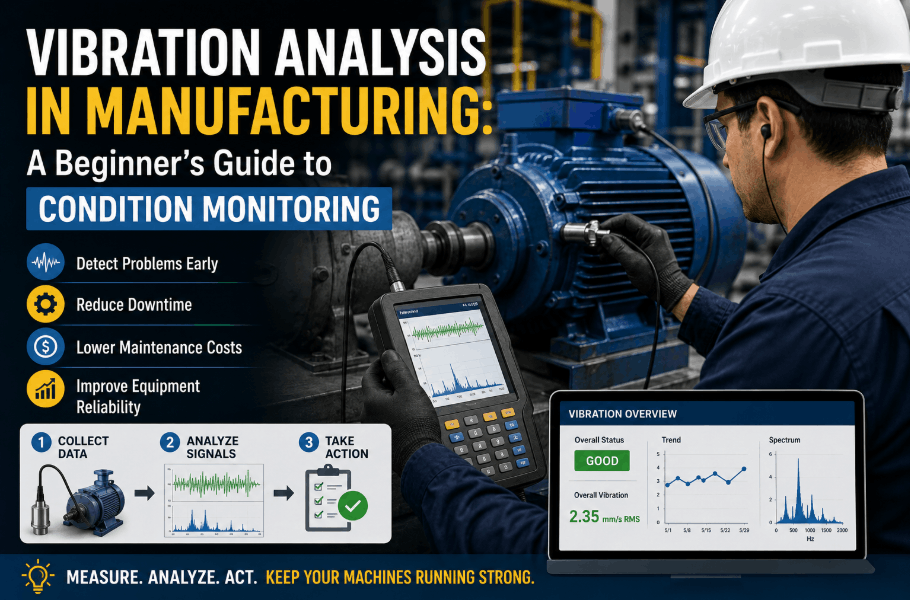
Every machine on your plant floor is talking. The hum of a motor, the rattle of a conveyor, the subtle whine from a gearbox — these are not random sounds. They are vibration signatures, and they carry detailed information about the internal health of your equipment. Vibration analysis is the science of reading these signatures to detect faults like bearing degradation, shaft misalignment, rotor imbalance, and mechanical looseness — often months before a breakdown occurs. For maintenance teams ready to move beyond reactive firefighting, this guide breaks down the fundamentals of vibration diagnostics and shows how connecting your findings to a CMMS like Oxmaint transforms raw vibration data into timely, automated maintenance action.
What Happens When You Ignore Machine Vibrations
Vibration does not fix itself. A slight imbalance in a fan rotor today becomes a cracked shaft and a seized bearing in three months. Reactive maintenance — running equipment until failure — costs manufacturing plants significantly more than planned corrective repairs. Beyond the direct repair expense, unplanned downtime triggers cascading losses across production schedules, overtime labor, expedited parts shipping, and quality rejects from the restart period.
3-10x
Higher Cost
Emergency repairs cost 3 to 10 times more than the same repair performed as a planned, scheduled activity
70%
Downtime Avoided
Plants using vibration-based predictive maintenance reduce unplanned equipment failures by up to 70 percent
90%
Fault Coverage
Four common faults — imbalance, misalignment, looseness, and bearing wear — account for 90 percent of rotating machinery issues
Stop Guessing, Start Diagnosing
Oxmaint connects vibration monitoring directly to your maintenance workflows — when a fault is detected, a work order is created automatically with the diagnosis, recommended action, and assigned technician.
Vibration is the mechanical oscillation of a machine component around its resting position. When a motor shaft spins, it generates a predictable vibration pattern based on its speed, load, and mechanical condition. Analysts measure this vibration using three properties — each revealing different aspects of the machine's health. Understanding these properties is the first step toward accurate fault diagnosis.
Displacement
How far it moves
Measured in mils (thousandths of an inch) or microns. Best for detecting faults in slow-speed machinery and fluid-film bearings where the shaft physically shifts position. Proximity probes are the typical sensor used for displacement measurement.
Velocity
How fast it moves
Measured in inches per second (in/s) or millimeters per second (mm/s). Provides the most balanced view of machine health across the typical fault frequency range of 10 Hz to 1 kHz. This is the standard measurement for most industrial equipment.
Acceleration
How quickly velocity changes
Measured in g (gravitational units). Excels at detecting high-frequency faults — bearing defects, gear mesh problems, and impacts. Accelerometers are the most common sensor type and are the workhorse of modern vibration programs.
From Raw Signal to Fault Diagnosis: The Analysis Process
Collecting vibration data is only the beginning. The real value comes from transforming that raw signal into a clear diagnosis that tells your maintenance team exactly what is wrong, where the problem is, and how urgent the repair is. Here is how vibration data flows from sensor to corrective action in a well-structured condition monitoring program.
1
Mount Sensors at Strategic Points
Accelerometers are placed on bearing housings in horizontal, vertical, and axial orientations. Consistent sensor placement on the same measurement points each time is critical — even small location changes affect the data. Magnetic mounts work for route-based programs; stud-mounted or adhesive-mounted sensors are used for permanent installations.
2
Capture the Time Waveform
The accelerometer converts mechanical vibration into an electrical signal — a voltage that varies with the intensity and speed of the vibration. This raw signal, plotted as amplitude versus time, is called the time waveform. It contains all the vibration information from the machine, but in a complex, overlapping form that is difficult to interpret directly.
3
Apply Fast Fourier Transform (FFT)
FFT is the mathematical engine of vibration analysis. It decomposes the complex time waveform into individual frequency components, producing a spectrum — a graph of amplitude versus frequency. Each peak in the spectrum corresponds to a specific mechanical event: shaft rotation, bearing element pass, gear mesh, or structural resonance.
4
Identify Fault Signatures in the Spectrum
Trained analysts — or AI-assisted software — compare the spectrum peaks against known fault patterns. A dominant peak at 1x shaft speed means imbalance. Elevated 2x with strong axial readings means misalignment. Non-synchronous peaks at calculated bearing frequencies mean bearing defects. Each fault has a recognizable fingerprint.
5
Generate a Work Order and Execute the Fix
The diagnosis is documented and a maintenance work order is created with the specific fault, recommended corrective action, priority level, and required parts. With Oxmaint, this entire step is automated — threshold-based alerts trigger work orders instantly, assigning the right technician with zero manual intervention.
Want to see this workflow in action? Book a live demo and we will walk through how Oxmaint automates the journey from vibration alert to completed repair.
The Four Faults That Cause 90% of Machine Problems
You do not need to memorize hundreds of fault patterns to start getting value from vibration analysis. Research and decades of field experience consistently show that four common mechanical faults are responsible for the vast majority of rotating equipment failures in manufacturing. Master these four, and you will be able to diagnose most problems your plant encounters.
Fault 01
Rotor Imbalance
Vibration SignatureDominant peak at exactly 1x RPM in the radial direction. Amplitude is proportional to the square of the speed.
Common CausesMaterial buildup on fan blades, broken or missing components, manufacturing defects, uneven erosion or corrosion.
FixDynamic balancing using trial weights. Clean impeller surfaces. Replace damaged blades or rotors.
Common CausesThermal growth, soft foot condition, improper coupling installation, pipe strain, foundation settlement.
FixLaser shaft alignment. Correct soft foot. Account for thermal growth with offset targets. Check and relieve pipe strain.
Fault 03
Bearing Degradation
Vibration SignatureNon-synchronous peaks at calculated bearing defect frequencies (BPFO, BPFI, BSF, FTF) with harmonics and sidebands at shaft speed.
Common CausesLubrication failure, contamination, overloading, improper installation, fatigue after extended service life.
FixReplace bearing before catastrophic failure. Improve lubrication practices. Address root cause (misalignment, overloading) to protect the new bearing.
Fault 04
Mechanical Looseness
Vibration SignatureMultiple harmonics of shaft speed (1x, 2x, 3x, 4x...) and often sub-harmonics at 0.5x RPM. Directional readings may differ significantly.
Common CausesLoose mounting bolts, cracked frame or baseplate, excessive bearing clearance, worn bearing seat in the housing.
FixTighten or replace fasteners. Repair mounting surfaces. Re-seat bearings with proper interference fit. Repair or reinforce cracked structural components.
Reading the Severity: When Is Vibration Too High?
Detecting a fault is only half the job — you also need to know how urgent it is. ISO 10816 and the newer ISO 20816 standards classify vibration severity into four zones based on velocity measurements. These zones help maintenance teams decide whether to keep monitoring, schedule a repair, or shut the machine down immediately.
Zone A
0 — 2.8 mm/s
Zone B
2.8 — 7.1 mm/s
Zone C
7.1 — 18 mm/s
Zone D
> 18 mm/s
Zone A — Good
Newly commissioned or reconditioned machines. No action needed.
Zone B — Acceptable
Suitable for unrestricted long-term operation. Monitor the trend.
Damage is occurring. Risk of catastrophic failure. Immediate action required.
Values shown are for Group 2 machines (medium size, 15-75 kW, rigid foundation) per ISO 10816-3. Thresholds vary by machine class and mounting type.
Where to Put Sensors: Measurement Point Strategy
The quality of your vibration data depends entirely on where and how you mount your sensors. Consistent, well-chosen measurement points produce reliable trend data. Random or inconsistent placement produces noise that masks developing faults.
Oxmaint lets you map vibration measurement points to individual assets, store historical readings, set custom alert thresholds, and auto-generate work orders when limits are exceeded — all from a single dashboard your entire team can access.
You do not need to instrument every machine on day one. The most successful vibration programs start small, prove value on critical assets, and expand based on demonstrated results.
Phase 1
Identify and Prioritize (Weeks 1-4)
Rank all rotating assets by criticality — production impact, safety risk, repair cost, spare parts lead timeSelect your top 10-20 most critical machines for the initial programDefine standardized measurement points and sensor mounting methodsCollect baseline vibration readings under normal operating conditions
Phase 2
Establish Route-Based Monitoring (Months 2-4)
Train at least two technicians on data collection and basic spectrum interpretationCreate monthly vibration routes in your data collector and CMMSSet initial alarm thresholds based on ISO 10816 and manufacturer recommendationsBegin trending — compare each reading against the baseline to detect changes
Phase 3
Integrate with Your CMMS (Months 4-6)
Connect vibration software to Oxmaint for automated work order generationLink vibration findings to specific asset records for long-term historyConfigure automatic alerts and escalation rules based on severity zonesTrack repair outcomes — did the corrective action resolve the vibration issue?
Phase 4
Scale and Optimize (Month 7+)
Install wireless continuous monitoring sensors on highest-priority assetsExpand the program to additional equipment based on demonstrated ROIIntroduce advanced techniques: envelope analysis, phase analysis, ODSReport program savings — avoided failures, reduced downtime, extended asset life
The best vibration analysis program is not the one with the most expensive equipment — it is the one where every finding gets acted on. The connection between your condition monitoring data and your maintenance work order system is what separates programs that deliver ROI from expensive data collection exercises.
Your Machines Are Already Telling You What Is Wrong
Oxmaint gives your maintenance team the CMMS foundation to turn vibration findings into scheduled repairs, track asset health trends over time, and prove the ROI of your predictive maintenance investment — all in one platform.
What types of manufacturing equipment benefit most from vibration analysis?
Any machine with rotating or reciprocating components benefits from vibration monitoring. The highest-value targets are electric motors, pumps, fans, compressors, gearboxes, conveyors, and CNC spindles — essentially the equipment whose failure would cause the most production loss or safety risk. Sign up for Oxmaint to create an asset criticality ranking and identify the best starting points for your plant.
Do we need a certified vibration analyst to get started?
Not to begin. Modern portable vibration analyzers include guided diagnostics and automated severity assessment that help technicians collect and interpret data without deep expertise. However, as your program matures, having at least one team member trained to ISO 18436-2 Category I or II improves your ability to diagnose complex faults accurately.
How often should vibration readings be collected?
Monthly collection on critical rotating assets is a practical starting point for route-based programs. If a developing fault has been identified, increase the frequency to weekly or biweekly to track progression. Continuous online monitoring with wireless sensors provides the best coverage. Book a demo to see how Oxmaint manages both route-based and continuous monitoring workflows.
What is the difference between vibration analysis and vibration monitoring?
Monitoring is collecting vibration data and comparing overall levels against alarm thresholds — it tells you something has changed. Analysis goes deeper: it examines the frequency spectrum to identify the specific fault, its severity, and the recommended corrective action. Effective programs need both — monitoring to flag changes, and analysis to diagnose causes.
How does a CMMS like Oxmaint improve our vibration program?
Without a CMMS connection, vibration findings often remain in the analyst's software while faults continue to develop uncorrected. Oxmaint closes that loop: threshold alerts automatically create prioritized work orders, technicians see the diagnosis on their mobile devices, parts are staged in advance, and the repair outcome is recorded against the asset. Sign up free to experience the difference integrated condition monitoring makes.