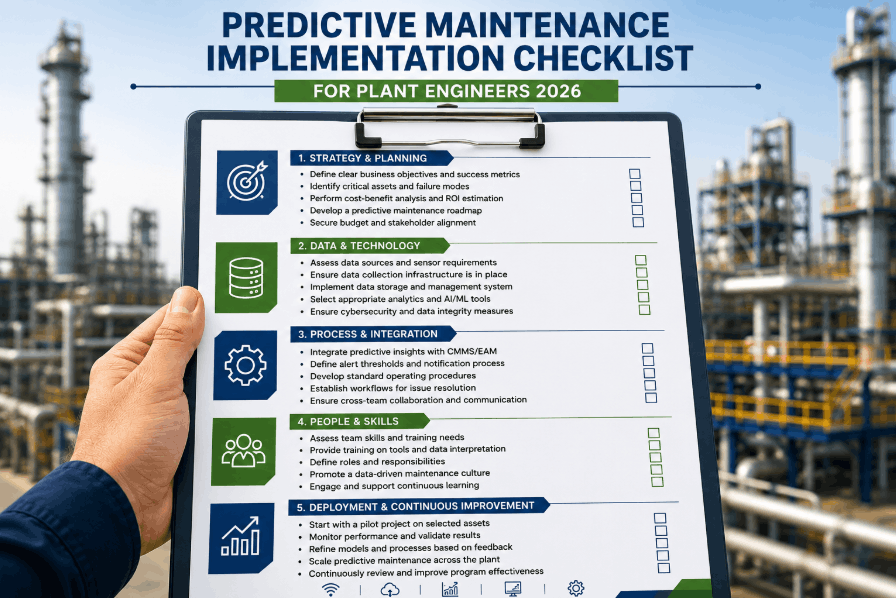
Predictive maintenance promises significant reductions in unplanned downtime and maintenance cost — and the technology to deliver on that promise is more accessible than it has ever been. But the gap between a compelling proof of concept and a functioning, scaled predictive maintenance program is where most industrial organizations stall. Sensor coverage without data infrastructure produces noise. Analytics capability without process readiness produces dashboards nobody acts on. A phased roadmap that sequences sensor deployment, data readiness, workforce training, and process integration prevents the most common failure modes of predictive maintenance adoption before they consume the budget. OxMaint provides the CMMS and asset management foundation that predictive programs require — Sign Up Free to anchor your roadmap in a platform built for operational execution, or Book a Demo to walk through how OxMaint integrates with your condition monitoring and predictive analytics tools.
Build Your Predictive Maintenance Program on a Solid Foundation
OxMaint connects condition monitoring data, asset history, and work order execution so predictive insights become maintenance actions — not just alerts nobody responds to.
Why Most Predictive Maintenance Programs Stall
The failure modes of predictive maintenance adoption are predictable — and preventable with the right sequencing. Understanding what goes wrong helps you design a roadmap that avoids the common traps.
01
Sensor Before Strategy
Deploying sensors on assets without criticality ranking or failure mode analysis produces data with no defined use. The monitoring system runs; nobody knows what to do with the alerts.
02
Analytics Without Process
Machine learning models that generate predictions have no value if maintenance teams have no defined workflow to receive, triage, and act on those predictions within the right timeframe.
03
Data Without History
Predictive models require historical failure data to train against. Facilities without structured work order history, failure codes, and asset condition records cannot generate reliable predictions from new sensors alone.
04
Technology Without Adoption
Technicians who don't trust — or don't understand — predictive alerts will defer to their instincts and scheduled work. Workforce capability development must be built into the roadmap from the start.
The Four-Phase Predictive Maintenance Adoption Roadmap
A structured phased approach sequences foundation building, pilot deployment, scale-up, and optimization — ensuring each phase produces operational value before the next phase begins. This prevents the "big bang" deployment failures that leave organizations with expensive sensor networks and no working program.
Phase 1 · Months 1–3
Foundation: Data and Asset Readiness
Complete asset criticality ranking — identify which assets justify predictive investment
Audit existing CMMS data quality — failure codes, work order history, component records
Map failure modes for target assets — define what conditions the program needs to detect
Establish OxMaint as the work order system of record before sensor data flows in
Phase 2 · Months 3–6
Pilot: Sensor Deployment on Critical Assets
Deploy condition monitoring sensors on 5–10 critical assets with defined failure modes
Establish alert thresholds and define the maintenance response workflow for each alert type
Train pilot team on alert interpretation, threshold validation, and work order creation
Track pilot results: false positive rate, alert-to-action time, failure predictions confirmed
Phase 3 · Months 6–12
Scale-Up: Expand Coverage and Refine Models
Extend sensor deployment to Major-tier assets using pilot learnings to set thresholds
Integrate condition monitoring data with OxMaint work order generation
Build reliability team capability — formal training on failure mode analysis and model interpretation
Refine alert thresholds based on 6 months of pilot data and confirmed failure events
Phase 4 · Month 12+
Optimization: Program Maturity and ROI Measurement
Measure MTBF improvement, unplanned downtime reduction, and maintenance cost per asset class
Optimize PM schedules — extend intervals for assets with strong predictive coverage
Build continuous improvement cycle: failure review → model refinement → threshold update
Present program ROI to leadership using OxMaint reporting data to justify program expansion
Readiness Assessment: Where Is Your Organization?
Before defining your starting phase, assess your current state across four readiness dimensions. Entering Phase 3 without Phase 1 readiness is the most common cause of predictive program failure.
Data Readiness
Structured work order history in CMMS
Failure codes applied consistently
Asset register with component records
Historical MTBF data per asset class
Process Readiness
Defined alert response workflow
Work order prioritization process
Predictive alert triage procedure
Cross-shift information handover
Workforce Capability
Technician mobile tool familiarity
Vibration / thermography interpretation
Failure mode analysis training
Predictive model output literacy
Technology Alignment
CMMS with API integration capability
Network connectivity in target areas
Sensor hardware selected for failure modes
Data pipeline from sensor to CMMS
Typically ready at program start Commonly requires development
KPIs to Measure Predictive Maintenance Program Success
A predictive maintenance program without measurement is just an expense. These six KPIs tell you whether your investment is working — and where to focus improvement effort across each phase of the roadmap.
MTBF
Mean Time Between Failures
The primary indicator of predictive program effectiveness. Rising MTBF on monitored assets confirms the program is intervening before failures occur. Track per asset class, not fleet-wide, to isolate impact.
Measurable from: Phase 3
MTTR
Mean Time to Repair
Planned interventions triggered by predictive alerts should take less time than emergency repairs on the same failure mode. Falling MTTR confirms technicians are arriving prepared with the right parts and procedure.
Measurable from: Phase 2
% Unplanned
Unplanned Downtime Rate
The ratio of unplanned to total downtime hours on monitored assets. The target trajectory is a declining unplanned percentage as predictive coverage matures and alert accuracy improves through Phase 3 and 4.
Measurable from: Phase 2
Alert → Action
Alert-to-Work-Order Time
How long from a predictive alert being generated to a work order being created and assigned. Long lag times indicate process gaps — alerts are reaching nobody or sitting unreviewed. Target under 4 hours for Critical-tier assets.
Measurable from: Phase 1
False Positive %
Alert Accuracy Rate
The percentage of alerts that resulted in confirmed degradation or failure on inspection. High false positive rates erode technician trust in the system. Track and use to refine thresholds during Phase 2 and 3 calibration cycles.
Measurable from: Phase 1
Cost / Asset
Maintenance Cost per Asset Class
Total maintenance spend (labor + parts + downtime cost) per asset class, tracked quarterly. Declining cost on monitored Critical-tier assets is the financial proof of program value — the number that justifies Phase 4 expansion investment.
Measurable from: Phase 3
OxMaint tracks MTBF, MTTR, work order completion times, and cost-per-asset in its reporting dashboard — giving you the KPI data needed to evaluate program performance and present ROI to leadership without manual data assembly.
OxMaint Is the Execution Layer Your Predictive Program Needs
Data readiness, work order execution, and performance measurement — OxMaint provides the operational foundation so predictive maintenance alerts become maintenance actions. Sign Up Free to start Phase 1 today, or Book a Demo to walk through predictive program integration.
Frequently Asked Questions
How much historical data do we need before starting predictive maintenance?
Most predictive models require 12–24 months of failure history to generate reliable predictions. If your CMMS has structured work order and failure code data going back at least one year, you have a viable starting foundation. OxMaint helps audit your existing data quality before sensor deployment begins.
How does OxMaint integrate with condition monitoring and sensor platforms?
OxMaint supports API integration with condition monitoring platforms, allowing sensor-generated alerts to trigger work orders automatically in the CMMS. This closes the loop between detection and maintenance action — the critical gap in most predictive programs where alerts exist but no one acts on them.
What is the typical ROI timeline for a predictive maintenance program?
Well-executed predictive programs typically demonstrate measurable ROI within 12–18 months of pilot completion — through reduced unplanned downtime, extended PM intervals, and lower emergency parts costs. OxMaint's reporting tools track the KPIs needed to measure and communicate this ROI to leadership.
Should we run predictive and preventive maintenance simultaneously during the transition?
Yes — predictive monitoring augments rather than immediately replaces preventive schedules during adoption. As confidence in prediction accuracy builds, PM intervals can be extended for well-monitored assets. OxMaint manages both schedules in parallel so the transition is gradual and evidence-based rather than abrupt.
How do we build technician buy-in for predictive maintenance alerts?
Involve technicians in pilot threshold setting and alert validation from the beginning. When technicians see that alerts correlate with real degradation and that acting on them prevents failures they previously responded to reactively, trust builds naturally. OxMaint's mobile work order tool makes acting on alerts as simple as responding to any other work order.
Your Predictive Maintenance Roadmap Starts With the Right Foundation
OxMaint gives your team the data infrastructure, work order execution, and performance tracking to make predictive maintenance a program that works — not just a technology investment that stalls.