Predictive Maintenance for Manufacturing Plants: The 2026 Definitive Guide
By Johnson on March 17, 2026
In 2026, manufacturing plants that still rely on scheduled or reactive maintenance are paying an avoidable tax — unplanned downtime, emergency repair premiums, and production losses that predictive maintenance eliminates before they start. This guide covers every technology, metric, and implementation step your plant needs to adopt predictive maintenance and begin capturing measurable results within 90 days.
IoT sensors, AI analytics, and CMMS integration that deliver 7–14 day failure warnings and up to 70% downtime reduction — without replacing your workforce, just empowering it.
Why Reactive Maintenance Is Costing You More Than You Think
Every unplanned stoppage costs a manufacturer between $50,000 and $250,000 per hour depending on sector. The difference between reactive and predictive maintenance is not philosophy — it is the difference between operating at that cost or eliminating it entirely.
Current State
Reactive Maintenance
✗ Fix after failure — production already lost
✗ Emergency parts at 3× premium cost
✗ Technicians dispatched without diagnosis
✗ Cascading failures damage adjacent parts
✗ Zero warning — zero preparation time
✗ Institutional knowledge lost when staff retire
Annual hidden cost per plant$1.2M – $4.8M
VS
Target State
Predictive Maintenance
✓ Detect failure 7–14 days before it happens
✓ Parts sourced in advance at standard cost
✓ Technicians arrive with AI-generated diagnosis
✓ Isolated interventions — no collateral damage
✓ Schedule repairs during planned downtime windows
✓ AI captures and preserves tribal knowledge
Annual savings per plant$800K – $3.4M
Core Technologies
The Four Technologies That Make Predictive Maintenance Work
01
IoT Sensor Networks
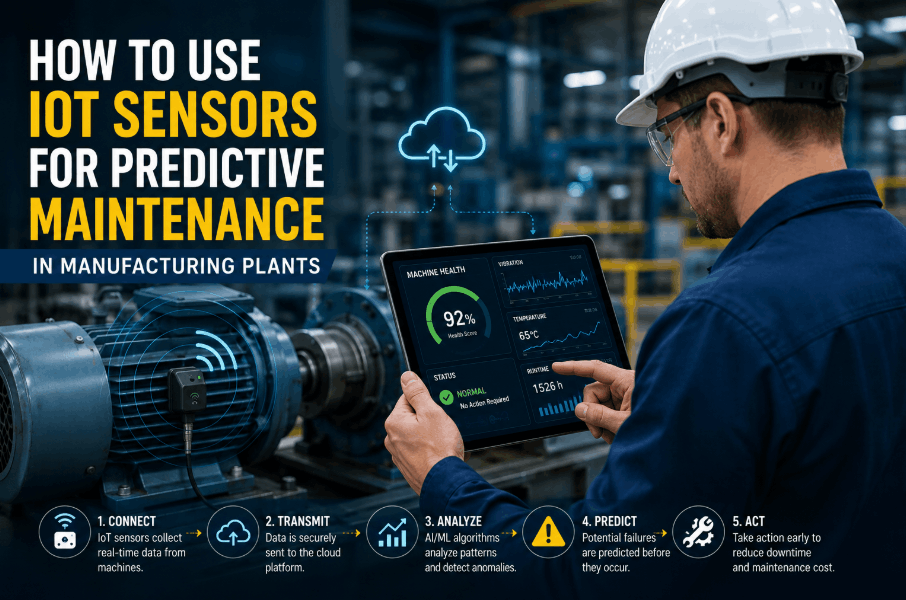
Vibration, temperature, pressure, and acoustic sensors stream real-time equipment data every 15 seconds. Sensor costs down 73% since 2018 — now $215 per asset, not $800.
Detects: Bearing wear · Imbalance · Cavitation
02
AI Fault Diagnosis
Machine learning models trained on thousands of historical fault signatures classify failure mode, probability, and recommended action — before a human ever touches the equipment.
Accuracy: 94% fault classification rate
03
Vibration & Condition Analysis
Frequency-domain vibration analysis identifies specific fault modes — bearing defects, gear mesh anomalies, shaft misalignment — with a resolution classical monitoring cannot achieve.
Warning lead time: 7–14 days average
04
CMMS Integration
Every sensor alert auto-generates a structured work order in your CMMS — with fault diagnosis, parts list, and estimated repair time pre-populated. No manual data entry. No missed alerts.
Zero manual steps from alert to work order
How It Works
From Sensor Signal to Scheduled Repair in Under 60 Seconds
1
Sensor Detects Anomaly
Vibration signature on motor bearing deviates from learned baseline pattern at 3:47 AM — no human was present.
2
AI Classifies Fault Mode
Model identifies: 78% outer-race bearing defect, 15% misalignment, 7% lubrication — with matched historical cases.
3
Work Order Auto-Created
CMMS generates a complete work order: asset ID, fault diagnosis, required parts, estimated time, and recommended technician skill level.
4
Repair Scheduled in Advance
Maintenance manager slots repair into the next planned downtime window — 9 days before projected failure. Zero production impact.
Proven Results
What Manufacturing Plants Achieve With PdM in 12 Months
50–70%
Unplanned Downtime Reduction
7–14 Days
Average Failure Warning Lead Time
25–30%
Maintenance Budget Reduction
22%
Higher First-Time Fix Rate
3×
Equipment Lifespan Extension
10:1
Average ROI in Year One
Implementation Roadmap
Your 90-Day Predictive Maintenance Launch Plan
Days 1 – 14
Deploy CMMS & Define Asset Hierarchy
Set up OxMaint, map your top 10 critical assets, configure asset hierarchy with failure mode templates. Begin closing work orders with structured completion notes.
Deliverable: Live CMMS with structured asset records and first work orders flowing
Days 15 – 45
Instrument Critical Assets With IoT Sensors
Install vibration, temperature, and pressure sensors on rotating equipment. Connect sensor data stream to OxMaint via API. Establish normal operating baselines for each asset.
Deliverable: Real-time sensor dashboard with baseline thresholds configured
Days 46 – 75
Activate AI Anomaly Detection
Enable AI-based anomaly detection on baseline data. Configure automatic work order generation on alert. Train technicians to act on AI-generated diagnoses. Review first-detection accuracy.
Deliverable: First AI-detected anomalies generating automatic work orders
Days 76 – 90
Measure, Report & Expand
Calculate first-time fix rates, downtime reduction, and parts cost savings against your pre-PdM baseline. Identify next 10 assets for sensor rollout. Present ROI case to leadership.
Deliverable: Quantified ROI report and expansion plan for remaining plant assets
Plant Voice
"
We had three unplanned motor failures in Q1 alone — each one costing us 6–9 hours of production. We deployed OxMaint with sensor integration in April. By August, our AI pilot on the conveyor line had caught two developing bearing failures 11 days before they would have stopped the line. Our maintenance cost per unit produced dropped 27% in six months. The data foundation we built is now the most valuable operational asset we own.
Head of Plant Maintenance Operations
Automotive Parts Manufacturer · 2,200 employees · Midwest US
OxMaint · Predictive Maintenance Platform · Free to Start
Start Building Your Predictive Maintenance Foundation Today
Every week without structured work order data is a week of training data your AI diagnosis engine will never have. OxMaint deploys in days, not months — at zero upfront hardware cost. Your 90-day results window starts on sign-up day.
Live in under 3 days IoT sensor integration included AI fault diagnosis built-in No upfront hardware cost
Everything You Need to Know About Predictive Maintenance
What is predictive maintenance and how is it different from preventive maintenance?
Preventive maintenance runs on a fixed schedule — you replace a bearing every 6 months whether it needs it or not. Predictive maintenance (PdM) uses real-time sensor data and AI to intervene only when equipment condition data indicates a fault is developing. The result is fewer unnecessary interventions, zero missed failures, and repair windows scheduled before production impact — not after. PdM typically reduces maintenance labour hours by 20–30% compared to a scheduled PM programme, while cutting unplanned stoppages by 50–70%. Start your PdM programme free on OxMaint.
How much does it cost to implement predictive maintenance in a manufacturing plant?
The primary cost components are IoT sensors (now averaging $215 per rotating asset after a 73% cost reduction since 2018), CMMS software subscription, and initial integration and training time. For a plant with 50 critical rotating assets, total hardware outlay runs $10,000–$15,000. Most plants recover this within the first prevented failure event — a single unplanned motor failure in a bottleneck process typically costs $50,000–$250,000 in lost production alone. OxMaint's CMMS and AI diagnosis layer is free to start, with sensor integration included. Book a demo to get a cost estimate for your plant size.
How long does it take to see results from predictive maintenance?
With OxMaint's 90-day implementation roadmap, most plants receive their first AI-generated anomaly alert within 45–60 days of sensor deployment — once baseline operating patterns are established. Measurable ROI in the form of prevented failure events typically occurs within the first 90 days for plants with active sensor coverage on high-risk rotating equipment. The full statistical picture — documented downtime reduction percentages, cost savings, and first-time fix rate improvement — is available at the 6-month mark when you have enough before-and-after data to compare. Sign up and begin your 90-day launch plan today.
Which manufacturing equipment benefits most from predictive maintenance sensors?
The highest-ROI assets for PdM sensor deployment are rotating equipment with high replacement cost or high production-impact on failure: motors, pumps, compressors, fans, gearboxes, and conveyors. These respond best to vibration and temperature monitoring. Secondary candidates include hydraulic systems (pressure and flow monitoring), heat exchangers (thermal imaging), and electrical panels (thermal and partial discharge detection). Start with the assets whose failure causes the most expensive stoppage or the longest lead time for repair parts — those deliver the fastest payback on sensor investment.
Do we need a data science team to implement AI-based predictive maintenance?
Not with a modern PdM platform like OxMaint. The AI models are pre-trained on fault signature libraries covering common industrial failure modes — bearing defects, gear mesh anomalies, shaft misalignment, cavitation, and more. Your team configures which assets to monitor and reviews the AI-generated alerts; the model handles pattern recognition, fault classification, and work order generation automatically. What you do need is structured work order history — completion notes, asset links, and photo documentation on every closed work order. That data is what allows the AI to improve its accuracy over time on your specific equipment and operating conditions.
Can predictive maintenance work alongside our existing CMMS or ERP system?
Yes. OxMaint is designed to integrate with existing ERP and CMMS environments via API — meaning sensor alert data, AI-generated work orders, and completion records can flow bidirectionally between OxMaint and systems like SAP, Oracle, or legacy CMMS platforms. For plants replacing an older CMMS entirely, OxMaint handles the full workflow from asset hierarchy to work order management to PM scheduling. Either path — integration or replacement — is supported. Book a demo to discuss your current system architecture.