Ask ten reliability leaders what the difference is between RCM, APM, and CMMS and you'll get eleven answers. The three acronyms have overlapped in vendor marketing for so long that they've become interchangeable in conversation — which is exactly why so many manufacturing plants end up either paying for two systems that do the same thing or missing a layer they genuinely need. The reality is cleaner than the marketing: CMMS is the system of record for maintenance work, APM is the system of intelligence for predictive analytics, and RCM is the methodology that turns both into a coherent reliability strategy. Each layer has a distinct role. In 2026, mature plants run all three — but not as three separate vendor contracts. The winning stack fuses them into one AI-native platform, which is why cloud-native CMMS-plus-RCM tools with native IoT ingest are displacing the traditional three-vendor arrangement. This guide walks the roles cleanly, shows what each does, and defines what manufacturers actually need. Book a free stack assessment against your current tools.
TL;DR · The 30-second answer
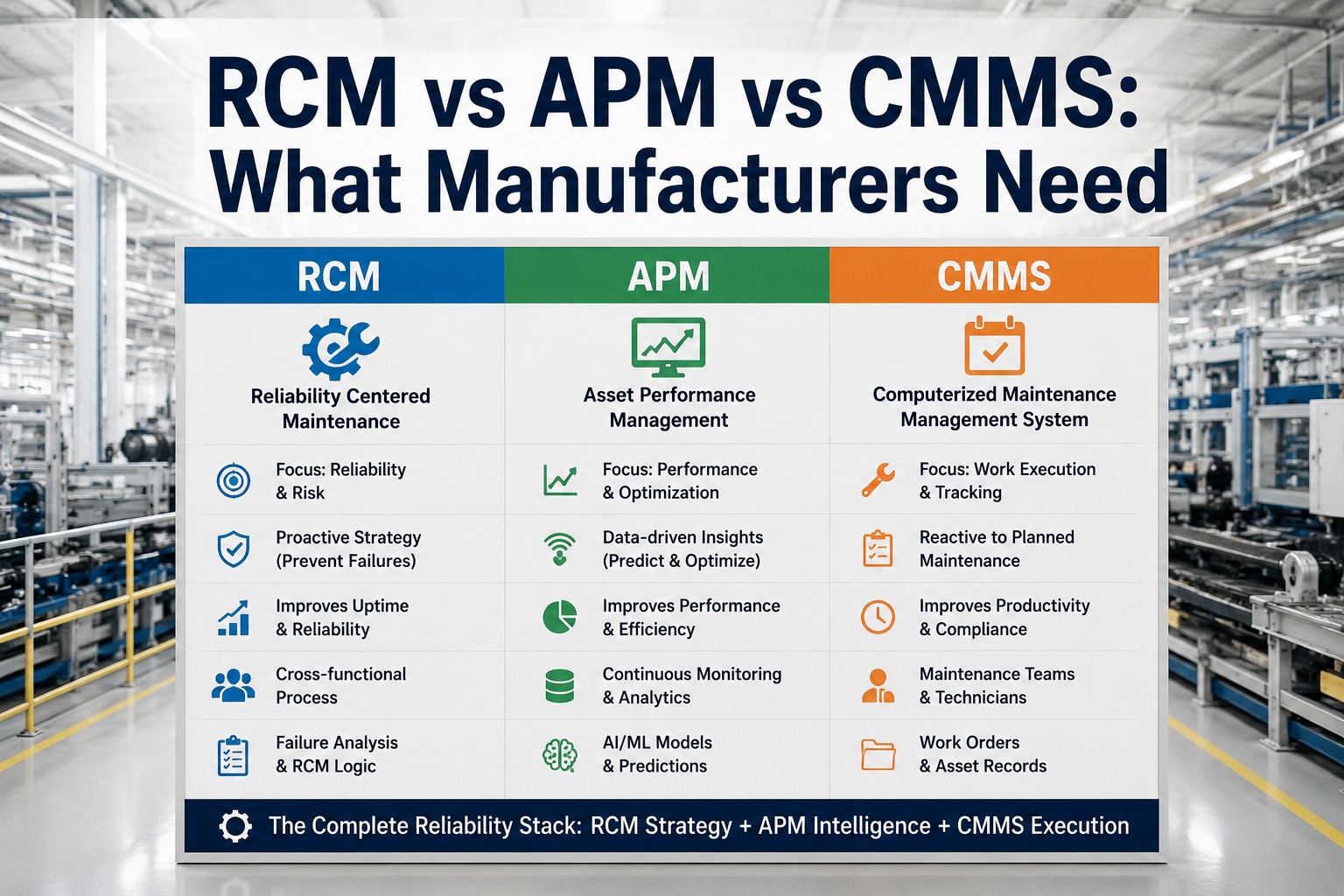
CMMS is the hands — it executes maintenance work, tracks work orders, manages spares, records history.
APM is the brain — it analyzes condition data, predicts failures, recommends interventions.
RCM is the playbook — it decides what maintenance strategy each asset should run, based on failure modes and consequences.
The 2026 answer is not to pick one — it's to run all three as a single integrated platform instead of three disconnected vendor stacks.
The Three Roles · What Each Actually Does
Start by getting the role definitions crisp. When the roles are clear, the vendor evaluation becomes ten times easier — and the temptation to over-buy or under-buy dissolves. Each of the three systems answers a specific question the maintenance organization has to answer.
CMMS
System of Record
Answers: "What maintenance work is happening right now, and did we do it?"
Owns:
Work order lifecycle · assignment, execution, close-out
Preventive maintenance schedules
Spare parts inventory & consumption
Technician labor hours
Asset history & documentation
Mobile execution for technicians
Metaphor: the hands
APM
System of Intelligence
Answers: "Which asset is about to fail, and what's the business risk if it does?"
Owns:
Real-time asset health dashboards
Condition monitoring data ingest & anomaly detection
Predictive analytics & failure modelling
Risk-based inspection prioritization
Digital twins & physics-based simulations
Operational risk scoring
Metaphor: the brain
RCM
System of Strategy
Answers: "For every failure mode, what is the right maintenance strategy?"
Owns:
FMEA · failure mode & effects analysis
JA1011 seven-question decision logic
Task type selection (predictive / preventive / condition / RTF)
P-F interval & task frequency setting
Criticality classification per asset
Living reliability program governance
Metaphor: the playbook
Where They Overlap · And Where the Confusion Lives
The three roles are conceptually distinct, but they overlap in ways that fuel vendor marketing arguments. Modern CMMS platforms have added predictive features that touch APM territory. Modern APM platforms have added work-order features that touch CMMS territory. Standalone RCM tools have added asset registers that mimic CMMS. The visual below is the working model — three overlapping zones, with the intersections describing exactly where the confusion happens.
CMMS Only
Work order routing · spares management · calendar PMs · mobile execution · asset documentation
APM Only
Physics-based failure models · digital twins · risk-based inspection · condition data lake · operational risk scoring
RCM Only
FMEA worksheets · JA1011 decision tree · task type selection · P-F interval calculation · living program governance
CMMS + APM
Predictive WOs auto-generated · condition-triggered maintenance · asset health scores routed to work
APM + RCM
Failure mode libraries · criticality-based analytics · risk model tuning from FMEA data
CMMS + RCM
FMEA-driven PM tasks · task cadence tied to failure mode · scheduled work reflects reliability strategy
All Three Fused
The 2026 stack · FMEA lives in the asset record · condition data auto-fires predictive tasks · execution runs on mobile · one platform, one data model
The Maintenance Maturity Curve · What Stage Are You On?
Every plant sits somewhere on a maturity progression from reactive maintenance through predictive, and the right investment depends entirely on where you are today. Skipping stages fails predictably — trying to deploy APM before you have basic work order discipline is the most common expensive mistake in industrial reliability.
01
Reactive
Fire-Fighting Mode
Break-fix maintenance dominates · no digital record · no scheduled PM discipline · MRO cost high, OEE low
What you need: Modern CMMS first — build the digital work-order foundation before anything else
02
Planned
Calendar-Based PM
CMMS running, PMs scheduled on calendar cycles · compliance visible · reactive rate falling but still 40%+
What you need: RCM layer — start optimizing which PMs are worth doing on which assets
03
Condition-Based
Sensor-Driven Interventions
Condition monitoring on critical assets · threshold-based work orders · reactive rate below 30% · MTBF improving
What you need: APM analytics — pattern recognition on the sensor streams already flowing in
04
Predictive
AI-Driven Reliability
Full RCM · APM · CMMS stack integrated · anomaly detection weeks ahead · reactive below 15% · OEE ≥85% · MTBF trending up
What you need: Continuous improvement — living FMEA, sensor coverage expansion, prescriptive analytics
Diagnose Your Maturity Stage in 30 Minutes
Working session with our reliability team — we'll walk your current CMMS, condition monitoring, and PM workflows and place you on the maturity curve. From there, the next investment becomes obvious rather than a guess.
Side-by-Side · The Comparison Table
The comparison table below is what actually goes into an RFP or a vendor evaluation. Every row shows how each of the three systems handles the same capability — and where the gaps live if you deploy any one of them alone.
Work order execution
Core function
Recommendations only
Task definitions only
Spare parts & inventory
Core function
Limited or absent
Not addressed
Preventive maintenance scheduling
Core function · calendar-based
Optimization recommendations
Task selection logic
Condition monitoring / IoT
Basic threshold alerts
Core function · deep analytics
Not addressed
Failure prediction
Reactive alerts only
Core function · AI models
Failure mode identification
FMEA / decision logic
Rarely available
Some platforms include it
Core function
Asset criticality analysis
Basic scoring
Risk-based, quantified
Core function · consequence-driven
Mobile technician execution
Core function
Not typical
Not addressed
Regulatory & audit trail
Core function
Risk documentation
Strategy documentation (JA1011)
Typical vendor examples
Standalone CMMS platforms
GE APM · SAP APM · Bentley AssetWise · ABB Ability
RCM++ · Windchill FMEA · dedicated RCM tools
The Traditional Three-Vendor Problem
Historically the industry answer was "buy all three from three different vendors" — a CMMS from vendor A, an APM from vendor B, an RCM tool from vendor C, wired together by middleware from vendor D. This produced the operational pattern most reliability directors know too well: three logins, three data models, three integration projects that never quite finish, and reliability analyses that die in shared drives because nobody wants to switch systems five times per work order.
Three-Vendor Stack
The 2015–2020 default · still common today
Three separate systems · three vendor contracts
Middleware layer required for integration
Data model drift between systems within months
Technicians work in the CMMS · engineers in APM · reliability team in RCM · nobody sees the whole picture
Total cost 3–5× a fused platform
Analysis stays theoretical because it never reaches the plant floor
Fused AI-Native Platform
The 2026 answer · CMMS + APM + RCM in one
Single platform · one login · one data model
No middleware · everything native
FMEA lives inside the asset record
Predictive alerts auto-generate work orders technicians see on their phones
One cloud subscription · free forever plan tier
Analysis becomes operational reality within weeks
What Manufacturers Actually Need in 2026
The buying decision has changed. Modern manufacturers don't need three vendors — they need one platform that handles the three roles as facets of a unified data model. The requirements below are what reliability directors should demand in every RFP conducted in 2026 and beyond.
01
CMMS as the Foundation
Modern work order lifecycle · mobile-first · offline sync · QR asset tags · SAP/Maximo overlay compatible · the non-negotiable base layer
02
Native FMEA & RCM Logic
Failure mode records linked directly to assets · JA1011 decision tree built in · task selection auto-generates recurring WOs · analysis never orphaned
03
IoT & Condition Ingest Native
MQTT and REST endpoints ready · vibration/thermal/current/pressure streams tied to FMEA modes · threshold crossings auto-fire predictive WOs
04
AI-Driven Anomaly Detection
Machine-learning models watching sensor streams for early failure signatures — surface anomalies before threshold-based rules catch them
05
Live Reliability KPIs
MTBF · MTTR · OEE · PM compliance · planned-to-reactive ratio · cost per operating hour — live dashboards, not monthly report cycles
06
Cloud-Native · Weeks to Deploy
Multi-tenant SaaS · production pilot live in days · full deployment in weeks · free forever plan available to trial · not a 12-month enterprise project
Expert Perspective · Why the Three-System Debate Is Ending
The CMMS-vs-APM-vs-RCM debate is a legacy of when these were separate products from separate vendors that only enterprise budgets could afford in combination. That's not the world anymore. Cloud-native platforms have collapsed the architectural boundary because there's no technical reason FMEA has to live in a different database from the asset record, or predictive analytics has to run in a different system from work orders. Every reason those systems used to be separate was economic and technical, and both of those constraints are gone. What replaces the three-vendor stack is one platform where the FMEA record and the work order and the sensor stream and the technician's phone are all facets of the same data model. The reliability engineer runs an FMEA and the predictive task shows up on the millwright's phone in the same platform. That's operational. That's not marketing. And it's what makes a free forever plan possible — because the platform architecture is one system doing three jobs, not three systems bolted together with integration effort. Manufacturers who understand this shift stop paying for three overlapping tools and start expecting all three roles from one vendor. The reliability programs those manufacturers run are objectively more effective because analysis and execution finally live in the same place.
One Data Model Beats Three
FMEA, work order, sensor, and mobile capture as facets of one database. Integration is not the answer — unification is.
Cloud-Native Killed the Cost
Three-vendor stacks cost 3–5x a fused platform. That economics gap is why the fused model is displacing traditional deployments.
Analysis Must Reach the Floor
RCM analyses die in shared drives when they live outside the CMMS. Fusion is what makes them operational.
How OxMaint Fuses the Three Roles
OxMaint delivers CMMS, RCM, and APM as one integrated cloud-native platform — not three modules bolted together. Every capability listed below is native to the same data model, which is why deployment is measured in weeks rather than years and analysis actually reaches the plant floor.
CMMS
Full Work Order Lifecycle
Mobile-first execution · offline sync · QR tags · spares management · SAP/Maximo overlay · complete audit trail
RCM
FMEA & JA1011 Native
Failure modes linked to assets · seven-question decision tree · task selection logic · P-F interval scheduling · living program governance
APM
IoT Ingest & Predictive Analytics
MQTT and REST endpoints · vibration/thermal/current streams · ML anomaly detection · threshold-crossing auto-fires WOs
Fused
One Data Model
FMEA · WO · asset · sensor · mobile capture as facets of one database — not three systems glued together with middleware
KPIs
Live Reliability Dashboards
MTBF · MTTR · OEE · PM compliance · planned-to-reactive · cost per operating hour — live, not monthly reports
Deploy
Days to Weeks · Free Tier
Cloud-native SaaS · production pilot in days · full plant deployment in weeks · free forever plan available
Stop Paying for Three Systems That Should Be One
See how OxMaint fuses CMMS, RCM, and APM into a single AI-native platform — one login, one data model, one subscription. Free forever plan available to trial the workflow before any commitment.
Frequently Asked Questions
What is the simplest way to explain the difference between CMMS, APM, and RCM?
CMMS is the hands — it executes maintenance work, tracks work orders, manages spares. APM is the brain — it analyzes sensor data, predicts failures, and recommends interventions. RCM is the playbook — the methodology that decides which maintenance strategy each asset should run based on failure modes and consequences. All three are needed at maturity, but the 2026 answer is not to buy them from three separate vendors — it's to run them as one fused AI-native platform where FMEA, work orders, and sensor data live in the same data model.
Do I need all three or can I start with just a CMMS?
Start with CMMS if you don't already have a digital work-order foundation — everything else depends on it. Once basic work-order discipline and planned PM compliance are in place, add RCM to optimize which tasks are worth doing on which assets. Add condition monitoring and APM analytics once critical assets are stable enough that predictive intervention pays off. Skipping stages fails predictably — deploying APM before you have work-order discipline typically produces predictive dashboards no one acts on.
Sign up free to start with the CMMS foundation.
Which vendors are the traditional leaders in each category?
In enterprise APM, GE APM (formerly Meridium), SAP APM, Bentley AssetWise, ABB Ability, and IBM Maximo APM are the traditional leaders. In enterprise CMMS/EAM the leaders are IBM Maximo, SAP PM, Infor EAM, and Oracle EAM. In standalone RCM tooling, RCM++ and PTC Windchill FMEA are common enterprise choices. What has changed in 2026 is that cloud-native platforms increasingly fuse all three roles into single systems, displacing the traditional three-vendor arrangement — particularly for mid-market manufacturers who can't justify enterprise-tier costs across three separate products.
Isn't APM the same as predictive maintenance software?
Predictive maintenance is one function within APM, but APM is broader. A full APM platform typically includes asset health monitoring, predictive analytics, digital twins and physics-based failure models, risk-based inspection prioritization, criticality scoring, and integration with CMMS for work-order execution. Standalone predictive maintenance tools focus narrowly on the analytics layer — they detect failure signatures in sensor data but don't necessarily handle the strategy or execution layers. The distinction matters at RFP time.
Book a free demo to see the full APM surface.
How does OxMaint compare to running a separate CMMS, APM, and RCM stack?
OxMaint delivers all three roles as one cloud-native platform on one data model. The direct comparison against a three-vendor stack: one login instead of three, one data model instead of three (no drift, no middleware sync issues), one subscription instead of three vendor contracts, and total cost typically 3–5x lower than the equivalent three-system arrangement. Operationally, the biggest win is that FMEA analysis lives inside the asset record — so failure mode findings automatically translate to scheduled work orders technicians see on their phones, rather than dying in a shared drive.
If I already have SAP PM or IBM Maximo, do I still need OxMaint?
SAP PM and IBM Maximo are excellent enterprise systems of record for asset masters, financial postings, and procurement — but they were built for desktop planners, not for mobile technicians, and they were never architected for continuous FMEA or live IoT ingest. OxMaint layers on top as a purpose-built RCM and APM overlay: SAP or Maximo remain authoritative for master data and financials, OxMaint handles the FMEA analysis, predictive triggers, and mobile execution. Optimized tasks push back into the EAM as real work orders. No rip-and-replace required. The free forever plan is available to trial the overlay pattern.
Sign up free to test the overlay.
-for-manufacturing-plants-a-2026-guide.png)