AI‑Powered Predictive Maintenance Software for Manufacturing Plants
By oxmaint on February 28, 2026
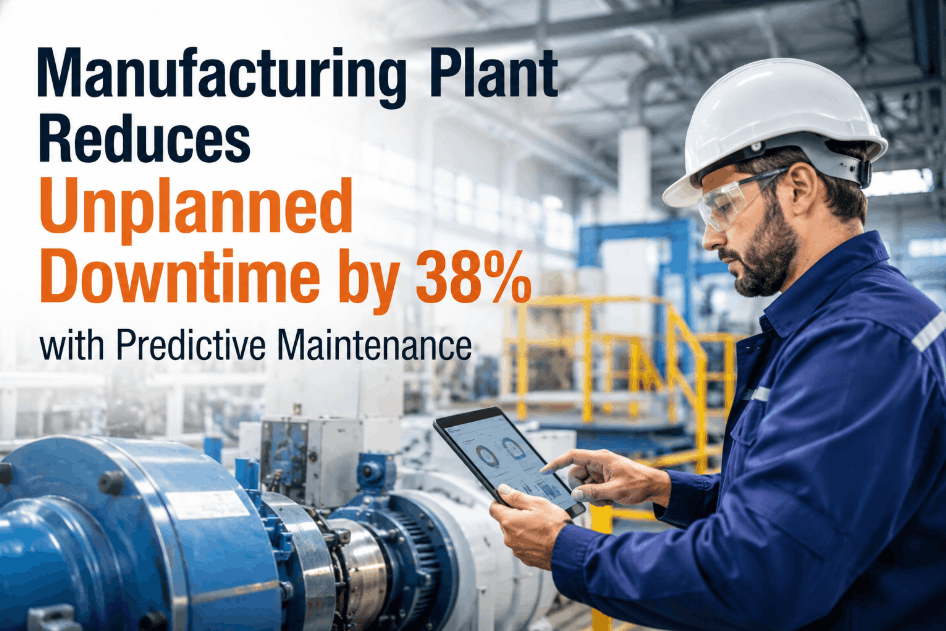
Every minute of unplanned downtime on a manufacturing floor carries a price tag that grows by the hour. While traditional maintenance approaches wait for machines to break or follow rigid calendar schedules, AI predictive maintenance software analyzes real-time sensor data to detect the earliest signs of equipment failure weeks before it happens. Manufacturers adopting this technology are cutting unplanned downtime by up to 50%, extending asset life by 40%, and reducing maintenance spend by 25%. Schedule a free predictive maintenance assessment to see how Oxmaint helps manufacturing plants move from reactive firefighting to intelligent, data-driven maintenance planning.
What Is AI Predictive Maintenance in Manufacturing?
AI predictive maintenance is a data-driven maintenance strategy that uses machine learning algorithms and IoT sensor networks to continuously monitor equipment health and forecast failures before they cause unplanned downtime. Unlike preventive maintenance that follows fixed schedules regardless of actual machine condition, predictive maintenance analyzes real-time vibration, temperature, pressure, and acoustic data to determine exactly when a component will need attention.
The global predictive maintenance market is growing rapidly, projected to exceed $97 billion by 2034 according to industry research. Manufacturing holds the largest share of adoption because the cost of unplanned downtime in this sector ranges from $30,000 per hour in consumer goods to over $1 million per hour in semiconductor fabrication. AI predictive maintenance closes the gap between knowing a machine exists and understanding its moment-to-moment health.
$97B+
Projected market size by 2034
50%
Downtime reduction with AI maintenance
90%
Failure prediction accuracy on trained models
6-12mo
Typical payback period for manufacturers
How Machine Learning Detects Equipment Failures Before They Happen
The core engine behind AI predictive maintenance is a layered system that transforms raw machine signals into failure forecasts. Understanding this process clarifies why the technology delivers results that no manual inspection or calendar-based program can match.
Layer 1
Continuous Data Capture
IoT sensors installed on motors, bearings, pumps, gearboxes, and hydraulic systems capture vibration spectra, thermal profiles, current signatures, acoustic emissions, and pressure fluctuations at intervals as frequent as 100 milliseconds. This creates a high-resolution picture of machine behavior in real time.
Layer 2
Edge Processing and Noise Filtering
Industrial edge computers sitting near the equipment pre-process raw streams locally, removing signal noise, validating sensor accuracy, and compressing data for transmission. This ensures alerts fire in seconds even when cloud connectivity is interrupted.
Layer 3
Pattern Recognition and Anomaly Detection
Machine learning models trained on thousands of hours of normal and failure-state data establish dynamic baselines for each asset. When a bearing begins to develop micro-pitting or a motor winding starts degrading, the model flags the deviation long before it becomes visible to human observation.
Layer 4
Remaining Useful Life Prediction
Deep learning time-series models estimate how many operating hours remain before a component reaches failure threshold. This allows maintenance teams to schedule repairs during planned windows rather than responding to emergencies. Sign up for Oxmaint to automate failure predictions into scheduled work orders and eliminate reactive maintenance from your workflow.
Layer 5
Automated Maintenance Action
Predictions integrate directly with your CMMS to generate prioritized work orders, reserve spare parts, and assign technicians with the right skills. The entire loop from detection to scheduled repair happens without manual intervention.
See How AI Predicts Failures on Your Equipment
Book a personalized walkthrough and our team will demonstrate real-time failure detection using data from your industry.
Key Benefits: Reducing Downtime and Maintenance Costs with AI
The value of AI predictive maintenance compounds across multiple operational areas simultaneously. Rather than solving a single problem, it creates a cascading improvement effect that touches every aspect of manufacturing efficiency.
30-50%
Unplanned Downtime Reduction
AI systems detect degradation patterns in bearings, motors, and hydraulic components days to weeks before failure. Plants shift from emergency shutdowns to scheduled maintenance windows aligned with production gaps.
25-40%
Lower Maintenance Costs
Eliminating unnecessary calendar-based part replacements and preventing cascading failures from single component breakdowns reduces total maintenance expenditure dramatically.
Up to 40%
Longer Equipment Lifespan
Early detection of vibration anomalies and thermal hotspots allows corrective action before minor issues cause permanent damage to expensive machinery.
15-25%
Higher OEE Scores
Overall Equipment Effectiveness improves as availability, performance, and quality metrics all benefit from machines running at optimal parameters continuously.
3.2x
Fewer Emergency Labor Hours
Planned repairs require a fraction of the labor time compared to emergency breakdowns, freeing skilled technicians for higher-value reliability engineering work.
Predictive vs. Preventive vs. Reactive: Which Maintenance Strategy Wins?
Manufacturing plants typically use a mix of maintenance strategies. Understanding where each approach fits and where AI predictive maintenance delivers its strongest advantage helps teams plan a realistic transition roadmap.
Reactive
Fix it when it breaks
TriggerEquipment failure
Cost ImpactHighest per incident
DowntimeUnpredictable, often extended
Parts WasteHigh (cascading damage)
Best ForNon-critical, low-cost assets
Adequate only for equipment where failure carries no production or safety consequence.
Preventive
Service on a fixed schedule
TriggerCalendar or runtime hours
Cost ImpactModerate but often wasteful
DowntimeScheduled but sometimes unnecessary
Parts WasteMedium (premature replacements)
Best ForCompliance items, simple assets
The industry standard, used by 71% of maintenance teams, but leaves 8-15% waste undetected.
AI Predictive
Maintain based on actual condition
TriggerAI-detected degradation pattern
Cost ImpactLowest total cost of ownership
DowntimePlanned, minimal, optimized
Parts WasteMinimal (replace only when needed)
Best ForCritical production assets
The highest ROI strategy for any equipment where downtime carries significant cost or safety risk.
Move Beyond Calendar-Based Maintenance
Oxmaint helps you transition from preventive schedules to condition-based intelligence without disrupting your existing operations.
What Data Do AI Systems Collect from Factory Equipment?
The accuracy of any predictive maintenance system depends on the quality and breadth of data it captures. Modern AI platforms pull from multiple sensor types simultaneously to build a multi-dimensional picture of asset health that no single measurement can provide alone.
Vibration Analysis
Accelerometers capture multi-axis vibration spectra to detect bearing wear, shaft misalignment, imbalance, looseness, and gear mesh problems at the earliest stage.
Thermal Monitoring
Infrared sensors and embedded thermocouples track temperature changes in windings, bearings, and fluid systems. Abnormal heat patterns signal friction, overload, or insulation breakdown.
Current and Power Signatures
Motor current analysis reveals rotor bar cracks, phase imbalances, and winding faults by detecting subtle changes in electrical draw patterns invisible to standard monitoring.
Acoustic Emission
Ultrasonic microphones detect high-frequency sounds from leaks, cavitation, electrical discharge, and early-stage crack propagation that are inaudible to the human ear.
Operational Context
Production schedules, ambient conditions, load profiles, and operator inputs provide context that helps AI distinguish between normal operational variation and genuine degradation signals.
Real-World ROI: How Much Can AI Maintenance Save Your Plant?
The financial case for AI predictive maintenance strengthens with every industry study published. Multiple independent sources confirm that the return on investment is substantial and measurable within the first year of deployment for most manufacturing operations.
50%
Reduction in unplanned downtime across adopting facilities
40%
Average equipment lifespan extension through early fault intervention
25%
Overall maintenance cost decrease reported by manufacturers
70%
Fewer breakdowns with IoT and AI sensor integration
Ready to see your numbers? Create a free Oxmaint account and our engineering team will model the projected savings specific to your plant, equipment mix, and current downtime data.
Which Manufacturing Equipment Benefits Most from AI Monitoring?
Not every asset requires the same level of predictive intelligence. The highest ROI comes from applying AI monitoring to equipment where failure is costly, where failure modes are detectable through sensor data, and where lead time on predictions allows meaningful scheduling flexibility.
Belt tracking issues, roller bearing failure, drive chain stretch
1 to 4 weeks before failure
Hydraulic Systems
Pressure, fluid particle count, temperature
Fluid contamination, cylinder seal degradation, pump wear
1 to 3 weeks before failure
Industrial Robots
Joint torque, vibration, encoder accuracy
Reducer gear wear, servo motor degradation, cable fatigue
1 to 4 weeks before failure
Step-by-Step: Implementing AI Predictive Maintenance on Your Factory Floor
Successful deployment follows a proven phased approach. Starting with a focused pilot on high-value assets builds organizational confidence and demonstrates ROI before expanding to the full plant. Here is the roadmap that leading manufacturers follow.
1
Week 1 - 3
Asset Criticality Assessment
Rank every asset by failure consequence: production impact, safety risk, repair cost, and replacement lead time. Select 5 to 10 machines with the highest risk scores for your pilot program. Audit existing sensors and data infrastructure to identify gaps.
2
Week 4 - 7
Sensor Installation and Data Connectivity
Deploy wireless vibration, thermal, and current sensors on pilot assets. Establish secure data pathways from sensors through edge devices to your analytics platform. Validate data quality and completeness before model training begins.
3
Week 8 - 11
AI Model Training and Calibration
Feed historical maintenance records and operational data into machine learning algorithms. Train anomaly detection and remaining useful life models. Tune alert thresholds to minimize false positives while catching genuine degradation early.
How Oxmaint Connects AI Predictions to Maintenance Workflows
The gap between knowing a machine will fail and actually preventing it comes down to workflow execution. Oxmaint bridges this gap by integrating AI-generated predictions directly into the maintenance management system your team already uses every day.
01
Real-Time Asset Health Dashboards
Every monitored machine displays a live health score combining vibration, thermal, and operational data into a single view. Color-coded risk levels make it instantly clear which assets need attention now and which are running safely.
02
Automated Work Order Generation
When AI detects a failure pattern forming, Oxmaint automatically creates a work order with the predicted failure type, recommended corrective action, required parts, and optimal scheduling window. No manual data entry required.
03
Smart Scheduling and Resource Allocation
The platform balances maintenance urgency against production schedules, technician availability, and parts inventory to find the lowest-disruption window for every repair. Teams stop scrambling and start working from an optimized queue.
04
Multi-Site Visibility and Benchmarking
Compare equipment performance, maintenance costs, and reliability metrics across plants from a single platform. Identify which facilities are achieving the best results and replicate their practices across your entire operation.
Turn Machine Data into Maintenance Intelligence
Your maintenance team deserves better than spreadsheets and guesswork. Oxmaint combines AI-powered predictive analytics with a purpose-built CMMS to help manufacturers prevent failures, reduce costs, and keep production lines running at peak performance.
What is the difference between predictive maintenance and condition-based maintenance?
Condition-based maintenance triggers action when a sensor reading crosses a fixed threshold. AI predictive maintenance goes further by analyzing trends over time and forecasting when a component will reach failure, giving teams days or weeks of advance notice rather than hours. This enables better planning, lower costs, and less production disruption. Book a demo to see how AI forecasts failures weeks ahead on your equipment types.
How long does it take to train AI models on our specific equipment?
Initial models can begin providing useful anomaly detection within 4 to 6 weeks of data collection. Prediction accuracy improves continuously over the first 6 to 12 months as the system accumulates more operational cycles, seasonal variations, and maintenance outcomes from your specific machines. Historical maintenance logs significantly accelerate the training process.
Can we use AI predictive maintenance with older, legacy manufacturing equipment?
Yes. Retrofit wireless sensors can be mounted externally on virtually any machine regardless of age or manufacturer. Vibration, temperature, and current sensors require no modification to the equipment itself. Many manufacturers successfully monitor 20+ year old assets that lack built-in digital connectivity. Sign up free to explore how Oxmaint monitors legacy machines with retrofit sensors.
What happens if our internet connection drops? Do we lose monitoring?
No. Edge computing devices installed locally continue to capture data, run anomaly detection, and trigger critical alerts even during network outages. When connectivity returns, buffered data syncs to the cloud platform automatically. This ensures zero gaps in monitoring for your most critical assets.
How does AI predictive maintenance integrate with our existing CMMS?
Modern AI platforms connect through standard APIs and pre-built connectors to all major CMMS and EAM systems. Predictions automatically generate work orders within your existing workflow. Oxmaint also provides a full-featured CMMS with native predictive capabilities built in, eliminating integration complexity entirely. Schedule a demo to see how Oxmaint integrates with your existing maintenance systems.