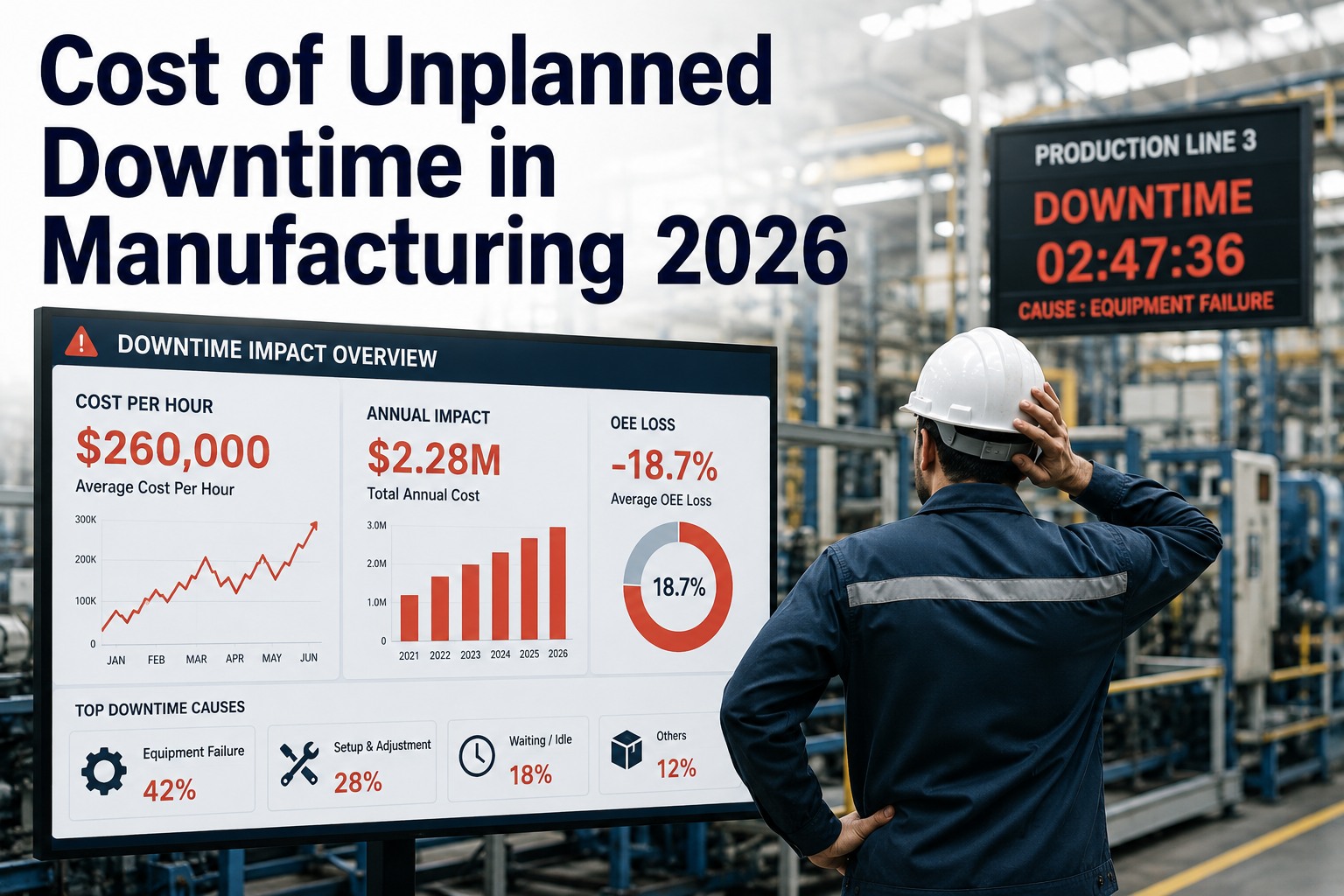
The hour your production line sat idle last Tuesday did not just lose you parts — it ate into margins across the entire week. Fluke's 2025 survey of 600 global manufacturers pegged the average cost of unplanned downtime at $1.7 million per hour for large plants, while the sector-wide benchmark still sits at $260,000 per hour. Sixty-one percent of manufacturers suffered an unplanned stoppage in the last year, and almost half of them now face 6 to 10 incidents every single week. The typical plant bleeds 800 hours of unplanned production time annually — paid labour, idle machines, scrapped material, and missed shipments stacking up relentlessly. Downtime is not a back-of-the-shop problem anymore; it is a board-level risk. The good news is it is also one of the most measurable and controllable losses in your operation. Start a free OxMaint trial to deploy downtime tracking, root-cause analysis, and preventive workflows that cut unplanned stoppages by 30–50%, or book a demo to see how manufacturing teams structure their downtime reduction programmes.
Reducing Machine Downtime in Manufacturing: Proven Strategies That Actually Work
A plain-English guide to the causes, real costs, and the five-step playbook manufacturing teams are using in 2026 to cut unplanned downtime by a third or more.
Why Downtime Keeps Getting More Expensive
Between 2019 and 2025, the number of downtime incidents at the average plant actually dropped — from 42 per month to 25. But the cost of each incident climbed faster than inflation, and the average recovery time stretched from 49 minutes to 81 minutes. Fewer stops, longer recoveries, and higher financial impact per minute: that is why downtime reduction has moved from a maintenance KPI to an enterprise risk metric.
What Is Actually Causing Your Downtime
Before you invest in predictive sensors, condition-based work orders, or a new CMMS, you need an honest picture of where your downtime hours are actually coming from. Industry data from L2L, Siemens, and ABB converges on a remarkably consistent split — and it is not purely a mechanical problem.
Takeaway: less than half of your downtime is raw mechanical failure. The bigger opportunity for most plants sits in human error, material readiness, and changeover discipline — all of which are solvable with process rigour, not capital spend.
OxMaint Tracks Every Incident, Every Cause, Every Minute
Log every downtime event with cause codes, MTTR, and downstream impact — and get the Pareto chart that tells you exactly where to spend your next improvement dollar. Your first 30 days are free.
Five Proven Strategies to Reduce Machine Downtime
Every successful downtime reduction programme we see in the field combines the same five strategies — in roughly the same order. Skip steps, and the savings evaporate. Run them in sequence, and manufacturers routinely report 30–50% reductions in unplanned downtime within 12 months.
What Downtime Reduction Actually Looks Like in Numbers
Below is the 12-month trajectory of a mid-sized US food processing plant we modelled against industry benchmarks — a single production line running two shifts, representative of thousands of similar facilities. The combined effect of the five strategies above is not theoretical. It is the default outcome for disciplined teams.
| Metric | Baseline (Month 0) | After 12 Months | Change |
|---|---|---|---|
| Unplanned downtime hours/month | 72 hours | 38 hours | –47% |
| Mean Time To Repair (MTTR) | 4.1 hours | 2.3 hours | –44% |
| Mean Time Between Failures (MTBF) | 118 hours | 204 hours | +73% |
| Emergency repair spend/month | $48,000 | $19,500 | –59% |
| Overtime hours/month | 340 | 160 | –53% |
| Annualised production saved | — | $1.94M | Recovered |
Model reflects a 2-shift operation with $260K/hour downtime cost and $400K annual maintenance budget. Your numbers will vary with production value, line criticality, and starting maturity — but the direction and order of magnitude are representative.
Frequently Asked Questions
How quickly can we realistically reduce downtime after deploying a CMMS?
Do I need IoT sensors on every machine to reduce downtime?
What is the single biggest mistake plants make when trying to cut downtime?
How do I calculate our actual cost of downtime?
Can a small manufacturer afford the same downtime programme as a large plant?
Turn Your Downtime Data Into Downtime Reduction
OxMaint gives manufacturing teams real-time downtime tracking, automated cause analysis, preventive work orders, and mobile-first operator workflows — all in one platform that deploys in days, not months. Built for the five-strategy playbook outlined above.