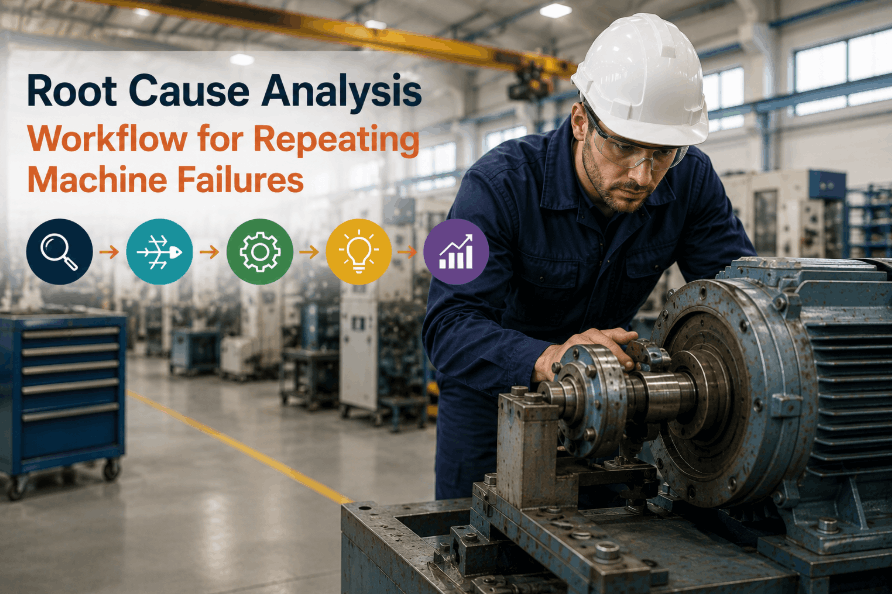
Chiller failures in manufacturing plants don't just cause discomfort—they halt production lines, damage sensitive equipment, and cost thousands per hour in downtime. Root Cause Analysis (RCA) transforms reactive firefighting into systematic prevention, helping maintenance teams identify why chillers fail and implement permanent fixes. Schedule a consultation to discover how structured RCA can eliminate repeat chiller failures at your facility.
Why Root Cause Analysis Matters for Chiller Systems
Manufacturing chillers operate under demanding conditions—continuous duty cycles, varying heat loads, and harsh environments. Without systematic failure analysis, maintenance teams fall into a costly pattern of replacing components without addressing underlying issues, leading to recurring failures and escalating costs.
Common Chiller Failure Modes in Manufacturing
Understanding typical failure patterns is the first step toward effective root cause analysis. Each failure mode has distinct symptoms, potential causes, and investigation pathways that guide the RCA process.
The 5-Why RCA Method for Chiller Failures
The 5-Why technique systematically drills down from symptoms to root causes by repeatedly asking "why" until the fundamental issue emerges. This structured approach prevents premature conclusions and ensures thorough investigation.
Fishbone Diagram Analysis for Complex Failures
When chiller failures involve multiple contributing factors, the Ishikawa (fishbone) diagram organizes potential causes into categories for systematic evaluation. This visual tool ensures no potential cause is overlooked during investigation.
RCA Investigation Checklist
A structured investigation checklist ensures consistent, thorough analysis regardless of who conducts the RCA. Following this protocol prevents missed evidence and incomplete conclusions.
| Phase | Actions | Documentation Required |
|---|---|---|
| Immediate Response | Secure scene, preserve evidence, interview witnesses, photograph conditions | Incident report, photos, witness statements, alarm logs |
| Data Collection | Download trend data, review maintenance history, check operating logs | CMMS records, BAS trends, operator logs, work order history |
| Physical Inspection | Examine failed components, check related systems, test controls | Inspection findings, measurements, component condition notes |
| Analysis | Apply 5-Why or fishbone method, identify contributing factors | RCA diagram, cause chain documentation, evidence mapping |
| Corrective Actions | Develop solutions, assign responsibilities, set implementation dates | Action plan, owner assignments, completion criteria |
| Verification | Confirm fixes implemented, monitor for recurrence, update procedures | Completion records, effectiveness metrics, procedure revisions |
Common Root Causes by Failure Type
Pattern analysis across multiple facilities reveals recurring root causes for each chiller failure category. Understanding these patterns accelerates investigation and highlights prevention priorities.
| Failure Type | Frequent Root Causes | Prevention Focus |
|---|---|---|
| Compressor Burnout | Low refrigerant charge, liquid slugging, electrical issues, oil degradation | Leak detection program, superheat monitoring, power quality checks |
| Low Cooling Capacity | Condenser fouling, refrigerant undercharge, expansion valve issues | Condenser cleaning schedule, annual refrigerant checks, valve testing |
| High Head Pressure | Condenser airflow restriction, non-condensables, overcharge | Filter maintenance, purge system verification, charge verification |
| Evaporator Freeze-up | Low water flow, glycol concentration, control sensor failure | Flow switch testing, glycol testing schedule, sensor calibration |
| Oil System Failures | Contamination, heater failure, level switch malfunction | Oil analysis program, heater resistance checks, level verification |
Implementing RCA-Driven Improvements
Effective RCA only delivers value when findings translate into lasting improvements. A structured implementation process ensures corrective actions address root causes and prevent recurrence.
CMMS Integration for RCA Success
A computerized maintenance management system provides the data foundation and workflow tools essential for effective root cause analysis. Integration connects failure investigation with historical context and corrective action tracking.
- Scattered paper records and tribal knowledge
- Hours spent gathering maintenance history
- No visibility into failure patterns
- Corrective actions lost or forgotten
- Same failures repeat across shifts
- Complete digital maintenance history
- Instant access to work orders and trends
- Failure analytics identify patterns
- Corrective actions tracked to completion
- Knowledge shared across all teams
Measuring RCA Program Effectiveness
Tracking key metrics validates that your RCA program delivers results and identifies areas for improvement. These indicators reveal whether root causes are truly being addressed.