SMED and Cobot Automation to Slash Changeover Time by 50% in Manufacturing
By Johnson on March 18, 2026
Changeover time — the window between the last good part of one production run and the first good part of the next — is one of manufacturing's most measurable, and most underaddressed, OEE losses. In high-mix, low-volume facilities, unoptimised changeover consumes up to 30% of total machine availability. SMED (Single-Minute Exchange of Die), the systematic framework developed by industrial engineer Shigeo Shingo for Toyota, combined with cobot (collaborative robot) automation, gives manufacturers a repeatable path to cutting that figure by 50% or more — and OxMaint's changeover and setup time tracking turns every improvement into measurable, benchmarkable production data.
Blog · OEE & Production Efficiency · 2026SMEDCobot AutomationSetup Time Tracking
SMED + Cobot Automation: Slash Changeover Time by 50%
How manufacturers in automotive, food, pharma, and electronics are combining Single-Minute Exchange of Die with collaborative robots — and why OxMaint is the tracking layer that makes the gains stick long-term.
50%+Changeover reduction achievable with SMED and cobot automation combined
94%Average documented reduction in Shingo's original SMED implementations at Toyota suppliers
<10 minSMED target — against industry averages of 60–240 minutes per changeover
20–35%OEE improvement reported after structured SMED implementation with continuous tracking
Typical changeover duration on a mid-volume line with no formal reduction programme — accepted as "planned downtime" and never challenged
$46K+
Average annual cost per line from unoptimised changeover — most invisible on the P&L because it's categorised as scheduled downtime
3.2×
More SKUs and product variants manufacturers run today versus a decade ago — making changeover frequency, not just duration, the fastest-growing OEE problem
Where Changeover Time Actually Goes
Repetitive physical tasks (fixturing, adjustment)
~32%
Searching for tools and materials
~25%
Waiting for technicians or approvals
~18%
Trial runs and first-article verification
~14%
Documentation and operator sign-off
~11%
57% of changeover time (physical tasks + search) is directly addressable through SMED and cobot automation — no capital equipment replacement required
SMED Methodology
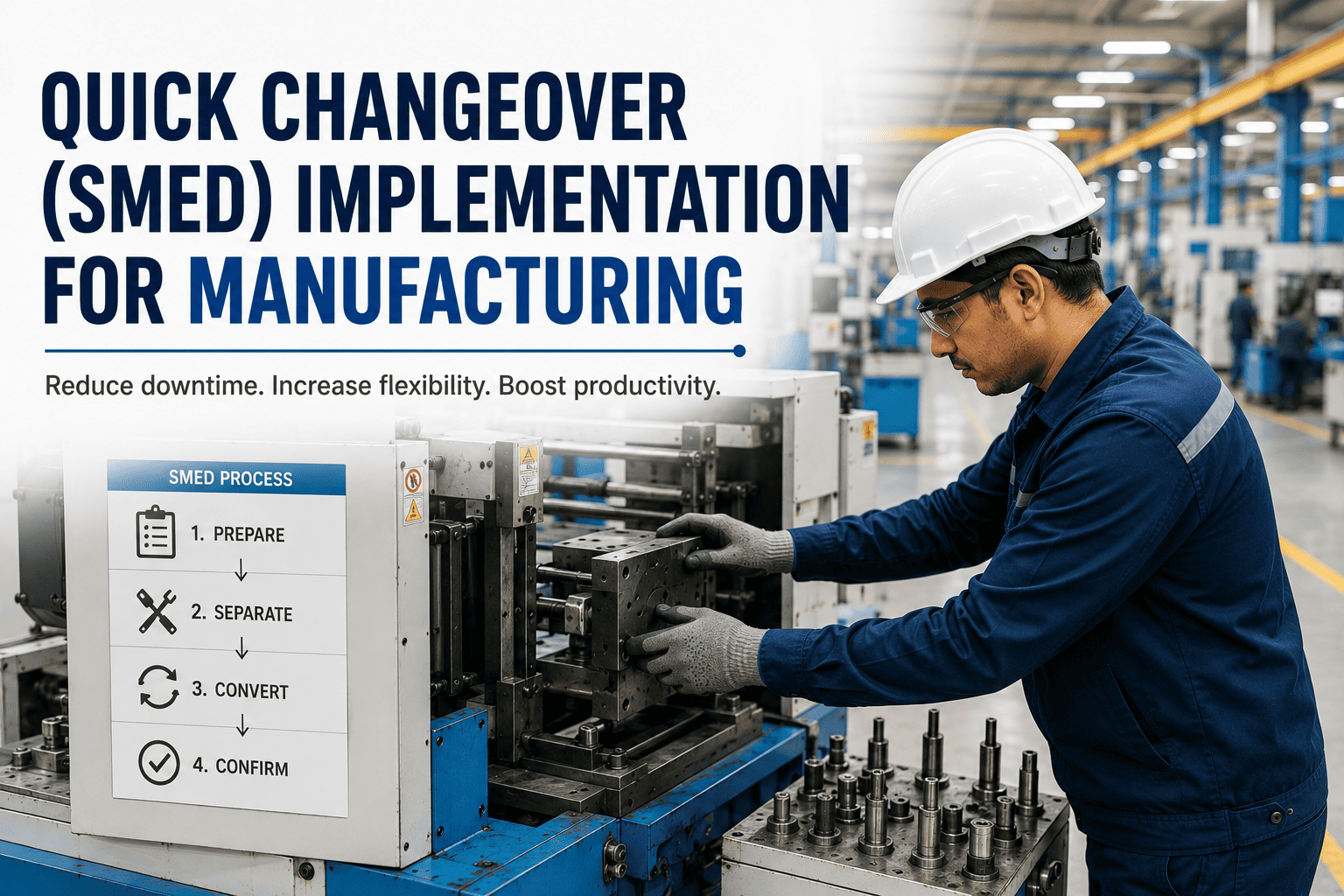
SMED in 4 Steps: A 40–60% Reduction Framework
Developed by Shigeo Shingo in the 1950s–70s and documented across hundreds of Toyota supplier factories, SMED is a structured engineering process — not a vague improvement philosophy. His original implementations averaged 94% reduction. Modern programmes consistently achieve 40–60% before any automation investment is made.
01
Observe & Document
Film the entire changeover from last good part to first good part. Time every discrete task. Most teams discover actual changeover is 40% longer than estimated — the gap is invisible without data.
02
Separate Tasks
Classify every task as Internal (machine must be stopped) or External (performable while machine runs). In most processes, 30–50% of "internal" tasks are actually external — they just haven't been separated.
03
Convert to External
Move every convertible task outside the stopped-machine window. Pre-stage tools, pre-set parameters, pre-heat components. This single step produces the largest time reduction in any SMED programme.
04
Streamline & Standardise
Eliminate remaining waste in internal tasks through quick-release clamps, one-turn fasteners, standardised tooling, and visual management. Formalise the optimised sequence and track it with OxMaint.
INTERNAL TASKS
Machine must be stopped to perform
Die and mould removal and installation
Physical fixture and jig changes
Machine zeroing and calibration
Safety interlocks and guarding changes
Target: Minimise — automate with cobots
VS
EXTERNAL TASKS
Performable while machine is running
Tool and material pre-staging
Next-run parameter setup and pre-heating
Documentation and work order preparation
Operator briefing and team handover
Target: Maximise — shift as much here as possible
Cobot Automation
Where Cobots Deliver the Next 20–30% Reduction
After SMED removes process waste, cobots address what SMED cannot — the physical internal tasks that still require machine stoppage. Unlike traditional industrial robots, cobots require no safety caging, are reprogrammable in minutes, and are now accessible to 93% of manufacturers regardless of facility size or budget.
Pre-Staging Automation
Cobots retrieve and position the next run's tools, dies, and materials during the active production run — eliminating search time entirely. Everything is at the line before the machine stops.
Addresses ~25% of changeover time
Physical Task Execution
Cobots perform consistent, repeatable fixture swaps, fastener tightening, and component installation with zero variation — cutting internal task duration by 40–60% and freeing operators for higher-skill work.
Addresses ~32% of changeover time
Setup Verification
Cobot-mounted vision and sensing verify fixture position, part presence, and setup accuracy before machine restart — eliminating the trial-run loop that adds 10–20 minutes to every changeover.
Eliminates ~14% of changeover time
Impact Comparison
What 50% Reduction Looks Like in Practice
No programme (baseline)180 min
After SMED alone108 min −40%
SMED + Cobot automation90 min −50%
+ OxMaint continuous tracking70 min −61%
+18%
Additional production capacity unlocked per shift from a 90-minute changeover saving
6–18mo
Typical ROI payback for combined SMED programme and cobot deployment
0
Additional headcount required — cobots work alongside existing operators at the line
OxMaint Changeover Tracking
Track Every Second. Improve Every Changeover.
SMED and cobots create the improvements. OxMaint makes them visible, accountable, and continuously compounding. Without structured tracking, SMED gains erode within 6 months as teams revert to old habits. With OxMaint, every changeover event becomes a data point that drives the next improvement cycle.
Real-Time Event Capture
Every changeover logged with start time, end time, operator, line, and SKU — via one-tap mobile entry from the production floor.
Target vs Actual Tracking
Set SMED target times per product, line, or SKU. Every overrun is flagged automatically — no manual reporting required from supervisors or engineers.
Bottleneck Identification
Ranked analysis of which lines, shifts, or SKUs consistently overrun targets — directing SMED programme effort to the highest-impact areas first.
SMED Trend Reporting
Changeover improvement trends visualised week-over-week. Prove programme ROI to management and identify performance regression before it compounds.
What does SMED stand for and where did it come from?
SMED stands for Single-Minute Exchange of Die — "single-minute" meaning the goal of reducing changeover to single-digit minutes (under 10), not literally one minute. It was developed by Japanese industrial engineer Shigeo Shingo while working with Toyota and its suppliers between the 1950s and 1970s. His documented implementations achieved an average 94% reduction in changeover times across a wide range of industries. Today SMED is a standard lean manufacturing methodology applied in automotive, food and beverage, pharma, electronics, and any production environment where frequent product or format changes are required. Start measuring your baseline changeover in OxMaint — free.
How much changeover reduction can we realistically expect from SMED alone?
Peer-reviewed studies consistently show 30–50% reduction from structured SMED implementation before any automation investment is made. The key variable is baseline discipline: facilities with no formal changeover process and no time tracking typically see the largest initial gains (40–60%) because a significant portion of their current changeover time consists of avoidable waste — searching for tools, waiting for approvals, performing internal tasks that could easily be externalised. Facilities already running informal quick-changeover practices see more modest initial gains (15–25%) but still benefit from the standardisation and continuous improvement tracking that SMED provides. The gains from SMED alone tend to erode over 6–12 months without structured tracking — which is where OxMaint's setup time monitoring locks in the improvement permanently. Book a demo to see how OxMaint tracks SMED targets vs actuals in real time.
What changeover tasks can cobots actually automate — and what can't they do?
Cobots are most effective on three categories of changeover work: (1) pre-staging — retrieving, positioning, and organising the next run's tools, dies, and materials while the current run is still active; (2) repetitive physical internal tasks — fixture swaps, fastener tightening, part placement, and component installation that follow a fixed sequence; and (3) setup verification — using mounted vision or sensing to confirm position, presence, and accuracy before machine restart, eliminating the trial-run loop. What cobots cannot replace is decision-making, process troubleshooting, and non-standard recovery tasks. Experienced operators remain essential — cobots free them from the repetitive physical work so their attention goes to the higher-skill elements that genuinely require human judgment. The combination of SMED-structured process and cobot physical assistance consistently delivers 45–60% total changeover reduction across documented case studies.
How does OxMaint help sustain SMED gains over time?
The most common failure mode in SMED programmes is not the initial implementation — it's the regression that occurs 6–12 months later when there is no tracking layer to detect performance drift. OxMaint prevents this by capturing every changeover event (start time, end time, operator, line, SKU) and comparing it against the SMED target time configured for that product and line. Any overrun is flagged automatically — supervisors see it the same shift, not weeks later in a monthly report. Over time, OxMaint's trend data shows whether changeover performance is improving, holding, or drifting — and the bottleneck analysis identifies which lines or SKUs are consistently overrunning targets, directing improvement effort to where it generates the most OEE recovery. Free to start, no IT project required. Sign up and configure your first SMED target in OxMaint today.
Which industries benefit most from SMED and cobot-assisted changeover?
Any manufacturing environment with frequent product changeovers benefits from SMED. The highest-impact industries are: automotive and automotive components (high SKU variety, multiple model lines, frequent format changes); food and beverage (recipe changeovers, packaging format changes, allergen cleaning requirements add internal complexity that SMED can systematically reduce); pharmaceuticals (regulated changeover procedures are already documented — SMED converts that documentation into a timed, optimised process); and electronics and consumer goods (short product cycles and high mix create changeover frequency that compounds directly into OEE losses). Cobot automation adds the most value where changeover involves consistent, repeatable physical tasks — stamping, injection moulding, packaging, and assembly lines are the highest-adoption environments. Book a demo to discuss your industry and changeover profile with an OxMaint specialist.