A single blast furnace outage can erase a full quarter of maintenance budget in under 48 hours. Rolling mill breakdowns halt entire finishing lines, burning $50,000 to $500,000 per hour in lost throughput, scrap, and expedited logistics. The steel industry spent $4.2 billion on unplanned downtime in 2024 alone — roughly 5 to 8% of total operating costs — and the gap between plants running AI-driven predictive maintenance and those still operating on calendar-based PM schedules is no longer incremental. ArcelorMittal, POSCO, Tata Steel, and JSW have moved hundreds of machine-learning algorithms into production across their blast furnaces, continuous casters, and hot strip mills. Their maintenance cost per tonne is falling while laggards hold flat. This guide walks through what predictive AI monitoring looks like inside a modern steel plant — from furnace thermal mapping to rolling mill vibration analytics to refractory lifecycle management — and how a CMMS platform like Oxmaint connects every sensor and alarm into a single maintenance workflow engine.
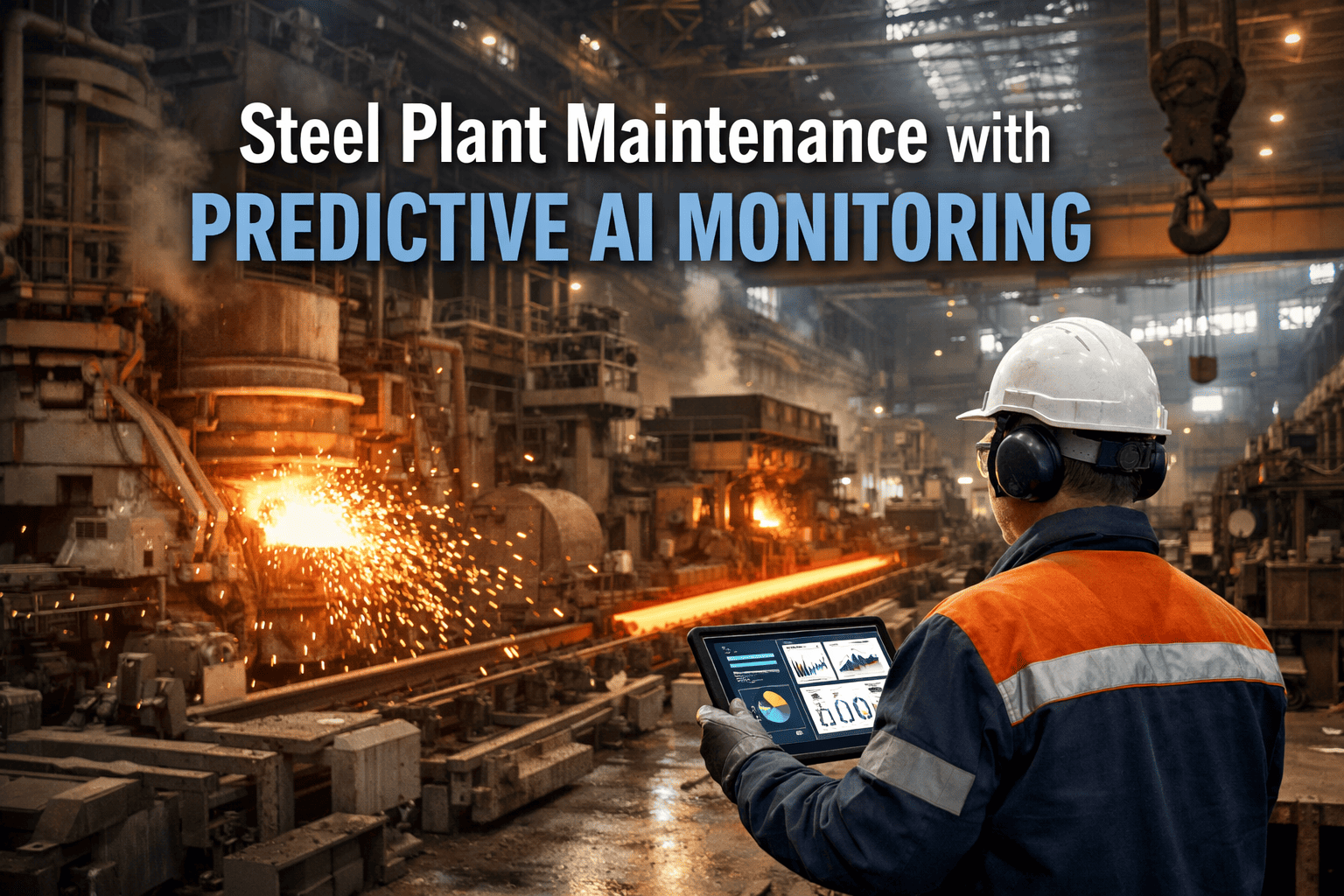
Steel Plant Maintenance with Predictive AI Monitoring
How modern integrated and EAF steel plants are deploying AI, IIoT sensors, and digital twins across furnaces, rolling mills, cranes, and refractory systems to eliminate unplanned downtime and protect margin per tonne.
The Steel Plant Reliability Pyramid
Not every asset in a steel plant deserves the same maintenance investment. Predictive AI delivers the highest return where failure consequences are catastrophic and redundancy is nonexistent. These five tiers organize every critical asset by how much a failure actually costs.
Which Signals Predict Which Failures
Predictive maintenance in steel is only as good as the sensor data feeding it. Each failure mode has its own signature — and matching the right sensor to the right asset is what separates a working program from a data-collection exercise.
Tracks rolling mill work-roll bearings using BPFO, BPFI, and BSF frequency signatures. Detects inner/outer race wear weeks before seizure. On fans, gearboxes, and pumps, vibration spectra identify imbalance, misalignment, and looseness with high precision.
Vessel shell temperature mapping tracks refractory degradation per heat. Thermal cameras on ladle shells flag hotspots indicating thinning refractory or impending leaks, allowing crews to pull equipment before spills occur.
Detects load imbalances and rotor bar faults on rolling mill drives within 3 electrical cycles. Reveals mechanical problems through the motor itself — no additional sensors needed on the driven equipment.
Oil particle counts combined with ferrous wear metrics tell you what's wearing where — gearbox, bearing, or hydraulic cylinder. Quarterly sampling at minimum for critical gearboxes; continuous particle counters on hydraulic AGC systems.
High-frequency microphones detect crack propagation, leaks, and electrical discharge long before vibration or thermal sensors pick up the symptom. Particularly valuable on pressure vessels and high-voltage equipment.
HD cameras feed vision models that inspect conveyor belt alignment, detect surface cracks on kiln walls, and monitor burner flame patterns. Reduces workplace accidents by ~12% when tied to safety event detection.
Turn sensor data into maintenance work — automatically.
Oxmaint connects IIoT sensors, SCADA alarm feeds, digital twin outputs, and inspection data into a single workflow that generates prioritized work orders the moment AI predicts a problem.
The Four Layers of a Steel Plant AI System
Predictive maintenance in steel has evolved far past single-sensor dashboards. Leading plants run a layered AI stack — edge inference, digital twins, multi-sensor fusion, and workflow automation — working together to predict, simulate, and execute maintenance decisions.
Workflow Automation Layer
High-confidence predictions above 90% automatically generate CMMS work orders, assign technicians, and reserve spare parts. Lower-confidence predictions create watchlist items for human review. The AI learns from every confirmed-wrong prediction so the same false positive never recurs.
Digital Twin Layer
Blast furnace twins ingest stave cooler temperatures, gas pressures, and tap hole data to project remaining refractory life within 3–6 weeks of accuracy. Caster twins simulate segment misalignment effects on strand quality before defects appear. Mill twins optimize roll change intervals against actual surface degradation.
Multi-Sensor Fusion Layer
Single-sensor models fire false positives on 35–40% of alerts. Multi-sensor fusion combines vibration, temperature, oil quality, current, and acoustic data into a composite health score — dropping false-positive rates below 8%. A gearbox alert only fires when vibration, oil particle count, AND motor current all deviate together.
Edge Inference Layer
Machine learning models run on edge hardware inside the plant — processing vibration and thermal data in under 10 milliseconds without a cloud round trip. For a caster where a bearing failure cascades into a $500K breakout in under 60 seconds, edge inference is the difference between planned swap and catastrophic loss.
Why Refractory Management Is Its Own Discipline
Refractory wear determines when a blast furnace needs relining, when a ladle is unsafe to cast, and when an EAF vessel becomes a thermal risk. In traditional plants, this is tracked on paper. In AI-enabled plants, it's a continuously-updated model tied to production data.
Stave & Hearth Wear
Thermocouple grids across stave coolers feed a physics-based wear model. Predicts relining within 3–6 week accuracy. Extends campaign life by detecting erosion hotspots before they compromise structural integrity.
Vessel Shell Mapping
Thermal cameras log shell temperature per heat, building a heat-by-heat degradation curve. Flags abnormal wear zones from uneven tapping or slag splash patterns before relining becomes mandatory.
Hotspot Detection
Ladle shell thermal scans identify thinning working lining zones. Pull ladle out before a shell burn-through. Tied to ladle ID in the CMMS, so relining history drives scheduling decisions.
Skid Pipe & Roof
Skid pipe cooling flow and roof refractory temperature feed a joint health model. Early detection of insulation failure avoids stock losses and thermal drift that compromises downstream mill quality.
What Steel Plants Are Actually Achieving
These numbers are not projections — they're documented outcomes from integrated and EAF steel operations running predictive AI platforms in 2025–2026.
How Oxmaint Powers Steel Plant Maintenance
Predictive AI only pays off when its outputs reach the floor as work. Oxmaint is the operational layer that connects every data source to every maintenance decision — turning sensor signals, twin predictions, and SCADA alarms into prioritized, tracked, executed work.
Standard Industrial Connectors
OPC-UA, REST APIs, MQTT, and direct database connectors for Siemens, ABB, Primetals, and other major steel platforms. SCADA alarm feeds convert to prioritized CMMS work orders automatically.
Steel-Specific Templates
Pre-built hierarchies for blast furnaces, EAFs, BOFs, continuous casters, rolling mills, reheat furnaces, and cranes. Import your asset list in days, not months.
Auto-Generation from AI
High-confidence predictions create work orders with pre-populated parts, procedures, and technician assignments. Lower confidence creates watchlist items for engineering review.
Predictive Inventory
Reorder points driven by predictive maintenance data. No emergency procurement at 3–7× markup. Critical spares reserved against forecasted failures.
Audit-Ready Documentation
Digital LOTO, confined space permits, crane inspections, and PSM documentation — timestamped and immutable. Supports OSHA, EU CBAM reporting, and SBTi decarbonization tracking.
Built for the Shop Floor
Works fully offline on iOS, Android, and rugged tablets. Extreme heat, electromagnetic interference, and spotty connectivity don't stop your crews from completing inspections and work orders.
See Oxmaint configured for your steel operation.
Book a 30-minute walkthrough and we'll build asset templates for your furnaces, casters, and mills — then show you live predictive dashboards tied to your actual equipment classes.
Frequently Asked Questions
How much does unplanned downtime actually cost a steel plant?
Does Oxmaint integrate with existing SCADA and Level 2 systems?
How fast do steel plants see ROI from predictive maintenance?
Can we start predictive maintenance on just one asset class?
How does AI reduce false-positive alerts in steel plants?
Does Oxmaint work in harsh steel plant environments?
The Window to Catch Up Is Closing
ArcelorMittal, Tata Steel, POSCO, and JSW have been running AI maintenance programs at scale for two years. Plants still on calendar-based PM are structurally disadvantaged — and the capital gap widens every quarter. Oxmaint gives your team the platform to start connecting sensor data to work orders within a week.