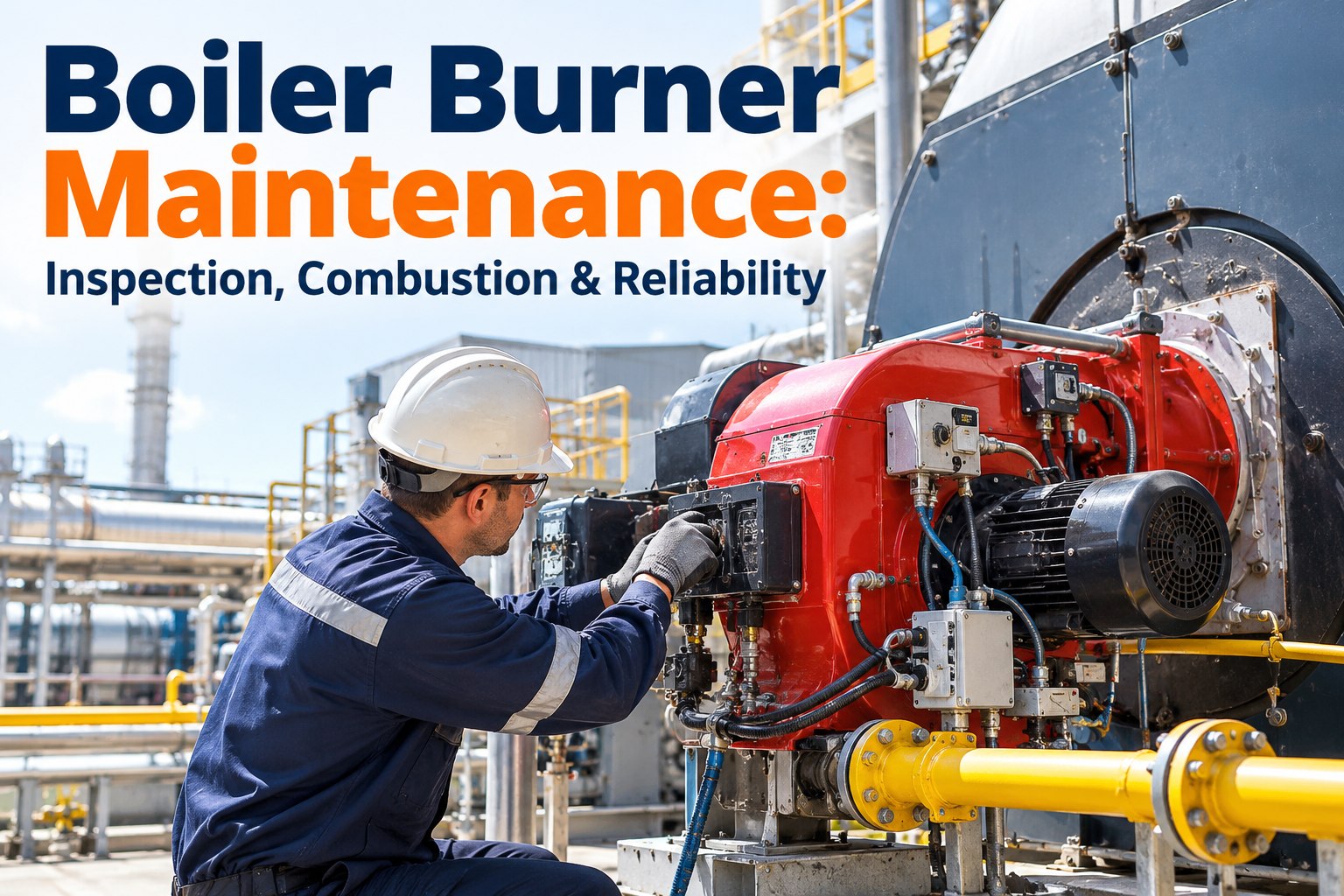
The burner is where a boiler either earns its efficiency or quietly bleeds it away. A nozzle worn out of its spray pattern, a flame scanner looking through a sooted lens, air linkages drifting out of tune — none of it trips an alarm, but all of it shows up as wasted fuel, a dirtier flame and, at the edge, a safety trip at the worst moment. Burner maintenance is where combustion efficiency and combustion safety are the same job. This guide works through the burner train component by component, and what keeps each one reliable. OXMAINT AI — the AI-powered maintenance management software — schedules every burner task and keeps the combustion record per unit.
Power Generation · Boiler Burner · Inspection, Combustion & Reliability · 2026
Boiler Burner Maintenance
Every burner component — nozzles, ignition, flame scanner, air control and the safety system — decides how cleanly and safely the boiler fires. The OXMAINT AI maintenance management software keeps each one on schedule, so combustion stays efficient and the safeguards stay proven.
Nozzles
Ignition
Flame scanner
Air control
Efficiency
clean nozzles and tuned air hold combustion where it's most efficient
Safety
the flame scanner and safety system are what make firing safe
One job
burner maintenance protects efficiency and safety at the same time
Per unit
combustion readings logged per boiler, so drift shows as a trend
What Burner Maintenance Protects
Neglect the burner and two things fail together — the boiler stops burning efficiently, and the safeguards that make firing safe stop being trustworthy. Good maintenance holds both; book a demo to see burner PM in OXMAINT AI.
Outcome one
Combustion efficiency
A burner firing on worn nozzles and untuned air burns more fuel for the same heat — poor atomization, the wrong air-fuel ratio and fouled surfaces all push efficiency down and the stack temperature up. Clean components and good tuning are what keep every unit of fuel working.
Outcome two
Combustion safety
The flame scanner, the purge cycle and the fuel safety shutoffs exist to stop fuel entering a furnace with no flame to burn it. They only protect you if they're tested and proven on a schedule — a safeguard nobody checks is a safeguard nobody can trust.
The Burner Train, Component by Component
A burner is a chain of parts that each fail in their own way. Knowing what to maintain on each one is half the job; start free and schedule each component in OXMAINT AI.
Fuel nozzles & atomizers
Worn or coked tips lose the spray pattern, so fuel atomizes poorly and burns dirty. Inspect for erosion and coking, clean regularly and replace to hold the pattern.
Ignition system
Igniter, pilot and spark electrodes have to light the main flame reliably every start. Inspect and clean them, and confirm dependable light-off.
Flame scanner
A sooted lens or a misaligned scanner reads a weak flame signal and nuisance-trips — or worse, misses a flame-out. Clean the lens and sight path, check signal and alignment.
Air registers & linkages
Dampers, registers, actuators and linkages set the air-fuel ratio. Seized or drifting linkages mistune combustion — keep them free, calibrated and feeding back correctly.
Burner management system
The safety brain — purge, interlocks, flame-failure trip and fuel shutoffs. Test each function, prove the purge, and never run with a safeguard bypassed.
Throat, diffuser & refractory
The burner throat, diffuser and surrounding refractory shape the flame. Cracked or eroded refractory distorts the flame and risks impingement — inspect and repair.
Burner Inspection Checklist
The components above come down to a recurring set of checks. Work them per burner on their cadence — the chip shows how often each is due; start free and put every check on a schedule in OXMAINT AI.
Frequency
MMonthly
QQuarterly
SASemi-annual
AAnnual
Never defeat a combustion safeguard. The flame scanner, purge cycle, flame-failure trip and fuel shutoffs prevent furnace explosions — fuel entering a furnace with no flame to burn it. They are tested, never bypassed to keep a unit running. Burner work follows your site's boiler safety procedures, the manufacturer's instructions and the applicable combustion-safety codes, by qualified people only.
Reading the Combustion
The flame and the flue gas tell you how the burner is really performing — these are the signs that point back to a maintenance task. Catch one and you know where to look; book a demo to see combustion readings trended in OXMAINT AI.
High excess air (O₂ up)
Too much air carries heat straight up the stack. Points to mistuned air control or drifting dampers — retune the air-fuel ratio.
High CO or unburnt fuel
Incomplete combustion from too little air or poor atomization — unsafe and wasteful. Check nozzles and the air setting.
Smoke or sooting
Poor atomization or an air shortage leaving unburnt carbon. Usually a worn nozzle or a fouled air path.
Erratic or pulsing flame
An unsteady flame signals a nozzle, fuel-pressure or air problem — and it's what nuisance-trips the scanner.
High stack temperature
Heat leaving unused — fouled heat-transfer surfaces or excess air. A direct read on lost efficiency.
Flame impingement
Flame licking the furnace wall or tubes means a distorted spray pattern — a worn nozzle or damaged diffuser.
A Combustion Reading Is Only Useful If You Can See It Drift.
Flue-gas O₂, CO and stack temperature creep as nozzles wear and tuning drifts — and on a paper log that creep is invisible. The OXMAINT AI maintenance management software captures each reading against the boiler and trends it, so efficiency loss shows up as a slope, not a surprise at the next test.
How OXMAINT AI Runs Burner Maintenance
Burner reliability depends on the schedule holding and the combustion record being somewhere you can read it. Here's what the OXMAINT AI maintenance management software brings; start free and keep every burner on a plan in OXMAINT AI.
Scheduled burner PM
Nozzle, ignition, scanner, air and safety checks each on their own cadence per burner, so none quietly lapses.
Combustion trends
Flue-gas O₂, CO and stack temperature trended per boiler, so efficiency drift surfaces as a visible slope.
Digital check capture
Each inspection ticked and timestamped on a device with readings and photos, legible and complete every round.
Safety tests on record
Flame-failure trips, purge proofs and interlock tests logged with dates, so the safeguards are proven, not assumed.
Auto work orders
A failed check or out-of-range combustion reading raises a work order with the burner, finding and parts attached.
Nozzle & parts tracking
Nozzles, electrodes and scanner parts tracked against the asset, so wear items are on the shelf when they're due.
“
We used to chase burner problems after they bit us — a nuisance flame-scanner trip at 2am, or a fuel bill that crept up for months before anyone connected it to worn nozzles. Putting the burner on a real schedule and logging O₂ and CO every round changed that. The combustion drift is visible now, so we clean and retune before efficiency falls off, and the scanner trips stopped once the lens cleaning was on the plan. The boiler runs cleaner and the safety tests are all on record.
Boiler & Combustion Engineer · Thermal Power Plant
Frequently Asked Questions
What does boiler burner maintenance involve?
Maintaining the whole burner train: fuel nozzles and atomizers, the ignition system, the flame scanner, the air registers and linkages that set the air-fuel ratio, the burner management safety system, and the throat and refractory that shape the flame. Each is inspected, cleaned, tested or replaced on its own interval.
Start free and schedule the full set.
How does burner maintenance improve combustion efficiency?
Worn nozzles atomize fuel poorly and drifting air control mistunes the air-fuel ratio, both of which burn more fuel for the same heat and push stack temperature up. Clean nozzles, free air linkages and regular combustion tuning keep the burner at its efficient point — and trending flue-gas O₂ and CO shows when it starts to drift.
Why is flame scanner maintenance so important?
The flame scanner is a safety device — it confirms a flame is present and trips the fuel if it isn't, preventing fuel from filling a furnace with no flame to burn it. A sooted lens or misaligned scanner reads a weak signal and either nuisance-trips the boiler or, far worse, misreads the flame. Cleaning the lens and checking alignment keeps it trustworthy.
Book a demo to see safety tests logged.
What are the signs a burner needs attention?
Rising flue-gas O₂ or CO, smoke or sooting, an erratic or pulsing flame, climbing stack temperature, flame impingement on the furnace wall, and repeated flame-scanner trips. Most show in the combustion readings first, which is why logging and trending them beats waiting for a symptom you can see.
How does a CMMS help with boiler burner maintenance?
It schedules each burner task on its own interval per unit, captures inspection results and combustion readings digitally, trends O₂, CO and stack temperature so efficiency drift is visible, logs safety-system tests with dates for a defensible record, turns a failed check into a work order automatically, and tracks wear parts like nozzles and electrodes against the asset.
Keep the Burner Clean, Tuned and Safe — Every Fire, Every Shift.
Run boiler burners on a plan with the OXMAINT AI maintenance management software — scheduled component PM, combustion trends, digital checks, safety tests on record, automatic work orders and nozzle tracking. Catch combustion drift on the log and keep the safeguards proven, not assumed.