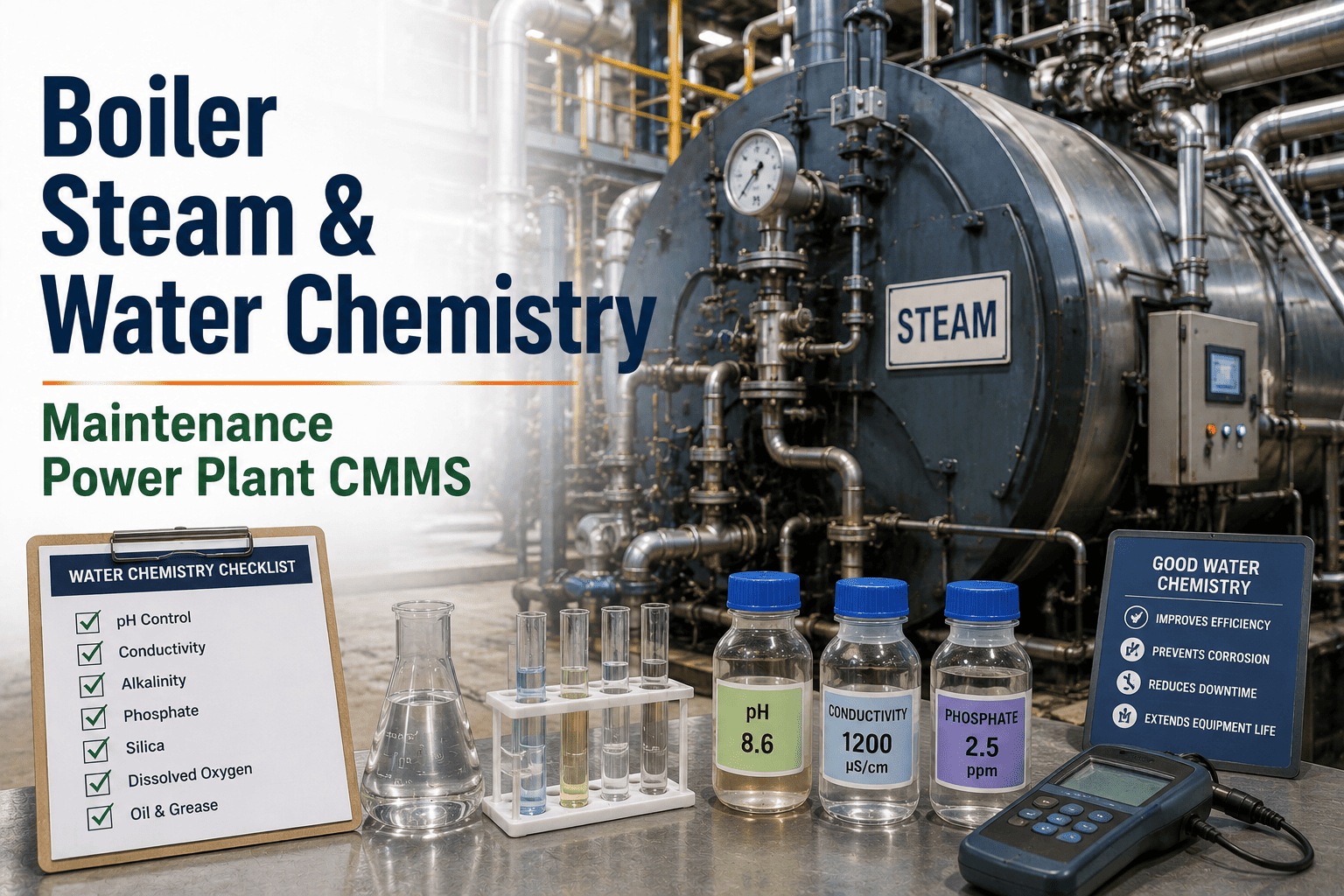
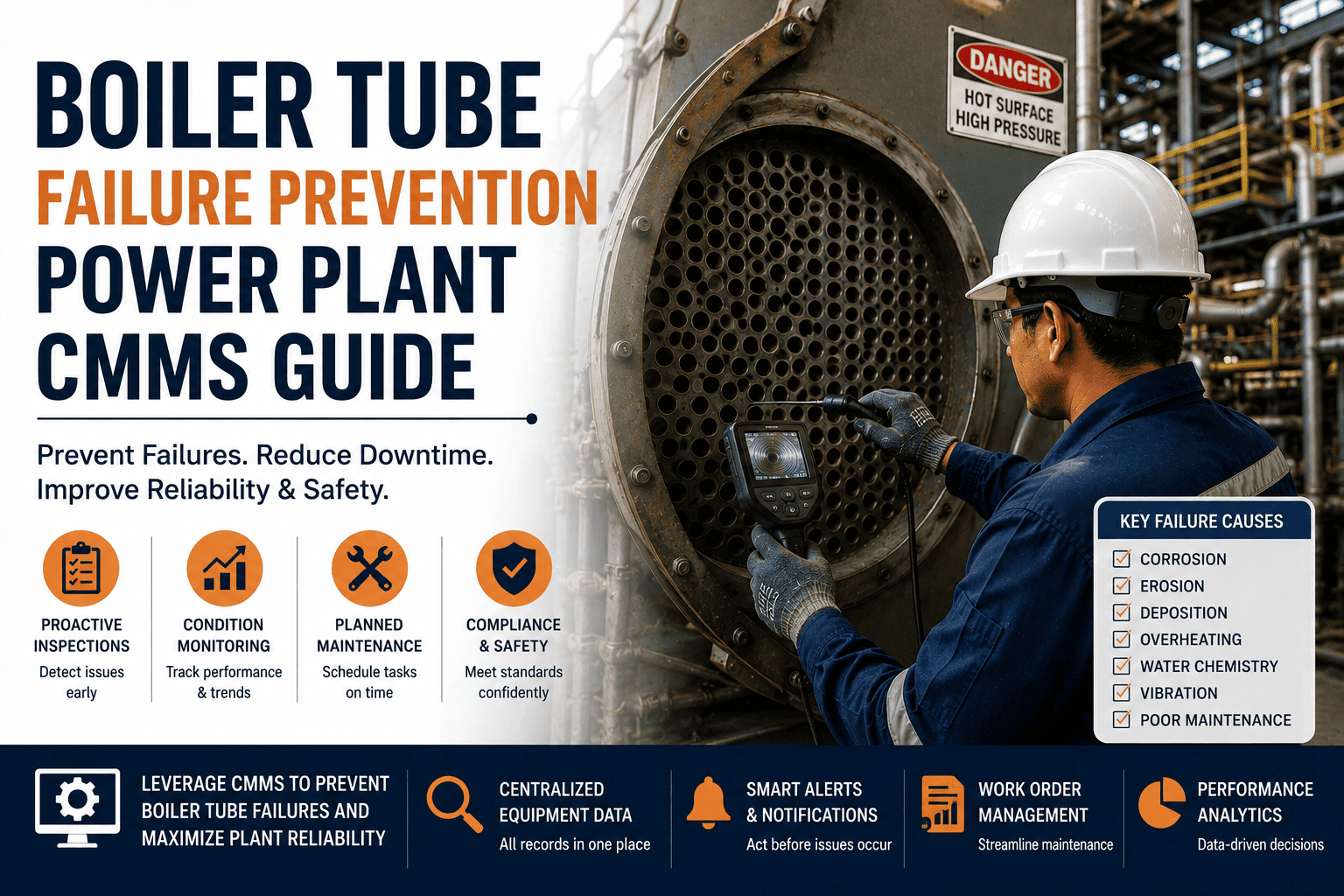
A single millimeter of scale on boiler tube surfaces adds up to 7.5% to your fuel costs — and just 3.2mm drives efficiency down by 15% or more. That is not a future risk; it is happening right now in every industrial boiler running on unmonitored or manually tracked water chemistry. Dissolved oxygen at even trace concentrations causes pitting corrosion that takes years off tube life. pH drift of less than one unit outside the safe band triggers acidic attack that no inspection catches until the damage is done. The boilers failing today were using manual logbooks and shift-by-shift grab samples two years ago. Start your free OxMaint trial to bring automated chemistry logging and real-time alerts to your feedwater and boiler systems, or book a demo to see live chemistry trend dashboards on actual boiler data.
The Hidden Cost of Poor Boiler Water Chemistry
7.5%
extra fuel cost from just 1mm of scale on boiler tubes
15%
efficiency drop from 3.2mm of scale — less than ⅛ inch
<0.007
mg/L — the maximum safe dissolved oxygen level in feedwater
The Six Parameters That Determine Whether Your Boiler Lives or Dies
Boiler water chemistry is not a single number — it is a system of six interdependent parameters that must stay within narrow bands simultaneously. Drift in one triggers a cascade in others. Understanding what each parameter controls and what goes wrong when it drifts is the foundation of any effective monitoring program.
pH
Safe Range
10.5 – 11.5
Below 9.5: acid attack on tube metal. Above 12.5: caustic embrittlement of welds and shell plates.
Dissolved Oxygen
Target
< 0.007 mg/L
Primary driver of pitting corrosion. Even ppb-level oxygen causes electrochemical attack on steel surfaces at high temperatures. Damage is irreversible once tubes are pitted.
Conductivity
Low/Medium Pressure
3,000 – 10,000 µS/cm
High conductivity signals elevated TDS — triggers foaming, steam carryover, and turbine contamination. Indicates when blowdown frequency must increase.
Phosphate
Minimum
10 ppm
Controls calcium hardness deposits. Below minimum, hardness minerals precipitate as hard scale rather than soft sludge removable by blowdown. Phosphate also buffers pH in the target range.
Hardness (Ca/Mg)
Feedwater Target
< 1 ppm
Calcium and magnesium are the primary raw materials for scale. Even small residual hardness post-softening accumulates into insulating deposits over weeks of operation. Zero is the only safe target.
Total Dissolved Solids
Blowdown Trigger
> 700 µmho/cm
High TDS causes foaming and carryover — water droplets contaminating steam lines, downstream valves, and any connected turbines. High chloride alongside TDS indicates contamination and accelerates pitting.
The Real Cost of Scale: What One Bad Season Does to Your Boiler
Scale growth is not dramatic — it is slow and silent. A softener that starts bypassing, a conductivity meter that drifts uncalibrated, a chemistry log that gets skipped on night shift. Each week of undetected chemistry drift builds a layer that no boiler wash can fully recover from.
0.8mm (1/32")
Heat loss: 8%
1.0mm
Scale type: normal mineral
3.2mm (1/8")
Tube overheating risk begins
1/32" High-Iron / Silica
High-silica scale is 3.5× more insulating
7.0mm
+70%+ energy cost increase
Tube failure risk — emergency shutdown territory
OxMaint Chemistry Monitoring
Stop Scale Before It Forms. Monitor Chemistry Continuously — Not Shift by Shift.
OxMaint logs pH, conductivity, dissolved oxygen, and phosphate in real time — generating automated alerts the moment any parameter exits its target band, and creating CMMS work orders before chemistry excursions become tube damage.
Manual Logging vs. Automated Chemistry Monitoring
Most industrial boiler operations still rely on manual water testing — a technician pulls a grab sample every 4–8 hours, runs a test, records the result in a paper or spreadsheet log, and adjusts chemical dosing based on that single data point. This is how chemistry excursions stay invisible for hours or days at a time.
Manual Chemistry Logging
Monitoring Frequency
Every 4–8 hours per shift
Detection Lag
Up to 8 hours of excursion before detection
Data Quality
Dependent on technician skill and shift consistency
Trend Analysis
Manual spreadsheet review — rarely done proactively
Alert Mechanism
None — action depends on who reads the log
Compliance Records
Paper logs — hard to audit, easy to lose
Blowdown Optimization
Fixed schedule — over-blowdown wastes heat and water
Chemistry excursions average 4–8 hours before corrective action
OxMaint Automated Monitoring
Monitoring Frequency
Continuous — readings every 1–5 minutes
Detection Lag
Alert within minutes of parameter excursion
Data Quality
Consistent, calibration-tracked sensor readings
Trend Analysis
Automated drift detection and rate-of-change alerts
Alert Mechanism
Instant mobile alert + auto CMMS work order
Compliance Records
Timestamped digital log — audit-ready at any time
Blowdown Optimization
Conductivity-triggered blowdown — saves 15–25% water
Excursions caught in minutes. Chemistry stays in spec continuously.
How OxMaint Automated Chemistry Logging Works
OxMaint connects your existing online analyzers or adds low-cost sensor integration to create a continuous chemistry data stream. Every reading is logged, timestamped, and evaluated against configurable parameter bands — with automated work orders generated the moment intervention is needed.
01
Sensor Integration
OxMaint connects to existing online pH, conductivity, and DO analyzers via 4–20mA, Modbus, or OPC-UA. Manual entry screens cover parameters tested by grab sample. No new hardware required in most facilities — the platform connects to what you already have.
02
Parameter Band Configuration
Every boiler system gets its own chemistry profile — target values, warning thresholds, and trip limits for each parameter based on your boiler pressure rating, OEM specifications, and ASME/ASTM guidelines. High-pressure boilers get tighter limits; low-pressure systems get broader bands. One configuration serves all your units simultaneously.
03
Continuous Trend Monitoring
OxMaint evaluates each reading against both the absolute limit and the rate of change. A pH that is still within range but drifting at 0.2 units per hour generates an early warning — giving your team time to adjust chemical dosing before the parameter exceeds the safe band. Trend alerts are the most valuable feature most operators discover after deployment.
04
Automated Alert and Work Order
When a parameter exceeds its threshold, OxMaint sends an immediate mobile alert to the responsible technician and auto-generates a structured CMMS work order — with the out-of-range reading, affected parameter, recommended corrective action, and chemical dosing guidance pre-populated. Nothing falls through the cracks between shifts.
Water Chemistry Reference: Acceptable Ranges by Boiler Type
Chemistry limits are not universal — they vary by operating pressure, boiler design, and whether you are measuring feedwater, boiler water, or condensate return. This reference table reflects industry guidance from ASME and the American Boiler Manufacturers Association.
| Parameter |
Feedwater Target |
Low Pressure Boiler
(<150 psi) |
Medium Pressure
(150–600 psi) |
High Pressure
(>600 psi) |
Consequence of Exceedance |
| pH |
8.5 – 9.5 |
10.5 – 11.5 |
10.0 – 11.0 |
9.0 – 10.0 |
Corrosion (low) or caustic embrittlement (high) |
| Dissolved Oxygen |
< 0.007 mg/L |
< 0.1 mg/L |
< 0.05 mg/L |
< 0.007 mg/L |
Pitting corrosion — irreversible tube damage |
| Conductivity |
< 10 µS/cm |
< 10,000 µS/cm |
< 5,000 µS/cm |
< 1,000 µS/cm |
Steam carryover, turbine blade deposits |
| Total Hardness |
< 1 ppm |
< 0 (nil) |
< 0 (nil) |
< 0 (nil) |
Scale formation — fuel cost penalty up to 70% |
| Phosphate |
Not required |
30 – 60 ppm |
20 – 40 ppm |
5 – 15 ppm |
Hardness precipitation as hard scale |
| Sulfite (O₂ scavenger) |
20+ ppm excess |
20 – 40 ppm |
20 – 30 ppm |
Not used (hydrazine) |
Residual oxygen causes pitting |
| Silica |
< 1 ppm |
< 150 ppm |
< 50 ppm |
< 2 ppm |
High-silica scale: 3.5× more insulating than normal scale |
| Chloride |
< 0.1 ppm |
< 100 ppm |
< 50 ppm |
< 10 ppm |
Stress corrosion cracking, pitting in austenitic alloys |
Frequently Asked Questions
Why is dissolved oxygen the most dangerous chemistry parameter in a boiler system?
Dissolved oxygen causes electrochemical pitting corrosion that is irreversible — once a tube wall is pitted, the damage cannot be repaired by chemistry correction. At boiler operating temperatures, even oxygen at parts-per-billion concentrations reacts aggressively with steel surfaces, creating localized craters that grow into through-wall leaks. Deaerators reduce oxygen to around 10 µg/L, but supplemental oxygen scavengers like sodium sulfite must be maintained above 20 ppm residual to neutralize the remainder. OxMaint monitors both DO sensors and sulfite residual to confirm the full scavenging program is working — not just the deaerator alone.
Start your free trial to configure DO monitoring on your feedwater system.
How does poor boiler water chemistry affect steam quality and downstream equipment?
When conductivity and TDS rise above limits, boiler water foams and carries droplets of dissolved-solids-laden water into the steam lines — a condition called carryover. These droplets deposit salts on turbine blades, control valves, and process heat exchangers, causing scale deposits in equipment that was never designed to handle them. High silica in boiler water is particularly damaging to turbine blades because silica volatilises at high pressure and deposits as hard glassy scale on the first-stage blades. OxMaint's conductivity alerts prevent TDS buildup that leads to carryover, protecting not just the boiler but the entire steam system.
Book a demo to see how steam system protection integrates with boiler chemistry tracking.
Can OxMaint integrate with our existing online analyzers without replacing them?
Yes — OxMaint is designed to connect to existing instrumentation rather than replace it. If you already have online pH, conductivity, or DO analyzers, OxMaint ingests their outputs via standard industrial protocols including 4–20mA, Modbus RTU/TCP, and OPC-UA. For parameters still tested by grab sample — hardness, phosphate, silica — OxMaint provides structured manual entry screens that timestamp and log each result identically to automated readings. The result is a single unified chemistry record across all parameters and all boilers in your facility.
Sign up free to explore integration options for your analyzer brands.
How does automated chemistry logging help with compliance and insurance audits?
Regulatory and insurance inspections of steam boiler operations require documented evidence of water chemistry monitoring — specific parameters, testing frequency, and corrective actions taken when values were out of range. Manual paper logs are easily lost, incomplete, and difficult to verify. OxMaint maintains a complete, timestamped, tamper-evident digital record of every chemistry reading, every alert generated, and every work order closed in response. Audit exports are available at any time in standard formats, reducing audit preparation from days to minutes.
Book a demo to see the compliance reporting module in action.
Does OxMaint support blowdown optimization based on actual conductivity readings?
Yes — and this is one of the highest-value features for operating cost reduction. OxMaint tracks real-time conductivity against your configured TDS limit and recommends blowdown timing based on actual water quality rather than a fixed schedule. Facilities running fixed-interval blowdown typically over-blow by 15–25%, wasting heated water and the chemical treatment it contains. Conductivity-triggered blowdown maintains TDS within limits while minimising heat and water losses. OxMaint auto-generates the blowdown work order at the right time and logs the post-blowdown reading to confirm the operation was effective.
Start your free trial to configure conductivity-based blowdown alerts for your boiler system.
OxMaint Boiler Chemistry CMMS
Your Boiler's Water Chemistry Is Either Being Monitored or Damaging Your Tubes Right Now.
Continuous
chemistry logging vs. shift-by-shift grab samples
Minutes
to alert and work order on any parameter excursion
15–25%
blowdown water savings from conductivity-triggered scheduling