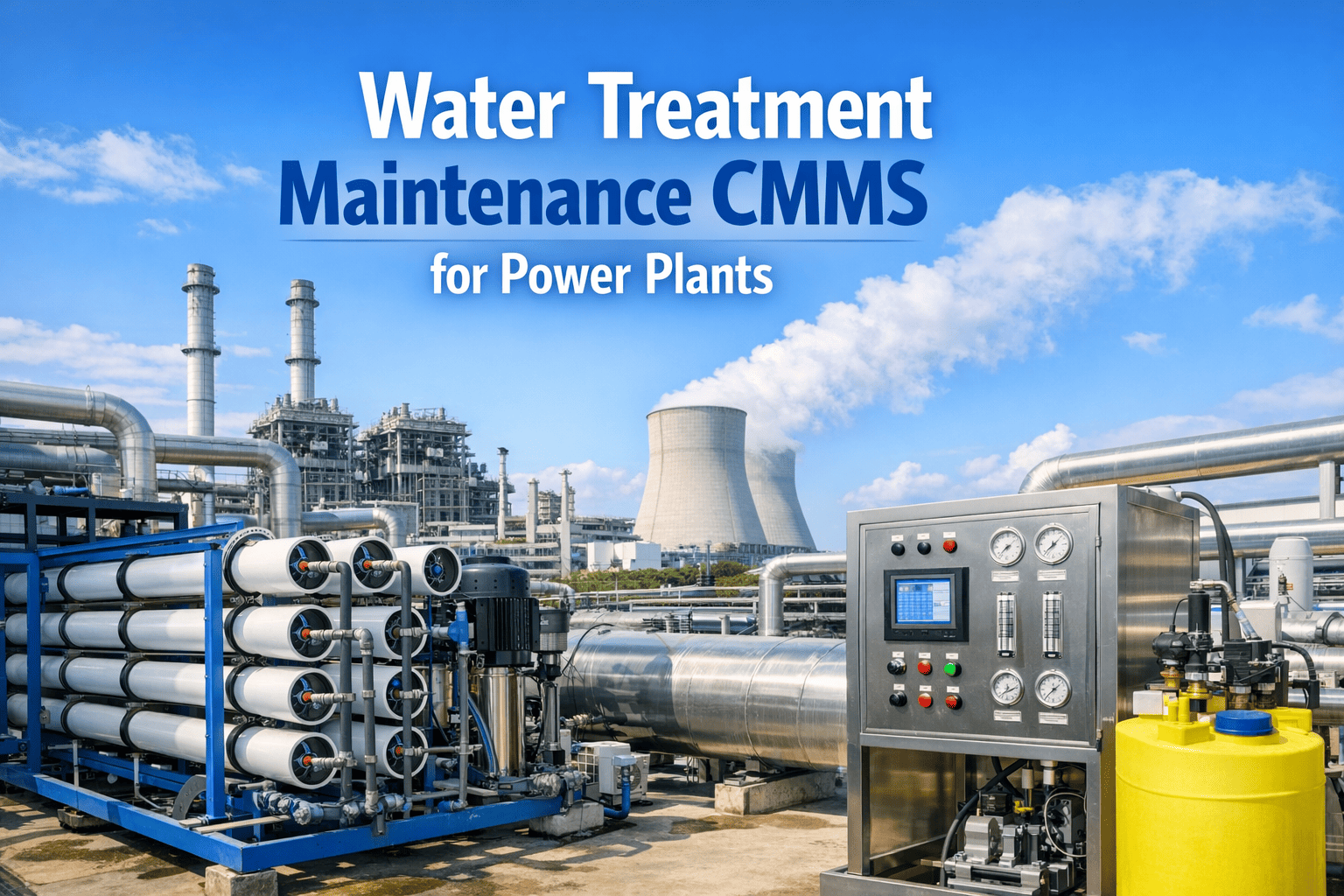
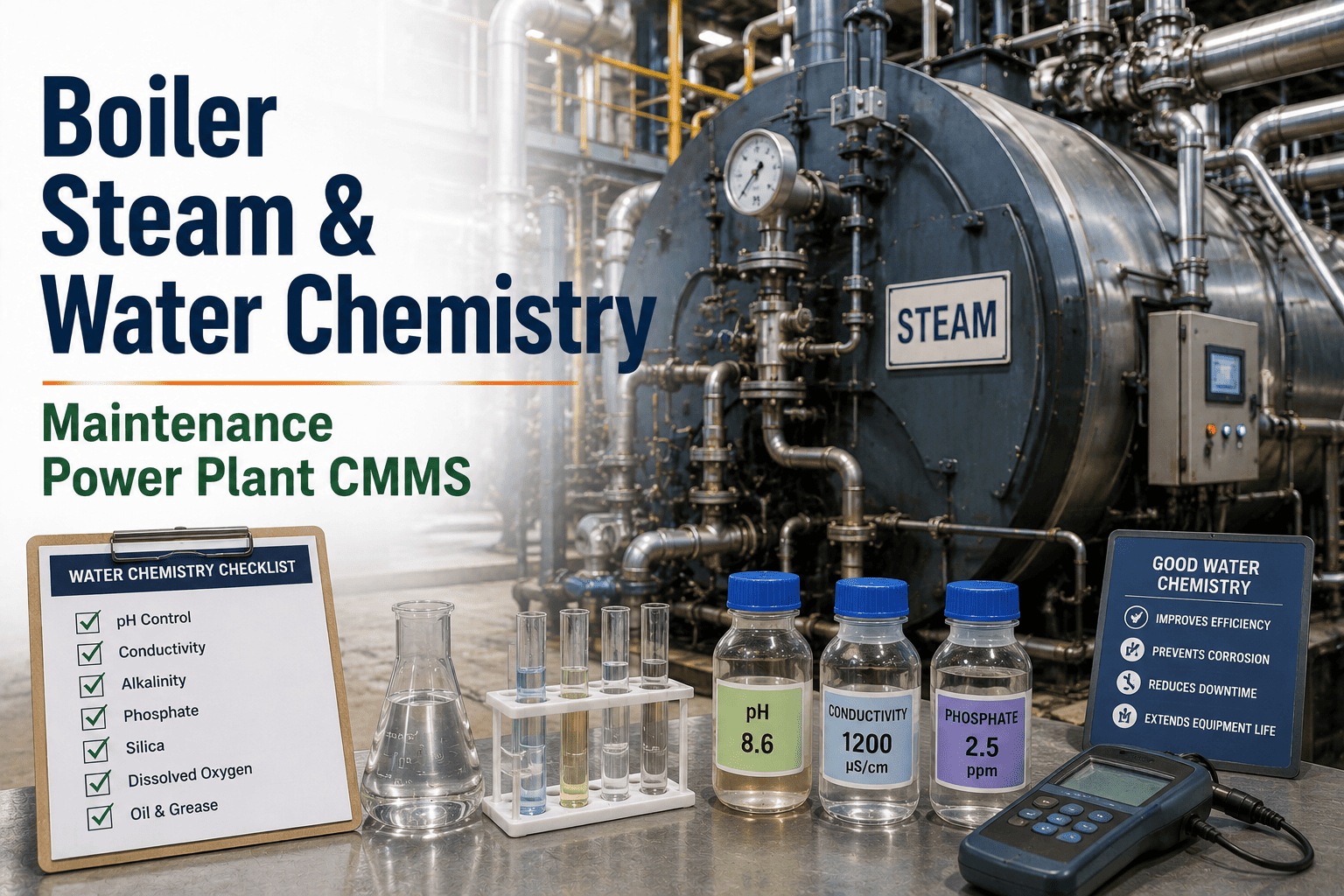
A single fouled RO membrane can reduce permeate flow by 15% overnight. A neglected cooling tower can drop condenser efficiency by 2%, quietly burning 3% more fuel every day. A boiler feedwater chemistry excursion that goes uncaught for six hours can cause tube deposits that cost $400,000 to remove — or, worse, tube ruptures that force a full unit shutdown. Every power plant in the world depends on water, and every failure on the generation side of that plant traces back to whether someone is scheduling, logging, and tracking the work orders that keep water systems inside spec. A water-aware CMMS turns RO membrane hours, resin regeneration cycles, cooling tower biocide dosing, and chemistry sampling into structured, auditable workflows — before silica breakthrough becomes a turbine deposit. Book a demo to see OxMaint track every stage of your plant water cycle.
UPCOMING OXMAINT EVENT
Water Treatment Reliability for Power Plants: From Intake to Condensate
A hands-on session on building a water-system maintenance program inside your CMMS — covering RO membrane tracking, ion exchange regeneration, cooling tower chemistry, boiler feedwater compliance, and condensate polisher health.
Live RO membrane trending walkthrough
ASME boiler water compliance workflows
Chemical dosing automation from CMMS triggers
Condenser and cooling tower PM templates
4,200 L
Water per MWh
Typical coal-fired plant withdrawal per megawatt-hour of generation
41%
Industrial Withdrawals
Share of daily industrial water use driven by thermoelectric generation
10x
Lower Blowdown
Reduction in blowdown frequency when ultrapure feedwater is maintained
99%
TDS Rejection
Dissolved solid removal from a properly maintained RO membrane train
The Plant Water Journey — Every Stage Is a Maintenance Risk
Raw water enters a power plant as river, well, municipal, or seawater. Before it reaches a boiler drum, it passes through a sequence of treatment stages — each with its own asset class, failure mode, and PM schedule. Miss a step in the chain and the damage doesn't stay local — it propagates downstream into your turbine.
Intake to Steam — The Full Treatment Chain
Stage 1
Intake & Screening
Traveling screens, strainers, raw water pumps
Risk: debris damage, pump cavitation
Stage 2
Clarification
Clarifiers, flocculators, chemical dosers
Risk: under-dosing, sludge buildup
Stage 3
Filtration
Multimedia, UF, cartridge filters
Risk: high DP, channel fouling
Stage 4
RO Membrane Train
HP pumps, membranes, antiscalant skid
Risk: fouling, oxidation, flux loss
Stage 5
Demin / Polish
Ion exchange, CEDI, mixed bed
Risk: resin exhaustion, silica slip
Stage 6
Boiler Feed
Deaerator, feed pumps, economizer
Risk: oxygen attack, under-deposit corrosion
A parallel loop handles cooling water through circulating pumps, cooling towers, and condensers — with chemistry control driving scale, corrosion, and biological fouling outcomes across both loops.
Water Chemistry Parameters Your CMMS Must Keep in Band
Boiler manufacturers, ASME, and EPRI all publish strict operating bands for feedwater, boiler water, and steam chemistry. Excursions outside these bands are the direct cause of most unscheduled shutdowns attributable to water chemistry. A CMMS that logs every sample and triggers a work order the moment a parameter drifts is the difference between catching a problem in hours versus discovering it during a tube leak.
Conductivity
Typical band: < 0.2 microS/cm
Indicates overall dissolved salt load. A rising trend is the earliest sign of RO performance loss or resin exhaustion.
CMMS action: trigger resin regen or membrane inspection
Silica (SiO2)
Typical band: < 20 ppb feed
Silica volatilizes into steam at high pressure and deposits on turbine blades — near impossible to remove without full overhaul.
CMMS action: immediate sample + polisher PM
Dissolved Oxygen
Typical band: < 7 ppb
Primary driver of pitting corrosion in boiler tubes and feedwater piping.
CMMS action: deaerator PM, scavenger dose review
pH
Typical band: 9.0 - 9.6
Low pH accelerates metal loss in carbon steel; high pH causes caustic attack in high-heat zones.
CMMS action: dosing pump verification + sample log
Total Iron
Typical band: < 5 ppb
Rising iron signals ongoing corrosion somewhere in the steam cycle — the deposit precursor.
CMMS action: trend review, source walk-down
Hardness
Typical band: undetectable
Any hardness breakthrough in feedwater means immediate scale formation on boiler tubes.
CMMS action: softener lockout + regen
Stop Running Water Chemistry on Whiteboards.
OxMaint captures every sample, automates excursion alerts, and triggers the right work order before a chemistry drift becomes a tube deposit.
RO Membrane Life — What the Data Says and What a CMMS Does About It
An RO membrane's performance is never static. Permeate flow decays, differential pressure climbs, and salt rejection slips over thousands of operating hours. Catching the decay curve early means a clean-in-place saves the membrane. Catching it late means replacement at $800-$2,500 per element, multiplied across an entire train.
RO Membrane Decay Curve — What to Watch
Normalized Permeate Flow
Flag at 10%: schedule CIP. Flag at 15%: inspect feed side fouling.
Differential Pressure
Flag at 15%: colloidal/biofouling likely. Flag at 50%: stop, clean, inspect.
Salt Rejection
Dropped 2.1% from baseline
Flag at 1%: sampling review. Flag at 5%: membrane integrity test.
Recovery Ratio
Flag on trend shift: verify concentrate valve + antiscalant dose.
OxMaint logs these four parameters against membrane serial number, hours, and CIP history — so the decision to clean, inspect, or replace is backed by trend data, not guesswork.
What Water System Failure Really Costs
Water treatment failures cascade. A pretreatment issue becomes an RO problem; an RO problem becomes a demin problem; a demin problem becomes a boiler problem; a boiler problem becomes a turbine problem. Each step up the pyramid multiplies the cost by an order of magnitude. This is exactly the hierarchy a maintenance system is supposed to block.
Turbine Deposits & Blade Damage
$2M - $15M+ per incident
Boiler Tube Failure / Forced Outage
$400K - $2M per event
RO Membrane Replacement (Full Train)
$150K - $600K
Cooling Tower Cleaning / Biocide Upset
$40K - $120K
Missed PM / Chemistry Sample
$0 - $2K
Seven Water System Workflows a CMMS Should Run on Autopilot
Water treatment maintenance is high frequency, high volume, and high consequence. Running it on paper logs or spreadsheets is where most plants quietly absorb risk. These are the seven recurring workflows OxMaint automates from day one.
Workflow
Frequency
Why It Matters
RO Membrane Performance Log
Daily
Early warning of flux loss, DP rise, and rejection slip
Boiler Feedwater Chemistry Sampling
Per shift
ASME compliance and tube integrity protection
Cooling Tower Biocide / Inhibitor Dosing
Continuous + daily log
Prevents scale, biofouling, and Legionella growth
Ion Exchange Resin Regeneration
Trigger-based
Prevents silica and sodium breakthrough to boiler
Chemical Dosing Pump Calibration
Weekly / monthly
Ensures antiscalant and scavenger reach target dose rate
Clean-in-Place (CIP) Execution
As triggered
Recovers membrane / heat exchanger performance
Wastewater & Blowdown Compliance Log
Per discharge event
Meets permit limits and environmental disclosures
How OxMaint Changes the Water Maintenance Model
Traditional water maintenance lives in paper binders, handoff spreadsheets, and institutional memory of senior operators. OxMaint turns that same work into structured, trended, auditable records — without asking your team to change how they actually operate the plant.
Paper & Spreadsheet Approach
Chemistry samples logged in notebooks
RO trends calculated monthly if at all
CIPs reactive, triggered by production loss
Compliance reports assembled manually
Chemical inventory tracked separately
Knowledge lost when operators retire
OxMaint Water CMMS
Samples captured with timestamp and asset ID
Live normalized RO trending per membrane train
CIPs triggered by parameter breach, scheduled automatically
Audit-ready compliance exports on demand
Chemical usage linked to dosing asset and work order
Every procedure, trend, and history searchable
Frequently Asked Questions
How does a CMMS improve power plant water treatment reliability?
By turning every chemistry sample, RO reading, and dosing log into a trended, timestamped record. OxMaint automatically triggers a work order when conductivity, silica, or pH drifts outside band — before the drift becomes a turbine deposit or tube failure.
Start free to see this in your own water lab.
Can OxMaint track RO membrane health across multiple trains?
Yes. Each membrane is tracked by serial number, operating hours, CIP history, permeate flow, DP, and rejection rate — normalized so decay trends are comparable across trains, feed temperatures, and recovery ratios.
Does OxMaint integrate with our existing water analyzers and SCADA?
Yes. OxMaint connects to online analyzers, DCS, SCADA, and PI historians via standard protocols — so continuous conductivity, silica, and pH readings flow in automatically, with manual samples captured through mobile forms.
Book a demo to see a live integration.
What water treatment compliance reports does OxMaint generate?
ASME boiler water compliance, NPDES discharge reporting, cooling tower Legionella logs, and chemical usage reports — all drawn from the same operational records, with full asset traceability required for auditor sign-off.
How fast can a plant see results on water system maintenance?
Baseline trending starts within the first 30 days of use. Most plants report their first intercepted chemistry excursion within the first quarter — turning what would have been a forced outage into a standard preventive work order.
Start free and capture your first excursion.
Your Water System Runs Your Power Plant. Run It Properly.
OxMaint gives power generators a single platform for RO membrane health, boiler feedwater chemistry, cooling tower compliance, and every dosing, sampling, and CIP workflow in between — so water system failures stop reaching your turbine.