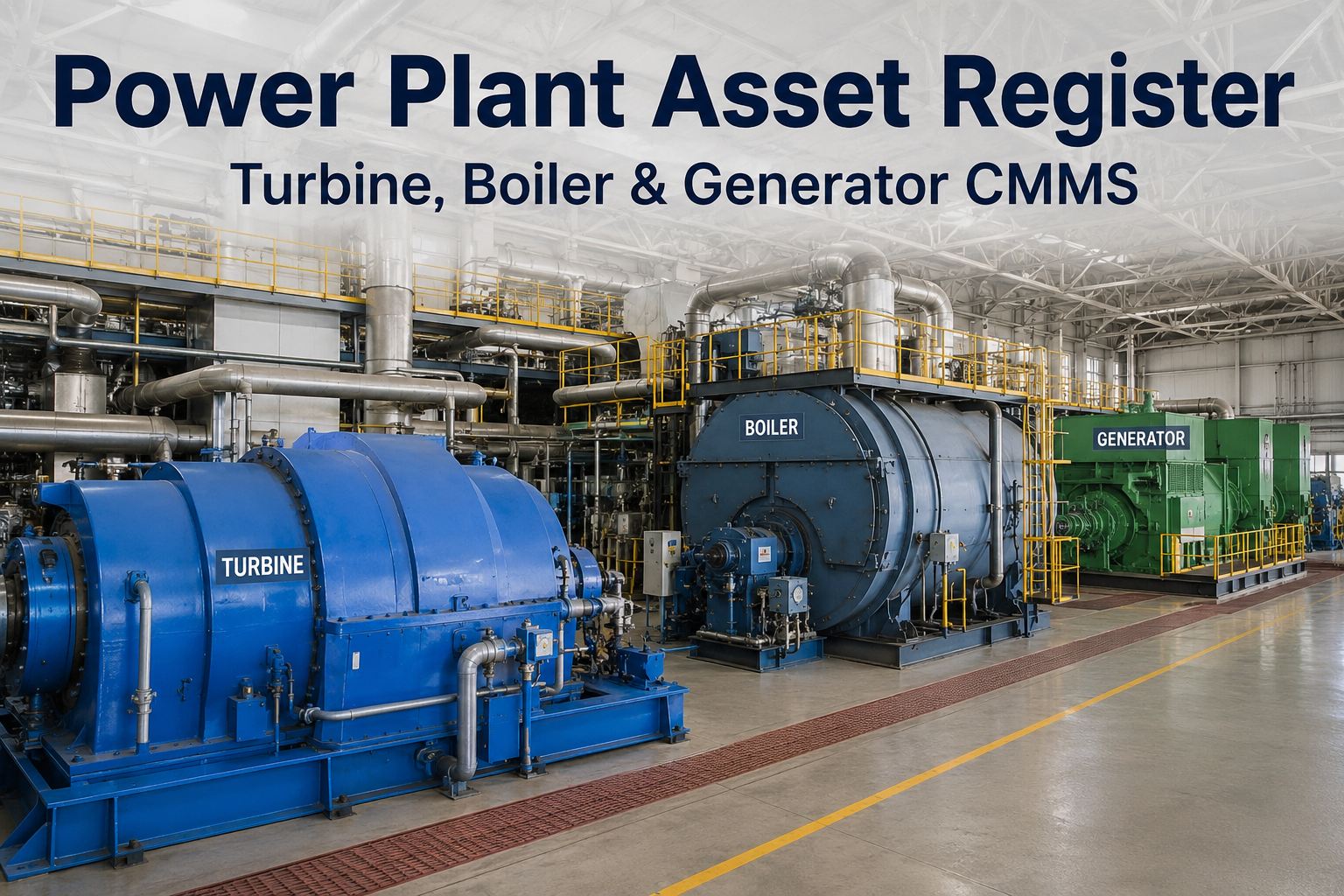
Thermal power plants are unforgiving environments — boiler tube leaks alone account for over 52% of all forced outages, and a single unplanned turbine failure can drain $500,000 or more before sunrise. Yet most thermal plant maintenance teams are still working from spreadsheet PM schedules, disconnected inspection logs, and reactive repair patterns that guarantee the next forced outage is already building somewhere in the plant. A specialized CMMS built for thermal power generation doesn't just organize work orders — it connects boiler inspection history, turbine health trends, asset lifecycle data, and compliance records into a single system that prevents the failures that cost the most. Start your free Oxmaint trial today or book a thermal plant demo to see how it works with your specific asset mix.
Thermal Power Plant CMMS
Maintenance Intelligence Built for Boilers, Turbines & Generators
Oxmaint gives thermal plant teams a single platform to schedule boiler inspections, track turbine health, manage asset lifecycles, and auto-generate work orders before failures become forced outages.
$23.8B
Global power plant maintenance market in 2024
69%
of plants experience unplanned outages every month
$500K+
cost per hour of unplanned thermal plant downtime
95%
of predictive maintenance adopters report positive ROI
Where Forced Outages Actually Come From in Thermal Plants
Before choosing a maintenance strategy, it helps to understand exactly what is causing forced outages in thermal power plants. NETL data consistently shows a small number of asset categories responsible for the overwhelming majority of unplanned shutdowns — and every one of them has a detectable warning window if the right data is being tracked.
Source: National Energy Technology Laboratory (NETL)
The Critical Finding
Every failure category in this chart produces detectable warning signals weeks before breakdown — rising stack temperatures, vibration shifts, winding temperature drift. The only reason these signals go unacted upon is that the data lives in disconnected systems that nobody is correlating. A CMMS purpose-built for thermal plants closes this gap automatically.
The Cost Reality
A single 5.8-hour forced outage at a large thermal facility results in an average of $1.7 million in combined direct losses — lost generation, emergency contractor premiums, expedited parts, and grid penalties. That figure does not include the insurance premium increases that typically follow.
5 Core CMMS Modules Every Thermal Plant Needs
Generic work order software treats a boiler the same as an office HVAC unit. Thermal plants require a CMMS with modules specifically designed for high-pressure, high-temperature assets operating under continuous regulatory scrutiny. These five capabilities define the difference between maintenance management and thermal plant maintenance intelligence.
01
Boiler Inspection Scheduling
Automates tube inspection cycles, waterwall surveys, and economizer checks based on operating hours, steam cycles, and ASME code intervals — not just calendar dates. Flags overdue inspections before the regulator does.
ASME Compliant
Cycle-Based Triggers
02
Turbine Health Tracking
Maintains continuous health records on HP/IP/LP turbine stages — tracking bearing vibration trends, blade erosion history, seal conditions, and lube oil analysis results with automatic deviation alerts against baseline readings.
Vibration Trending
Oil Analysis Logs
03
Asset Lifecycle Management
Tracks every major component from commissioning through end-of-life — recording maintenance history, overhaul costs, manufacturer limits, remaining useful life estimates, and replacement planning timelines against capital budget windows.
RUL Estimation
Capex Planning
04
Compliance & Audit Documentation
Generates on-demand compliance reports for NERC reliability standards, OSHA 1910.269, EPA NESHAP emission limits, and ASME boiler codes — with timestamped, immutable audit trails covering every inspection, work order, and corrective action.
NERC CIP Ready
Audit in <10 min
05
Outage Planning & Critical Path
Coordinates planned maintenance windows across turbines, boilers, HRSGs, and balance of plant — scheduling parallel task execution, managing contractor access, tracking parts readiness, and modeling critical path to minimize outage duration.
25–35% Shorter Outages
Multi-Crew Coordination
See All 5 Modules Working Together on Your Plant Data
Oxmaint's thermal plant CMMS is live-demonstrable with your actual asset types, inspection intervals, and compliance requirements — not a generic walkthrough.
Boiler Inspection Scheduling: From Manual Binders to Automated Cycles
Boiler inspections are the single highest-impact maintenance activity in a thermal plant — and the one most frequently delayed, missed, or inadequately documented when managed on paper. Oxmaint replaces inspection binders with an automated scheduling engine that ties every inspection to the parameters that actually determine when it's needed.
Waterwall Tube Survey
Every 18,000 steam hours or annual, whichever comes first
Auto-scheduled from DCS hour counter
ASME BPVC Section I
Economizer Thickness Check
Every major outage cycle or on temperature trend deviation
Triggered by stack temperature drift
NBIC Part 2
Safety Relief Valve Test
Annual or per number of lifts, whichever triggers first
Lift-count tracking from PLC signal
OSHA 1910.269
Refractory & Casing Inspection
Every planned outage or on external hot spot detection
Linked to IR thermography scan results
Manufacturer Spec
Drum Level Instrument Calibration
Every 6 months or after any safety-level event
Calendar + event-triggered dual schedule
ISA 5.1 / NERC CIP
Asset Lifecycle Management Across the Thermal Plant
Thermal plant assets don't fail on a fixed schedule — they degrade based on operating conditions, load cycles, fuel quality, and maintenance history. Oxmaint tracks every major asset through its full lifecycle, combining manufacturer limits with actual usage data to produce real remaining-life estimates instead of optimistic calendar projections.
Commissioning
Baseline data capture
OEM spec import
Initial PM schedule
→
Active Operation
Continuous health scoring
PM & inspection execution
Failure & repair history
→
Aging Management
RUL estimation
Major overhaul planning
Cost-vs-replace analysis
→
End-of-Life
Replacement planning
Capex budget link
Decommission records
Steam Turbine (HP Stage)
Overhaul in 18 mo
Main Steam Boiler
On Schedule
BFW Pump Set
Plan Replacement
Main Generator
On Schedule
Condenser Tube Bundle
Review in 24 mo
25–35%
Reduction in major overhaul duration with CMMS-coordinated outage planning
27%
of adopters achieve full CMMS investment payback within Year 1
8 mo
Advance warning available for HRSG failures when maintenance data is correlated
Ready to Stop Running Your Thermal Plant on Spreadsheets?
Oxmaint deploys in 1–2 weeks with pre-built thermal plant templates for boilers, steam turbines, HRSGs, generators, and balance of plant — not a blank CMMS you have to configure from scratch.
Frequently Asked Questions
How is a thermal plant CMMS different from a generic maintenance system?
Generic CMMS platforms are built for facilities management — they handle work orders and PM schedules but have no concept of steam cycles, ASME boiler codes, NERC reliability standards, or HRSG tube failure patterns. A thermal plant CMMS like Oxmaint includes pre-built inspection templates for high-pressure equipment, compliance documentation tied to specific regulatory frameworks, and asset health models calibrated to power generation failure modes.
Sign up for Oxmaint to explore the thermal plant template library without a sales call.
What thermal plant assets does Oxmaint cover in its pre-built templates?
Oxmaint's thermal plant library covers steam turbines (HP, IP, LP stages), main and auxiliary boilers, heat recovery steam generators (HRSGs), condensers, boiler feedwater pumps, cooling towers, main generators, transformers, ash handling systems, and balance of plant auxiliaries. Each template includes manufacturer-aligned inspection intervals, failure mode checklists, and compliance code references.
Book a demo to see the full template set applied to your plant's asset register.
How long does it take to deploy Oxmaint in an operating thermal power plant?
Initial deployment — asset registry, PM schedule activation, and work order workflows live — typically takes 1–2 weeks using Oxmaint's guided onboarding and pre-built thermal templates. Sensor integration and condition-monitoring-triggered work orders come in Phase 2 at 4–6 weeks. Full predictive capability with failure pattern detection develops over 60–90 days as your asset-linked work order history accumulates.
Start your free trial and our onboarding team will map a deployment plan specific to your plant size and priority assets within 24 hours.
Can Oxmaint generate compliance documentation for NERC, ASME, and OSHA audits?
Yes. Every inspection, work order, and corrective action in Oxmaint is logged with timestamps, technician records, asset identifiers, and compliance code references — creating an always-current, immutable audit trail. On-demand compliance reports can be generated in under 10 minutes, covering NERC reliability standards, OSHA 1910.269, EPA NESHAP, and ASME boiler and pressure vessel code requirements.
Book a demo to see the compliance reporting dashboard and assess it against your specific audit requirements.
How does Oxmaint help reduce planned outage duration in thermal plants?
Oxmaint shortens outage windows through three mechanisms: pre-outage preparation that verifies parts availability and stages procedures before shutdown day; parallel task scheduling that identifies which maintenance activities can run simultaneously across crew teams; and digital closeout that captures inspection findings on mobile devices during execution rather than during post-outage documentation catch-up. Plants using structured CMMS outage coordination report 25–35% reductions in major overhaul duration.
Try Oxmaint free and build your first outage plan on the platform to see the scheduling capability firsthand.
Every Forced Outage in Your Plant Had a Warning Sign. Start Catching Them.
Boiler tube failures, turbine bearing drift, generator temperature rise — each one announces itself weeks in advance through data your plant is already generating. Oxmaint connects that data to the maintenance team that can act on it, before the next $1.7 million outage event takes you offline.