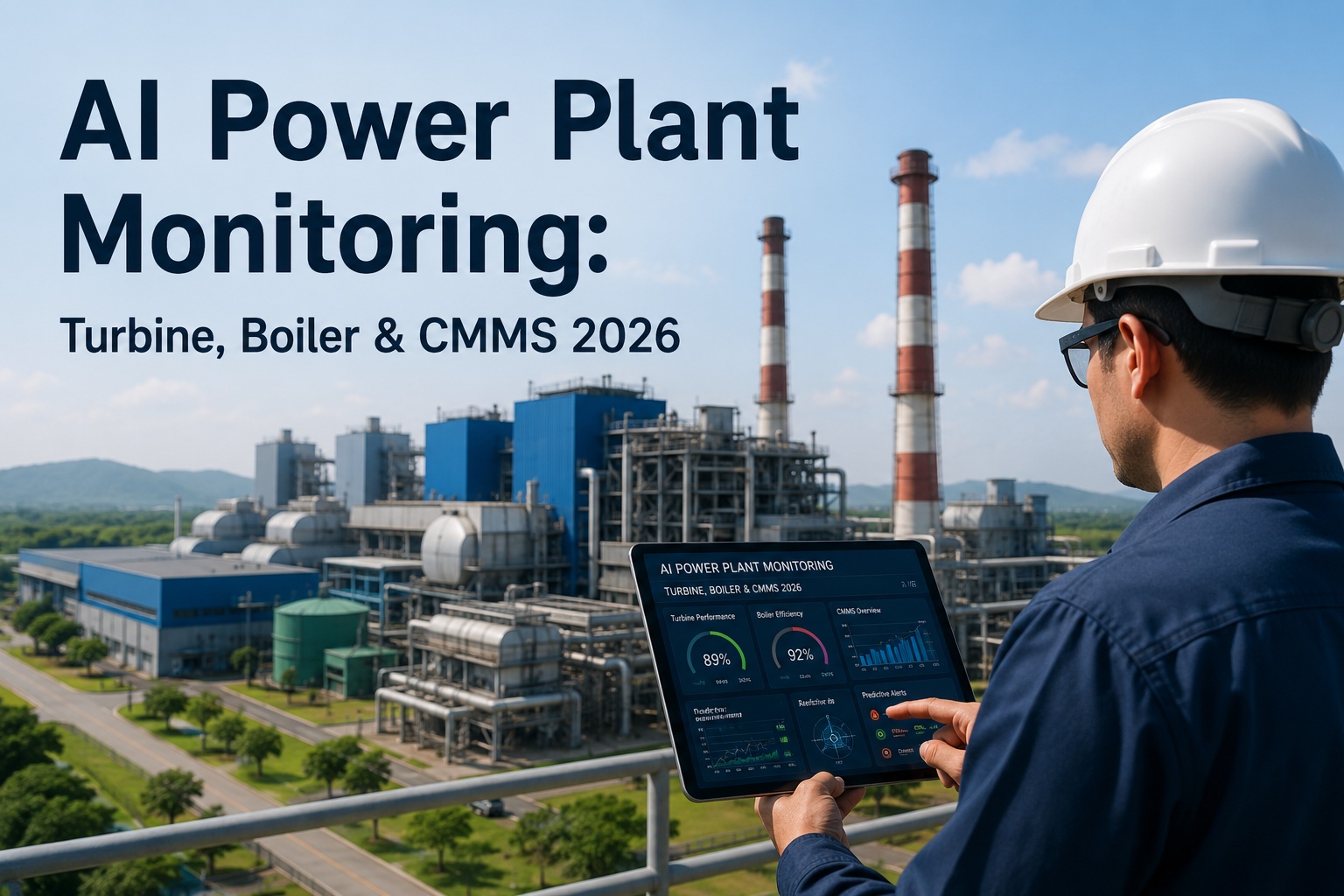
The power sector is hitting an inflection point in 2026 that legacy CMMS platforms simply were not designed for. Renewables surpassed coal in global electricity generation for the first time, 76% of US power and renewable executives are increasing AI spending, 65% of energy companies now run AI predictive maintenance, and OSHA's 2026 electronic recordkeeping rules force digital evidence capture on every safety record. Yet 1 in 4 CMMS implementations still fail — almost always due to workforce pushback against systems that feel built for the last decade. The plants that lead in 2026 are not the ones with the biggest IT budgets; they are the ones whose CMMS is fast, mobile, AI-ready, and audit-ready. Here are the five power industry trends rewriting what a CMMS needs to do — and why most platforms cannot keep up. To see how OxMaint is engineered for the 2026 power plant, you can start a free trial or book a 30-minute modernization walkthrough with a power specialist.
Top 5 Trends · CMMS Modernization · Power Sector 2026
The Top 5 Power Industry Trends Driving CMMS Modernization in 2026
From coal-to-renewable transition to AI predictive maintenance, mobile-first workforce, ERP consolidation, and ESG reporting — these are the five forces making legacy CMMS obsolete and rewriting buyer requirements this year.
793 GW
New renewable capacity added globally in 2025
76%
Of US power executives increasing AI spend in 2026
65%
Of energy firms now run AI predictive maintenance
1 in 4
CMMS rollouts fail — usually workforce, not tech
The Tectonic Shift — Legacy CMMS vs Modern CMMS
The five trends below are not feature wishlists. They are structural shifts that turn yesterday's enterprise EAM into a liability. Here is what changed.
Legacy CMMS / Enterprise EAM
Built for 2010s
Deployment
6–18 months, $200K+
Mobile
Bolted-on, partial parity
AI & IoT
Custom integration projects
ESG Reporting
Manual data assembly
Updates
Quarterly with downtime
Workforce
Trained admins, steep curve
Modern Cloud-Native CMMS
Built for 2026
Deployment
1–3 days per site
Mobile
Full feature parity, offline
AI & IoT
Native ingestion, auto-triggers
ESG Reporting
Auto-generated from work orders
Updates
Continuous, zero downtime
Workforce
Consumer-grade UX, day-one adoption
The 5 Trends Reshaping Power Plant CMMS in 2026
Each trend below ties to a specific data point from the field and a concrete capability your CMMS shortlist needs to demonstrate. Walk the timeline from #1 to #5.
Trend 01
793 GW added in 2025
Coal-to-Renewable Generation Mix Shift
In 2025, renewables surpassed coal in global electricity generation for the first time — solar PV alone accounted for 83% of new capacity additions, and the IEA projects 4,600 GW of new renewable capacity between 2025 and 2030. At the same time, US utilities are extending coal plant life, running gas peakers more hours, and procuring 8–10 hour storage to fill reliability gaps from data center demand. Power plant maintenance teams now manage hybrid fleets — thermal, renewable, BESS — under one umbrella.
CMMS Implication
Asset hierarchies must natively model turbines, inverters, battery racks, thermal systems, and BOS components with separate failure-mode libraries — not generic equipment templates.
Trend 02
$26.3B AI in energy market
AI Predictive Maintenance Crosses the Adoption Tipping Point
The AI in renewable energy market reaches $26.3 billion in 2026 at a 25.65% CAGR. 65% of energy companies now run AI predictive maintenance — up from a minority three years ago. NextEra is shifting to predictive equipment models on Google Cloud; AES is using Vertex AI and BigQuery for outage prediction. Plants connecting condition monitoring sensors to a CMMS achieved 40–60% reductions in unplanned bearing and gearbox failures within 12 months — no capital equipment replacement required.
CMMS Implication
Native ingestion of vibration, thermal, current-signature, and IoT sensor data — with automatic work order triggers when thresholds are breached. Manual reconciliation is the bottleneck modernization eliminates.
Trend 03
7M skilled worker shortfall by 2030
Mobile-First Workforce Enablement
The energy sector faces a projected shortfall of up to 7 million skilled workers by 2030. Unified mobile platforms cut administrative burdens by 40–60%, and field technicians increasingly demand consumer-grade smartphone UX. OSHA's 2026 electronic recordkeeping rules force the digital capture of inspections, training records, and incident logs. Legacy CMMS with desktop-only or "mobile-lite" interfaces drive shadow maintenance — paper logs, group chats, spreadsheets — that destroys audit-readiness.
CMMS Implication
Full feature parity on mobile, offline capability for plant areas without WiFi, photo capture, voice notes, and intuitive UX that doesn't require dedicated training to onboard a new technician.
Trend 04
40–60% admin cost reduction
CMMS & ERP Consolidation Into One System of Record
Organizations are consolidating work orders, financial data, compliance records, and capital planning tools into single systems of record. SAP, Oracle, and other ERPs handle procurement and finance — but their maintenance modules drive shadow maintenance because technicians refuse to use them. The 2026 pattern: SAP PM for financial integration paired with a modern mobile CMMS front-end for plant floor execution. API-first integration is no longer a bonus; it is the table-stakes requirement.
CMMS Implication
Out-of-the-box REST API connectors for SAP, Oracle, Microsoft Dynamics, and historian platforms — without months of professional services to wire up bidirectional sync of cost, asset, and procurement data.
Trend 05
ESG mandates expanding
ESG Reporting Becomes a Maintenance Department KPI
Energy consumption is now tied to operating budgets and regulatory ESG compliance — particularly under the European Green Deal and tightening US disclosure rules. Maintenance teams are being asked to track energy consumption per asset, quantify the carbon impact of completed work orders, and produce auditable sustainability reports. Modern CMMS platforms include energy modules that link consumption spikes to specific assets and trigger investigative work orders automatically.
CMMS Implication
Energy and emissions fields on every asset, work order outcomes that quantify kWh saved or CO₂ avoided, and one-click ESG report exports compatible with corporate sustainability filings.
OxMaint Is Built for All Five Trends — Out of the Box
Hybrid asset modeling, AI/IoT ingestion, full mobile parity, ERP API connectors, and ESG reporting modules — all native to a cloud-native platform that deploys in days, not months.
The CMMS Modernization Maturity Model
Where does your plant sit today? The four stages below map the journey from reactive paper-driven maintenance to a fully integrated, AI-augmented platform of record.
Stage 1
Reactive
Paper work orders, spreadsheets, tribal knowledge. PM is run on memory. Audits take weeks.
~25% of plants in 2026
Stage 2
Digital
Legacy CMMS deployed but mostly desktop. Technicians use it as a logging system, not an execution system.
~40% of plants in 2026
Stage 3
Connected
Cloud-native CMMS with mobile parity, ERP sync, and starting to ingest IoT signals. Audit-readiness is continuous.
~25% of plants in 2026
Stage 4
Predictive
AI predictive models running on live sensor data, ESG metrics auto-reported, digital twins on critical assets.
~10% of plants in 2026
Most plants modernize in 6–9 months when they pick a cloud-native platform — vs 12–18 months on legacy EAM rollouts.
Why CMMS Modernization Can't Wait Past 2026
Four converging pressures are turning "we'll evaluate next year" into a measurable cost. Each driver below has a specific 2026 trigger.
$
Penalty Exposure Rises
NERC CIP penalties reach $1.29M per violation per day; OSHA willful violations hit $165,514 — and 2026 electronic recordkeeping makes documentation gaps visible.
AI
AI Models Need Clean Data
Predictive maintenance is only as good as the structured maintenance history feeding it. Plants on legacy CMMS forfeit AI's ROI for years.
HR
Workforce Adoption Window
7M skilled-worker gap by 2030 means new hires will refuse desktop-only systems. Consumer-grade mobile UX is the new minimum.
CO2
ESG Disclosure Tightens
Sustainability reporting mandates expand under the EU Green Deal and US disclosure rules — maintenance becomes a board-level data source.
OxMaint Capability Match Against the 5 Trends
Direct mapping: each trend, the capability it demands, and how OxMaint addresses it natively.
| Trend |
What 2026 Demands |
OxMaint Native Capability |
| 01 Coal-to-Renewable Mix |
Hybrid asset modeling: thermal + renewable + BESS |
Pre-configured templates for turbines, inverters, battery racks, BOP — all in one hierarchy |
| 02 AI Predictive Maintenance |
Native IoT ingestion + auto work order triggers |
REST API and OPC-UA connectors for SCADA, historians, and IoT sensor streams |
| 03 Mobile-First Workforce |
Full feature parity on mobile, offline mode |
Mobile-native UX, offline work order completion, photo and voice capture |
| 04 ERP Consolidation |
Bidirectional sync with SAP, Oracle, Dynamics |
Out-of-the-box API connectors for major ERPs — no custom integration projects |
| 05 ESG Reporting |
Energy and emissions tagging per asset |
Energy module, kWh tracking per asset, exportable sustainability reports |
OxMaint deploys in 1–3 days per site, not 6–18 months. Start a free trial and have your asset register loaded before the week ends.
Frequently Asked Questions
Why are legacy enterprise EAM systems struggling to keep up with 2026 power plant needs?
Legacy EAM platforms were designed for desktop workflows, custom integration projects, and annual upgrade cycles — none of which match the pace of AI predictive maintenance, mobile workforce expectations, ERP consolidation, or continuous ESG reporting. Implementations on platforms like Maximo and SAP PM run 6–18 months and $200K+. Cloud-native CMMS platforms deploy in days, update continuously, and arrive pre-configured for the integrations a 2026 power plant actually needs.
How long does CMMS modernization actually take for a power plant?
Most single-site power plants on OxMaint are fully operational — asset register loaded, PM schedules configured, technicians on mobile — within one to three days. Multi-site fleet rollouts typically complete within 30–60 days per site on a rolling schedule. Free data migration support means teams do not manually re-enter asset data from legacy systems or spreadsheets.
Start a free trial to see deployment in practice.
What is the realistic ROI on AI predictive maintenance for a power plant?
Plants that connect condition monitoring sensors to a CMMS achieve 40–60% reductions in unplanned bearing and gearbox failures within 12 months — without buying new equipment. The data quality matters more than the algorithm: AI models trained on clean, structured maintenance history from a specific plant outperform generic vendor models significantly. A modern CMMS is the data foundation that makes AI ROI possible.
Can OxMaint integrate with our existing SAP or Oracle ERP?
Yes. OxMaint provides API access and pre-built connectors for SAP, Oracle, Microsoft Dynamics, and other ERP platforms. The most common pattern for power plants is using OxMaint for maintenance execution and mobile work order data — where technician adoption is critical — while syncing cost, procurement, and asset financial data back to the ERP for corporate reporting.
Book a demo to discuss your specific stack.
Why do 1 in 4 CMMS rollouts fail, and how is OxMaint different?
Industry data shows roughly 25% of CMMS implementations fail — and the root cause is almost always workforce pushback, not technology limits. Veteran technicians refuse systems with clunky desktop UX, slow mobile experiences, or workflows that feel like surveillance. OxMaint is engineered consumer-first: mobile-native, photo and voice capture, intuitive PM scheduling, and a UX that does not require a training program to onboard new hires. Day-one adoption is the difference.
How does CMMS modernization support ESG reporting?
Modern CMMS platforms tag energy consumption and emissions data per asset, link maintenance work orders to their kWh saved or CO₂ avoided, and produce exportable sustainability reports formatted for ESG disclosures. Maintenance becomes a measurable input to corporate sustainability KPIs — not a separate documentation exercise. This is increasingly required under EU Green Deal rules and tightening US disclosure mandates.
Modernize Your CMMS for the 2026 Power Plant — In Days, Not Months
The five trends shaping power plant operations in 2026 are not optional checkboxes — they are structural shifts that decide which plants run leaner, safer, and more compliant. OxMaint is the cloud-native, mobile-first, AI-ready CMMS engineered for exactly this moment. Deploy in 1–3 days, integrate with your existing ERP and SCADA, give your technicians a tool they actually want to use, and turn maintenance into a measurable driver of reliability, compliance, and ESG performance.