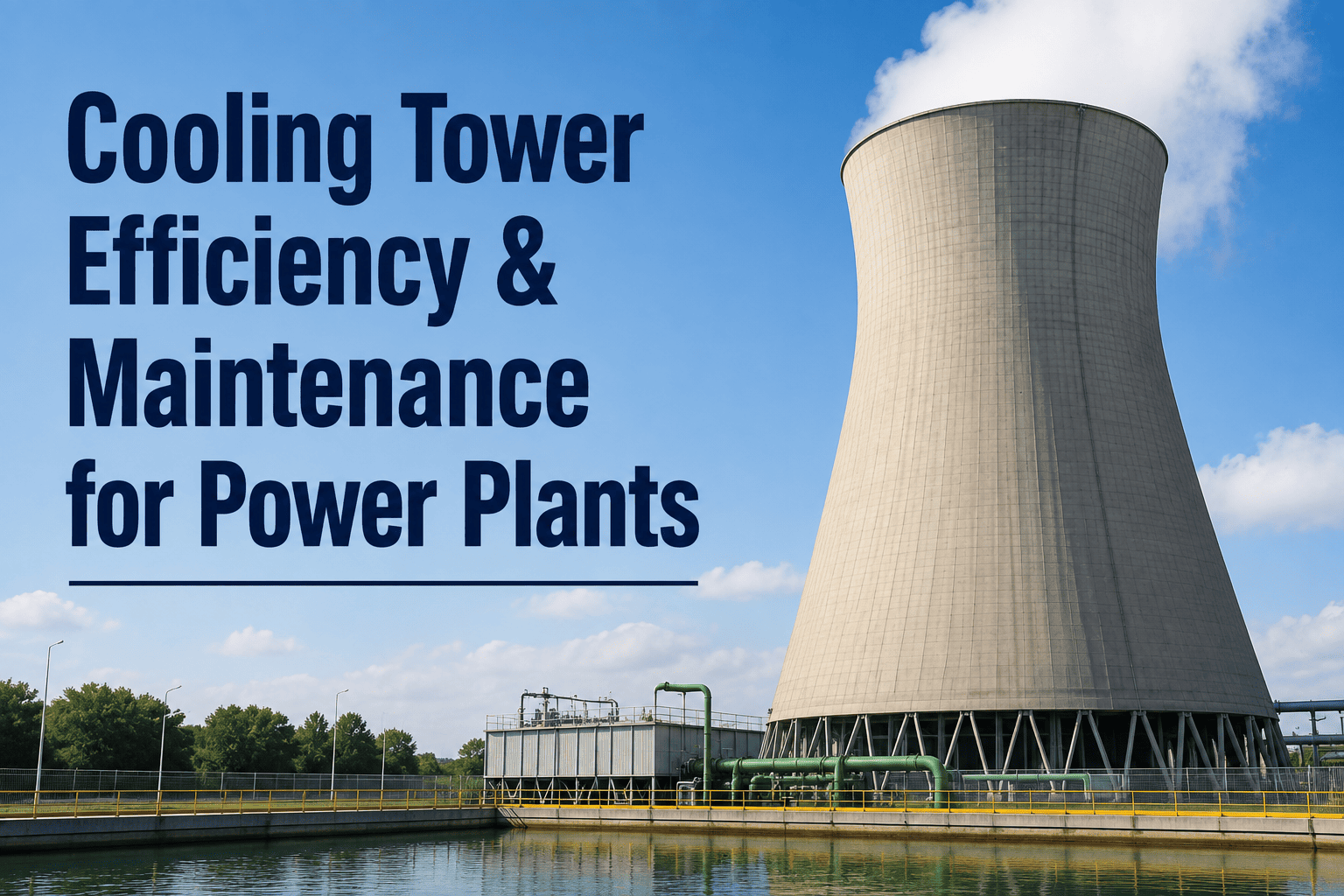
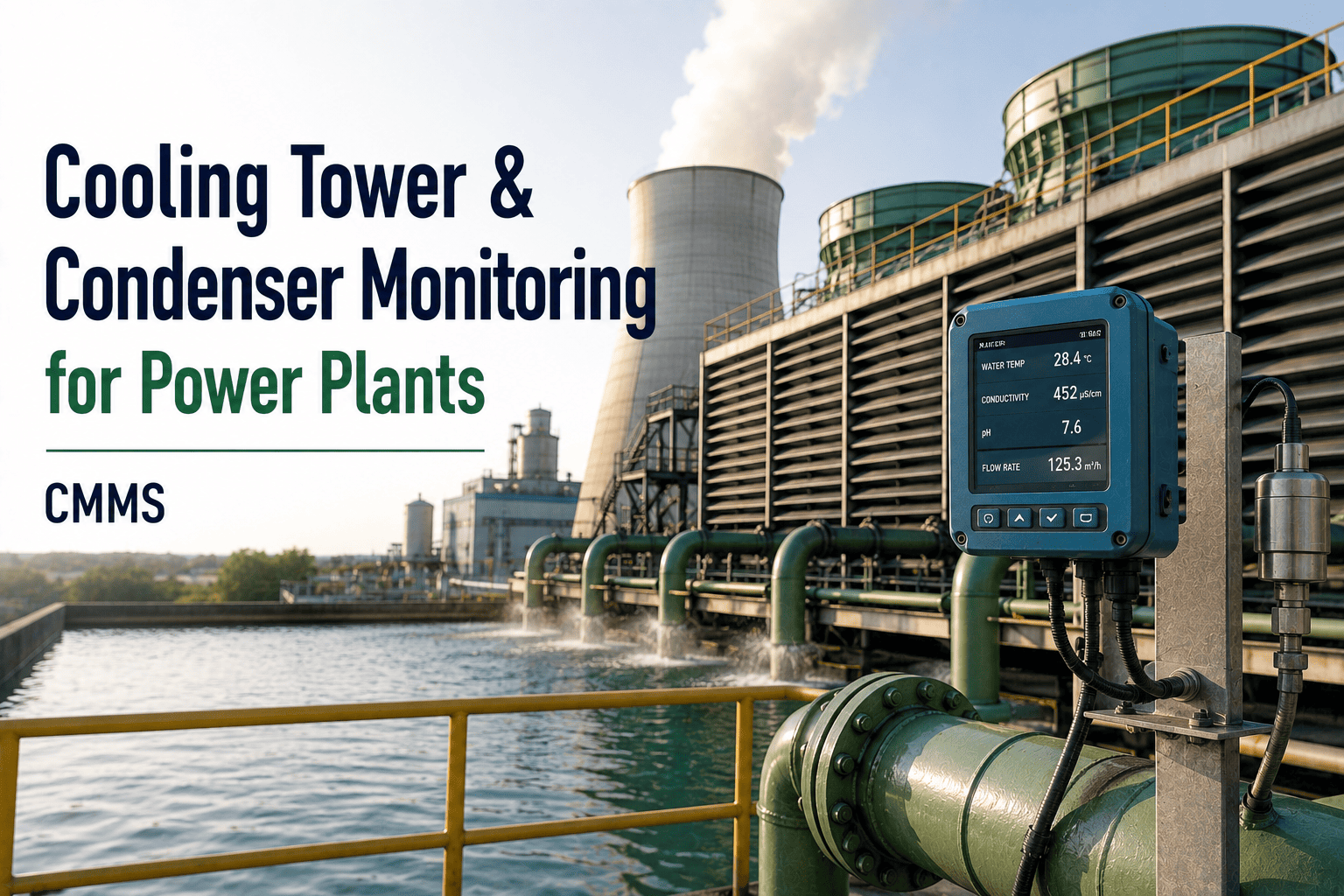
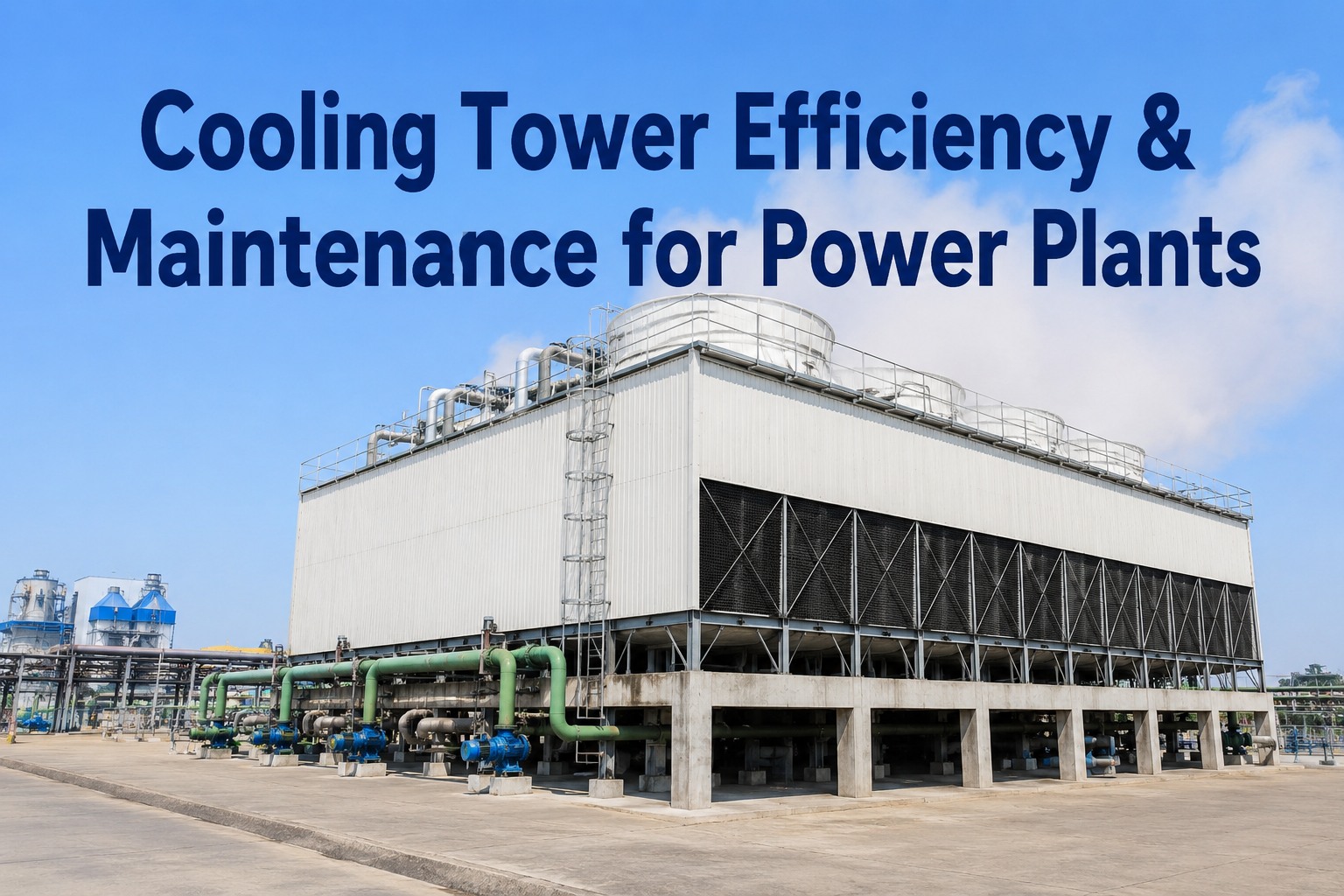
Cooling Tower Maintenance Management for Power Plants
By Willam Jerry on October 21, 2026
A power plant's cooling tower is where megawatts go to die — and a tower that is 2°F warm on the cold-water side is a tower that is quietly costing the plant 1-2% of its heat rate. Fouled fill, a drifted fan pitch, a scaled basin, a biogrowth bloom, a worn gearbox bearing — every one of these shows up at the condenser as warmer circulating water, lower vacuum and more coal, gas or fuel burned for the same MW out. This guide walks the cooling-tower maintenance program the way the plant lives it — anatomy, component cadence, water chemistry, cold-end performance and the live cell board. OXMAINT AI is the AI-powered power plant maintenance software that holds every cell, every PM cadence, every water-chemistry log and the cold-end performance trend on one record.
COOLING TOWER MAINTENANCE · POWER PLANTS · BALANCE OF PLANT · 2026
Cooling Tower Maintenance Management for Power Plants
One cell register, one PM cadence per component, one cold-end performance trend. OXMAINT AI runs the whole tower program — fan assembly, drift eliminators, fill, basin, pumps, nozzles — against the cold-end performance the plant cares about: approach and range.
Each component family has its own inspection cadence — too tight and the plant burns labor; too loose and tower performance falls away. The matrix below is a working baseline for a power-plant cooling tower; OXMAINT AI holds it as the default PM calendar.
Component
Daily
Weekly
Monthly
Quarterly
Annual
Fan motor & gearbox
Vib / amp
Oil level
Oil sample
Backlash
Teardown
Fan blades & hub
Visual
Erosion
Pitch check
Balance
Drift eliminators
Visual
Clean / fit
Replace sections
Nozzles & headers
Spray pattern
Nozzle check
Header pressure
Replace fouled
Fill / pack
Visual fouling
Clean / wash
Section replace
Circulating pumps
Vib / amp / ΔP
Seal check
Alignment
Impeller inspect
Teardown
Basin & structure
Debris sweep
Chem log
Scale / corrosion walk
Drain & clean
Water Chemistry — The Four Numbers The Loop Lives By
A cooling-tower loop is a chemistry problem. Four parameters cover almost every scaling, corrosion and biogrowth decision; everything else is a sub-metric of these.
01
Cycles of concentration
4 - 7
typical range
Ratio of circulating-water to make-up conductivity. Higher means less make-up and less blow-down, but also higher scaling tendency.
02
pH
7.5 - 9.0
typical range
Below 7.0 corrodes; above 9.5 scales. Automatic acid feed usually holds the window; manual sample confirms the probe reads true.
03
Conductivity
1500 - 4000 µS
cycle-driven
Proxy for total dissolved solids. The automatic blow-down controller works off this number; drift is a controller or probe fault.
04
Biocide residual
0.2 - 0.5 ppm
free chlorine
Below 0.2 ppm free-chlorine (or non-oxidizing-biocide equivalent) is where biogrowth starts; above 1.0 ppm corrodes stainless internals.
The Three Villains — Scale, Corrosion, Biogrowth
A fouled tower has one of three causes. Each shows up at the condenser the same way — warmer cold-water, higher back pressure — but the fix is different. OXMAINT AI pins the diagnosis to the inspection record so the next event starts from history.
Scale
Calcium / silica / phosphate
Chalky white or tan buildup on fill, nozzles, basin. Causes: cycles too high, pH too high, chemistry treatment imbalanced. Fix: acid or scale-inhibitor adjustment, cell wash on cadence.
Green sheen on wet surfaces, slime in basin, musty smell. Causes: biocide residual below threshold, dead zones, warm layup. Fix: biocide program, shock treatment, physical cleaning.
Cold-End Performance — Approach And Range
A cooling tower is paid in degrees. Two numbers tell the whole story. The plant cares about the trend of both, not the absolute values — a 2°F creep in approach over 90 days is money being wasted.
APPROACH
8.5°F
cold water − wet-bulb · design 7.0°F
The tower's distance from the thermodynamic limit. A rising approach means fill fouling, drift drift, or airflow issues.
+1.5°F above design · investigate
RANGE
18°F
hot in − cold out · design 20°F
The tower's duty — how much heat it is actually rejecting. A falling range means circulation or process-side change.
−2°F below design · investigate
Fan Assembly — The Highest-Risk Rotating Element
The induced-draft fan is where ISO 10816 severity thresholds matter the most. A tower fan failure is a cell outage and a safety event. The signature below is what the vibration record looks like on a healthy, aging and failing bearing.
INDUCED-DRAFT FAN · VIBRATION PER ISO 10816
A0 - 2.8 mm/s · good
B2.8 - 4.5 mm/s · acceptable
C4.5 - 7.1 mm/s · limited run
D> 7.1 mm/s · shutdown
1x
Unbalance — blade pitch drift, debris on blade, worn hub
2x
Misalignment — motor-gearbox coupling, drive-shaft fit
GMF
Gearbox tooth wear — gear-mesh frequency climbing over months
BPFI
Inner-race bearing fault — the 10-14 day early warning on seizure
Live Multi-Cell Board — What A Plant Operator Sees
A big power-plant tower is six to twelve cells. The live board shows every cell's airflow, water flow, approach and open WOs on one screen. OXMAINT AI renders it from the live sensor feed.
COOLING TOWER CELL BOARD · UNIT 2 · 15:00
8
cells on line
6
at target approach
2
creeping warm
1
fan vib > alert
Cell 2-04Fan vib 5.2 mm/s · BPFI rising 11 dP1 WO 61221 open
Cell 2-04 isolated 06:00 for fan bearing replacement · cold-end impact 0.3°F on CW out
A 2°F Warm Tower Burns Real Fuel. Every Day.
Cold-end performance is the first thing a tower program is paid for and the easiest to let slip. OXMAINT AI runs the component cadence, the water chemistry, the vibration record and the cold-end trend on one screen — so the 2°F creep gets investigated at week two, not reconciled at quarter-end.
Every cell as a parent asset with seven sub-assets — fan, drift, nozzles, fill, pumps, basin, structure — each with its own PM cadence.
Chemistry Policy
Four-parameter windows per unit; in-window hours tracked live; out-of-window raises a P2 WO automatically.
Cold-End Trend
Approach and range read daily, trended quarterly; a 2°F creep raises an investigation WO before quarter-end.
ISO 10816 Fan Watch
Band A/B/C/D tagged live per cell fan; Band C triggers planning, Band D triggers isolation.
Fouling Diagnosis Pin
Scale / corrosion / biogrowth tag pinned to the inspection record; next event starts from history, not from scratch.
Live Cell Board
6-12 cells on one screen with approach, flow, vibration band and open WOs — the operator sees the tower at a glance.
Frequently Asked Questions
How much heat rate hit does a warm tower really cost?
Rule of thumb: 1-2% heat rate for a 2°F creep in condenser cooling water temperature on a steam plant, with the exact number driven by condenser design and backpressure sensitivity. On a 500 MW unit that is a measurable fuel-cost line in a month.
Why does the matrix inspect fan vibration daily?
The induced-draft fan is a safety-critical rotating element above the fill. A seizure sends a 20-ton assembly into the pack. Daily vibration (or BMS trended continuous) catches the ISO Band C transition before it reaches Band D shutdown.
How often should fill be replaced?
Film-fill lifetime runs 10-15 years in good chemistry and 5-8 years in bad. Quarterly wash extends it; cell-level annual condition walk guides replacement planning. OXMAINT AI keeps the service history on the sub-asset so a cell-by-cell plan is possible.
What's the leading indicator for Legionella risk?
Biocide residual below the policy minimum (free chlorine < 0.2 ppm or non-oxidizing-biocide equivalent) for a sustained period, plus warm layup conditions. OXMAINT AI tracks the in-window hours KPI and raises an incident if the window is missed for a sustained period — the pattern that precedes a Legionella event.
Run Every Cell Against One Register.
Load the cooling-tower bank into the OXMAINT AI power plant maintenance software — cell anatomy, component PM cadence, chemistry policy, cold-end trend, ISO 10816 fan watch and the live cell board. The 2°F creep gets investigated at week two, every quarter.