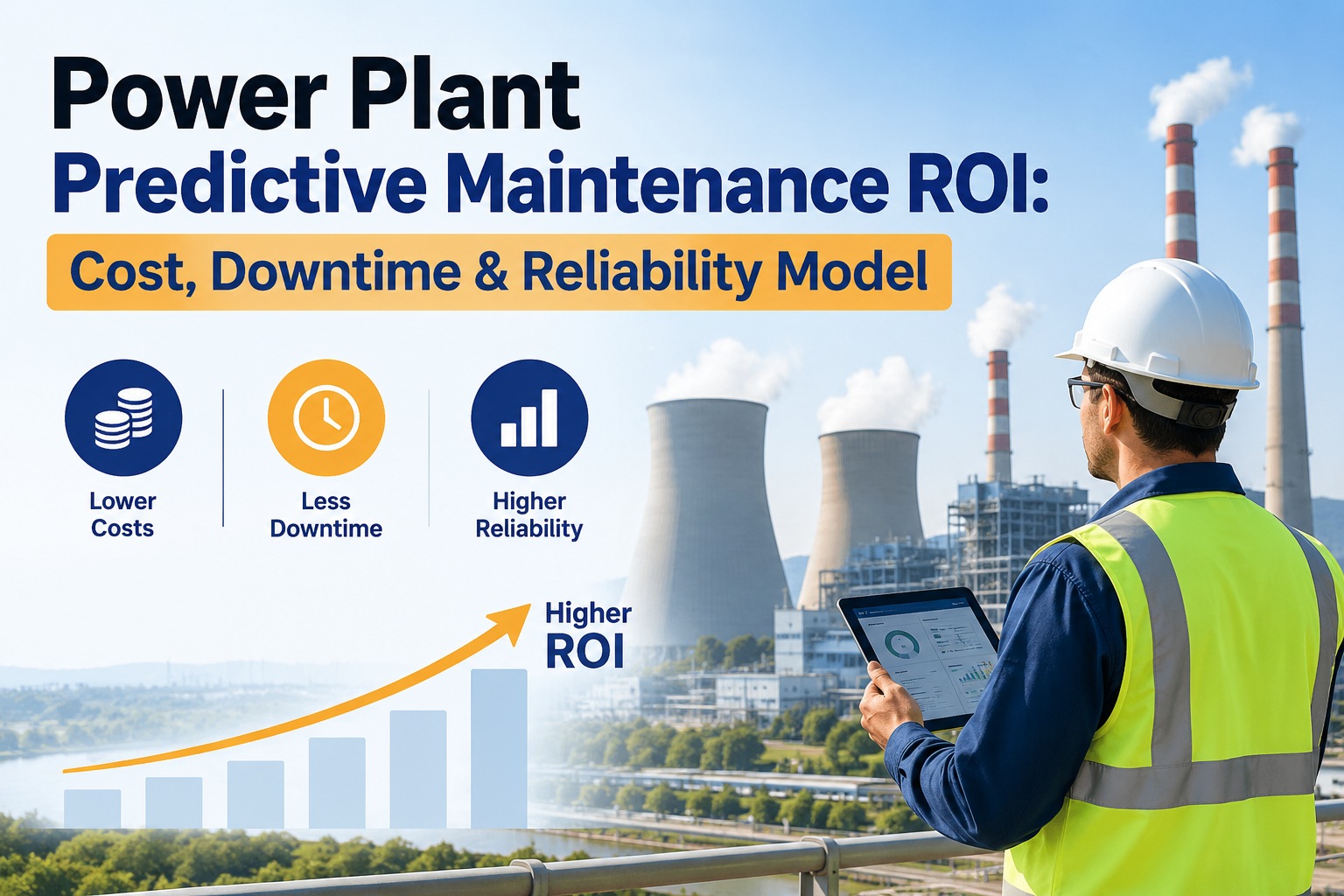
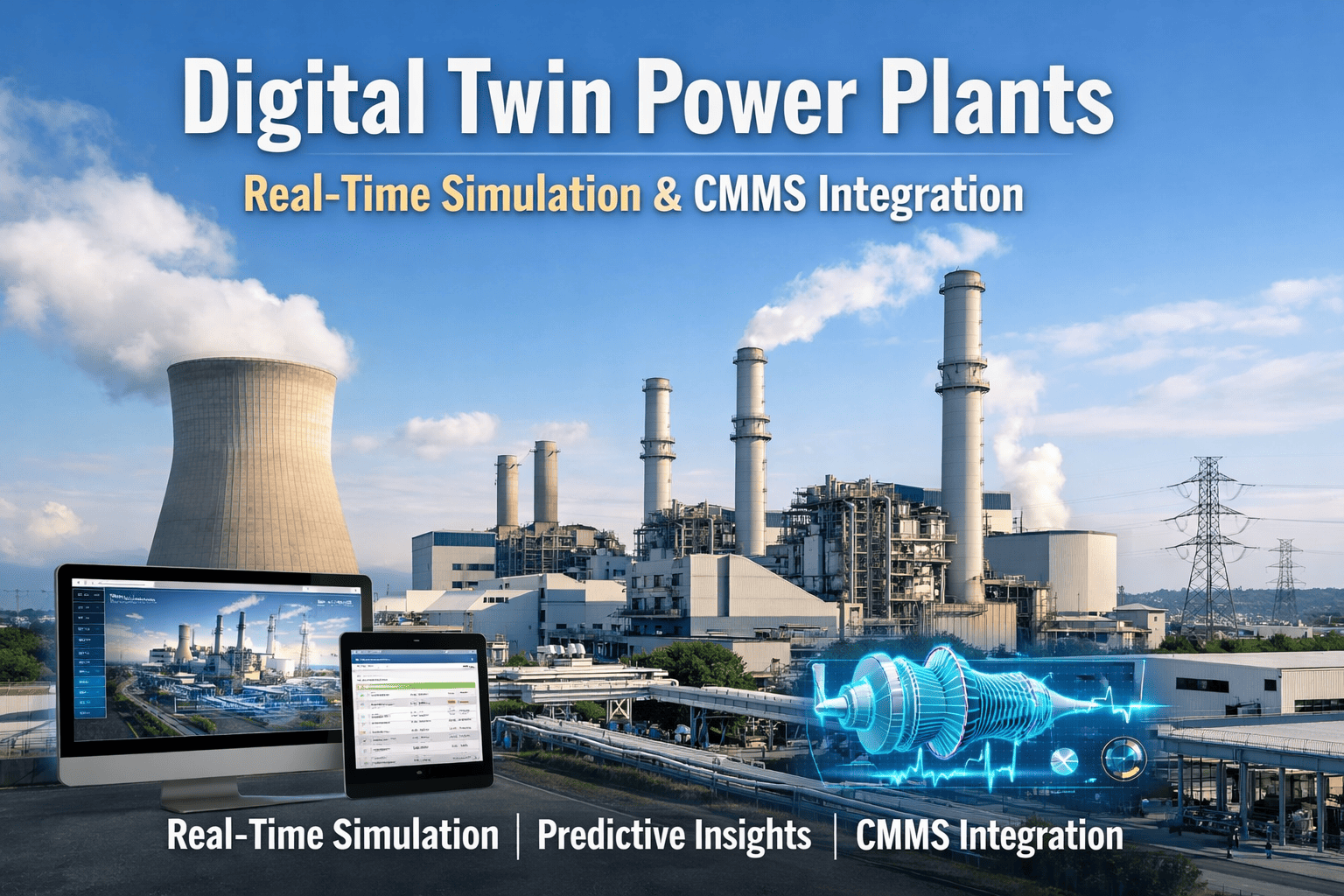
Every power plant manager knows the feeling — a turbine trips at 2 AM, replacement power costs stack up by the minute, and someone is asking why the maintenance log didn't catch this three weeks ago. Digital twin technology has fundamentally changed that equation. Plants deploying connected virtual replicas alongside their physical assets are reporting $1 million or more in annual savings through prevented failures, reduced maintenance costs, and faster troubleshooting. Sign in to OXmaint to connect your plant's digital twin data to work orders your team can act on immediately.
Annual Savings Potential
$1M – $4M+
per 500 MW combined-cycle plant with full digital twin + CMMS integration
22%
average annual ROI reported by companies implementing digital twin technology across 11 global industries
45%
reduction in asset downtime documented on Siemens cloud-based digital twin deployments
30%
drop in maintenance costs reported by plants shifting from reactive to digital twin-driven predictive maintenance
The Business Case
Why Power Plants Are the Highest-ROI Use Case for Digital Twins
The return on digital twin investment is not equal across industries. Power generation delivers the largest ROI for a simple reason: the consequences of failure are catastrophically expensive. A single forced outage on a 500 MW combined-cycle plant costs between $850,000 and $1.5 million in replacement power, capacity penalties, and emergency repair. Preventing two or three such events annually pays back a digital twin program entirely — with savings left over.
A 2024 survey of 660 executives across global industries found that digital twin adopters achieved an average 19% cost reduction and 22% annual ROI. In power generation, where asset replacement costs run into the tens of millions and regulatory penalties add another layer, those percentages translate into numbers that get board-level attention fast.
Where the $1M+ Actually Comes From: The ROI Breakdown
Plant managers and CFOs want specifics. Here is how digital twin savings accumulate across a typical 500 MW combined-cycle facility running 8,000 hours per year, sourced from documented industry deployments and NERC GADS reliability data.
2–3 prevented forced outage events annually at $850K avg cost per event. Digital twins deliver 4–8 weeks of advance warning on rotating equipment.
30% maintenance cost reduction by eliminating unnecessary scheduled inspections and focusing labor on condition-flagged assets only.
Real-time turbine performance monitoring catches 1–2% heat rate degradation before it compounds. Each 1% improvement saves ~$95K annually on fuel cost.
60% reduction in compliance documentation time for NERC GADS, NERC CIP, and EPA reporting. Eliminates manual log consolidation before audits.
8–15% machinery breakdown insurance premium reductions for facilities with digitally documented, structured maintenance programs and traceable asset records.
Total Annual Savings Range
$895K
—
$2.73M
per 500 MW combined-cycle facility
Typical Payback Period
6 – 14 months
Start Free — No Credit Card
Before vs. After: Life With and Without a Digital Twin
The difference is not just financial. It changes how every shift plays out — from what a control room operator sees at midnight to what a maintenance planner does on Monday morning.
Turbine fault at 11 PM. On-call tech guesses refrigerant vs. mechanical. Three hours of troubleshooting before root cause is found.
Maintenance follows a calendar. Inspections happen every 90 days regardless of load cycles, ambient conditions, or actual asset health.
HRSG failure after 11 months of warning signals that lived in three disconnected systems — DCS, spreadsheet, and handwritten logs.
NERC audit prep takes 3 weeks of pulling records from multiple sources, reconciling gaps, and formatting documentation manually.
Heat rate degradation goes undetected for months, quietly adding $30,000+ in unnecessary monthly fuel cost before anyone notices.
Same fault flagged 6 weeks earlier by digital twin vibration model. Work order already scheduled, parts staged, tech assigned before it becomes a crisis.
Inspections trigger on condition. A turbine running at high summer load gets an inspection when the twin says so — saving labor on healthy assets, catching degraded ones.
HRSG approach temperature rise detected at week 3, not month 11. Condition-triggered work order created in OXmaint before damage compounds.
NERC audit documentation generated automatically. Every xDT-triggered inspection creates a timestamped, signed digital record ready for regulator review.
Heat rate dashboard alerts at 0.5% efficiency drop. Maintenance triggered, cleaned, baseline restored — weeks before fuel cost impact reaches six figures.
Stop Calculating What Failures Cost. Start Calculating What You Save.
OXmaint connects digital twin condition data to automated work orders, compliance records, and performance trend analytics — turning real-time asset intelligence into measurable uptime and cost savings your finance team can see.
The Digital Twin ROI Timeline: What Happens in Year One
Most plants see measurable financial return within the first 6 months. Here is what a typical 500 MW facility experiences from deployment to full ROI realization.
Month 1 – 2
Baseline Establishment
Digital twin models calibrated against historical DCS data. OXmaint asset hierarchy configured. First condition-based PM triggers set. Teams trained on mobile work order workflow. Zero ROI yet — but the system is learning.
Month 3 – 4
First Detections Fire
Digital twin flags first anomalies — typically bearing degradation trends or efficiency deviations. Condition-triggered work orders execute in OXmaint. Maintenance team validates predictions against physical findings. First avoided failures begin accumulating.
Month 5 – 6
ROI Breakeven Point
Most plants cross breakeven here. Two to three prevented unplanned maintenance events, documented via OXmaint, demonstrate tangible savings. Insurance underwriter notified of structured digital program. Premium reduction discussions begin.
Month 7 – 12
Full Annual ROI Realized
Heat rate improvements documented. NERC audit completed in days rather than weeks. Maintenance labor optimized against actual condition data. Full annual savings between $895K and $2.73M documented against implementation cost. CFO presentation ready.
What the Data Says: Digital Twin ROI Across Power and Energy
92%
of companies using digital twins achieved returns exceeding 10%, with more than half reporting at least 20% ROI
Global Market Insights, 2024
$36M
annual savings potential per rig from a 20% reduction in unexpected stoppages — the documented result of digital twin deployment in the oil and gas sector
Astute Analytica via Hexagon, 2025
50%
downtime reduction achieved through digital twin predictive maintenance applications across energy and industrial sectors
Deloitte Study, cited 2024
35–50%
faster troubleshooting when digital twin models pre-diagnose failure modes, giving maintenance teams root cause context before they reach the asset
Industry deployment benchmarks, 2024
We built the ROI case for our board using three numbers: two prevented turbine trips at $850K each, a 31% reduction in scheduled maintenance labor hours, and an insurance premium drop of $480,000 annually. Total first-year documented savings came to $2.3 million against an implementation cost that paid back in eight months. The digital twin was not the hard sell — showing the finance team what a single prevented forced outage looks like on a P&L statement was.
— VP of Asset Management, 1.1 GW Multi-Plant Utility Portfolio, Mid-Atlantic United States
How OXmaint Turns Digital Twin Data Into Documented Savings
01
Capture Every Condition Trigger
When your digital twin model flags a degradation threshold, OXmaint creates a prioritized work order automatically — including asset ID, failure mode context, and recommended action pre-populated from the diagnostic output. No manual handoff. No alert that disappears into a dashboard nobody checks.
02
Match Work to Certified Technicians
OXmaint's skill matching engine routes digital twin-triggered work orders to the certified technician qualified for that specific asset and failure type. Turbine compressor overhauls require different credentials than HRSG tube inspections. The system enforces this automatically, preventing warranty voids and safety incidents.
03
Track Performance Trends Over Time
OXmaint dashboards chart kW output, heat rate, approach temperature, and vibration trends alongside work order history. When maintenance restores a turbine's efficiency, the improvement is captured and dated — giving you the documented correlation between maintenance actions and performance gains your CFO needs to see.
04
Generate Compliance Records Automatically
Every digital twin-triggered inspection generates a timestamped, digitally signed work order record. NERC GADS event logs, EPA Section 608 refrigerant inspection documentation, and insurance-required maintenance histories are built automatically as your team works — not assembled manually before each audit.
Frequently Asked Questions
How long does it take to see ROI from a digital twin program in a power plant?
Most power plants cross breakeven within 6 months of full deployment. The first prevented forced outage or major equipment failure typically covers a significant portion of the program cost on its own. Months 1–2 are baseline calibration and workflow setup. Months 3–4 yield the first condition detections and avoided failures. By month 6, most plants have documented enough prevented events and labor savings to demonstrate positive ROI. Full annual savings realization typically occurs between months 7 and 12.
Sign up for OXmaint to begin building your ROI baseline today.
What is a realistic annual savings figure for a 500 MW combined-cycle plant using digital twins?
Based on NERC GADS outage cost data and documented digital twin deployment results, a 500 MW combined-cycle plant can realistically expect annual savings of $895,000 to $2.73 million. This range reflects: 2–3 prevented forced outage events ($850K–$1.8M), a 30% reduction in maintenance labor cost ($180K–$420K), heat rate efficiency improvements ($95K–$280K), compliance documentation time savings ($60K–$120K), and 8–15% insurance premium reductions on machinery breakdown coverage ($40K–$112K).
What does "35–50% faster troubleshooting" actually mean in practice?
Without a digital twin, a technician arriving at a faulted asset starts from zero — visual inspection, pressure readings, system history review, and often a call to the OEM technical line before root cause is identified. With a digital twin, the CMMS work order already contains the model's pre-diagnosis: the specific sensor readings that triggered the alert, the likely failure mode based on physics-based simulation, and the component most likely requiring attention. That context cuts the diagnostic phase from 3–4 hours to under 90 minutes in most documented cases, which is the source of the 35–50% faster troubleshooting benchmark.
Can OXmaint receive digital twin alerts from any platform, not just Siemens?
Yes. OXmaint operates as an asset-agnostic CMMS platform that can receive condition-based triggers via API from any digital twin platform — including Siemens Xcelerator xDT, GE Vernova APM, AVEVA, AspenTech, and custom IIoT implementations. The platform also manages non-digital-twin assets on calendar-based or meter-based PM schedules in the same workspace, so your entire plant is visible regardless of which assets have connected virtual replicas.
Book a demo to see how multi-source integration works.
How do digital twins reduce insurance premiums for power plants?
Property and machinery breakdown insurers increasingly offer premium reductions of 8–15% for power generation facilities that can demonstrate structured, digitally documented maintenance programs with traceable inspection histories tied to specific asset condition events. A digital twin program that routes condition triggers through a CMMS like OXmaint creates exactly this kind of audit trail — timestamped work orders, inspection results, and repair outcomes linked to asset-level performance data. For a plant carrying $50 million in machinery breakdown coverage, an 8% premium reduction translates to $400,000 in annual savings alone.
What types of power plant assets benefit most from digital twin ROI?
The assets with the highest ROI from digital twin programs are those with the most expensive failure consequences: gas turbines ($2.4M+ per major failure), HRSGs and boilers ($28M+ for major tube failures), steam turbines ($1.8M+), and generators ($5M+). Cooling systems and balance-of-plant equipment show strong ROI through efficiency improvements and prevented chemical treatment failures. Assets with lower failure costs but high frequency issues — pumps, fans, control valves — also contribute meaningfully through cumulative labor savings and extended service intervals driven by condition-based scheduling.
Ready to Build Your ROI Case?
Your Plant's Digital Twin Is Already Generating the Data. OXmaint Makes It Pay.
Connect condition-based alerts to automated work orders, performance trend tracking, and compliance documentation — and start documenting the savings your digital twin program is already creating.