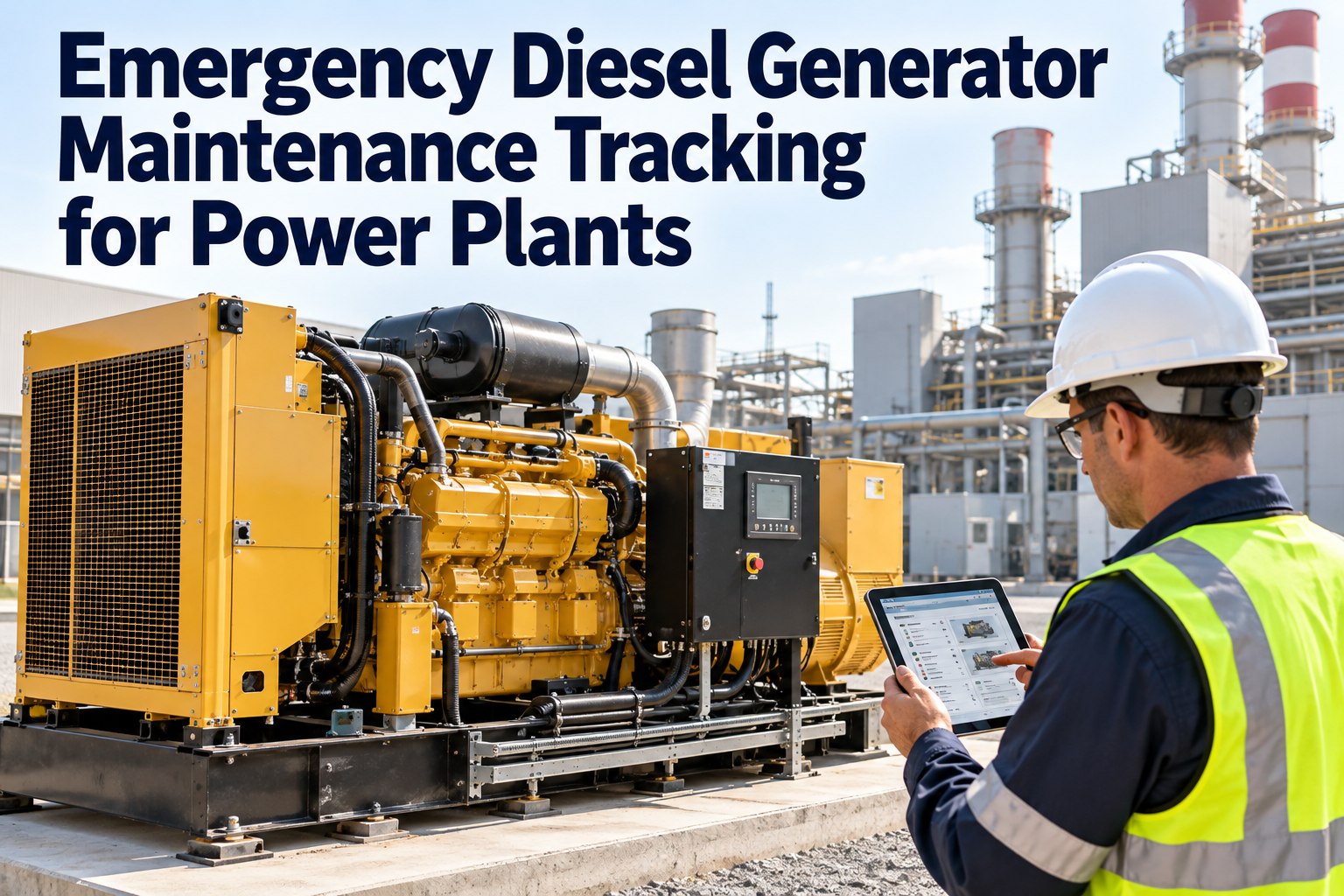
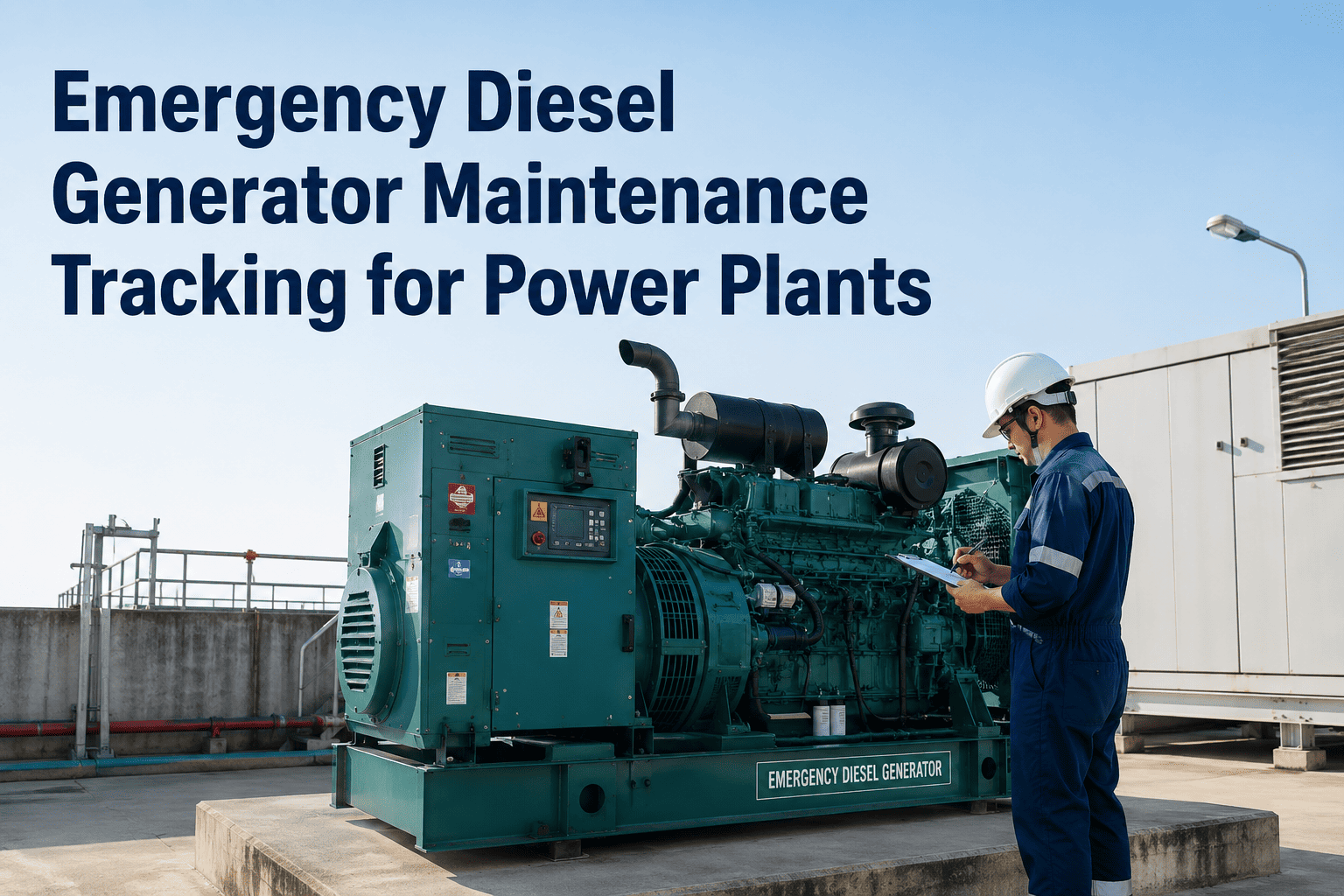
An emergency diesel generator sits silent for 99.9% of its life and then has 10 seconds to prove it works. When the grid falls, you don't get a second chance — you get a flat battery, a stuck air-start, a fuel line fouled with microbial growth, or a jacket-water heater that failed last winter and nobody logged. OXMAINT AI is the AI-powered CMMS and maintenance management software that tracks every EDG inspection, start test, fuel sample, battery reading and defect against NFPA 110, so your plant's backup power is readiness-rated the day you need it, not the day after.
EMERGENCY DIESEL GENERATOR · MAINTENANCE TRACKING · NFPA 110 ALIGNED 2026
Emergency Diesel Generator Maintenance Tracking for Power Plants
A missed monthly start test. A battery with a sagging specific gravity nobody logged. A fuel polishing cycle skipped two quarters running. Every EDG failure-to-start traces back to a maintenance record that didn't exist or a reading that nobody acted on. The OXMAINT AI maintenance management software holds every EDG's inspection cadence, test results, fuel samples, battery readings and defect history against NFPA 110 — one readiness scorecard per unit, one audit trail per plant.
BBattery
FFuel
AAir Start
CCooling
LLube
EControls
10 sec
from utility loss to EDG at rated voltage and frequency (NFPA 110 Level 1 Type 10)
Monthly
operational start test required under NFPA 110 — minimum 30 minutes at 30% rated load
Annual
load bank test at full rated load (2+ hours) when monthly runs don't hit the exercise band
#1
cause of EDG failure-to-start across EPRI studies: starting system (battery, cables, cranking)
The Readiness Scorecard: Six Subsystems, One Verdict
An EDG is only as ready as its weakest subsystem. One flat cell, one clogged fuel filter, one dry air-start receiver — and the unit fails to start regardless of how well the other five are maintained. OXMAINT AI rolls every reading from every inspection into one readiness scorecard per unit, so a plant engineer sees "ready / watch / blocked" at a glance across the whole backup fleet — schedule a walkthrough of the EDG scorecard in OXMAINT AI.
EDG-02 · 2500 kW standby · Last start 03 Oct 2026
COOCooling / jacket heater
95%Ready
LUBLubrication & sample
90%Ready
ELCControls & ATS
62%Overdue test
The 10-Second Start Sequence — What Has to Work Perfectly
When the grid falls, the sequence that follows is almost entirely automatic — and almost entirely dependent on preventive maintenance done months earlier. Every second has a subsystem behind it. OXMAINT AI holds the PM record that proves each one is current — the only honest answer to "is EDG-02 going to start when we need it".
T +0.0s
Utility Failure Detected
ATS senses loss of utility voltage/frequency; signals the EDG to start. Depends on ATS sensing circuits being tested and healthy.
T +1.0s
Starting System Engages
Battery cranks or air-start spins the engine. Depends on battery state-of-charge, cable terminations, or air-receiver pressure being within spec.
T +3.0s
Engine Fires & Builds Speed
Fuel reaches the injectors; jacket heater has kept the block warm; lubrication circulates. Depends on fuel quality, injector condition and lube system.
T +7.0s
Voltage & Frequency Stabilize
AVR brings terminal voltage to rated; governor settles frequency at 60 Hz. Depends on controls, excitation and governor being functionally tested.
T +10s
Load Transfer & Carry
ATS transfers the load; EDG picks up emergency bus; begins extended run. Depends on load bank test history proving the unit can hold rated load for hours.
Test Cadence Matrix: What NFPA 110 Expects
EDG readiness isn't maintained on inspiration — it is maintained on a documented cadence under NFPA 110. Monthly operational start tests, weekly inspections, semi-annual battery checks, annual load banks. OXMAINT AI holds the cadence per unit, auto-schedules the work orders, and blocks a unit from the "ready" list the moment a required test runs overdue.
Frequency
Test / Activity
What it verifies
Reference
Weekly
Visual inspection, leak check, panel-indicator walk
No fluid leaks, no fault lamps, heater energized, breaker in auto
NFPA 110 Ch. 8
Monthly
Operational start test, 30 min at ≥ 30% rated load
Engine starts, picks up load, holds voltage & frequency
NFPA 110 8.4.2
Monthly
Battery electrolyte, voltage, specific gravity (lead-acid)
Each cell within spec; connection integrity
IEEE 450 / NFPA 110 8.3.7
Quarterly
Fuel sample analysis — water, particulate, microbial
ASTM D975 compliance; no microbial growth; cleanliness
ASTM D975 / NFPA 110 8.3.6
Semi-annual
Battery load/conductance test; cable terminations
Capacity sufficient for 60s crank at design temp
IEEE 450
Annual
Load bank test — 2 hrs at full rated load
Unit holds full load; cooling & exhaust at rated
NFPA 110 8.4.2.3
Annual
Fuel polishing / tank cleaning as condition requires
Removes water, sediment, microbial sludge from stored fuel
NFPA 110 8.3.6
Triennial
Protective relay calibration, ATS maintenance
Breaker trip settings, ATS mechanism integrity
NFPA 110 Annex A
The Monthly Operational Start Test Checklist
The monthly start test is the single most important EDG readiness activity — and the one most often done without a repeatable checklist. This 10-point list walks the test from pre-check to log-and-reset. In OXMAINT AI, every box becomes a timestamped record against the unit, so the evidence chain for the next audit is already built.
Backup Power Is Only Backup When the Evidence Says It Is.
Clipboards get lost. Spreadsheets lie by omission. The OXMAINT AI maintenance management software holds every start test, every fuel sample, every battery reading and every open defect against the EDG itself — one scorecard, one audit trail, one honest answer when the grid falls.
The Readiness Evidence Locker: What Each EDG Must Carry
An EDG's readiness is not a feeling — it is a stack of six documented records any auditor, insurer or AHJ can ask for. If a plant can't produce them against a specific unit, the unit is officially not ready. OXMAINT AI holds all six per unit, with hard expiry rules on every one.
01 · START-TEST LOG
Monthly operational start-test records showing load, duration, start time, voltage and frequency stabilization — signed and timestamped.
02 · LOAD-BANK CERTIFICATE
Annual 2-hour full-load bank test certificate showing unit held rated load through cooling, exhaust and fuel loading cycles.
03 · FUEL SAMPLE REPORT
Quarterly fuel analysis against ASTM D975 — water, particulate, microbial contamination counts and polishing-cycle history.
04 · BATTERY RECORDS
IEEE 450 battery log — monthly voltage/SG readings, semi-annual conductance or load tests, replacement history per cell.
05 · LUBRICANT ANALYSIS
Oil sample results against OEM limits — viscosity, TBN, wear metals, fuel dilution, water — with trend history per unit.
06 · DEFECT & REPAIR HISTORY
Open defects, closed defects, parts replaced, root causes — the complete reliability record of the unit through its service life.
Six Failure Modes That Keep EDGs From Starting
Nearly every EDG failure-to-start sits in one of six categories. EPRI studies of nuclear and large commercial standby fleets consistently rank starting-system (battery, cables, cranking) first, followed by controls and fuel. OXMAINT AI maps each failure mode to the inspection and test that catches it — so the next failure is the one you prevented.
STARTING SYSTEM
Flat or sulphated battery, loose cable, corroded terminal, failed charger. Caught by monthly voltage/SG readings and semi-annual conductance tests.
CONTROLS / ATS
ATS sensing fault, failed relay, miscalibrated protective device, breaker in wrong position. Caught by triennial relay calibration and ATS maintenance.
FUEL CONTAMINATION
Water, particulate or microbial sludge in stored diesel plugging filters and starving injectors. Caught by quarterly sampling and polishing cadence.
COOLING / HEATER
Failed jacket-water heater leaves the block cold; thermostat sticks; coolant level low. Caught by weekly indicator walk and heater current check.
LUBRICATION
Low oil, degraded viscosity, water in oil, fuel dilution starving bearings on crank. Caught by lubricant analysis and pre-test oil-level check.
AIR SYSTEM
Air-start receiver below spec, isolation valve closed, air-dryer failed introducing water into the system. Caught by weekly receiver-pressure log.
How the OXMAINT AI Software Runs EDG Maintenance
The readiness scorecard, the test cadence, the monthly start-test checklist, the evidence locker and the failure-mode library are all features the OXMAINT AI maintenance management software was built to run across a plant's EDG fleet — spin up a free account and put your EDG fleet on OXMAINT AI.
Per-Unit Readiness Scorecard
Battery, fuel, air, cooling, lube and controls rolled into one live readiness score per EDG — a plant-wide view in one glance.
NFPA 110 Cadence Enforcement
Weekly, monthly, quarterly, semi-annual, annual and triennial tests auto-scheduled and flagged the moment they run overdue.
Mobile Start-Test Capture
The 10-point start-test checklist filed from a phone next to the unit — readings timestamped, defects raised in the same workflow.
Fuel & Oil Sample Register
Quarterly fuel reports and lube analysis attached to the unit, trended over time, with alerts on wear-metal and microbial threshold breach.
Battery IEEE 450 Log
Cell-by-cell voltage and specific gravity history, conductance test results, replacement cycle — the full IEEE 450 record in one place.
Audit-Ready Evidence Pack
Every record, test, sample, defect and repair retained — the readiness evidence locker is one search when the AHJ asks, not a scramble.
Frequently Asked Questions
What is the single most important EDG test under NFPA 110?
The monthly operational start test under NFPA 110 8.4.2 — the engine must start, pick up at least 30% of rated load, and run a minimum of 30 minutes. The OXMAINT AI software holds the test on cadence per unit and refuses to mark the EDG "ready" if the test runs overdue.
Start free and set up your monthly test cadence in OXMAINT AI.
Does a monthly start test satisfy the annual load bank requirement?
Only if the monthly runs cumulatively hit the required load exercise band. If the plant's monthly tests don't reach that threshold, NFPA 110 8.4.2.3 requires an annual 2-hour load bank test at full rated load — OXMAINT AI tracks the monthly load history and flags when a load bank is required.
How do we track diesel fuel quality in long-term storage?
Quarterly sampling against ASTM D975 with lab analysis for water, particulate and microbial contamination. OXMAINT AI holds the sample schedule per tank, attaches each lab report to the tank record, and alerts on threshold breaches that call for fuel polishing.
What's the single most common cause of EDG failure-to-start?
The starting system — across EPRI reliability studies of standby fleets, battery and cranking issues are consistently first, controls and fuel-system issues close behind. The readiness scorecard surfaces exactly these subsystems first.
How fast can we have EDG tracking running for our plant?
Most plants have the unit register, cadences and start-test checklist configured in OXMAINT AI within one to two weeks per site. Book a walkthrough and the OXMAINT AI team will scope the setup with you.
Know Your Backup Is Ready — Before the Grid Asks.
Put every EDG on the OXMAINT AI maintenance management software — one readiness scorecard per unit, NFPA 110 cadence auto-enforced, every start test, fuel sample, battery reading and defect retained as audit-ready evidence. The 10 seconds that matter are the ones you planned for months ago.