Electrostatic precipitators and baghouse fabric filters are the last line of defense before stack emissions — and their failure means regulatory violations, opacity exceedances, and forced load curtailment. Sign Up Free on OxMaint to track rapper sequences, TR set performance, bag differential pressure trends, and hopper evacuation schedules in one CMMS built for environmental control asset reliability.
The Emissions Stakes: Why These Systems Cannot Fail Silently
Under environmental regulations, continuous opacity monitoring data is transmitted to regulators in real time on most coal plants. An ESP or baghouse degradation event is not a "fix it next outage" situation — opacity exceedances trigger compliance notices within hours, and repeated violations lead to consent orders, financial penalties, and mandated load reductions. The maintenance program for these systems must treat performance degradation as an emergency, not a scheduled corrective.
Removes particulate by charging particles and collecting them on grounded plates. Collection efficiency of 99.5%+ when operating correctly. Sensitivity: TR set failure, rapper malfunction, and hopper overflows each cause measurable opacity spikes within minutes.
Captures particulate on woven or felted filter bags with collection efficiency exceeding 99.9%. Sensitivity: broken bags cause immediate opacity increases; high differential pressure reduces airflow and can trip ID fans or force plant derating if not controlled.
Most jurisdictions allow 6-minute average opacity exceedances above 20% for a maximum of 2% of operating hours before a Notice of Violation is issued. One significant equipment failure can exhaust a full quarter's compliance margin in a single shift.
ESP Maintenance: TR Sets, Rapper Systems, and Field Performance
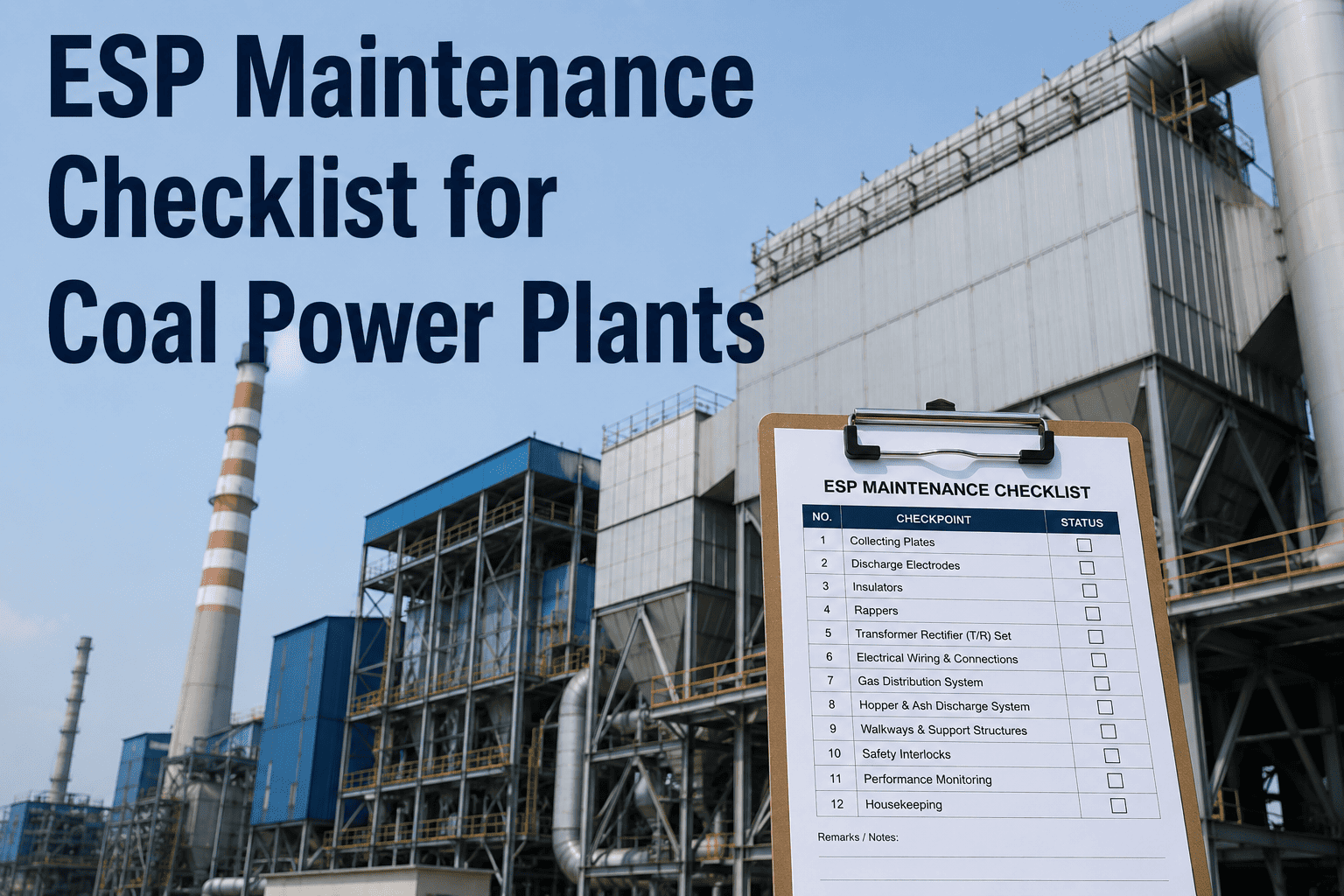
An ESP functions through the interaction of three maintainable subsystems: the high-voltage TR sets that charge particles, the rapper systems that dislodge collected dust from collecting and discharge electrodes, and the hopper evacuation system that removes collected ash. Degradation in any one subsystem reduces collection efficiency — often without immediate opacity impact until the degradation crosses a threshold.
TR sets (transformer-rectifier sets) are monitored by secondary voltage (kV) and secondary current (mA). The operating point on the V-I curve defines collection efficiency for that electrical section. Key failure modes and indicators:
| Symptom | Likely Cause | Action |
|---|---|---|
| High current, low voltage (sparking) | Electrode misalignment or broken wire | Physical inspection at next outage |
| Low current, low voltage (open circuit) | TR set primary failure or broken connection | TR set replacement or repair |
| Elevated spark rate | High-resistivity ash, back corona condition | Adjust pulse energization settings or add SO3 conditioning |
| Gradual kV decline over weeks | Electrode buildup, rapper failure in that section | Increase rapper intensity or frequency in that section |
Rapper systems (pneumatic or mechanical impact) dislodge accumulated dust from collecting plates and discharge electrodes. Poor rapper programs are the most common cause of gradual ESP efficiency loss. Key optimization parameters:
- Rapper frequency — more frequent rapping reduces buildup thickness but increases re-entrainment (dust blown back into gas stream). Optimize based on ash resistivity and gas velocity.
- Rapper intensity — insufficient impact fails to dislodge compacted dust; excessive impact causes electrode damage. Set per electrode geometry and ash properties.
- Sequential vs. simultaneous rapping — simultaneous rapping of multiple fields maximizes re-entrainment losses; sequential rapping is standard. Never rap inlet and outlet fields simultaneously.
- Rapping during load transients — inhibit rapping during load ramps to prevent opacity spikes when gas velocity is changing and re-entrained ash has higher carryover probability.
Hopper Management: The Maintenance Task That Causes the Most Forced Outages
Hopper ash accumulation and plugging is the leading cause of forced load reduction events in ESP-equipped coal plants. Hoppers that overflow push collected ash back into the gas stream, causing rapid opacity increases that cannot be corrected without load reduction or trip. A rigorous hopper maintenance program prevents these events through scheduled evacuation, level monitoring, and heater maintenance.
Install electromechanical or capacitance-type high-level alarms on all hoppers. Define alarm setpoints at 70% fill level with automatic work order generation in CMMS — giving the ash handling crew time to clear the hopper before overflow occurs. Log every alarm activation against the hopper asset record to track hoppers with abnormally high fill rates (indicating rapper or collection problems in that section).
Hopper heating elements maintain ash above the dew point to prevent ash cementing and hopper bridging. Heater failures are a primary cause of hopper pluggage in cold weather operations. Verify heater operation quarterly and perform full resistance testing annually. An unheated hopper on a humid day can bridge within hours and require mechanical breakout during operation — a high-risk confined space activity that is entirely preventable.
Rotary airlocks, screw conveyors, and pneumatic conveying systems feeding the ash silo require their own PM program independent of the ESP. Airlock blade wear, conveyor trough wear, and compressed air system issues upstream in the conveying network all cause hopper backup without any ESP fault present. These assets must be in CMMS with independent PM schedules — not bundled under the ESP asset record.
Baghouse Maintenance: Bag DP Management and Bag Failure Detection
Fabric filter maintenance centers on two measurable parameters: bag differential pressure (DP) across the filter media, and outlet opacity as an indicator of bag failure. Both require trending in CMMS to distinguish normal seasonal variation from degradation requiring intervention.
Bags are conditioning normally. Pulse-jet or reverse-air cleaning is maintaining filter media in target operating range. No action required beyond scheduled inspections.
Possible causes: reduced cleaning frequency, blinded bags, high inlet loading, or reduced gas temperature causing moisture absorption. Increase cleaning cycles, verify pulse pressure, check inlet conditions.
Immediate investigation required. Risks: ID fan derating, baghouse compartment bypass, structural bag damage from excessive vacuum. Bring offline for inspection if DP does not respond to increased cleaning within 2–4 hours.
Simultaneous DP decrease and opacity increase is the signature of broken bags. Identify the failing compartment by opacity correlation with compartment isolation valves. Take compartment offline for bag inspection and replacement.
Outage Inspection Checklist: ESP and Baghouse
| System | Inspection Item | Accept Criteria | Frequency |
|---|---|---|---|
| ESP | Collecting plate alignment and spacing | Spacing within ±3 mm of design across full plate height | Every major outage |
| ESP | Discharge electrode integrity (wire or rigid frame) | No broken wires, no visible erosion at support welds | Every major outage |
| ESP | Rapper impact verification (all rappers) | Audible impact on each rapper actuation; no silent units | Annual |
| ESP | TR set insulator cleaning and inspection | No tracking marks, no crazing, clean surface | Annual |
| ESP | Hopper evacuation component wear check | Airlock blades within 10% of new dimension; no visible casing erosion | Annual |
| Baghouse | Bag visual inspection (top and bottom 12") | No holes, no fabric delamination, no cage corrosion marks | Every 2–3 years or on bag life schedule |
| Baghouse | Pulse valve operation (all valves) | Correct actuation time, no stuck-open valves | Annual |
| Baghouse | Tubesheet condition | No cracks, no erosion at bag collar seats; sealing rings intact | Every 2–3 years |
| Baghouse | Inlet duct erosion check | Wall thickness within 80% of original in high-velocity zones | Every major outage |
Expert Review
The rapper program is the cheapest and most impactful maintenance lever on an ESP. I have seen plants recover 1.5 inHg of stack opacity margin just by rebuilding a rapper sequence that had degraded over years of ad-hoc adjustments. Get the TR set data trending in your CMMS and correlate it with rapper activation logs — the correlation between declining secondary voltage in a section and unresponsive rappers is almost always direct. Fix the rappers first before you blame the TR set.
Bag life is far more dependent on inlet temperature excursions and cleaning system maintenance than on flue gas particulate loading. I have seen bags last 8+ years in well-maintained systems and fail in under 2 years on plants with irregular pulse valve maintenance and acid dew point upsets. Log every temperature excursion below dew point as a maintenance event against the baghouse asset — they predict accelerated bag degradation 12 to 18 months before DP trends become visible.