Electrostatic precipitators are the emissions compliance backbone of coal-fired power plants — and one of the most complex mechanical-electrical systems that maintenance teams are expected to keep operational under continuous duty. When an ESP field trips offline or rapper systems fail, particulate emissions spike, opacity monitors alarm, and compliance timers start running. Regulators don't accept "under maintenance" as a defense for an opacity exceedance. OxMaint gives coal plant maintenance teams a structured digital inspection system for ESP fields, rappers, hoppers, and voltage control — turning reactive troubleshooting into proactive compliance management.
EPA MATS Rule
Filterable PM limit: 0.03 lb/MMBtu
Opacity Standard
6-minute average limit: 20% (most state permits)
Exceedance Risk
NOV potential if opacity exceeds limit during operation
COAL PLANT MAINTENANCE · INSPECTION MANAGEMENT
ESP Maintenance Is a Compliance Event — Not Just a Maintenance Event
Unlike most plant equipment, ESP degradation directly and immediately affects your permit status. A failed rapper zone, a tripped T-R set, or ash buildup on collection plates doesn't just reduce equipment efficiency — it puts your plant's operating permit at risk. OxMaint connects your ESP inspection findings directly to work order management, ensuring every compliance-critical finding gets tracked, escalated, and resolved before your next opacity monitor exceedance.
68%
of ESP opacity exceedances preceded by rapper system failures detected 2+ weeks earlier
4–6
ESP field sections required for full collection efficiency in a typical 4-field unit
$250K+
average EPA enforcement penalty for documented opacity non-compliance events
Understanding Your ESP — Four Systems That Require Structured Inspection
T-R Sets
Transformer-rectifier sets supply high-voltage DC to collection fields. Voltage and current trending identifies electrode degradation weeks before field failure.
Rapper Systems
Mechanical or electromagnetic rappers dislodge collected ash from electrodes and plates into hoppers. Failed rappers cause ash re-entrainment and opacity spikes within days.
Ash Hoppers
Ash hoppers collect dislodged particulate for conveyance to storage. Hopper pluggage or ash bridging causes backfilling into collection fields — a critical operational hazard.
Collection Plates
Grounded collection plates attract charged particulate. Plate alignment, ash buildup, and corona wire condition directly determine collection efficiency and specific collection area.
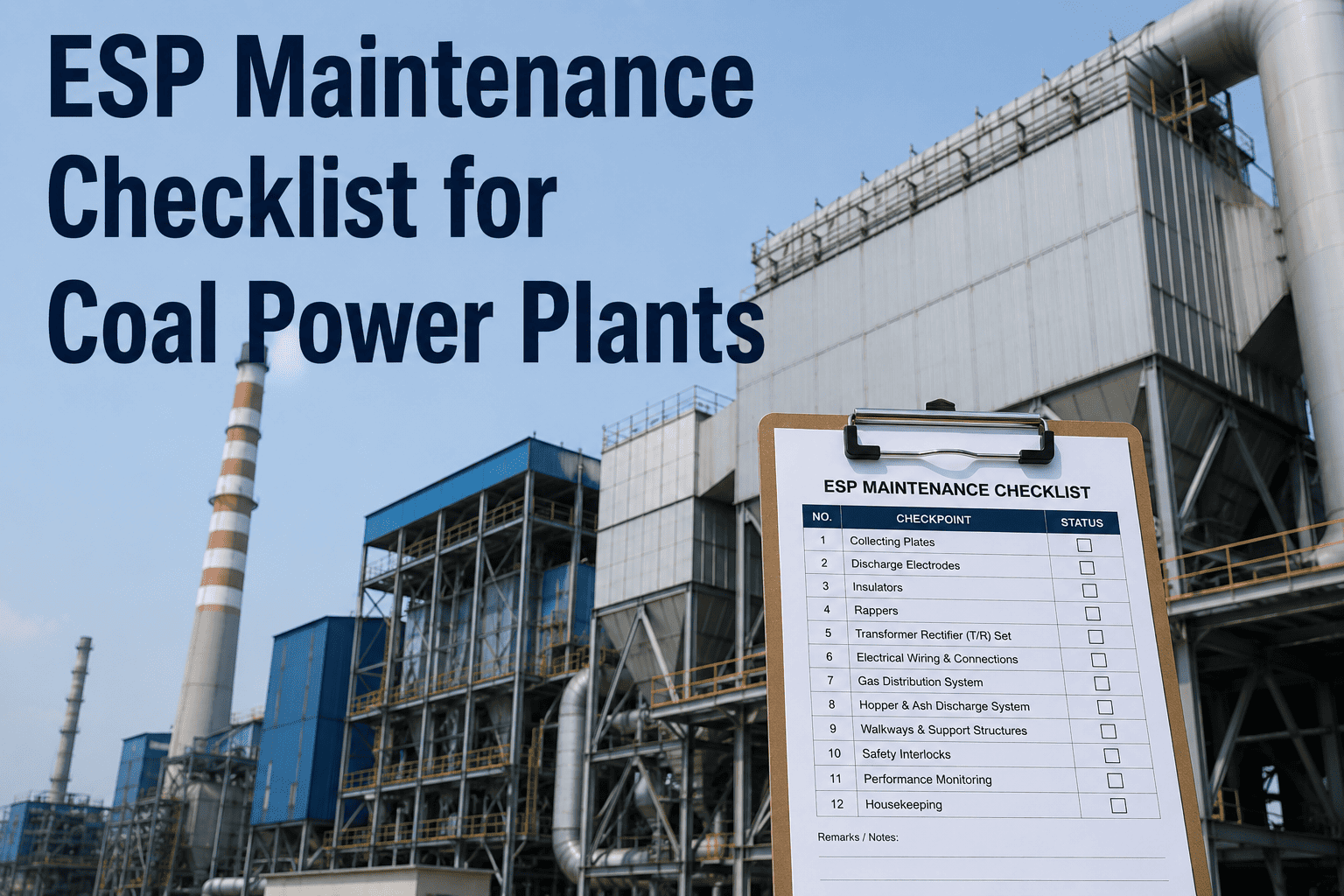
ESP Maintenance and Inspection Checklist
This checklist combines online monitoring checks with planned outage inspection tasks. The online checks should be completed on a weekly basis during continuous operation. Shutdown inspections are completed during planned forced outages or maintenance windows when the ESP is de-energized and cooled.
Electrostatic Precipitator (ESP) Inspection Checklist
Coal Plant
EPA MATS Compliance
OxMaint Integrated
ONLINE MONITORING CHECKS — Weekly During Operation
Record T-R set secondary voltage and current for each field — compare to baseline
Document secondary kV and mA for each field at similar load conditions. Trending reduction in secondary voltage indicates ash buildup on electrodes; increasing current with reduced voltage suggests internal arcing. Enter readings in OxMaint for automatic trending and threshold alerts on each T-R set asset.
ELECTRICAL
Verify rapper cycling sequence on all fields — check rapper controller indicators
Confirm rapper controller is cycling through all programmed zones. Individual rapper failures often show as a specific zone that never cycles. In OxMaint, log the rapper zone status for each field — a pattern of repeated zone failures in the same location indicates a rapper drive or electrode connection defect.
MECHANICAL
Check hopper temperature indicators — confirm ash is being discharged, not bridging
Hopper high-temperature alarms indicate ash bridging or conveyance failure. Cold hoppers with no discharge suggest a blocked rotary valve or plugged conveyance line. Any hopper with a high-temperature or no-discharge alarm requires an immediate corrective work order in OxMaint — hopper overflow into collection fields is a critical event.
OPERATIONS
Review CEMS and opacity monitor data — check for trending opacity increase
Pull CEMS opacity data for the past 7 days and compare to the prior week. A gradual upward trend in opacity is the earliest indication of ESP performance degradation. Log the opacity trend in OxMaint as an inspection finding and cross-reference with T-R set and rapper data to identify the contributing field or zone.
COMPLIANCE
SHUTDOWN INSPECTION TASKS — Each Planned Outage
Enter each field and inspect collection plates for ash buildup, warping, or damage
Walk each field section after confirming ESP is fully de-energized, grounded, and cooled. Inspect collection plates for excessive ash accumulation, physical warping from thermal stress, and spacing uniformity. Plate spacing deviation greater than 10% of design spec creates corona discharge non-uniformity. Photograph and log findings in OxMaint with field and section reference.
MECHANICAL
Inspect corona discharge wires or rigid discharge electrodes for breakage and fouling
Broken corona wires are one of the most common causes of sudden field performance loss. Walk each discharge electrode row and inspect for wire breaks, sagging, or anchor failure. For rigid frame ESP, check electrode alignment and surface condition. Flag all broken or displaced electrodes as corrective work orders in OxMaint for repair during the current outage.
ELECTRICAL
Inspect rapper drive mechanisms — check impact force, stroke, and mounting integrity
With ESP cooled, manually verify rapper impact on each row. Check rapper mounting bolts for looseness, rapper head for wear, and drive mechanism for proper stroke length. Weak or misfiring rappers leave ash on collection surfaces, reducing efficiency progressively. Replace worn rapper heads and tighten mountings during outage; document all replacements in OxMaint.
MECHANICAL
Inspect hopper walls, valves, and discharge systems for ash bridging residue or damage
Inspect each hopper interior for ash bridging patterns, wall buildup, and structural integrity. Check rotary valves and slide gates for wear or jam damage. Inspect conveying system connections for air in-leakage points. Hopper inspection findings are logged in OxMaint linked to the specific hopper asset record for trending across multiple outages.
MECHANICAL
Inspect ESP casing insulator compartments — check for ash tracking or moisture ingress
Discharge electrode frames are supported on high-voltage insulators housed in heated compartments. Inspect each insulator for ash tracking, moisture staining, or physical cracking. A tracked insulator causes leakage current that degrades field performance and may cause T-R set sparking. Replace any damaged insulators before re-energization.
ELECTRICAL
Perform T-R set electrical inspection — check rectifier diodes, transformer oil, and connections
With T-R set de-energized, inspect transformer oil level and dielectric strength if sampling is due. Check all high-voltage cable connections for heating damage or tracking. Verify rectifier diode condition. Log T-R set inspection findings in OxMaint and compare to previous outage findings to identify accelerating degradation trends.
ELECTRICAL
RE-ENERGIZATION AND CLOSEOUT
Perform pre-energization walkthrough — confirm all personnel clear and grounding removed
Before issuing energization clearance, confirm all personnel have exited ESP casing, all access hatches are secured, and all safety grounding cables are removed. Issue clearance in OxMaint — the work order closeout checklist requires energization clearance sign-off before re-energization status is set.
SAFETY
Re-energize fields in sequence and record initial voltage and current — compare to pre-outage baseline
Re-energize one field at a time, recording secondary voltage and current at stabilized conditions. Compare to pre-outage T-R set readings and to the post-inspection baseline in OxMaint. Confirm opacity monitor shows expected improvement within 30 minutes of full ESP re-energization at unit load.
ELECTRICAL
ESP Performance — Key Metrics to Track in Your CMMS
| Performance Parameter |
Measurement Frequency |
Degradation Indicator |
Action Trigger |
| Field secondary voltage (kV) |
Weekly during operation |
Declining trend vs. baseline |
Decrease greater than 15% — inspect electrodes |
| Field secondary current (mA) |
Weekly during operation |
Abnormal sparking rate |
Sparking rate exceeding 50/min — check spacing |
| Stack opacity reading |
Continuous (CEMS) |
Upward weekly trend |
Approaching 15% — accelerate rapper checks |
| Hopper discharge temperature |
Daily during operation |
Sustained elevation or cold hopper |
High temp alarm — immediate corrective WO |
| Rapper zone completion rate |
Weekly controller log review |
Zones consistently not cycling |
More than 2 zones failed — rapper inspection |
PLANT MAINTENANCE DIRECTOR
David Okafor
Coal Plant Maintenance Director — 24 Years Power Plant Operations
We used to run our ESP like a black box — when opacity alarmed, we went looking for problems. Moving to weekly T-R set voltage and current trending in OxMaint changed our entire approach. We can now see a field degrading over three or four weeks before it affects our CEMS reading. We schedule a rapper inspection at the next weekend window instead of scrambling during a violation event. The compliance story to our state regulator is also completely different — we walk in with trend charts instead of violation reports.
COAL PLANT COMPLIANCE TEAMS
Turn Your ESP From a Compliance Risk Into a Compliance Asset
OxMaint gives your coal plant maintenance team structured ESP inspection workflows, T-R set and rapper performance trending, and automatic work order escalation — so opacity exceedances become the exception, not the expectation.
Frequently Asked Questions
Can OxMaint generate an ESP field-level performance report for EPA or state agency compliance documentation?
Yes. OxMaint's reporting module can generate ESP maintenance activity reports showing inspection dates, T-R set readings, rapper status, corrective actions, and technician sign-offs organized by field, unit, and date range. These reports provide the documentation trail required to demonstrate due diligence in maintenance programs during state or EPA compliance reviews.
Sign up free to configure your ESP asset structure and reporting parameters.
How does OxMaint handle priority escalation when ESP performance drops toward an opacity limit?
OxMaint allows maintenance managers to configure threshold-based work order escalation rules. When a T-R set reading or opacity inspection finding crosses a predefined threshold, OxMaint automatically upgrades the work order priority, notifies the maintenance supervisor and plant manager, and sets a response time target. This ensures compliance-critical ESP findings get management visibility immediately.
Book a demo to see the escalation workflow configured for an ESP asset.
Does OxMaint support confined space entry permits for ESP internal inspection tasks?
Yes. OxMaint's work order system includes permit-to-work functionality that links confined space entry permits directly to the inspection work order. Technicians cannot sign off on an internal ESP inspection work order without completing the confined space permit steps. This creates a documented safety authorization trail for every internal entry.
Sign up free to configure permit-to-work for your ESP inspection workflow.
Can we trend T-R set performance data across multiple outage cycles in OxMaint?
Yes. OxMaint stores T-R set secondary voltage and current readings as structured performance data tied to the asset record. Your maintenance engineers can view trends across every inspection cycle — identifying which fields are degrading, which rappers are failing repeatedly, and which ESP sections need capital investment. This data also supports CapEx justification for T-R set replacements or electrode rehabilitation.
How do we manage ESP inspection work orders during forced outages versus planned maintenance windows?
OxMaint differentiates between planned PM work orders (scheduled in advance with full resource planning) and emergency/forced outage work orders (created reactively with expedited assignment). During a forced outage, maintenance planners can pull the complete list of outstanding ESP corrective and PM work orders scoped for the next outage and batch-assign them to available resources in one workflow.
Book a demo to walk through the forced outage work management workflow.