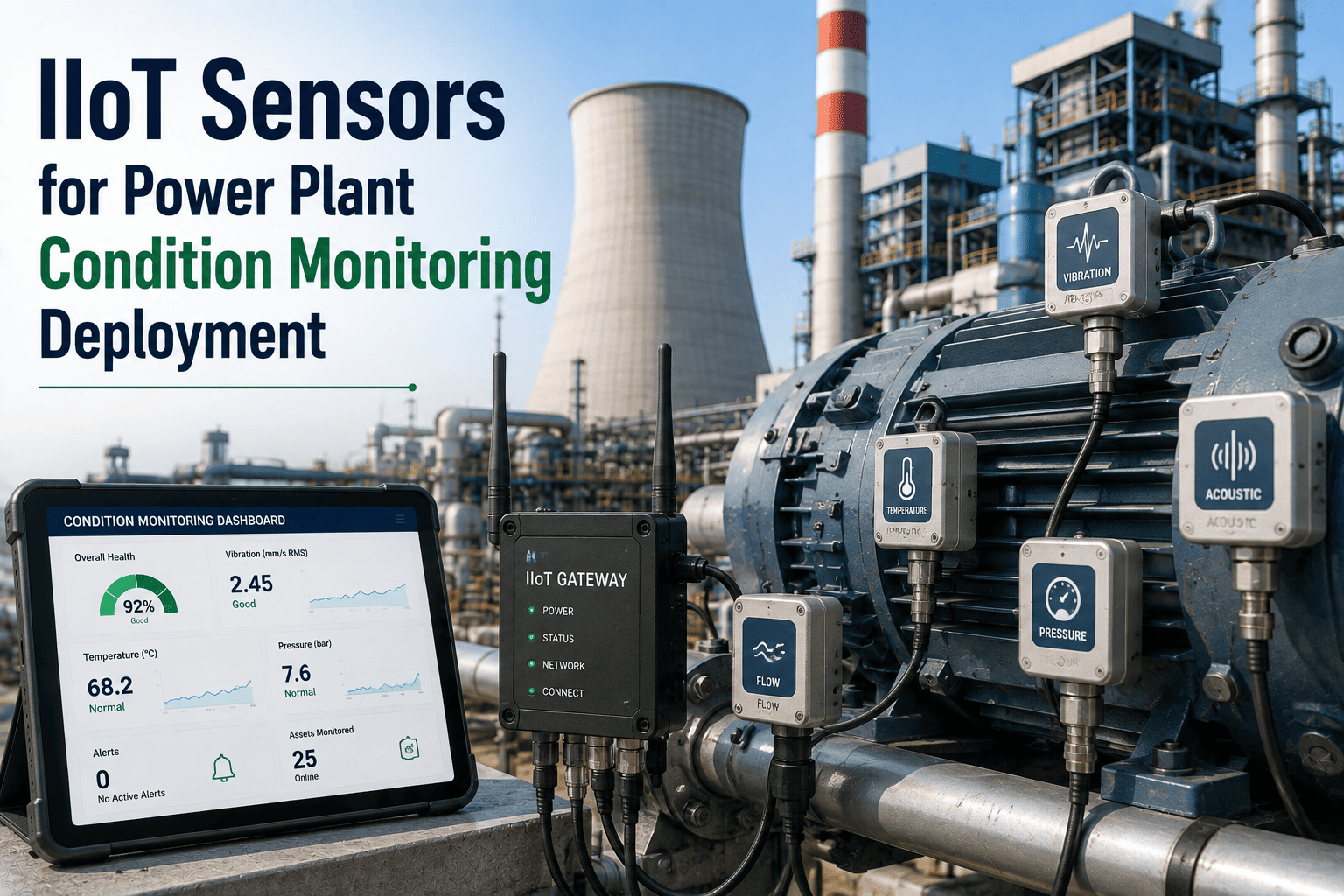
Power plants that still rely on manual rounds to check equipment health are flying blind between inspections — and most critical failures develop in the hours or days between those rounds. IIoT sensors integrated with maintenance software close that visibility gap permanently: continuous vibration, temperature, and pressure readings stream directly into your maintenance platform, triggering automated work orders before a fault becomes a failure. If your plant is still depending on technician walkarounds to catch equipment problems, book a demo to see how connected sensor data automates condition monitoring across every critical asset.
70%
of equipment failures occur between scheduled manual inspections
$260B
lost globally each year to unplanned industrial downtime
40%
reduction in maintenance costs with IIoT-driven predictive programs
9×
faster fault detection vs. manual inspection cycles
What IIoT Condition Monitoring Actually Does in a Power Plant
Industrial IoT (IIoT) condition monitoring is the practice of placing connected sensors directly on or near critical equipment — turbines, pumps, motors, transformers, compressors — and streaming real-time health data into a central platform that analyzes trends, detects anomalies, and automatically initiates maintenance responses. The goal is not to generate more data. The goal is to replace the uncertainty between manual inspection rounds with continuous, actionable equipment intelligence.
How IIoT Condition Monitoring Works — End to End
1
Sensor Measures
Vibration, temperature, pressure, current, or ultrasonic readings captured continuously at the asset — every second, not every month.
→
2
Gateway Transmits
Readings sent via wireless protocol (LoRaWAN, Wi-Fi, 4G/LTE) to a local or cloud gateway — no manual data collection required.
→
3
Platform Analyzes
Maintenance platform applies baseline thresholds and trend models to identify anomalies — distinguishing normal operating variation from developing faults.
→
4
Alert Triggers
When a threshold is breached, an automated work order is created and assigned — with the asset ID, fault type, sensor reading, and timestamp already populated.
→
5
Team Responds
Maintenance crew receives a prioritized, context-rich task on mobile — not an alarm flood — and resolves the issue before failure propagates.
IIoT Sensor Types Used in Power Plant Condition Monitoring
Not all plant assets need the same type of monitoring. Sensor selection depends on the failure mode you are trying to detect, the installation environment, and the data transmission requirements. Here are the six primary sensor types deployed in power generation facilities.
01 — Most Widely Deployed
Vibration Sensors
Rotating machinery: turbines, pumps, fans, motors, compressors
Detects:
Bearing wear · imbalance · misalignment · looseness · resonance
The single highest-ROI sensor category in power generation. Bearing faults detected 2–8 weeks before failure, enabling planned replacement vs. emergency repair.
02
Temperature Sensors
Transformers, bearings, cable terminations, generator windings, cooling systems
Detects:
Overheating · insulation breakdown · cooling loss · contact degradation
Transformer winding temperature is a leading indicator of insulation life. Continuous monitoring extends transformer service life by 3–5 years on average.
03
Pressure Sensors
Boilers, steam lines, hydraulic systems, lube oil circuits, cooling water
Detects:
Blockages · leaks · pump degradation · valve failure · system fouling
Differential pressure trending across heat exchangers and filters reveals fouling buildup weeks before flow restriction triggers a process trip.
04
Current & Power Sensors
Motors, variable frequency drives, MV/LV switchgear, breakers
Detects:
Motor degradation · increased load · rotor bar faults · efficiency loss
Motor current signature analysis (MCSA) detects developing rotor and stator faults without physical access — critical for motors in hazardous or confined spaces.
05
Ultrasonic Sensors
Valves, steam traps, pipework, compressed air systems, electrical cabinets
Detects:
Internal leakage · partial discharge · steam trap failure · compressed air loss
A single failed steam trap wastes $5,000–$25,000 per year in energy. Continuous ultrasonic monitoring identifies trap failures within hours of onset.
06
Oil Quality Sensors
Turbine lube systems, gearboxes, transformers, hydraulic power units
Detects:
Contamination · moisture ingress · particle count rise · viscosity change
Online oil quality sensors replace fixed-interval oil sampling with continuous monitoring, reducing oil-related gearbox failures by up to 60% and cutting unnecessary oil changes.
Connect Your Plant Sensors to Automated Maintenance Workflows
Oxmaint integrates with IIoT sensor data feeds to automatically generate condition-based work orders, assign them to field crews, and close the loop from sensor alert to verified resolution — all without manual intervention.
Sensor Deployment by Power Plant Asset Class
Effective IIoT deployment is not about instrucing every pipe and bolt — it is about placing the right sensors on the assets where early warning delivers the highest return. The table below maps priority assets to recommended sensor configurations based on failure mode criticality and monitoring ROI.
| Asset |
Recommended Sensors |
Key Fault Detected |
Lead Time Gained |
Avoided Cost |
| Steam / Gas Turbine |
Vibration (shaft & bearing) + temperature + oil quality |
Bearing degradation, rotor imbalance |
2–8 weeks |
$800K–$2M per event |
| Boiler Feed Pumps |
Vibration + pressure differential + temperature |
Cavitation, seal wear, impeller erosion |
1–4 weeks |
$120K–$400K per event |
| Power Transformers |
Temperature + oil quality + partial discharge (ultrasonic) |
Insulation breakdown, winding hotspot |
3–12 weeks |
$500K–$3M per unit |
| Cooling Tower Fans |
Vibration + current + temperature |
Blade imbalance, gearbox wear, motor fault |
2–6 weeks |
$80K–$250K per event |
| Air Compressors |
Vibration + pressure + temperature + current |
Valve failure, bearing wear, overheating |
1–3 weeks |
$50K–$180K per event |
| Generator Stator |
Temperature (winding) + partial discharge + vibration |
Insulation aging, end-winding looseness |
4–16 weeks |
$1M–$5M per rewind |
| HV Switchgear |
Temperature (IR) + partial discharge (ultrasonic) |
Contact overheating, insulation failure |
2–8 weeks |
$200K–$800K per event |
| Steam Traps |
Ultrasonic + temperature |
Internal bypass failure, blockage |
Hours to days |
$5K–$25K per trap/year |
Manual Inspection vs. IIoT Condition Monitoring — The Real Difference
Manual Inspection Rounds
Equipment checked once per shift or once per week — faults develop undetected between rounds
Technician availability limits inspection frequency — nights, weekends, and remote areas go unchecked
Subjective observations — different technicians assess the same equipment differently with no baseline
Paper or tablet data entry delays analysis — by the time a trend is identified, the window for early intervention has closed
No early warning for developing faults — failure is often the first indication that something was wrong
High labor cost per data point — skilled technician time spent on data collection rather than repairs
IIoT Condition Monitoring
Continuous 24/7 monitoring — anomalies detected within seconds or minutes of onset, regardless of time or location
No dependency on technician availability — sensors monitor remote, hazardous, and confined-space assets without physical access
Objective digital measurements against established baselines — consistent, comparable data across every asset and every shift
Real-time trend analysis — platform identifies developing faults 2–8 weeks before failure, enabling planned maintenance windows
Automated work order generation — maintenance crew receives a prioritized task with full context before the fault escalates
Technician time redirected to high-value interventions — data collection automated, skilled hours used for actual maintenance
Integrating IIoT Sensors with Your Maintenance Management Platform
Sensors alone do not reduce downtime. The business value of IIoT condition monitoring is only realized when sensor data is connected to a maintenance workflow platform that can act on it automatically — creating work orders, assigning crews, tracking resolution, and logging outcomes for compliance and analysis.
Step 01
Sensor Data Ingestion
Oxmaint accepts sensor data via standard APIs, MQTT, Modbus, or direct integration with popular IIoT gateways. Existing historian data from DCS and SCADA systems can also be piped in — no new hardware required for already-instrumented assets.
Step 02
Threshold & Baseline Configuration
Per-asset alert thresholds are configured based on OEM specifications, ISO standards, or learned operating baselines. Thresholds can be tiered — advisory, warning, and critical — each triggering a different priority work order level and escalation path.
Step 03
Automated Work Order Creation
When sensor data breaches a configured threshold, Oxmaint automatically creates a condition-based work order — pre-populated with the asset ID, fault description, sensor reading, timestamp, and recommended action — and routes it to the assigned crew or supervisor for immediate action.
Step 04
Mobile Field Execution
Field technicians receive and complete condition-based work orders on mobile — capturing inspection findings, photos, and corrective actions with GPS confirmation. Offline capability ensures no data loss in areas without network coverage, common in large generation facilities.
Step 05
Trend Tracking & Reporting
Completed work orders feed back into asset history alongside sensor trends — building a continuous health record for every monitored asset. Compliance dashboards show inspection frequency, sensor-triggered interventions, and fault resolution times for NERC, OSHA, and ISO audit requirements.
Result
Closed-Loop Condition-Based Maintenance
From sensor alert to field resolution to compliance record — fully automated, fully documented, and continuously improving as the platform learns each asset's normal operating signature. No manual hand-offs. No data gaps. No missed interventions.
The Business Case: What IIoT Monitoring Delivers in Numbers
40%
Maintenance Cost Reduction
Condition-based interventions replace fixed-interval PM — eliminating unnecessary maintenance on healthy assets while catching real degradation early.
35%
Reduction in Unplanned Downtime
Early fault detection gives maintenance teams lead time to schedule repairs during planned outage windows — not during forced generation curtailments.
25%
Increase in Asset Availability
Fewer forced outages and shorter planned outage durations (because the fault is known in advance) directly translate to higher capacity factor and generation revenue.
60%
Fewer Emergency Repair Events
Emergency repairs cost 3–5× more than planned repairs for the same fault — plus expedited parts, overtime labor, and collateral damage costs that planned interventions avoid entirely.
Typical Sensor Deployment Cost
$150K–$400K
For a mid-size thermal plant — sensors, gateways, integration, and commissioning
→
First-Year Savings (avoided failures + PM optimization)
$900K–$2.5M
Based on industry benchmarks across thermal, combined-cycle, and hydro facilities
→
Payback Period
3–6 months
A single avoided major failure event often covers the full deployment cost
Automate Your Plant's Condition Monitoring With Oxmaint
Oxmaint connects your IIoT sensor infrastructure to a fully automated maintenance workflow — from alert to work order to field resolution to compliance record. Your team responds to real equipment needs, not calendar dates. Start a free trial or speak with a power generation specialist about your sensor integration requirements.
Frequently Asked Questions
QWhat types of IIoT sensors are most effective for power plant condition monitoring?
Vibration sensors deliver the highest ROI in rotating-machinery-heavy plants — detecting bearing wear, imbalance, and misalignment 2 to 8 weeks before failure on turbines, pumps, and motors. Temperature sensors are critical for transformers and generator windings, where insulation breakdown is a leading cause of catastrophic failure. The right sensor mix depends on your asset criticality profile and dominant failure modes.
Book a sensor strategy session to identify the highest-priority monitoring points in your facility.
QHow does IIoT sensor data connect to a maintenance management platform?
Oxmaint accepts sensor data via standard APIs, MQTT messaging, Modbus protocol, and direct integration with common IIoT gateway platforms. When sensor readings breach configured alert thresholds, the platform automatically creates a condition-based work order — pre-populated with asset details, fault description, and sensor readings — and routes it to the appropriate maintenance crew. No manual hand-off is required at any point in the chain.
Sign up to explore the integration options available for your plant's existing instrumentation infrastructure.
QCan IIoT sensors work in remote or hazardous areas of a power plant?
Yes — this is one of the core value propositions of IIoT monitoring. Wireless sensors installed in confined spaces, switchyards, rooftop cooling towers, or underground cable tunnels transmit data continuously without requiring physical technician access. LoRaWAN and 4G/LTE-enabled gateways ensure reliable data transmission even in electrically noisy industrial environments. Monitoring in these areas eliminates high-risk manual inspection rounds while maintaining continuous equipment visibility.
Discuss your remote monitoring requirements with a specialist.
QHow long does IIoT sensor deployment take for a power plant?
A phased deployment for a mid-size thermal plant — covering priority assets like turbines, transformers, and boiler feed pumps — typically completes in 8 to 14 weeks from sensor selection to live monitoring. Starting with 20 to 30 high-criticality assets and expanding from there is the most effective approach: it delivers early ROI, validates the integration with your maintenance platform, and builds internal confidence before rolling out to the full asset register.
Book a scoping call to build a phased deployment timeline for your facility.
QDoes IIoT condition monitoring help with NERC and regulatory compliance?
Significantly — because every sensor-triggered work order in Oxmaint is timestamped, inspector-attributed, and linked to the asset health record that prompted it. When NERC, OSHA, or EPA auditors request evidence of inspection and maintenance activity, the compliance export produces a complete, auditor-ready package in hours rather than staff-weeks. The automated scheduling engine also ensures regulated inspection intervals are never missed, eliminating the compliance gaps that attract corrective action findings.
Start a free trial to explore the compliance documentation features for your plant's regulatory requirements.
Stop Waiting for Failures. Start Monitoring Continuously.
IIoT sensors give your plant the early warning system it has always needed — but that data is only valuable when it triggers the right maintenance response automatically. Oxmaint connects your sensor infrastructure to a complete condition-based maintenance workflow: from alert to work order to field resolution to compliance record, without manual intervention at any step.