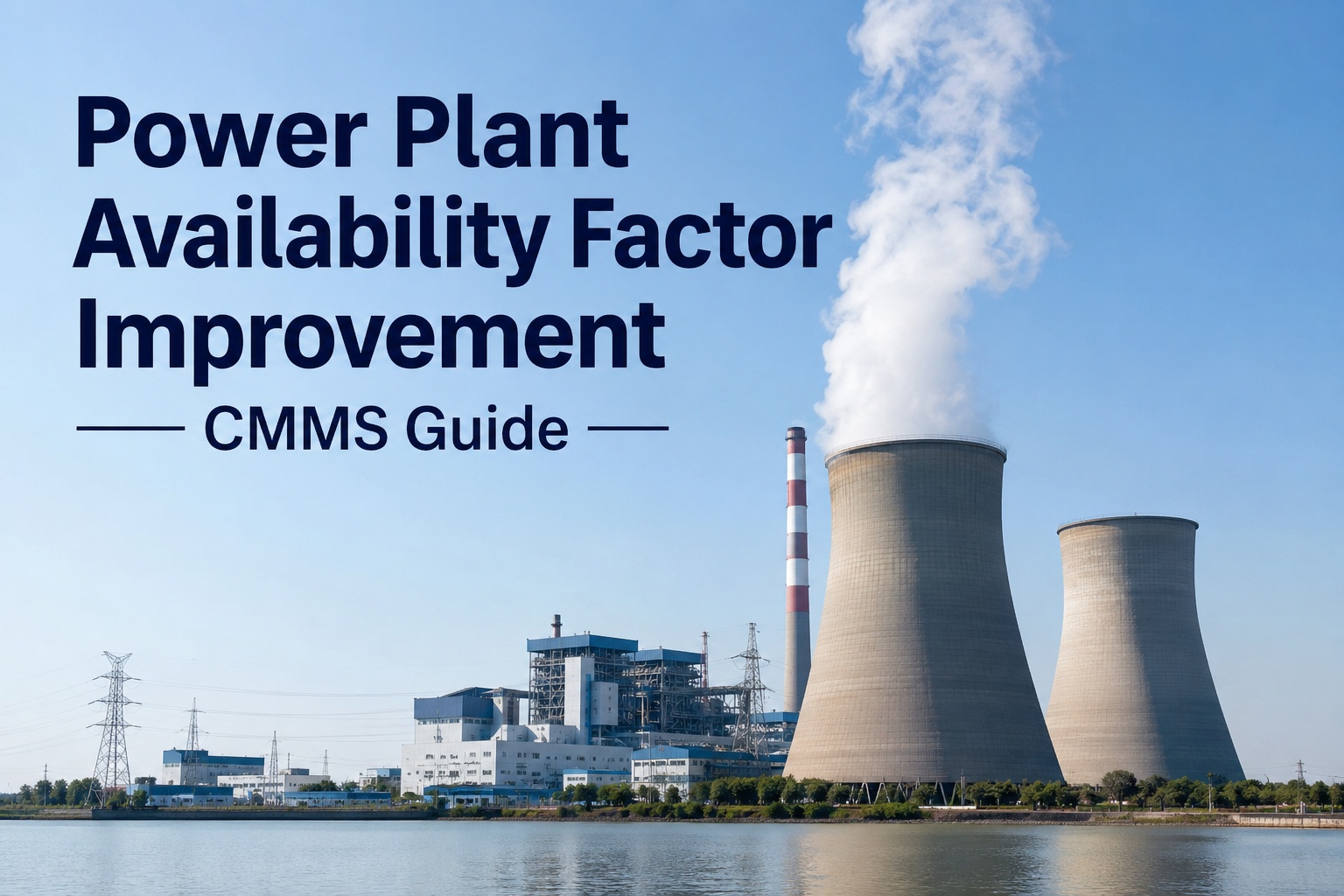
Power plant availability factor — the percentage of hours a generating unit is available to produce electricity at full capacity — is the single most tracked reliability metric in the power generation industry, and improving it even one percentage point can translate to millions of dollars in recovered revenue annually. The equivalent availability factor (EAF) accounts for planned and forced outages as well as deratings, giving plant managers a true picture of how maintenance strategy impacts generation performance. Whether you operate a coal, gas, nuclear, or renewable plant, availability factor improvement depends on disciplined preventive maintenance scheduling, rapid work-order execution, and real-time visibility into asset health. OxMaint's AI-powered CMMS gives maintenance and reliability teams the tools to track EAF, reduce forced outages, and optimize planned outage windows — you can Start Free Trial today or book a personalized demo to see it on your assets.
Power Plant Availability Factor Improvement
Is your equivalent availability factor stuck below 90%?
The average fossil-fuel plant loses 6–10% of annual generation capacity to planned and forced outages — a 500 MW unit losing just one EAF point forfeits roughly $1.2M in annual revenue. OxMaint's CMMS helps maintenance teams claw back availability through predictive scheduling, work-order automation, and real-time outage tracking.
EAF FUNDAMENTALS
What drives power plant availability factor?
Plant availability factor is the ratio of available hours to total period hours, expressed as a percentage. Equivalent availability factor (EAF) goes further — it weights seasonal deratings, economic dispatch curtailments, and environmental constraints to reflect real-world generation capability. Industry benchmarks from NERC GADS data show top-quartile thermal plants sustain EAF above 92%, while bottom-quartile units hover near 78–82%.
Available Hours = Period Hours − (Planned Outage Hours + Forced Outage Hours + Reserve Shutdown Hours)
Equivalent derating converts partial-load hours into full-capacity equivalents using the unit's net dependable capacity.
Annual planned maintenance typically consumes 5–7% of period hours for coal and gas units — the largest controllable availability loss.
Industry-average forced outage rates range 3–5%; top-quartile plants keep forced outages under 2% through predictive maintenance.
A 500 MW unit at $50/MWh loses approximately $1.2M annually for every 1% drop in equivalent availability factor.
AVAILABILITY LOSS BREAKDOWN
Where does generation availability actually leak?
A 2023 analysis of NERC GADS reporting data across 1,200+ thermal units reveals that over 70% of availability loss is maintenance-addressable — meaning the right CMMS workflow, spare-parts strategy, and condition-monitoring program can recover it. Here's how the losses break down for a typical steam plant:
| Loss Category | Annual Hours (Typical 500 MW Unit) | EAF Impact | CMMS Addressable? |
|---|---|---|---|
| Planned Maintenance Outages | 1,200–1,500 hrs | −5.5 to −7.0% | Yes — optimize scope, scheduling, and critical-path duration |
| Forced Outages (Boiler, Turbine, BOP) | 400–650 hrs | −2.0 to −3.5% | Yes — predictive maintenance and condition-based work orders |
| Equipment Deratings | 300–500 equiv. hrs | −1.5 to −2.5% | Yes — track derating causes and trigger corrective WOs |
| Reserve Shutdowns (Economic) | 500–2,000 hrs | 0% (excluded from EAF) | No — dispatch decision, not maintenance |
| Regulatory / Environmental Curtailments | 100–300 hrs | −0.5 to −1.5% | Partially — emissions equipment reliability affects this |
IMPROVEMENT ROADMAP
How to improve EAF in a power plant — a 6-month timeline
Availability factor improvement is not a single project — it's a sustained program. The following roadmap, drawn from ISO 55000-aligned asset management practices, shows how a maintenance team can move from reactive firefighting to a predictive, data-driven EAF improvement cycle using OxMaint's CMMS capabilities.
Asset Register & Criticality Baseline
Import all critical assets — boiler feed pumps, ID/FD fans, turbine bearings, condensers, generators — into OxMaint's asset hierarchy. Assign criticality ratings (A/B/C) based on generation impact. Establish the baseline EAF from the past 12 months of outage data.
PM Optimization & Scheduling
Migrate preventive maintenance schedules from spreadsheets into OxMaint's automated PM engine. Set time-based and condition-based triggers for every Class-A asset. Target: 95% PM compliance within 60 days.
Work-Order Automation Go-Live
Eliminate paper work orders. OxMaint's mobile app dispatches WOs to technicians with checklists, safety permits, and parts lists attached. Track mean-time-to-repair (MTTR) and wrench-time ratio from day one.
Predictive Maintenance Integration
Connect vibration, oil analysis, thermography, and DCS alarm data to OxMaint's predictive engine. AI models flag bearing degradation, tube leaks, and heat-exchanger fouling 2–6 weeks before failure — converting forced outages into planned corrections.
Spare-Parts Inventory Optimization
Link min/max levels to critical-asset BOMs. OxMaint auto-generates purchase requisitions when stock dips below safety thresholds — eliminating the "parts not available" delay that extends outages by 18 hours on average.
EAF Review & Continuous Improvement
Generate OxMaint's availability analytics dashboard: compare planned vs. actual outage hours, forced-outage frequency, PM compliance, and MTBF trends. Set EAF improvement targets for the next quarter. Most plants see 1.5–3% EAF gain within the first cycle.
See how OxMaint lifts your plant's EAF — book a 30-minute demo
We'll map your current outage data, asset hierarchy, and maintenance workflows to OxMaint's CMMS — and show you exactly where availability gains are hiding.
HOW OXMAINT HELPS
CMMS capabilities that directly improve plant availability factor
OxMaint is built for maintenance and reliability teams in power generation. Every feature maps to a specific availability loss — here's how four core capabilities translate to measurable EAF improvement:
Predictive Maintenance Engine
AI models analyze vibration, oil, and temperature trends to predict asset failures 2–6 weeks in advance. Converts potential forced outages into planned work — cutting unplanned downtime 30–50%.
Automated PM Scheduling
Time-based and condition-based PM triggers fire automatically. OxMaint balances workload across technicians and aligns PM windows with generation dispatch schedules to avoid conflicts.
Mobile Work Orders & Permits
Technicians receive WOs on mobile devices with safety permits, lockout/tagout checklists, and digital sign-offs. Cuts outage execution time by eliminating paper delays and miscommunication.
Availability Analytics Dashboard
Real-time EAF tracking with drill-downs by unit, system, and asset. Compare planned vs. actual outage hours, identify repeat offenders, and trend MTBF/MTTR against availability targets.
REAL-WORLD IMPACT
A 180-asset gas plant recovered 2.4 EAF points in 8 months
A 320 MW combined-cycle plant in the Southeast U.S. was running at 86.7% EAF — below the NERC median for its class. Their maintenance team tracked work orders on spreadsheets, PM compliance sat at 68%, and forced outages from boiler feed-pump bearings averaged 4 per year. After deploying OxMaint's CMMS, the results within 8 months were striking:
- EAF: 86.7%
- PM compliance: 68%
- Forced outages/yr: 4 (avg 52 hrs each)
- WO cycle time: 6.2 days avg
- Spare-parts stockouts: 11/month
- EAF: 89.1% (+2.4 points)
- PM compliance: 94%
- Forced outages/yr: 1 (22 hrs)
- WO cycle time: 2.1 days avg
- Spare-parts stockouts: 2/month
"The 2.4-point EAF recovery translated to $3.6M in additional annual generation revenue — OxMaint paid for itself in under 90 days. The predictive alerts on feed-pump bearings alone prevented two forced outages."
— Reliability Manager, 320 MW Combined-Cycle Plant
FREQUENTLY ASKED
Power plant availability factor — your questions answered
What is a good equivalent availability factor (EAF) for a power plant?
A good EAF target depends on unit type and age. For modern gas-fired combined-cycle plants, top-quartile EAF is 92–95%. Coal units typically target 88–92%. Nuclear plants routinely achieve 90–93% due to long refueling cycles. If your EAF is below 85%, you're likely in the bottom quartile and leaving significant revenue on the table — a CMMS like OxMaint can identify and recover the maintenance-addressable losses.
How is availability factor different from capacity factor in power generation?
Availability factor measures the percentage of time a unit could operate at full capacity, regardless of whether it was dispatched. Capacity factor measures actual energy produced as a percentage of maximum possible output. A plant can have 95% availability but only 50% capacity factor if it's cycled for economic reasons. EAF is the maintenance team's metric; capacity factor is a commercial/dispatch metric.
How much does a 1% EAF improvement save a power plant?
For a 500 MW unit at an average wholesale price of $50/MWh, each 1% EAF improvement recovers approximately 43.8 GWh of generation potential — worth roughly $2.19M annually. Larger units or higher price environments amplify this. A CMMS that improves EAF by 2–3 points typically delivers ROI within the first quarter. Book a demo and we'll calculate the exact figure for your plant.
Can a CMMS reduce forced outages in a power plant?
Yes — forced outages are primarily caused by equipment failures that predictive and preventive maintenance can prevent. OxMaint's AI-powered CMMS analyzes condition-monitoring data (vibration, oil analysis, thermography) to flag degrading assets 2–6 weeks before failure, converting forced outages into planned repairs. Plants using OxMaint typically cut forced outage frequency by 50–70% and reduce forced-outage hours by 40–60%.
How long does it take to deploy OxMaint CMMS in a power plant?
Most power plants go live on OxMaint in 4–8 weeks. The timeline depends on asset register size, integration depth (DCS, SCADA, ERP), and data quality. We import your existing asset hierarchy, PM schedules, and spare-parts BOMs during onboarding. You can Start Free Trial immediately to explore the platform, or book a guided demo to see a deployment plan tailored to your plant.
Stop losing availability to reactive maintenance
Join the power generation teams using OxMaint to track EAF in real time, prevent forced outages before they happen, and recover 1–3 availability points in the first year. Your competitors already are.
Free 14-day trial · No credit card