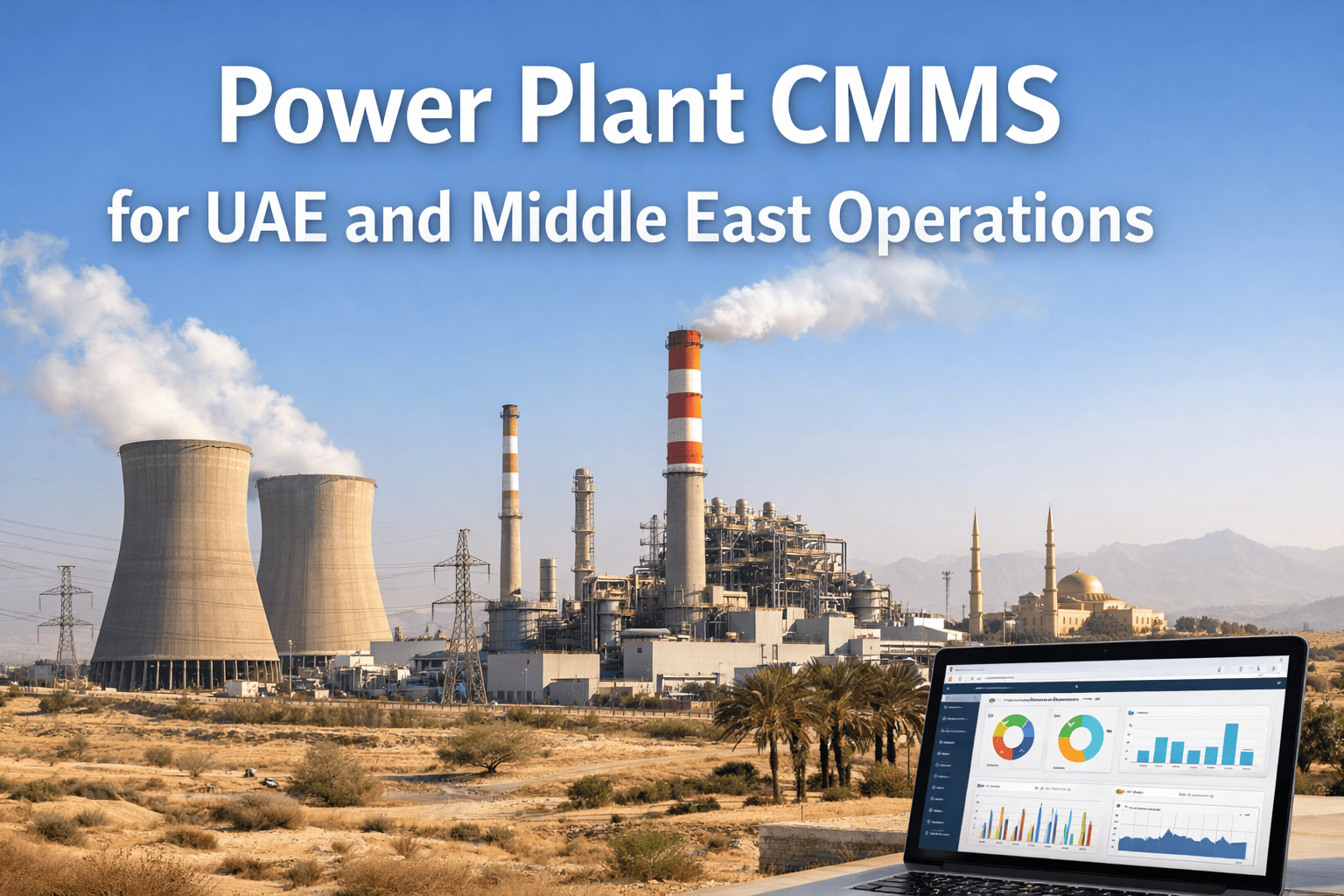
Power plants from Jebel Ali to Jubail operate in conditions that break the assumptions built into most maintenance software. Ambient temperatures crossing 50°C strip years off rotating equipment life, dust ingress from Shamal winds defeats filtration schedules calibrated for temperate climates, and coastal humidity at Ras Al Khair or Taweelah accelerates corrosion on assets that data sheets assumed would last two decades. Layered on top of that physical reality is a regulatory environment shaped by Saudi PDPL, UAE NESA and SIA, Aramco IKTVA localisation requirements, and Gulf grid codes that increasingly mandate data residency inside the Kingdom or Emirates. Start a free trial of OxMaint, or book a 30-minute demo to see how the platform supports Middle East power plant operations — with on-premise, hybrid, and in-region cloud deployment options built for Gulf conditions.
Middle East Deployment / Gulf Region / Power Generation
Power Plant CMMS Built for UAE, Saudi Arabia, and the Gulf — Extreme Conditions, Local Regulations, Deployment Flexibility
Operators across the GCC need a maintenance platform that can survive 52°C summers, Shamal dust events, and coastal humidity while meeting Saudi PDPL, UAE data localisation, Aramco vendor requirements, and country-specific grid codes. OxMaint offers on-premise, in-region cloud, and hybrid deployment — with Arabic and English interfaces, in-Kingdom data residency options, and failure-mode libraries calibrated for desert and coastal power plant operations.
52°CPeak ambient conditions supported in failure-mode library
3Deployment models — cloud, hybrid, on-premise
AR/ENNative Arabic and English interface
GCCAll 6 Gulf markets supported
Why Gulf Power Plants Need a Different CMMS Approach
A CMMS that works in Rotterdam will not serve a plant in Ruwais the same way. Gulf power generation operates at the intersection of three pressures that rarely converge elsewhere — physical conditions that accelerate asset degradation, regulatory frameworks that demand in-region data handling, and operational contexts from oil and gas cogeneration to desalination-linked power where availability is not optional. A maintenance platform deployed here must account for all three from day one.
01
Environmental Extremes
Summer ambient peaks of 48 to 52°C drive gas turbine derating, cooling tower capacity loss, and accelerated lube oil degradation. Sandstorm events introduce particulate loads that filtration regimes designed for temperate climates simply cannot match.
02
Regulatory Localisation
Saudi PDPL, UAE data protection regulations, NESA and SIA standards for critical infrastructure, Aramco IKTVA scoring, and national grid codes from SEC, DEWA, ADDC, and Kahramaa each impose specific documentation and data residency expectations.
03
Deployment Sovereignty
Many Gulf operators — particularly those tied to strategic assets in oil and gas, defence, or desalination — require on-premise or in-Kingdom cloud deployment. A SaaS-only CMMS that cannot run inside the operator's own data centre is disqualified before evaluation begins.
The Temperature Reality — What Heat Does to Power Plant Assets
The Gulf's thermal profile is not a footnote to maintenance planning; it is the planning. Equipment specified to international standards at 15°C ISO conditions loses performance and life at Gulf ambient temperatures. OxMaint's failure-mode library and PM scheduling are calibrated to these realities rather than generic temperate-climate assumptions.
Gas Turbine Power Output
ISO 15°C baseline
Gulf summer 50°C
Cooling Tower Capacity
Design conditions
Coastal summer peak
Lubricant Service Life
Temperate climate expectation
Gulf operating reality
Air Filter Change Interval
Generic CMMS default
Gulf dust reality
Generic PM intervals miss the Gulf reality by 2 to 4x. OxMaint's preventive maintenance library is calibrated against field data from plants operating at Gulf ambient conditions.
Maintenance Schedules That Reflect Gulf Operating Reality
Stop relying on PM intervals calibrated for 15°C baseline conditions. OxMaint's failure-mode library is built around the temperature, dust, and humidity profile of actual Gulf power plants.
Deployment Options Built for Gulf Data Sovereignty
Middle East operators rarely have a single answer to the deployment question. Saudi national champions may require in-Kingdom hosting. UAE private-sector IPPs often prefer in-region cloud. Integrated oil and power complexes tied to critical infrastructure may mandate on-premise deployment behind their own air-gapped networks. OxMaint supports all three without forcing a trade-off on functionality.
Cloud — In-Region
UAE and Bahrain regional data centres
Data residencyGCC region, no out-of-region transfer
Deployment time2 to 4 weeks to production
UpdatesContinuous, managed by OxMaint
Best forIPPs, mid-size utilities, water-power complexes
Hybrid
In-region application, customer-controlled data store
Data residencyCustomer database in customer data centre
Deployment time6 to 10 weeks including integration
UpdatesApplication managed, DB customer controlled
Best forNational utilities, regulated oil and gas operators
On-Premise
Full deployment inside customer infrastructure
Data residency100% inside customer data centre
Deployment time10 to 16 weeks including hardening
UpdatesScheduled releases, customer-controlled
Best forStrategic infrastructure, air-gapped networks
Country Regulatory Map — What Applies Across the GCC
Each Gulf country presents a distinct combination of grid operator, regulatory authority, data protection framework, and critical infrastructure regime. OxMaint is configured for the specific documentation, reporting, and localisation requirements each jurisdiction imposes on power plant operators.
Scroll horizontally to view all GCC markets →
| Country |
Energy Regulator |
Grid and Utility Operators |
Data Protection |
Critical Infrastructure |
| Saudi Arabia |
WERA / ECRA |
SEC, Marafiq, SPPC |
PDPL (SDAIA) |
NCA ECC, Aramco IKTVA |
| United Arab Emirates |
Federal ERA, EWEC |
DEWA, ADDC, FEWA, SEWA |
UAE PDPL, DIFC DPL |
NESA, SIA (Abu Dhabi) |
| Qatar |
Kahramaa |
Kahramaa, QEWC |
Qatar PDPPL |
NCSA critical sector rules |
| Kuwait |
MEW |
MEW generation and transmission |
Data Privacy Protection Reg. |
CITRA cybersecurity framework |
| Oman |
APSR |
OPWP, Nama Group |
PDP Law 2022 |
Sultanate cybersecurity rules |
| Bahrain |
EWA |
EWA, power companies |
PDPL (MOICT) |
NCSC critical sector guidance |
Desert and Coastal Failure Modes — Calibrated for the Region
A generic equipment failure library will list bearing wear, lubricant degradation, and insulation failure at generic rates. Gulf operators need a library that reflects what actually fails first in this region — and how fast. OxMaint's failure-mode configuration for the Middle East is grounded in documented degradation patterns at desert and coastal plants.
Desert Inland
Air Inlet Filtration
Pulse-clean cartridge filters on gas turbines face dust loading 3 to 5x higher than temperate design assumptions during Shamal season. Differential pressure monitoring and condition-based change-outs replace calendar-based PM.
Typical change frequency: 20 to 30 days peak season
Coastal Humid
Electrical Insulation and Switchgear
Salt-laden humidity at coastal plants drives insulation resistance degradation, switchgear corrosion, and terminal connection failures. Ambient-adjusted thermographic inspection intervals become critical.
Insulation test cadence: quarterly, not annual
Thermal Stress
Rotating Equipment Lubrication
Oil oxidation rates double with every 10°C rise above 60°C bulk temperature. Gulf gas turbine and BOP lube oils reach replacement thresholds at 50 to 60% of temperate-climate service hours.
Oil analysis cadence: monthly during summer peak
Water Quality
Cooling and Boiler Water Chemistry
Desalinated feedwater and high-TDS cooling water drive scaling, corrosion, and heat-transfer loss at rates unfamiliar to operators trained on temperate freshwater systems. Chemistry monitoring must integrate with PM scheduling.
Chemistry sampling: shift-based during high-demand periods
See OxMaint Configured for Your Jurisdiction
Whether you are deploying under PDPL in Riyadh, NESA in Abu Dhabi, or Aramco vendor requirements in the Eastern Province, OxMaint is configured to your specific regulatory environment. Speak to a specialist who has deployed in your jurisdiction.
What Gulf Operators Gain From OxMaint
Scroll horizontally for full comparison →
| Operational Area |
Typical Gulf Plant Today |
With OxMaint Deployed |
| PM scheduling |
OEM-default calendar PM, misses Gulf-specific degradation |
Condition-based, calibrated to Gulf temperature and dust profile |
| Data residency |
Cloud CMMS hosted outside region, regulatory risk |
In-region cloud, hybrid, or on-premise — customer choice |
| Language support |
English-only interface, Arabic reports rebuilt manually |
Native Arabic and English UI, bilingual reports out of the box |
| Aramco IKTVA and local content |
Vendor spend tracking in separate finance system |
Local content tagging at PO level, IKTVA-ready reports |
| Cybersecurity framework |
Generic access controls, no NCA ECC or NESA mapping |
Controls mapped to NCA ECC and NESA IA standards |
| Shutdown and overhaul planning |
Spreadsheet-driven, poor visibility across contractor scope |
Structured TAR planning with contractor access audit trail |
| Availability reporting to regulator |
Manual compilation from SCADA and maintenance logs |
Templated export in WERA, DEWA, Kahramaa formats |
Frequently Asked Questions
Does OxMaint offer in-Kingdom hosting for Saudi Arabia?
Yes. OxMaint supports in-Kingdom deployment through Saudi-resident cloud regions and fully on-premise installation inside customer data centres — aligned with PDPL and NCA ECC expectations.
Book a call to discuss your specific hosting requirements.
Is the platform available in Arabic?
Yes. The OxMaint interface, mobile app, and standard reports are available in Arabic and English, with right-to-left layout support. Bilingual reports can be generated for regulatory submissions.
Start a trial to see the Arabic interface.
How are PM schedules adjusted for Gulf ambient conditions?
Failure-mode templates are calibrated against documented degradation rates at 40 to 52°C ambient operation. PM intervals on filtration, lubrication, and insulation testing reflect Gulf field data — not temperate-climate defaults from generic OEM libraries.
Can OxMaint support Aramco IKTVA localisation reporting?
Yes. Local content tagging at purchase order and work order level rolls up into IKTVA-ready reports covering Saudi-origin spend, workforce, and supplier development activity.
Schedule a demo to see the IKTVA workflow.
What does on-premise deployment require from our IT team?
On-premise deployment runs on standard Linux server infrastructure with PostgreSQL. OxMaint provides sizing guidance, deployment scripts, and hardening configuration for NCA ECC and NESA alignment. Typical deployment runs 10 to 16 weeks including integration testing.
Does OxMaint integrate with the SCADA and DCS systems used in Gulf plants?
Yes. Standard integrations support OPC UA, OSIsoft PI, ABB 800xA, Siemens PCS 7, and Emerson Ovation — the platforms commonly deployed in Gulf power generation. Condition data drives condition-based work order generation inside OxMaint.
Built for Gulf Reality — Heat, Dust, Humidity, and Sovereignty
OxMaint is the CMMS that actually accounts for how Gulf power plants operate — with deployment flexibility, in-region data residency, Arabic interface, and failure-mode libraries calibrated to desert and coastal conditions. Start with a trial or book a specialist demo configured to your jurisdiction.