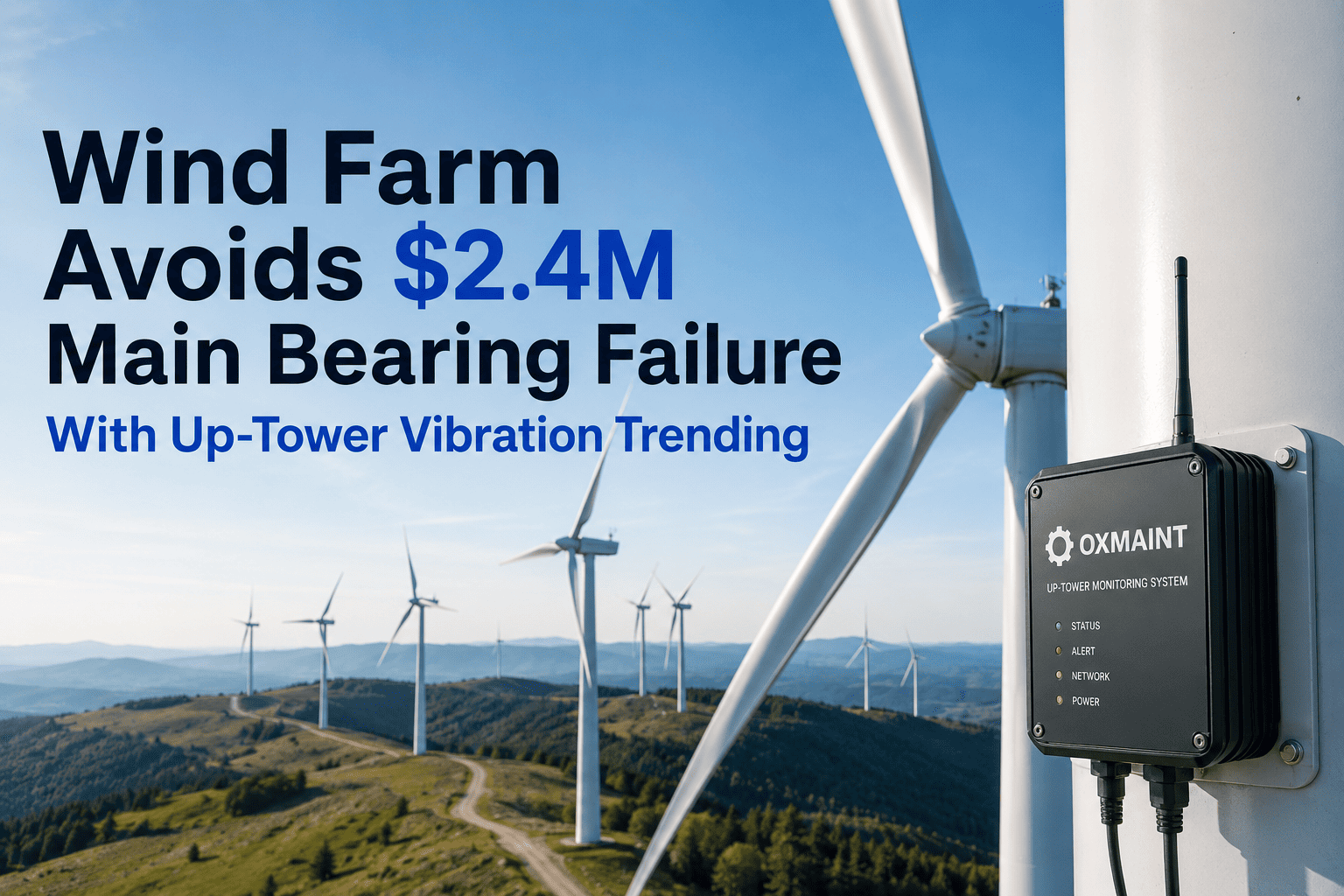
A wind operator running a 200-turbine, 4 MW fleet was averaging 14 gearbox failures per year — each one costing upward of $350,000 in crane hire, replacement parts, and lost generation revenue. The team had SCADA data, periodic oil samples, and a paper-based inspection log, but no system connecting those signals to timely action. Twelve months after deploying OxMaint's gearbox oil analysis trending, vibration record workflows, and bolt torque tracking, failures dropped to 3 per year. This is the story of how that happened — and what any wind O&M team can replicate. Start tracking your gearbox fleet on OxMaint today.
Case Study · Wind Energy · Predictive Maintenance
200-Turbine · 4 MW Fleet · 12-Month Result
Wind Operator Cuts Gearbox Failures From 14 to 3 Per Year
How structured oil analysis, vibration trending, and bolt torque records in OxMaint reduced catastrophic gearbox events by 79% — and turned a reactive O&M team into a predictive one.
Before OxMaint
14
Gearbox failures / year
→
After OxMaint
3
Gearbox failures / year
Estimated Annual Saving
$3.85M+
79%
Reduction in gearbox failure events year-over-year
$350K
Average cost per catastrophic gearbox failure (crane + parts + downtime)
85%
Of gearbox failures are predictable with vibration and oil analysis before catastrophic event
6–8 wk
Typical lead time vibration deviation gives before bearing seizure in a 4 MW gearbox
The Problem: Data Existed. Action Didn't.
01
Oil Reports in PDFs — Not Work Orders
The fleet had quarterly oil sampling in place. Every sample came back as a lab PDF. High iron particle counts sat in email inboxes for weeks before anyone opened a work order — if they opened one at all. By the time action was taken, the gearbox was already in advanced wear.
02
Vibration Data With No Trend Line
Technicians recorded handheld vibration readings on paper route sheets. There was no system comparing this week's reading to last quarter's baseline. A bearing entering failure mode looked the same on paper as a healthy one — until the nacelle needed a crane.
03
Bolt Torque Records Per Tower Did Not Exist
Gearbox mounting bolt torque checks were performed during scheduled maintenance, but results were not recorded against the individual turbine asset. No one knew which towers had received a torque check in the last 18 months and which had been skipped under schedule pressure.
The Three Signals That Predict Gearbox Failure — and How OxMaint Tracks Them
What it detects
Iron particle count rise (ferrous debris from gear tooth or bearing wear), silicon contamination (water ingress or seal failure), and viscosity degradation — all 4–12 weeks before catastrophic failure.
How OxMaint tracks it
Oil sample results are entered against the turbine asset record. OxMaint trends particle count per sample date and flags any single-interval rise above the configured threshold as a condition alert — auto-generating an investigation work order before the next sample window.
Fleet result: 9 of 11 avoided failures were first identified by iron particle rise in oil data.
What it detects
Rising RMS velocity or narrowband defect frequencies on high-speed shaft bearings and planet carrier bearings — indicating inner race, outer race, or rolling element fatigue typically 6–8 weeks before seizure.
How OxMaint tracks it
Technicians record route-based vibration readings via the OxMaint mobile app against each bearing location. Each reading is stored in the asset timeline, and OxMaint generates a deviation alert when the current reading exceeds the individual turbine's commissioning baseline by the configured percentage.
Fleet result: baseline deviation alerts fired an average of 47 days before planned intervention — enough time to pre-order parts and schedule crane access.
What it detects
Gearbox mounting bolt loosening under cyclic torque loading transfers vibration into the nacelle frame rather than through the designed load path — accelerating bearing wear and misalignment. Missing torque check records identify at-risk turbines before this secondary damage occurs.
How OxMaint tracks it
Each torque check is recorded as a PM task completion with the measured torque value per bolt group. OxMaint identifies overdue torque checks by turbine and batches them into the next scheduled climb. No tower is skipped invisibly.
Fleet result: 23 turbines found with overdue torque records in the first OxMaint audit. All cleared within 6 weeks of deployment.
Your Oil Data Is Already Telling You Which Gearboxes Will Fail Next.
OxMaint connects oil analysis results, vibration readings, and torque records into a single gearbox health timeline per turbine — so your team acts on signals, not surprises.
12-Month Rollout Timeline — What the Operator Did and When
Month 1–2
Asset Register Setup
All 200 turbines registered in OxMaint with individual asset records. Gearbox serial numbers, installation dates, last oil change dates, and commissioning vibration baselines entered per turbine. PM templates for oil sampling, vibration routes, and torque checks configured and assigned.
Month 3–4
First Oil Analysis Audit
Historical oil sample PDFs entered into OxMaint against each turbine. 34 turbines flagged with elevated iron particle readings that had received no follow-up action under the old system. Investigation work orders raised. 6 gearboxes found in active wear — scheduled for controlled replacement before failure.
Month 5–7
Vibration Route Digitalisation
Technician vibration routes converted from paper sheets to OxMaint mobile app checklists. Each bearing location given a baseline value. First deviation alerts generated within 8 weeks — 4 turbines showing high-speed shaft bearing rise above 4.5 mm/s RMS flagged and inspected.
Month 8–10
Torque Record Catch-Up Campaign
OxMaint PM compliance report identified 23 turbines with no recorded torque check in the previous 18 months. Crew deployed on a dedicated torque campaign. 7 turbines found with measurably loose mounting bolt groups. All retorqued and rechecked — findings recorded against each asset.
Month 11–12
Results Measurement
End-of-year gearbox failure count: 3. All 3 were turbines where oil analysis had not yet been normalised into the OxMaint workflow at the time of failure. Zero catastrophic failures in turbines with a full OxMaint oil + vibration + torque record for the preceding 6 months.
Failure Cost Comparison — Reactive vs Predictive
| Cost Category |
Reactive Failure |
Planned Intervention (OxMaint) |
| Gearbox Replacement |
$180,000–$220,000 (emergency stock premium) |
$150,000–$180,000 (planned procurement) |
| Crane Hire |
$60,000–$90,000 (emergency mobilisation) |
$35,000–$50,000 (scheduled window) |
| Lost Generation Revenue |
14–21 days unplanned downtime |
3–5 days planned maintenance window |
| Secondary Damage |
Often: generator bearing, nacelle frame, coupling |
Contained: gearbox component only |
| Total Per Event |
$280,000–$370,000 |
$45,000–$80,000 |
Frequently Asked Questions
Does OxMaint replace our existing CMS vibration hardware?
No. OxMaint works alongside your existing condition monitoring hardware. Vibration data from your CMS feeds into OxMaint where it is combined with oil analysis results and inspection records to build a complete gearbox health picture per turbine. The value is connecting those signals to work orders, not replacing the sensors that generate them.
See how OxMaint integrates with existing CMS data.
How long does it take to set up 200 turbines in OxMaint?
The operator in this case study had all 200 turbines registered with PM templates active within 6 weeks. OxMaint's bulk asset import and configurable PM templates significantly reduce the manual entry required. Most fleets of 50–300 turbines are fully configured within 4–8 weeks.
Book a scoping call to plan your fleet setup.
What oil analysis parameters does OxMaint track?
OxMaint tracks iron particle count, silicon content, water content, viscosity, and any additional lab parameters your sample program reports. Each result is stored against the turbine asset record and trended across sample dates, with configurable alert thresholds per parameter.
Can field technicians use OxMaint without constant internet connectivity?
Yes. The OxMaint mobile app supports offline data capture for vibration readings, inspection checklists, and torque records. Data syncs automatically when connectivity is restored — important for remote onshore wind sites with limited coverage.
What ROI can a fleet of 200 turbines expect from OxMaint?
The operator in this study avoided 11 catastrophic failures at an average saving of $280,000 per event — a fleet-level saving of over $3 million in year one alone. A single avoided catastrophic gearbox failure covers the platform cost for an entire year.
Book a demo and we'll model the ROI for your fleet size.
Ready to Replicate These Results?
14 Failures a Year Is Not Bad Luck. It's Missing Data.
OxMaint gives wind O&M teams the oil analysis trending, vibration records, and bolt torque workflows to catch gearbox failures before they become crane events — across every turbine in the fleet.