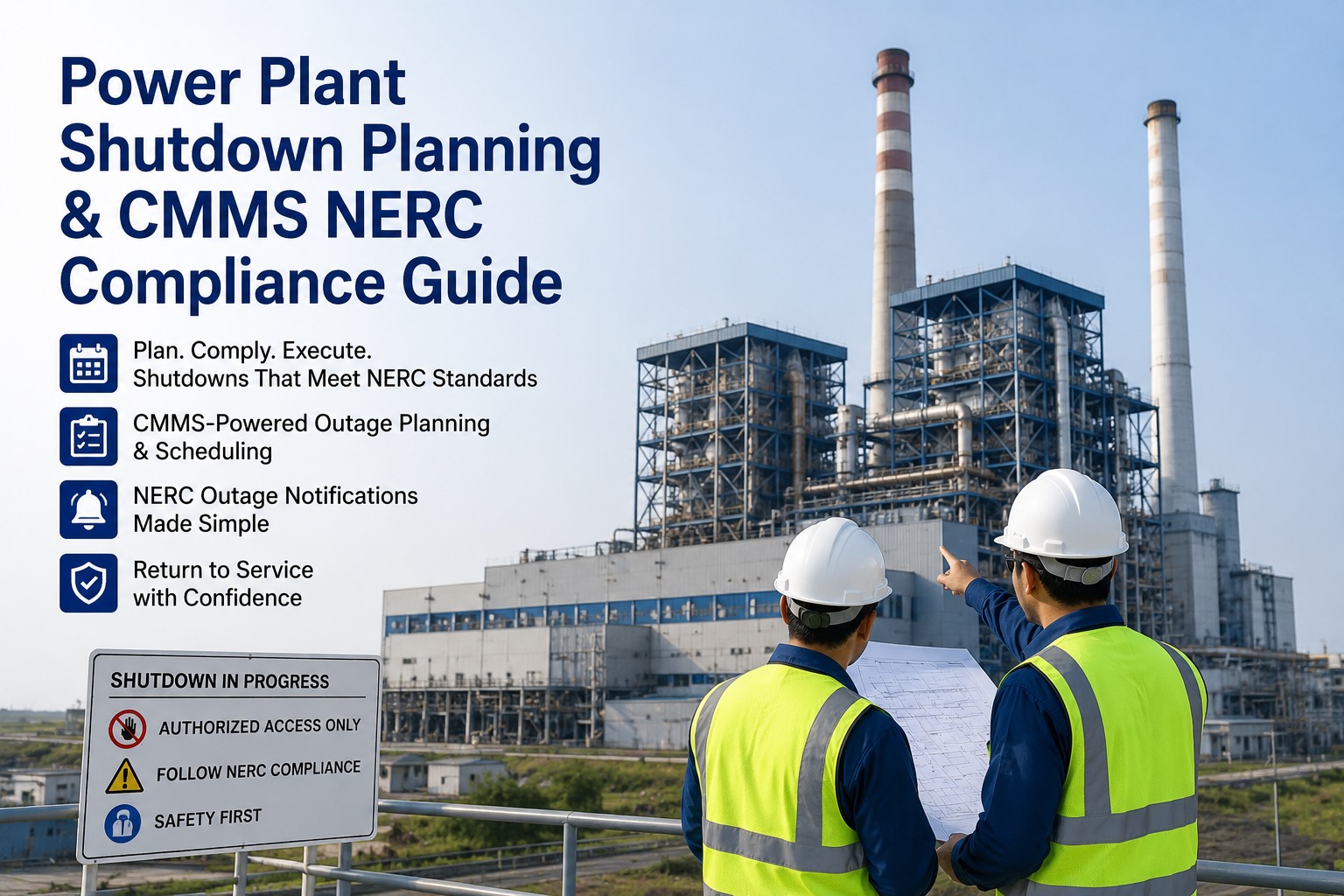
Power plants generate more maintenance data per hour than almost any other industrial asset class — and most of that data goes unactioned. In 2026, the gap between facilities running modern CMMS platforms and those managing work orders in spreadsheets or legacy systems has become the single biggest predictor of unplanned downtime, compliance exposure, and maintenance cost overruns. Whether you operate gas turbines, steam boilers, hydro units, or a solar-wind hybrid portfolio, choosing the right CMMS is a strategic decision — not just a software purchase. This guide cuts through the noise to show you exactly what separates average platforms from the ones that actually move the needle on reliability and cost.
Top Power Plant CMMS Software 2026
Compare turbine health monitoring, NERC CIP compliance, outage planning, and predictive maintenance capabilities across the leading platforms — and discover why AI-native solutions are pulling ahead.
Why Power Plants Need a Specialized CMMS — Not a Generic One
A hotel chain and a 600 MW combined-cycle plant both need work order management. But the similarities end there. Power plants operate under NERC CIP cyber security mandates, FERC reliability standards, environmental permit requirements, and insurance-driven inspection cycles that generic facilities software was never built to handle. Add turbine hot-section monitoring, forced outage risk scoring, and multi-unit outage coordination — and the gap between a general CMMS and a power-generation-focused platform becomes enormous.
Turbine Health Monitoring
Real-time exhaust gas temperature spread, vibration signatures, compressor pressure ratio tracking — connected to automatic work order generation before failure occurs.
NERC CIP Compliance
Automated audit trails, access control records, cyber asset maintenance logs, and compliance reporting built into every work order — not bolted on as an afterthought.
Outage Planning & Scheduling
Multi-unit outage coordination with resource leveling, critical path scheduling, parts pre-staging, and contractor management — designed for planned and forced outage scenarios.
Predictive Intelligence
AI anomaly detection on DCS/SCADA data streams, remaining useful life estimation per component, and failure probability timelines that schedule maintenance months in advance.
Renewable Asset Management
Wind turbine gearbox and blade maintenance, solar inverter health tracking, hydro unit runner inspection cycles — unified in one platform across the entire generation portfolio.
Regulatory & Insurance Reporting
Automated OSHA, EPA, and insurance inspection documentation. One-click audit packages that satisfy FERC, state PUC, and ISO/RTO reporting requirements on demand.
2026 CMMS Platform Comparison: Power Generation Edition
The following comparison evaluates the platforms most commonly deployed at power generation facilities in 2026, scored across the capabilities that matter most to plant reliability engineers, maintenance managers, and compliance officers. Scores reflect published capabilities, independent analyst assessments, and operator feedback.
| Platform | Gas Turbine Monitoring | Steam Plant Support | Renewable Asset Mgmt | Outage Planning | NERC CIP Compliance | Predictive Failure AI | DCS/SCADA Integration | Deployment Time |
|---|---|---|---|---|---|---|---|---|
| Oxmaint | EGT, vibration, compressor ratio, bearing health — real-time | Boiler tube, steam turbine, condenser fouling, valve cycling | Wind gearbox, solar inverter, hydro runner, BESS tracking | Multi-unit, critical path, contractor & parts pre-staging | CIP-007, CIP-010, CIP-014 — auto audit package in <4 hrs | 85–92% accuracy; 3–18 month lead time; auto work orders | OPC-UA, Modbus, OSIsoft PI, DNP3 — no DCS replacement | 2–4 Weeks |
| IBM Maximo | Supported via APM add-on module; separate licensing required | Strong boiler and steam asset register; manual inspection workflows | Basic asset tracking; no native renewable-specific analytics | Enterprise-grade outage scheduling; ERP-integrated | Compliance workflows available; not auto-generated per WO | Maximo APM add-on; requires significant configuration | PI, OPC-UA, SAP PI adapters via MAS integration layer | 12–24 Months |
| SAP PM | Asset hierarchy supports turbines; no native sensor ingestion | Full SAP PM work order and inspection plan support for steam plants | Renewable assets supported in SAP S/4HANA with custom config | Outage management via PS module; deep SAP ERP integration | Audit trails in SAP GRC; not embedded in maintenance workflow | No native AI; predictive requires SAP IBP or third-party add-on | SAP MII, PI/PO adapters; heavy configuration and IT resources | 18–36 Months |
| GE APM (Predix) | Best-in-class for GE 7F/9F/HA turbines; OEM data models built in | Steam turbine support limited to GE-manufactured units | No renewable asset management capability | Outage scheduling exists; not multi-OEM or multi-site optimized | No NERC CIP compliance module | Strong AI for GE turbine failure modes; limited to GE fleet | Native Predix integration with GE Mark VIe DCS | 6–12 Months |
| Infor EAM | Turbine assets supported; no real-time condition monitoring | Steam plant PM and inspection scheduling; solid work order engine | Renewable assets manageable; no specialized analytics | Outage and shutdown management module available | Compliance documentation via Infor GRC integration | Basic condition monitoring; AI features limited to premium tier | OPC adapters available; requires middleware configuration | 6–15 Months |
| Fiix (by Rockwell) | No turbine-specific health monitoring or condition analytics | Generic PM scheduling; no steam-specific inspection workflows | Wind and solar assets trackable; no performance analytics | Basic scheduling; no multi-unit outage coordination | No NERC CIP compliance support | AI work order suggestions via Rockwell integration; basic | REST API available; manual sensor mapping required | 1–3 Weeks |
| UpKeep | No gas turbine or condition monitoring capability | Not designed for steam plant or boiler inspection workflows | Basic asset records for solar and wind; no health analytics | No outage planning or multi-unit scheduling | No regulatory compliance module | No predictive AI; reactive and preventive maintenance only | No DCS/SCADA integration; manual data entry only | Days–1 Week |
Oxmaint for Power Plants: What AI-Native Actually Means
Most CMMS platforms added "AI features" to existing architectures designed in the 1990s. Oxmaint was built from the ground up as an intelligence platform — meaning every work order, every sensor reading, every maintenance history record feeds a continuously learning model that makes the platform smarter every day your plant runs on it.
Continuous ingestion of EGT spread, vibration, pressure ratio, and bearing data from DCS/SCADA. AI baseline models detect degradation 3–18 months before failure — auto-generating work orders with parts lists and optimal outage timing.
Every work order touching a BES Cyber System automatically captures the access controls, change documentation, and audit trails required under CIP-007, CIP-010, and CIP-014. One-click audit package generation eliminates hundreds of hours of manual compliance prep per audit cycle.
Each asset carries a live risk score combining component health, operating hours, thermal cycle count, and historical failure data. Maintenance planners see which units are highest risk at a glance — and what intervention costs vs. failure costs.
Schedule planned outage work across multiple units simultaneously, with resource leveling, contractor capacity planning, critical path visualization, and parts pre-staging integrated into a single outage management workflow.
NERC CIP Compliance: The Hidden Cost Most CMMS Platforms Miss
NERC CIP violations carry fines of up to $1 million per violation per day. Yet compliance documentation is often managed in disconnected spreadsheets, email chains, and paper logs — completely separate from the CMMS where the actual maintenance work happens. When auditors arrive, maintenance teams spend weeks reconstructing records that should have been captured automatically. Oxmaint's compliance engine eliminates this double-work entirely.
- Manual documentation in parallel with work orders
- 3–6 weeks of audit prep per NERC audit cycle
- Version control failures on CIP documentation
- Access log gaps discovered during auditor review
- Average $180,000 in compliance labor costs annually
- Risk of $1M/day fines for documentation failures
- Compliance documentation auto-captured on every WO
- Audit package generated in under 4 hours
- Version-controlled, timestamped, tamper-evident records
- Access control logs automatically tied to asset records
- Average $140,000 reduction in compliance labor annually
- 90%+ audit pass rate on first submission
How to Choose the Right CMMS for Your Plant Type
The right CMMS depends on your generation mix, fleet age, compliance obligations, and where you are on the predictive maintenance maturity curve. Here is a straightforward guide for the most common scenarios.
Ready to See What Your Plant Data Is Telling You?
Oxmaint connects to your existing DCS, SCADA, and sensor infrastructure in 2–4 weeks — no replacement of current systems. Your turbines, boilers, and renewable assets start generating actionable predictive intelligence from day one.
.png)