Power Plant LOTO Procedure & CMMS Workflow

By William Jerry on September 23, 2026

power-plant-loto-procedure-cmms-workflow

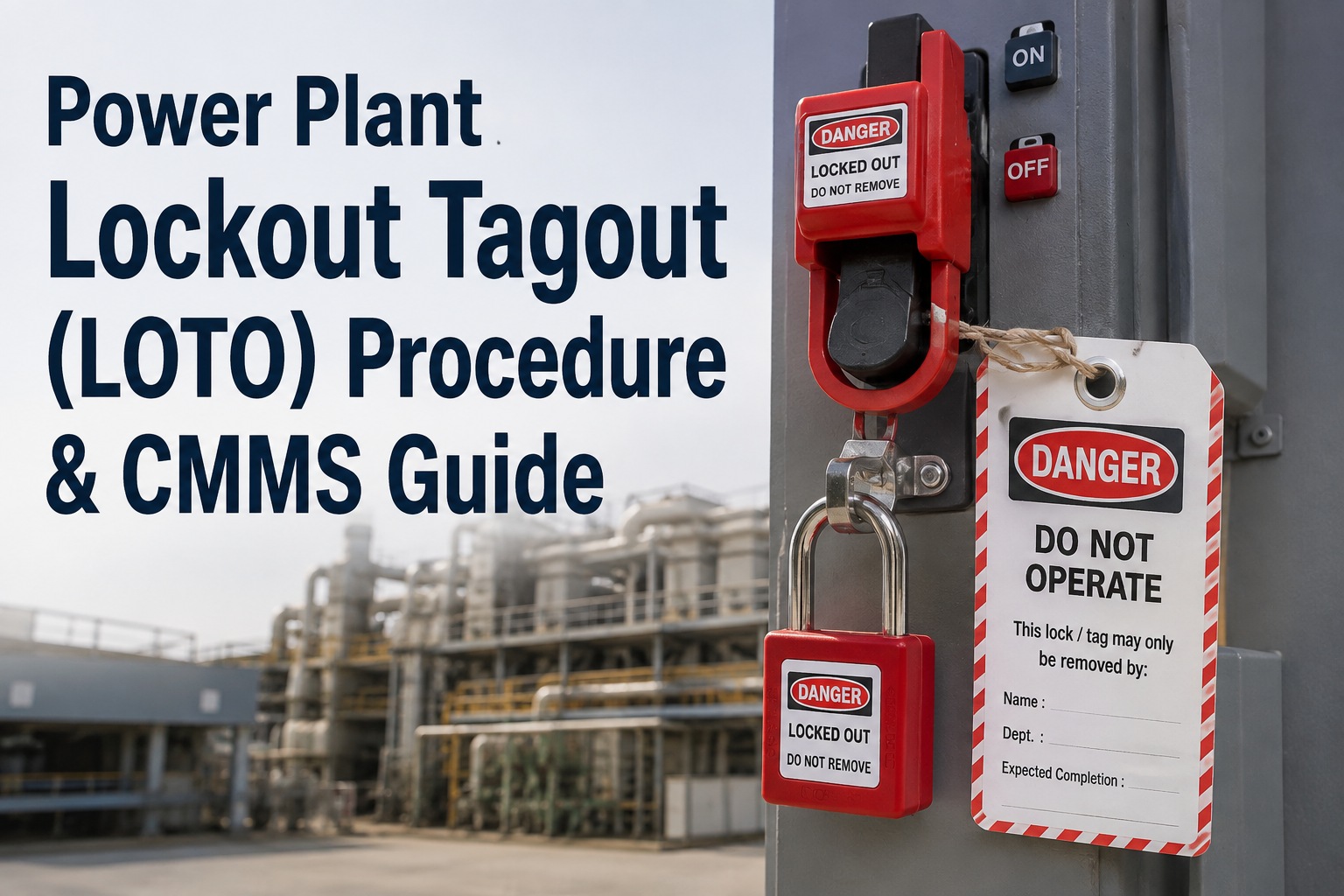
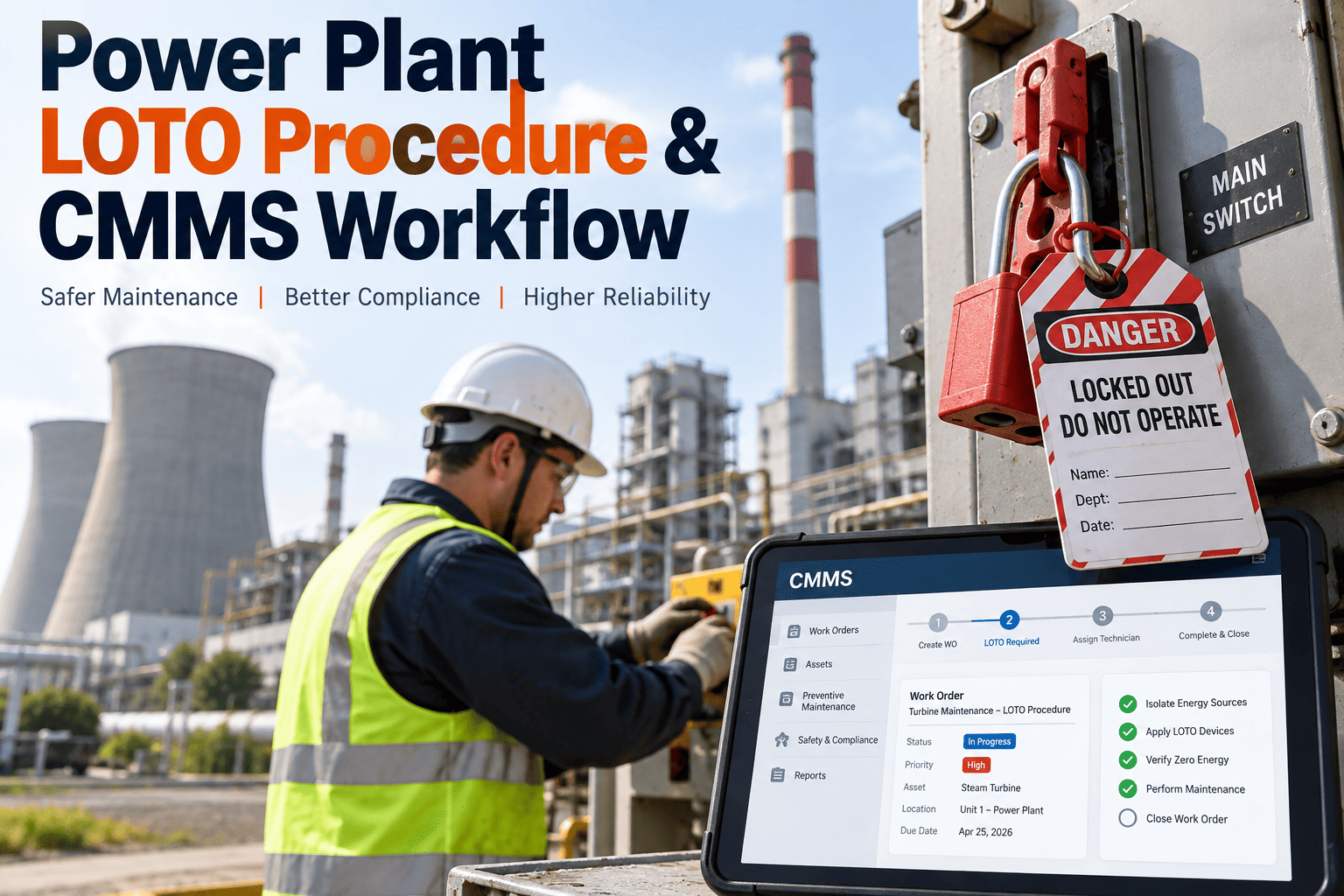
A paper LOTO permit gets signed at 06:40, the machine gets worked on at 09:15, and the isolation was actually broken at 08:50 when a fitter needed to rotate a valve for access — and nobody logged it. That's the failure mode LOTO is meant to prevent, and it's the reason the discipline is moving off paper and onto CMMS. A digital LOTO workflow ties isolation points to the asset, forces group-lock sequencing, holds every permit signature on the same record, and closes with photographic verification that the lock is actually off. This guide walks that workflow using OXMAINT AI, the AI-powered CMMS for high-risk maintenance environments.

Safety · Power Generation · Lockout Tagout

A LOTO Permit Is Only As Good As Its Weakest Isolation Point

OXMAINT AI, the AI-powered CMMS/maintenance management software, holds the whole LOTO chain on one record — isolation points tied to the asset, group-lock sequencing enforced, authorised issuer and receiver signatures captured, and photographic verification held for every lock on and lock off.

Asset-Linked Isolation Points Group-Lock Sequencing Photographic Verification
6 Energy Types
electrical, mechanical, hydraulic, pneumatic, thermal, chemical
8 Steps
notify, prepare, shutdown, isolate, lock, tag, dissipate, verify
3 Roles
authorised issuer, authorised receiver, affected worker — separated on the permit
1 Record
where the permit, isolation, verification and closeout all live for life

Paper LOTO vs Digital LOTO — What Actually Changes

The core LOTO steps don't change on CMMS. What changes is what's evidenced, what's enforced, and what stays retrievable when an auditor arrives 18 months later asking about a specific isolation. OXMAINT AI enforces the sequence and holds the evidence forever. Sign up free and see the digital LOTO workflow in OXMAINT AI.

Paper LOTO
Isolation list drawn from memory or generic template
Signatures on paper — no timestamp integrity
Group-lock sequence tracked on a clipboard
Verification is a signed line, no photo evidence
Closeout permit stored in a filing cabinet
Audit trail requires physical retrieval
Digital LOTO on CMMS
Isolation points held on the asset — pulled onto the permit automatically
Signatures with authorised role check + timestamp + device ID
Group-lock sequence enforced — cannot skip a lock on or lock off
Verification requires attached photograph of each lock in place
Closeout permit retained on the asset's life-of-asset ledger
Audit query returns the full permit in seconds

The 6 Energy Types — What Actually Needs Isolating

"Isolate the machine" isn't an instruction — it's a list. A pump has electrical, hydraulic and thermal energy. A turbine has all six. OXMAINT AI holds each energy source as a distinct isolation point on the asset so the permit carries every one, not just the electrical breaker. Book a demo to see per-energy isolation lists live.

E
Electrical
Motor circuit breakers, MCC feeders, control power, UPS supplies, battery banks
Isolation: rack out + lock + tag + test-for-dead
M
Mechanical
Rotating equipment, spring-loaded actuators, gravity-loaded components, stored kinetic energy
Isolation: pin, block, chock, restrain against movement
H
Hydraulic
Hydraulic power packs, accumulators, hydraulic actuators holding stored pressure
Isolation: valve closed + locked + pressure bled to zero
P
Pneumatic
Compressed air supplies, instrument air, pneumatic actuators, air receivers
Isolation: valve closed + locked + downstream vented
T
Thermal
Steam lines, boiler water, hot condensate, cooling water, superheated fluids
Isolation: double-block-and-bleed + cool-down verified
C
Chemical
Fuel gas, ammonia, hydrogen, sulphuric acid, water treatment chemicals
Isolation: valve locked + line drained + purged + tested

The 8-Step LOTO Sequence — Enforced by the Workflow

Every LOTO event walks the same eight steps in the same order. The value of CMMS enforcement is that step 5 (lock on) cannot happen until step 4 (isolate) is signed, and step 8 (verify) cannot happen until steps 6 and 7 (tag + dissipate) are complete. OXMAINT AI enforces the sequence at the workflow layer. Start free and configure your LOTO sequence in OXMAINT AI.

1
Notify Affected Personnel
Operations, adjacent crews and control room notified — asset marked as out of service on the plant dashboard
2
Prepare — Identify All Energy Sources
Isolation list pulled from the asset record — all 6 energy types checked, none skipped by omission
3
Shutdown by Normal Means
Operator stops the equipment via control room or local HMI — controlled shutdown, not emergency stop
4
Isolate Each Energy Source
Breakers racked out, valves closed, blocks fitted, chocks placed — one action per isolation point
5
Apply Locks
Personal padlock on each isolation point — group lockbox for multi-person work, key retained by receiver
6
Apply Tags
Danger tag on every lock — WO number, receiver name, date and time recorded on each tag
7
Dissipate Stored Energy
Springs relaxed, accumulators bled, capacitors discharged, hot lines cooled, chemical lines drained and purged
8
Verify Zero Energy State
Test-for-dead on electrical, gauge check on pressure, try-to-start on rotating — verification signed and photographed

The Permit Signature Chain — Who Signs What, When

A LOTO permit isn't one signature — it's a chain. Issuer signs to authorise the isolation. Receiver signs to accept custody. Affected workers acknowledge the scope. Return-to-service reverses the chain. OXMAINT AI enforces role authorisation at each signature — a fitter can't sign as an issuer. Book a demo to see the signature chain live.

StageRole RequiredWhat They SignEnforced By
Permit IssueAuthorised IssuerIsolation list is complete and correct for the scope of workRole check + timestamp
Isolation AppliedIsolation Team LeadEvery listed isolation point is locked and taggedSequence enforcement
Zero-Energy VerifiedAuthorised IssuerTest-for-dead / pressure zero / try-to-start passed on each sourcePhotograph attachment required
Permit ReceivedAuthorised ReceiverAccepts custody of the isolation — takes group lockbox keyRole check + WO link
Worker OnboardingEvery Affected WorkerAcknowledges scope, isolation state and safe work boundariesNamed list, per-person sign
Work CompleteAuthorised ReceiverWork is finished, tools removed, guards refitted, area safe to re-energisePhotograph of restoration
Lock OffIsolation Team LeadEvery lock and tag removed in reverse order — no lock left behindSequence enforcement + count
Return to ServiceAuthorised IssuerAsset ready to re-energise — control room and operations notifiedAsset status returned to service

One Missing Lock. One Skipped Verification. One Career-Ending Incident.

OXMAINT AI enforces the sequence, the signatures, and the photographic evidence — the workflow physically prevents a permit closing with an isolation still live or a lock still on.

The Group-Lock Model — When Multiple Crews Share an Isolation

Real plant work rarely fits one permit, one lock. A boiler outage has electrical crews, mechanical crews, insulation crews and inspection crews on the same isolation. The group-lock model gives each crew a personal padlock on a shared lockbox — the isolation only lifts when every crew has removed its own lock. OXMAINT AI holds the lockbox as a record. Sign up free and configure group-lock workflows.

Isolation Point
Locked · Tagged · Verified
Group Lockbox
Isolation key inside · sealed
Electrical Crew
Personal padlock
Padlock #E-247
Mechanical Crew
Personal padlock
Padlock #M-118
Insulation Crew
Personal padlock
Padlock #I-054
Inspection Crew
Personal padlock
Padlock #Q-091
The lockbox opens only when every crew has removed its own padlock. No single crew can unlock the isolation on its own.

The Verification Evidence Stack — What Closeout Requires

A closed LOTO permit isn't a signature at the bottom of a page. It's a stack of evidence that proves the isolation was applied, verified, held for the work, then reversed cleanly. OXMAINT AI holds every piece of evidence on the same WO record. Book a demo to see the evidence stack.

01
Isolation List Signed
Authorised issuer signature confirming every energy source is listed for the scope of work
02
Per-Point Lock Photograph
Photograph of each padlock and tag in place — timestamped, geotagged where mobile signal allows
03
Zero-Energy Test Results
Electrical test-for-dead readings, pressure gauge photos, try-to-start confirmation — attached per source
04
Worker Onboarding Log
Named list of every person who signed onto the permit, when, and what scope they were briefed on
05
Restoration Photograph
Photograph of guards refitted, tools removed and area safe — before locks come off
06
Lock-Off Count Reconciled
Every lock applied at step 5 is confirmed removed at closeout — count in equals count out

What OXMAINT AI Gives a Power Plant Safety Team

Purpose-built for high-risk isolation work — one platform behind the permit desk, the isolation crew, the receiving crew and the compliance auditor. Start free and load your isolation registers into OXMAINT AI.

Asset-Linked Isolation Registers
Every isolation point held on the asset — the permit pulls the list automatically, nothing left off by memory.
Sequence Enforcement
Step 5 cannot happen until step 4 is signed. Lock off cannot happen until work-complete is signed.
Role-Authorised Signatures
Issuer role, receiver role and affected worker role separated — a fitter cannot sign as an issuer.
Group-Lockbox Records
Multi-crew work held as a lockbox with per-crew padlocks — isolation lifts only when every crew unlocks.
Photographic Verification
Photograph attachment enforced at lock on, zero-energy test and restoration — no permit closes without evidence.
Lifetime Permit Retention
Every permit held on the asset ledger — audit query returns the full permit in seconds, not days.
"

The audit that changed our thinking wasn't the one we passed — it was the one that took our team three days to pull permit records for the previous quarter's turbine outage. Three days on paper. When we ran the same query on the CMMS after go-live, it took ninety seconds. That's when the safety manager stopped calling this a maintenance system and started calling it evidence infrastructure.

Safety & Compliance Manager · 480 MW Combined-Cycle Plant

Frequently Asked Questions

Can OXMAINT AI enforce role authorisation for permit signatures?
Yes — issuer, receiver and affected worker are separate role permissions. Only users with the issuer role can sign an isolation as complete, and role assignments are held on the user record with expiry dates for competency currency. Sign up free and set up your permit roles.
How does the platform handle photographic evidence attachment?
Photographs attach via the mobile app at each enforcement point — lock on, zero-energy test, restoration. They're timestamped, associated with the WO, and retained for the life of the asset. Book a demo to see the mobile capture flow.
Does the group-lockbox model support crews from multiple contractors?
Yes — external contractor crews are configured as named crews with their own padlock records. Every crew's padlock is tracked, and the isolation cannot lift until every named crew has signed off and removed its lock. Start free and configure contractor crews.
Can we integrate the CMMS LOTO record with our Permit-to-Work system?
Yes — the platform supports bi-directional API integration with common PTW systems so the LOTO permit and the hot-work / confined-space permit reference the same WO and the same asset record. Book a demo to discuss your PTW integration.
How long is permit history retained for audit purposes?
Permits are retained for the life of the asset by default. Retention policies can be configured for longer regulatory windows where required. Audit queries return the full permit — isolation list, signatures, photographs and closeout — in seconds. Sign up free and see the retention model.

Isolate. Lock. Verify. Retain. Every Permit. Every Time.

Move your LOTO programme onto OXMAINT AI — asset-linked isolation registers, sequence enforcement, role-authorised signatures, group-lockbox tracking and photographic evidence retained for the life of the asset.



Share This Story, Choose Your Platform!