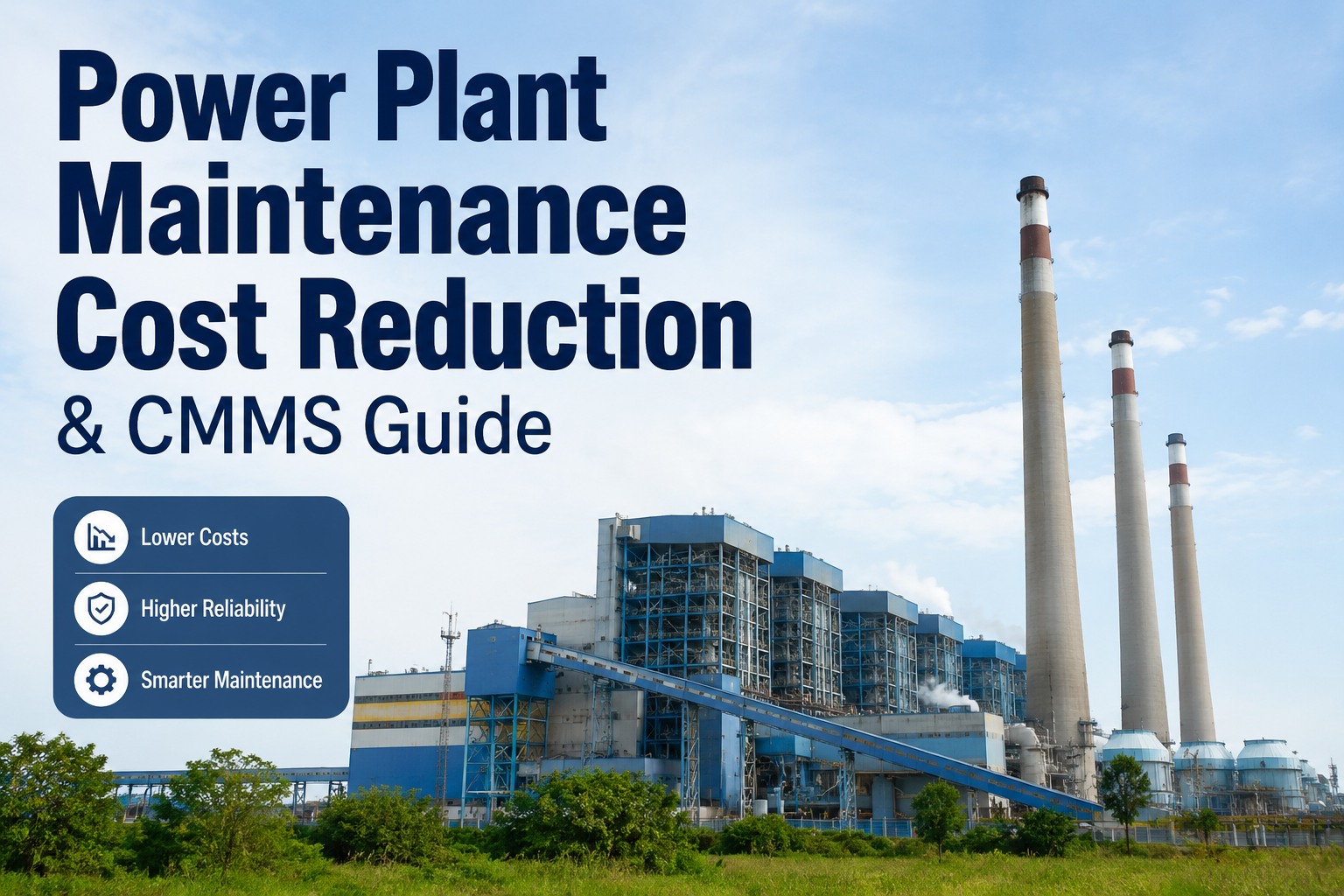
The most expensive line in a power plant's maintenance budget is not on the budget. It is the reactive premium — the extra you pay every time a repair happens as an emergency instead of on a plan. The identical fix costs three to eight times more when it is forced: after-hours labor rates, expedited and air-freighted parts at over twice the planned price, contractor emergency call-out fees, and the lost generation revenue while the unit sits down. A single forced outage on a 500 MW unit averages around $1.4 million, and most of that is premium, not repair. Yet most plants still set their maintenance budget by tradition rather than data, carrying six figures of avoidable emergency overhead they never see itemized. The path to a lower maintenance cost per MWh is not spending less on maintenance — it is converting reactive spend into planned spend, where the same work costs a fraction as much. This guide covers the four levers that do it and how a CMMS makes the savings auditable. Start a free Oxmaint trial and map your emergency-vs-planned cost ratio, or book a demo to see maintenance cost per MWh tracked automatically.
Power Generation · Maintenance Cost · CMMS ROI
Power Plant Maintenance Cost Reduction & CMMS Guide
Emergency-repair elimination, outage scope optimization, spare-parts rationalization, and labor efficiency — how power plants cut maintenance cost per MWh by converting reactive spend to planned spend, with CMMS-driven ROI you can report to finance.
-
3–8x
cost of a reactive repair versus the identical planned one
-
$1.4M
average cost of one unplanned outage at a 500 MW plant
-
40%
maintenance-cost reduction moving reactive to proactive
-
12–18 mo
typical payback window for a CMMS-driven program
Where the Money Actually Goes
The True Cost of One Forced Outage
A forced outage is never just the repair. The bill is a stack of premiums that a planned intervention avoids almost entirely. Break a single unplanned event into its parts and the reactive premium becomes visible — and so does what a CMMS eliminates.
- Lost generation revenueEvery hour down is MWh not sold — the single largest component of outage cost.
- Emergency labor premiumAfter-hours and call-out rates run 1.5–2x base — overtime nobody planned for.
- Expedited partsEmergency orders average ~2.4x planned price after air freight and premium supplier fees.
- Grid / availability penaltiesBreaching a PPA availability guarantee can trigger penalties of $100K–$1M per incident.
- Cascade & shortened asset lifeReactively run assets reach end of life 25–30% sooner — a hidden capital cost.
A single prevented outage at a large utility typically saves $420,000 to $1.7 million once every layer is counted. Book a demo to see the full outage-cost cascade mapped to your assets.
The Core Arithmetic
Same Repair, Very Different Invoice
The entire cost case rests on one fact: the identical repair is a fraction of the price when it is planned. This is not a productivity gain — it is the same wrench turning on the same bolt, billed at a planned rate instead of an emergency one.
Predictive alerts detect degradation 3–5 weeks before failure, letting the repair land in a planned window instead of a forced shutdown — which is how the multiplier collapses. Sign up for Oxmaint to move repairs from emergency to planned windows.
The Four Cost Levers
Where a CMMS Takes the Cost Out
Maintenance-cost reduction in a power plant concentrates in four levers. Each converts an uncontrolled reactive spend into a planned, lower one — and each is directly measurable.
-
01
Eliminate Emergency Repairs
Predictive alerts schedule intervention before failure, cutting unplanned outage events by over 75% within 18 months — recapturing the emergency premium on labor, parts, and lost generation. -
02
Optimize Outage Scope
Pre-staged parts, pre-assigned work scopes, and critical-path scheduling cut planned outage duration 15–25% — eliminating the reactive discovery of missing parts that drives overruns. -
03
Rationalize Spare Parts
Failure-probability forecasting orders parts 30 days ahead at standard cost with planned delivery — no expediting premium — and drops parts-driven outage events from 8–12 a year to 2–3. -
04
Cut Reactive Overtime
Distributing preventive work evenly across shifts converts emergency overtime — often $340K–$680K a year on a 30-person team — into planned hours, and lifts wrench time up to 12%.
Industry 4.0 mature plants report 38% lower maintenance spend than reactive peers on equivalent equipment. Book a demo to see all four levers tracked as dollar savings.
Build the Business Case
The ROI Is Arithmetic, Not a Vendor Projection
A credible CMMS business case for a power plant finance team rests on four numbers from your own plant, not a brochure. First, downtime cost per event — lost generation revenue plus emergency labor, expedited parts, and restart fuel, typically $180K–$420K for a 200 MW gas unit. Second, the emergency labor premium, running 1.5–2x base and $120K–$400K a year at a mid-size plant. Third, expedited parts spend at ~2.4x planned price. Fourth, compliance-preparation hours saved. Even a 30% cut in unplanned events against these numbers delivers seven-figure annual savings — and a modern platform tracks the actual reduction so ROI is reported, not estimated.
Oxmaint for Power Generation
How Oxmaint Drives the Cost Down
-
Cost Per MWh
The Metric Finance Wants
Track maintenance cost per MWh generated alongside emergency-vs-planned cost ratio — so the budget conversation moves from tradition to a number that trends down quarter over quarter.
-
Predictive Alerts
Repairs Before They Force
Ingest DCS and SCADA data to catch degradation weeks ahead, scheduling intervention into a planned window — collapsing the reactive premium on the failure modes that drive most emergency spend.
-
Outage Planning
Parts Staged, Scope Assigned
Multi-unit outage coordination with critical-path scheduling and parts pre-staging — so no procurement gap surfaces mid-shutdown and planned duration drops 15–25%.
-
Parts Forecasting
Standard Cost, Not Expedited
Failure-probability scores let procurement order 30 days ahead at standard price with planned delivery — ending the ~2.4x expediting premium on emergency parts orders.
-
Labor Scheduling
Overtime Into Planned Hours
Distribute preventive work evenly across shifts to convert reactive overtime into planned labor, cut admin backlog, and raise technician wrench time — where a large share of premium pay hides.
-
ROI Dashboard
Savings You Can Report
Automatic tracking of outages prevented, cost per MWh, PM compliance, emergency-parts reduction, and audit hours saved — a month-over-month view against your pre-CMMS baseline for leadership.
Frequently Asked
Power Plant Maintenance Cost Questions
How much more does a reactive repair cost than a planned one?
The identical repair costs roughly 3 to 8 times more when performed reactively. The premium covers after-hours and call-out labor at 1.5–2x base rate, expedited parts averaging around 2.4x the planned price, and contractor emergency fees — on top of the lost generation revenue while the unit is down. Converting that reactive work to planned work is the single largest maintenance-cost lever in a power plant. Sign up for Oxmaint to shift repairs from emergency to planned.
What does a single unplanned outage actually cost?
It depends on unit size, but the number is large and mostly premium. A forced outage at a 500 MW plant averages about $1.4 million; a 200 MW gas unit typically runs $180K–$420K per event. The cost stacks lost generation revenue, emergency labor premium, expedited parts, grid or PPA availability penalties of $100K–$1M, and cascade damage. A single prevented outage at a large utility commonly saves $420K–$1.7M.
What is the payback period on a power plant CMMS?
Most plants see measurable, auditable ROI within 12–18 months, driven by reduced emergency procurement, fewer unplanned outages, and lower overtime. Because even a 30% reduction in unplanned events against a plant's real downtime cost delivers seven-figure annual savings, the payback is arithmetic based on your numbers — not a vendor projection. Implementation on a clean asset database is typically fast and low-cost. Book a demo to build your plant's ROI case.
How does reactive maintenance affect asset life and capital cost?
Assets maintained reactively reach end of serviceable life 25–30% earlier than condition-monitored equipment. A $2M turbine lasting 22 years under a predictive program versus 16 years reactively is a $500K+ capital difference in one asset lifecycle — invisible in the annual maintenance budget but significant in capital planning. Reducing maintenance cost is therefore not only an operating-budget win but a capital-deferral one. Sign up for Oxmaint to extend asset life with condition-based maintenance.
Plan · Predict · Pre-Stage · Prove
Lower Cost Per MWh Comes From Planned Spend, Not Less Spend
Every forced outage, expedited part, and emergency overtime shift is reactive premium that a plan would have avoided. Oxmaint gives power plant teams one platform to catch degradation before it forces a shutdown, pre-stage parts and scope for planned outages, order spares at standard cost, convert reactive overtime into planned hours, and track maintenance cost per MWh — turning a lower maintenance bill into a number you can report to finance.