Power plant maintenance safety culture is the single biggest predictor of incident prevention — far more than compliance checklists alone. When teams build a strong maintenance safety culture, they surface power plant near-miss events early, act on safety observation data before injuries occur, and create the daily habits that keep personnel and critical generation assets protected. This guide breaks down how reliability leaders can build a power plant safety program that actually reduces maintenance incidents — and how a CMMS like OxMaint turns safety culture into a measurable, auditable system. Ready to see it on your assets? Start Free Trial or read on.
SAFETY CULTURE GUIDE
Does your maintenance team catch the near-miss before it becomes a $2M recordable incident?
Most power plant safety programs find out about hazards after the damage is done. OxMaint helps you flip that timeline — logging safety observations inside every work order, tracking near-misses to root cause, and proving your safety culture with audit-ready data. Building a proactive power plant safety culture starts with one shift: capture, act, measure.
MAINTENANCE SAFETY CULTURE
What is a power plant safety culture — and why does it prevent incidents?
Safety culture is the shared set of values, behaviors, and systems that determine how people act when no one is watching. In power generation, where a single maintenance incident can cost $50K–$2M in downtime, medical costs, and regulatory penalties, culture is not soft — it is the most cost-effective control you have.
A mature maintenance safety culture has four visible traits: front-line technicians freely report hazards without fear of blame; supervisors close the loop on every report within 48 hours; near-miss data is trended alongside asset health data; and safety observations are embedded directly into the work-order workflow — not a separate paper form filed weeks later. When any of these break down, the next near-miss quietly becomes the next incident. OxMaint closes this gap by making safety observation and near-miss capture a native part of every work order, so reporting takes seconds, not a separate system.
HOW-TO GUIDE
How to build a power plant safety program: a 4-month implementation timeline
A structured rollout turns good intentions into daily habits. Here is a proven four-phase path that reliability leaders use to build a sustainable power plant safety program — with measurable milestones at each stage.
Baseline & Leadership Alignment
Audit the last 12 months of near-miss and incident reports. Set a baseline metric — e.g., 0.3 near-misses reported per technician per month. Brief plant leadership on the safety leadership commitment: every near-miss gets a 48-hour response. Deploy OxMaint mobile work orders with a built-in safety observation toggle so capture takes one tap.
Near-Miss Blitz & Training
Run a 30-day near-miss reporting campaign with a goal of 3× the baseline volume — the surge surfaces hidden hazards fast. Train every shift on the difference between a near-miss (no harm, potential for harm) and an unsafe condition (no person involved). Use OxMaint dashboards to show daily reporting counts by crew, creating healthy peer visibility without punishment.
Close-the-Loop System
Every reported near-miss or observation must get a documented corrective action — a lockout/tagout update, a procedure change, a spare-part reorder, or a training refresh. OxMaint auto-generates a corrective work order from each flagged observation, assigns an owner, and tracks it to completion. Target: 95% of near-misses closed within 14 days.
Predict & Sustain
Now trend the data. Are near-misses clustering on a specific asset, shift, or contractor crew? OxMaint analytics surface those patterns automatically, linking safety events to asset history and PM compliance. By month four, most plants see a 25–40% drop in recordable incidents and a measurable shift in crew willingness to report — the leading indicator that culture is changing.
SAFETY OBSERVATION CHECKLIST
Power plant maintenance safety observation checklist
A safety observation program only works if technicians know what to look for. Use this tiered checklist — embedded directly in OxMaint work orders — to standardize what gets captured on every maintenance walkdown.
- Correct arc-rated PPE for the voltage class present
- Fall protection anchored and inspected (harness, lanyard, anchor point)
- Hearing protection in zones above 85 dBA
- Confined-space entry permit completed and atmospheric test current
- LOTO applied and verified by try-start test
- Stored energy released (capacitors, springs, hydraulic, pneumatic)
- Isolation list matches the asset hierarchy in the CMMS exactly
- Group lock box present when multiple crews share isolation
- Insulated tools rated for the working voltage, inspected pre-use
- Housekeeping: tripping hazards, oil spills, obstructed egress cleared
- Adequate lighting on stairways, platforms, and control rooms
- Weather and heat-stress conditions assessed for outdoor work
- Job Safety Analysis (JSA) reviewed and signed by all crew members
- Work order steps match the approved maintenance procedure
- Technician certification current for the task (e.g., NERC CIP, rigging)
- Two-person rule applied for high-risk electrical or elevated work
CMMS & SAFETY CULTURE
How OxMaint builds CMMS-driven safety culture — and prevents incidents
OxMaint turns safety from a clipboard exercise into a live, data-driven system. When near-miss reporting and safety observation live inside the same CMMS as your work orders, asset history, and PM compliance, you get one source of truth — and incidents get prevented because the data is actually acted on. Here is what changes for your team:
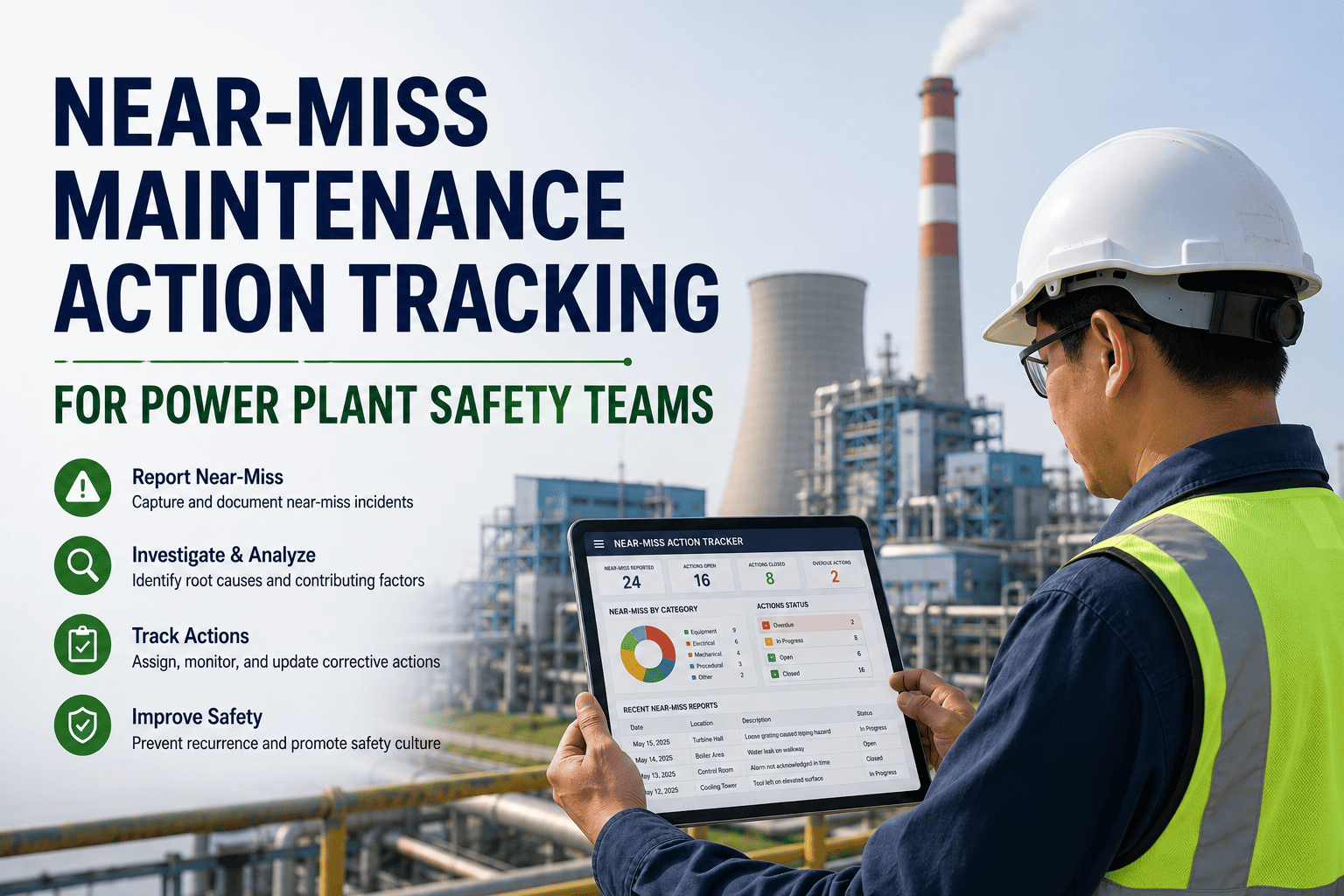
One-tap near-miss capture in every work order
Technicians log a power plant near-miss or safety observation in two taps from the mobile app — without leaving the job site or opening a separate form. Outcome: 3–5× more near-misses reported, giving you early warning before a recordable incident occurs.
Auto-generated corrective work orders
Every flagged observation automatically creates a corrective work order with an assigned owner and due date — no manual handoff, no lost emails. Outcome: 95%+ of near-misses closed within 14 days, vs. 40% with paper-based systems.
Predictive risk trending on assets
OxMaint AI correlates near-miss frequency with asset health, PM compliance, and failure history — flagging assets that are becoming safety liabilities before they fail. Outcome: 30–50% fewer unplanned downtime events and the safety incidents that accompany them.
Audit-ready safety records in one place
Every observation, corrective action, LOTO event, and JSA is time-stamped, geo-tagged, and tied to the asset record — exportable for OSHA, NERC, or internal audit in seconds. Outcome: audit prep drops from days to hours, with zero gaps in the chain of custody.
A 180-asset combined-cycle plant spending $42K/yr on safety incident administrative costs — plus an average of one $180K recordable incident every 18 months — deployed OxMaint's near-miss module. In the first quarter, technicians logged 212 near-misses (vs. 19 the prior quarter). Of those, 47 became corrective work orders for LOTO updates, procedure fixes, and guard replacements. Over 12 months the plant recorded zero recordable incidents, cut unplanned downtime 28%, and reduced audit prep time from 3 days to 4 hours.
See OxMaint prevent incidents on your assets — book a 30-min demo
We'll show you how near-miss capture, auto-corrective work orders, and predictive safety trending fit your plant's exact asset hierarchy and shift structure.
NEAR-MISS CMMS
Power plant safety program: reactive paper vs. CMMS-driven culture
Most plants think they have a safety program — but when reporting lives on paper forms and spreadsheets, the loop never closes. Here is what changes when safety moves into a CMMS like OxMaint:
| Safety Program Dimension | Paper / Spreadsheet System | OxMaint CMMS-Driven System |
|---|---|---|
| Near-miss reporting volume | 0.2–0.5 per technician / quarter (friction-heavy) | 2–5 per technician / quarter (one-tap, in-work-order) |
| Time to log a safety observation | 5–10 min + travel to office | 30 seconds on mobile, at the point of work |
| Corrective action close-out rate | ~40% within 14 days (no tracking) | 95%+ within 14 days (auto-assigned, auto-tracked) |
| Linkage to asset history | None — safety data lives in a separate binder | Every observation tied to asset record, PM history, and failure code |
| Audit readiness | 3–5 days of manual compilation, frequent gaps | Export complete record in seconds, zero gaps |
| Predictive insight | Reactive — discovered after the incident | AI flags rising near-miss trends on specific assets before failure |
FREQUENTLY ASKED
Power plant safety culture & incident prevention — your questions answered
What is a near-miss in power plant maintenance, and why does reporting it matter?
A near-miss is an unplanned event that did not result in injury or damage but had the potential to do so — a dropped tool near energized buswork, a slip on an oily platform, or a LOTO gap caught just in time. Reporting matters because near-misses are the earliest, cheapest warning signal you will ever get. Studies show that for every serious injury there are typically 10–30 unreported near-misses; capturing them lets you fix the hazard before it causes harm. OxMaint makes near-miss logging a one-tap action inside every work order, so you actually capture that signal.
How does a CMMS improve maintenance safety culture?
A CMMS like OxMaint embeds safety directly into the daily work-order workflow instead of treating it as a separate paperwork exercise. Technicians capture observations at the point of work, corrective actions auto-generate as tracked work orders with owners and due dates, and safety data links to asset history so trends become visible. When people see their reports lead to real fixes within days — not forms that disappear — trust and reporting volume both rise, which is the core of a healthy safety culture. You can book a demo to see the full closed-loop workflow on your own asset list.
How many near-misses should each technician report per month?
In a mature power plant safety program, expect 1–3 near-misses or safety observations per technician per month. If the number is near zero, you do not have a safe plant — you have an under-reporting problem. The goal is not high numbers for their own sake; it is a steady flow that tells you hazards are being seen and surfaced. A sudden spike is not bad either — it usually means a new hazard cluster has been discovered and can now be fixed before it causes an incident.
What is the difference between a safety observation and a near-miss?
A near-miss involves an event that almost caused harm — someone was in the chain of events but escaped injury. A safety observation (or unsafe condition) is a hazard noticed before any event occurs: a missing guard, a leaking valve, a blocked exit, an unguarded energized boundary. Both are critical inputs to incident prevention. OxMaint lets technicians log either type from the same one-tap interface inside a work order, then routes them through the same corrective-action workflow so nothing gets lost.
How long does it take to implement a CMMS-based safety program in a power plant?
A focused implementation takes 4–8 weeks for a mid-sized plant: week one for asset hierarchy and user setup, weeks two to three for safety observation templates and LOTO procedure integration, week four for mobile rollout and crew training, and weeks five to eight for the first near-miss blitz and dashboard tuning. Most plants see measurable culture change — higher reporting volume, faster close-out — within the first quarter. Start Free Trial to map your asset structure today, or book a demo for a guided rollout plan tailored to your plant.
Stop reacting to incidents. Start preventing them.
OxMaint gives your team the tools to capture every near-miss, close every corrective action, and prove your safety culture with audit-ready data — all inside one AI-powered CMMS.
Free 14-day trial · No credit card