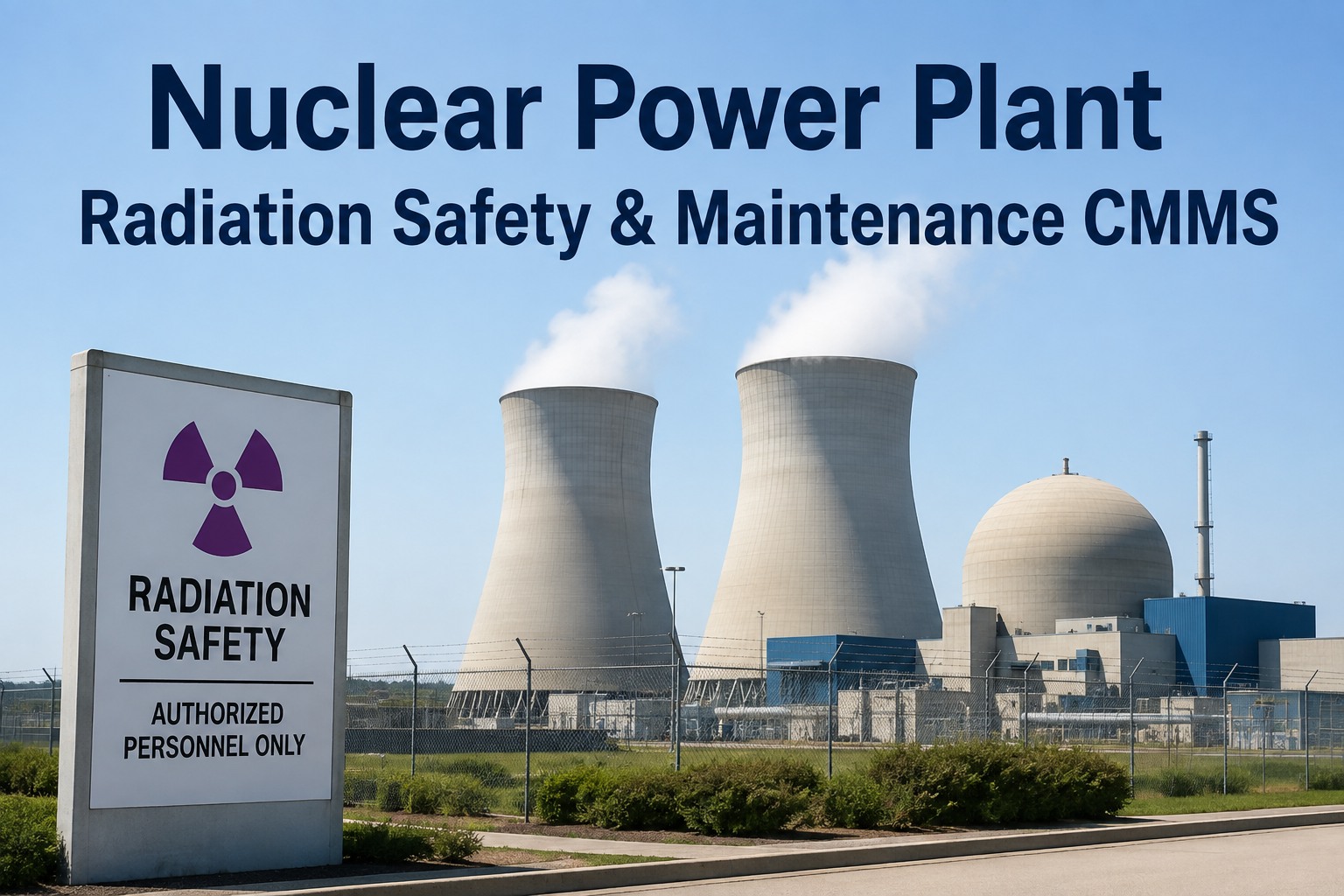
Nuclear power plant maintenance demands the highest standards of radiation safety, regulatory compliance and operational rigor of any industry on earth. A single refueling outage can involve 12,000+ work orders executed under ALARA (As Low As Reasonably Achievable) dose constraints, where every additional minute of personnel exposure has tangible human and financial cost. This guide breaks down how modern radiological maintenance programs integrate contamination control, outage planning and compliance tracking — and how an AI-powered CMMS like OxMaint eliminates paperwork bottlenecks so teams can focus on safe, reliable execution. See it on your assets with a Start Free Trial or read on for the full framework.
Can your maintenance team hold ALARA dose limits during a 21-day refueling outage?
Every work order in a nuclear facility carries radiological risk. Spreadsheets and paper routes cannot guarantee dose tracking, contamination control or NRC audit readiness at scale. OxMaint digitizes the entire nuclear maintenance lifecycle — from ALARA work planning to outage scheduling — so your team executes safely, stays compliant and returns the unit to service on time.
How ALARA principles shape every nuclear maintenance work order
ALARA is not a slogan — it is a quantifiable constraint. The NRC requires licensees to keep radiation exposure below regulatory limits (5 rem/year for occupational workers) and to optimize doses well below that ceiling. Every maintenance task must be planned, reviewed and executed against dose budgets before a wrench is turned.
Pre-Job ALARA Planning
- Job-specific dose estimate vs. historical baseline
- Shielding plan and engineering control verification
- Mock-up training for high-dose or first-time tasks
- Contamination zone boundary and PPE requirements
During-Job Dose Control
- Real-time dosimetry feed to radiation safety officer
- Stay-time alerts when 75% of dose budget reached
- Contamination survey at zone exits per step-off pad
- Work pause/stop authority for Rad Safety
Post-Job ALARA Review
- Actual vs. planned dose variance analysis
- Lessons-learned entry for future job planning
- Contamination event documentation and root cause
- NRC reportability determination and filing
Refueling outage safety: the 28-day critical path for nuclear maintenance
A pressurized water reactor refueling outage typically runs 18–30 days and concentrates 60–70% of a plant's annual occupational dose into a single window. Every day of delay costs $1–2M in replacement power. OxMaint's outage module sequences critical-path work orders with radiological holds, resource leveling and real-time completion tracking.
Freeze the work order scope. Complete ALARA reviews for all high-dose jobs. Lock in shielding installations, scaffold builds and mock-up training. OxMaint flags any work order missing ALARA sign-off before it enters the critical path.
Plant mode change to cold shutdown. Containment building access established with RWP (Radiation Work Permit). OxMaint activates outage dashboards — every team sees live work order status, dose accumulated and hold points.
Highest-dose window. Underwater fuel transfer, CEA shuffling and inspections. OxMaint tracks fuel-handling sequences and ties each work order to its RWP and cumulative crew dose in real time.
In-service inspection, steam generator work, reactor coolant pump seal replacement, valve packing. OxMaint enforces hold points, quarantine tags for contaminated tools, and digital sign-offs that replace paper travelers in the RCA.
Core reconstitution, lower internals, vessel head remate. Post-maintenance testing begins. OxMaint auto-generates PM completion reports and identifies any open work orders that would block mode ascension.
Primary system leak tests, criticality approach, power ascension. Final ALARA closeout: dose summaries, contamination surveys and lessons-learned filed in OxMaint for the next cycle's planning baseline.
Radiological contamination control during maintenance: a benchmark comparison
Contamination events cost an average of $50K–$250K each in decon labor, schedule delay and dose uptake. Plants using a digital CMMS with integrated radiological tracking see 40–60% fewer cross-contamination incidents compared to paper-based programs. Here is how the approaches stack up.
| Contamination Control Factor | Paper / Spreadsheet Program | OxMaint CMMS Program |
|---|---|---|
| RWP linkage to work orders | Manual; prone to mismatch | Auto-linked; no WO releases without active RWP |
| Tool & equipment contamination tracking | Logbook entries, often delayed | QR-tagged assets with quarantine status in real time |
| Dose budget enforcement | Post-job calculation only | Pre-job gate + live stay-time alerts at 75% threshold |
| Contamination survey documentation | Paper forms, manual data entry | Mobile capture in RCA, auto-attached to work order |
| NRC audit response time | 5–10 business days to assemble records | Instant — all records indexed and exportable |
| Cross-contamination incidents (annual) | Baseline (industry avg. 8–12 per outage) | 40–60% reduction via enforced zone controls |
A two-unit plant spending $42K per outage on paper travelers and manual dose tracking switched to OxMaint and recovered the full first-year license cost in a single refueling cycle — while cutting total outage dose by 18%.
How OxMaint powers nuclear plant safety and radiation maintenance compliance
OxMaint brings AI-driven work order management, predictive maintenance and real-time analytics to the radiological maintenance environment. These four capabilities map directly to the safety, compliance and cost pressures nuclear teams face every cycle.
ALARA-Enforced Work Orders
Every work order carries a dose budget, RWP linkage and mandatory ALARA review sign-off. No job releases to execution without it — eliminating the #1 cause of unplanned dose uptake: undocumented or bypassed planning.
Real-Time Outage Dashboards
Live critical-path visibility across 1,200+ concurrent work orders with cumulative dose tracking, hold-point status and resource conflicts surfaced before they slip the schedule. Replace the status whiteboard with a single source of truth.
Predictive Asset Degradation
AI models analyze vibration, temperature and historical failure data on safety-related pumps, valves and heat exchangers to flag degradation before it becomes a scram-cause or forces an emergent outage entry.
Instant NRC Audit Readiness
Every maintenance action, dose record, contamination survey and ALARA review is digitally timestamped and indexed. Produce a complete audit trail for any work order, asset or date range in seconds — not weeks.
The real cost of reactive maintenance in nuclear power plant safety programs
Reactive maintenance in a nuclear plant is not just expensive — it is a safety risk. Emergent work during power operation risks unplanned radiation exposure and potential scrams. During outages, unplanned emergent work extends critical path time at $1–2M per day in replacement power. Here is what the numbers look like for a typical two-unit station.
| Metric | Reactive / Paper-Based | OxMaint CMMS | Annual Savings |
|---|---|---|---|
| Emergent work orders per outage | 180–250 | 60–90 | $420K–$680K |
| Outage duration (days) | 28–32 | 22–26 | $4.2M–$8.4M |
| Documentation & audit prep labor (hrs/yr) | 6,000+ | 2,200 | $240K+ |
| Unplanned occupational dose (person-rem/yr) | 180–220 | 110–140 | Safety value — immeasurable |
See OxMaint manage your next refueling outage
Book a 30-minute demo and we will map your ALARA workflow, outage critical path and compliance reporting onto OxMaint — live, on your asset hierarchy.
Nuclear power plant maintenance & radiation safety: what teams ask most
What is ALARA and how does a CMMS enforce it in nuclear maintenance?
ALARA (As Low As Reasonably Achievable) is the radiological safety principle requiring nuclear facilities to minimize radiation exposure below regulatory limits through optimization. A CMMS like OxMaint enforces it by gating every work order behind a pre-job ALARA review, attaching dose budgets and RWP linkage, and blocking release until the radiation safety officer signs off digitally. This eliminates the bypass risk that paper-based systems cannot prevent.
How does OxMaint support refueling outage safety and scheduling?
OxMaint provides a dedicated outage module that sequences 1,000+ critical-path work orders with real-time completion tracking, hold-point enforcement and cumulative dose monitoring. It surfaces resource conflicts and schedule slips before they happen, helping plants compress outage duration by 1–3 days. You can see it on your outage plan — Book a Demo and we will walk through your critical path live.
What are the NRC recordkeeping requirements for nuclear maintenance and how does OxMaint help?
NRC regulations under 10 CFR 50 require licensees to maintain maintenance records, including safety-related work, ISI results, radiation exposure data and corrective actions, typically for the life of the facility or a minimum of 3–5 years depending on the record type. OxMaint stores every work order, dose record, contamination survey and ALARA review in a fully indexed, timestamped and exportable system — making audit response a query, not a project.
Can OxMaint track radiological contamination on tools and equipment?
Yes. OxMaint assigns QR tags to tools and equipment, and any item flagged for contamination is instantly quarantined in the system — blocking its checkout on future work orders until a release survey is documented. This replaces unreliable logbook tracking and reduces cross-contamination incidents by 40–60% in plants that adopt the workflow.
How long does it take to implement a CMMS in a nuclear power plant?
A focused OxMaint implementation for a nuclear maintenance team typically takes 6–12 weeks, depending on asset hierarchy size and integration depth with existing radiological protection systems. OxMaint imports your existing asset data, PM schedules and work order history, and we configure ALARA gates and RWP templates to match your procedures. Start with a Start Free Trial or a guided demo to scope your rollout.
Ready to modernize your nuclear maintenance program?
Join the maintenance teams using OxMaint to enforce ALARA, cut outage duration and stay audit-ready — every single day.
Free 14-day trial · No credit card